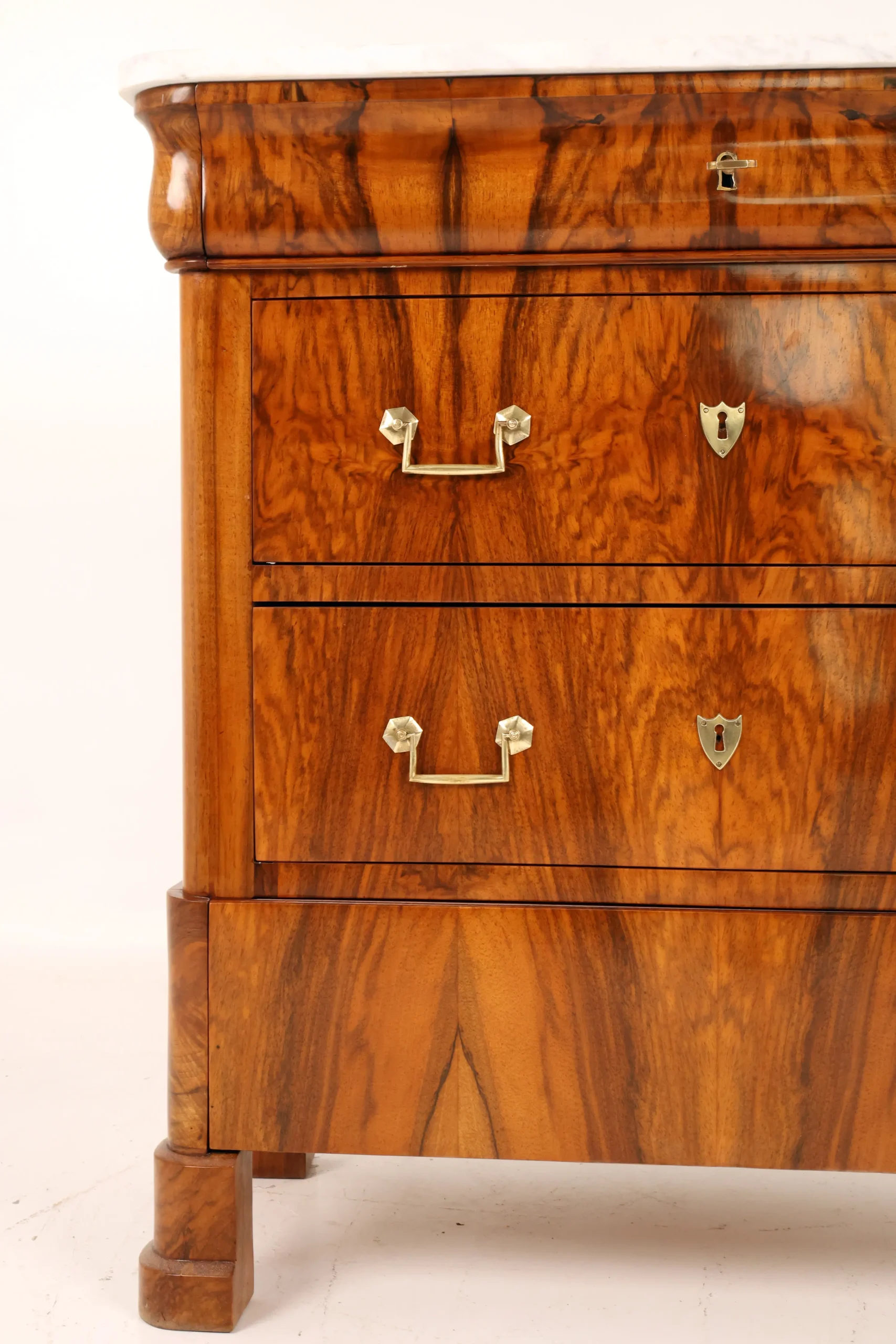
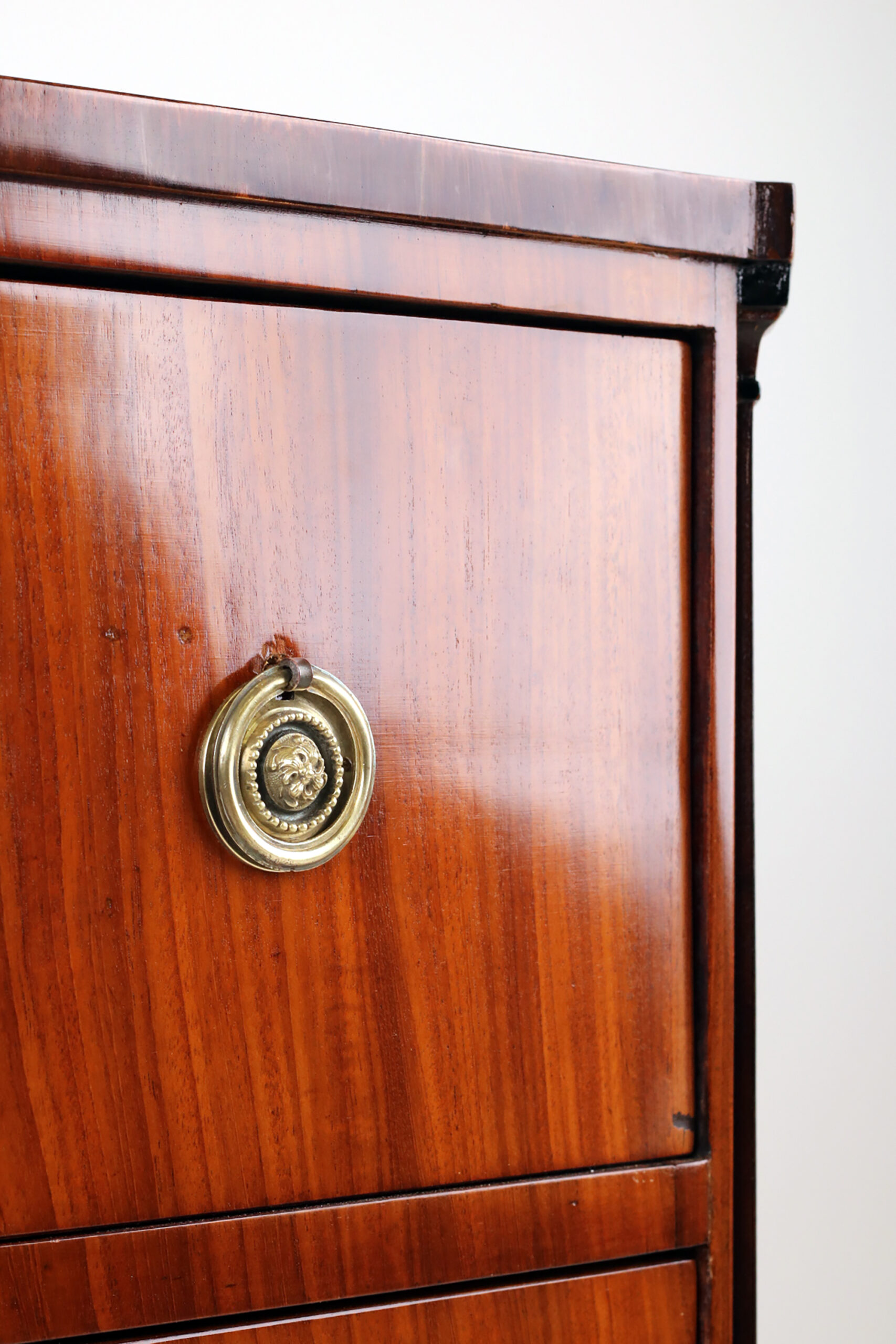
They are both called Empire. They were both produced in France. They both reference the authority of the Napoléon name. Beyond that, First Empire and Second Empire furniture have almost nothing in common, and confusing the two is one of the more expensive mistakes a buyer can make in the antique market.
The Political Logic Behind Two Completely Different Aesthetics
Napoléon Bonaparte crowned himself Emperor of the French in 1804 at Notre-Dame Cathedral, and he understood immediately that political power requires visual expression. His solution was to bypass the recent French past entirely, the Bourbon dynasty, the Revolution, all of it, and align his new regime with the eternal authority of ancient Rome, Greece, and Pharaonic Egypt. The furniture that emerged from that decision was not designed to be comfortable. It was designed to project the absolute discipline and permanence of a new imperial order.
The result was a unified, centrally dictated aesthetic produced under the direct oversight of his court architects Charles Percier and Pierre-François-Léonard Fontaine, whose 1812 publication Recueil de décorations intérieures served as the definitive blueprint for everything from palace interiors to provincial drawing rooms. First Empire furniture speaks in a single, consistent voice: dark mahogany, heavy fire-gilded bronze, mathematical symmetry, and the symbolic vocabulary of eagles, bees, sphinxes, and laurel wreaths.
Forty years later, his nephew Louis-Napoléon Bonaparte declared himself Napoléon III and faced a different problem entirely. He needed to legitimize a regime that had arrived by coup d’état in 1852, in a France transformed by the Industrial Revolution and governed by a wealthy bourgeoisie whose primary desire was not military authority but domestic comfort and conspicuous display. The furniture of the Second Empire reflected that reality exactly. Where the First Empire looked forward with imperial confidence, the Second Empire looked backward with nostalgic longing, assembling the most opulent elements of France’s royal past into rooms designed to announce prosperity rather than project power.
The tastemaker of the Second Empire was not the emperor but his wife, Empress Eugénie, whose personal obsession with Marie-Antoinette drove a massive Louis XVI revival that runs through the entire period as a constant thread. She purchased furniture belonging to the former queen, curated a major exhibition at the Petit Trianon in 1867, and directed the refurbishment of imperial palaces in a hybrid aesthetic that blended the Ancien Régime with the ambitions of the new bourgeoisie. The result was an eclecticism that the naturalist Émile Zola famously and unfairly dismissed as the opulent bastard child of all the styles. He was not wrong about the eclecticism. He was wrong to dismiss it.
What First Empire Furniture Actually Looks Like
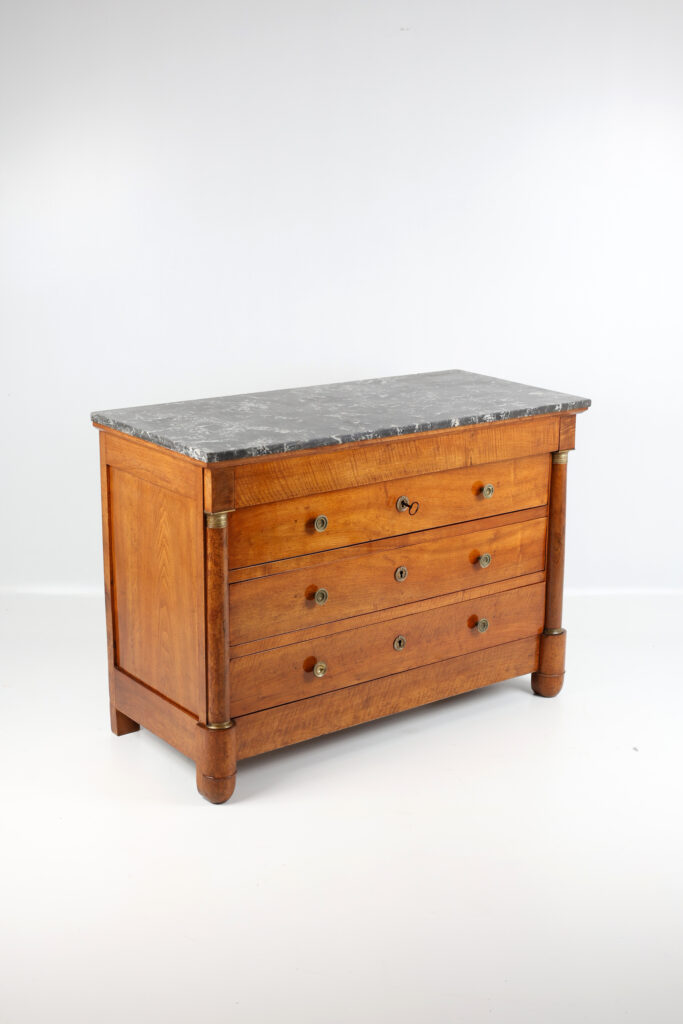
A First Empire commode or secretary desk is a monumental rectangular object. The surfaces are flat and unbroken. The veneer is dark mahogany, polished to a high gloss, and the contrast between that darkness and the fire-gilded bronze mounts is the defining visual character of the style. There is no marquetry, no decorative inlay, no applied porcelain. The wood is allowed to be itself, and the bronze does the symbolic work.
Those bronze mounts were produced by specialist workshops, above all that of Pierre-Philippe Thomire, whose mastery of sand casting and hand chasing elevated furniture hardware to the level of fine jewelry. The motifs are overt political propaganda: the Napoleonic bee, the imperial eagle clutching a thunderbolt, Egyptian sphinxes referencing the Egyptian campaigns, Roman laurel wreaths, and military fasces. These are not decorative choices. They are statements about the regime’s legitimacy and permanence, applied to furniture with the same deliberateness that a general deploys troops on a battlefield.
The chairs of the First Empire demand upright posture. The backs are straight, the armrests heavy, the legs rigid. State bedrooms were designed as glamorous facsimiles of military encampments, with tented beds and folding stools that referenced Roman field commanders. This is furniture that enforces behavior. It does not invite the sitter to relax.
What Second Empire Furniture Actually Looks Like
A Second Empire commode swells. Where the First Empire insisted on flat surfaces and right angles, the Second Empire borrowed the bombé form from Louis XV and the geometric marquetry from Louis XVI and combined them with the dark exotic woods and heavy bronze framing of the Louis XIV Boulle tradition. A single piece might reference three different historical periods simultaneously, and that eclecticism is not a flaw. It is the entire point.
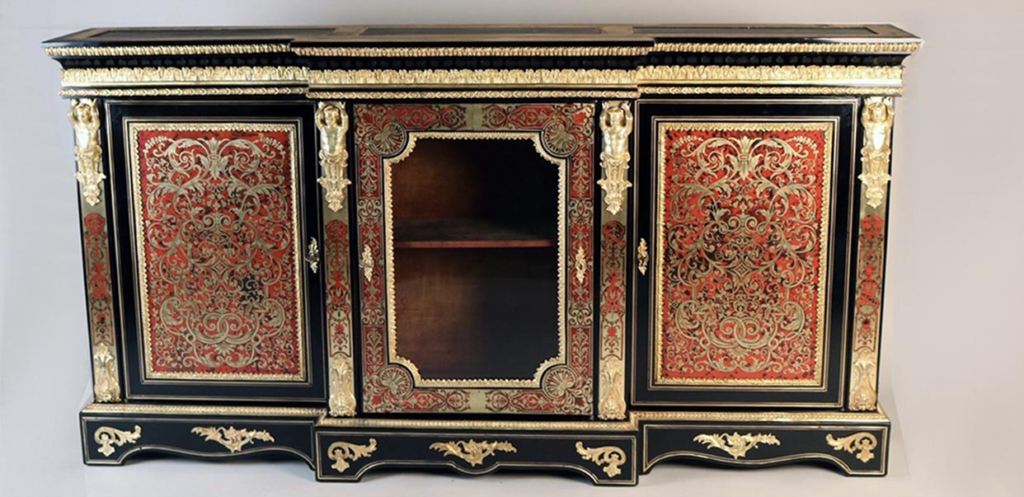
The Boulle marquetry revival is the most spectacular material achievement of the period. The technique, originally developed by André-Charles Boulle for Louis XIV, involves stacking sheets of brass and tortoiseshell and cutting through them simultaneously to create perfectly interlocking veneers. Second Empire workshops executed this with industrial precision, producing brass-on-tortoiseshell and tortoiseshell-on-brass panels of remarkable visual complexity. Applied to swelling bombé commodes and large display cabinets, these surfaces catch light in a way that no flat mahogany veneer can.
The seating of the Second Empire tells the story of its time most directly. The invention of deep button tufting in 1838 and the mass production of coiled steel springs transformed what a chair or sofa could physically do. The quintessential Second Empire armchair, the fauteuil crapaud or toad chair, is low, thickly padded, and entirely enveloped in fabric, with a heavy fringe that hides the legs completely. It is the physical opposite of the First Empire fauteuil in every dimension: where one demands discipline, the other offers an embrace.
The Ormolu Divide — Fire Gilding vs Electroplating
The bronze mounts on French furniture of this period are one of the most reliable authentication indicators available, and understanding the difference between First and Second Empire bronze work is genuinely useful knowledge for any serious buyer.
First Empire mounts were fire-gilded using a mercury amalgam process that was extraordinarily toxic. Gold was ground into mercury to form a paste, painted onto cast bronze, and fired in a kiln. The mercury vaporized, leaving a layer of gold chemically fused into the pores of the bronze. The craftsmen who did this work frequently suffered severe neurological damage from mercury vapor inhalation. The process was officially outlawed in France around 1830, though it continued illicitly in the finest workshops for decades. The result is a warm, deep, buttery luminosity called the mercury bloom, visible as a soft matte texture in the deepest recesses of the chasing, that no subsequent gilding technique replicates.
By the height of the Second Empire in the 1850s and 1860s, electroplating had become the industrial standard for mass production. A thin film of gold deposited by electrical current is safe, economical, and visually flat in a way that fire gilding is not. The finest Second Empire workshops, notably Henry Dasson who stamped and dated his pieces with the pride of a luxury brand, refused this compromise and continued with traditional mercury gilding. That choice is visible and distinguishes Dasson’s work from lesser Second Empire production as clearly as any maker’s mark.
The Master Craftsmen of Each Period
First Empire production was dominated by François-Honoré-Georges Jacob-Desmalter, whose immense workshop supplied the imperial palaces with the furniture Percier and Fontaine designed. Thomire handled the bronzework. The collaboration between these workshops, coordinated by state commission and operating to the highest standards of hand craftsmanship, produced pieces of remarkable coherence and quality. Production was slow, exclusive, and deliberately so.
The Second Empire operated differently. Henry Dasson, Alfred Beurdeley, Maison Béfort, and Edouard Lièvre ran workshops that combined exceptional hand finishing with the production efficiencies of industrial machinery. These were luxury brands in the modern sense: recognizable, stamped, and marketed through the Universal Exhibitions of 1855 and 1867 where competition for prestige was as fierce as any commercial market today.
Lièvre pushed the vocabulary of the period furthest, producing Japonisme-influenced pieces that incorporated Asian lacquer panels and orientalist motifs into French furniture forms. His work, and that of Beurdeley’s firm which created cabinets inlaid with lapis lazuli and jasper, commands serious prices at auction today independently of any comparison with 18th century originals. These are not reproduction pieces. They are 19th century masterworks in their own right.
How to Tell First Empire from Second Empire — The Practical Indicators
The most immediate visual tell is the surface. First Empire surfaces are flat, dark, and unbroken. Second Empire surfaces swell, curve, and are covered in marquetry, porcelain, or applied bronze framing. If you are looking at a bombé commode with Boulle marquetry and heavy wrapping bronze mounts, you are looking at Second Empire regardless of what the seller calls it.
Veneer thickness confirms the period independently. First Empire veneers were hand-sawn and measure between one and a half and three millimeters thick. Second Empire veneers, sliced by industrial steam-powered machines after 1806, are paper thin. Where a chip has occurred at an edge, the depth of the loss tells you which era produced the piece.
The dovetails in the drawer construction follow the same logic. Hand-cut First Empire joints show slight irregularities in spacing. Machine-cut Second Empire joints are mathematically uniform. Hardware is equally telling: hand-forged iron screws with irregular flat-head slots confirm early 19th century production. Machine-threaded pointed screws confirm the later period.
The bronze mounts settle any remaining questions. Fire-gilded mounts from the First Empire have a warm, deep luminosity and show hand-chasing marks under a loupe. Electroplated Second Empire mounts are brighter, more uniform, and lack the sculptural depth of genuine fire gilding. The mercury bloom in the deepest recesses of a genuine Thomire mount, once you have seen it, is unmistakable.
Which Style Suits Which Collector and Which Room
The antique Empire furniture collection at Antiqueria Breitling includes pieces from both imperial traditions, each assessed for the quality of the original bronze work, the integrity of the veneer surface, and the honesty of any restoration carried out before listing.
First Empire furniture suits a buyer who wants a single monumental piece that anchors a contemporary space with historical authority. Dark mahogany, flat surfaces, and the mathematical discipline of neoclassical proportion sit naturally in a room with white walls and modern furniture. The furniture does not compete with its surroundings. It commands them.
Second Empire furniture suits a buyer who wants theatrical richness and maximalist presence. A Boulle marquetry cabinet, a deeply tufted velvet sofa, or a Dasson center table with fire-gilded mounts and a shaped marble top makes a room that announces itself completely. These are pieces for buyers who understand that a room can tell a story, and who want that story told in the most extravagant possible terms.
At Antiqueria Breitling, both traditions have been part of the collection since the founder began sourcing French pieces in the 1980s, and the distinction between them is one that informs every assessment. A First Empire secretary that has been confused with Second Empire production, or vice versa, is a misidentified piece and a misvalued one. Getting that distinction right is part of what four decades of looking at this furniture teaches you.