Worldwide Insured Shipping
Hand-Restored in our Atelier
Professional Custom Crating

Worldwide Insured Shipping
Hand-Restored in our Atelier
Professional Custom Crating
An antique mirror does something a reproduction simply cannot. The glass has age in it. The frame carries the marks of the hand that made it. The overall effect, whether it is a large gilt mirror above a mantel or a smaller wood mirror propped against a wall, is one of warmth and depth that a new mirror glass cannot replicate. This category brings together a wide range of antique mirrors from across Europe, spanning the 18th and 19th century and covering virtually every major style and period.
Every mirror here is an original piece, assessed for condition and authenticity before it is offered for sale. Where new mirror glass has been fitted, this is noted clearly in the listing. Where the original glass survives, that is noted too, because original glass, with its particular reflective quality and its subtle imperfections, is one of the things that gives a vintage and antique mirror its distinctive character.
The range of antique mirror styles available in this category reflects the full breadth of European decorative art from roughly 1700 to 1930. Each period produced mirrors with their own visual logic, their own relationship to the wall and the interior around them, and their own approach to the frame as an object in its own right.
The gilt mirror is probably the most recognised form in the antique mirror market, and for good reason. A well-preserved giltwood mirror, whether French, Italian, or English, has an architectural presence that very few other decorative objects can match. The gilding on a 19th century mirror was applied in layers, using techniques passed down for generations, and the tone it produces, especially as it ages, has a warmth that modern gilt finishes rarely achieve.
French gilt wood mirrors of the 18th and early 19th century are among the finest examples of the form. A carved and giltwood mirror in the Louis XVI style, with its restrained classical ornament and elegant proportions, sits comfortably in almost any interior. Italian gilt mirrors tend to be more exuberant: the carving deeper, the imagery more elaborate, the overall effect more theatrical. An italian gilt mirror circa 1800, ornately carved with floral and foliate detail, urn finials, and original glass in the backing, is an exceptional object by any measure.
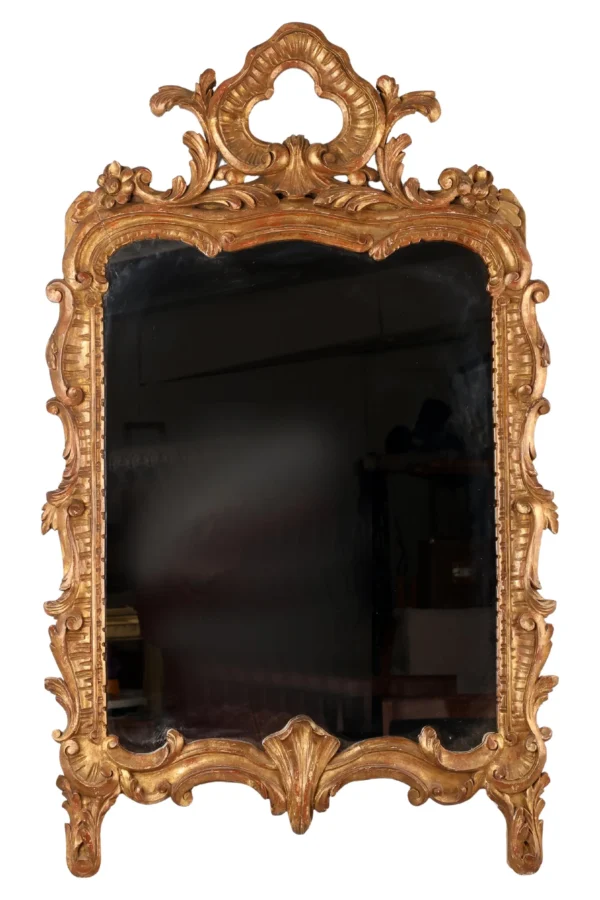
Rococo gilt mirrors, with their asymmetric frames and swirling carved pine or giltwood ornament, represent the style at its most expressive. Baroque mirrors push further still, with heavier frames, bolder imagery, and a sense of grandeur that suits large rooms and high ceilings. Both styles remain highly sought after, and good examples in original condition are increasingly rare.
The neoclassical mirror emerged in the second half of the 18th century as a direct response to the exuberance of Rococo. Straighter lines, classical motifs, a preference for symmetry and architectural detail. A neoclassical mirror frame might feature reeded columns, patera roundels, swags, or an urn finial at the top, all rendered with precision and restraint.
The Louis XVI style sits at the heart of this tradition. French mirrors in this manner, produced in the decades around 1789 and continuing into the early 19th century, combine sophistication with a clarity of design that makes them among the most versatile antique mirrors available. A painted trumeau mirror in the neoclassical manner, with its painted panel above the glass and its carved and gilded frame, is a particularly distinctive form. The painted frame, often depicting classical figures, landscapes, or architectural scenes, adds a layer of imagery that makes each one mirror unlike any other.
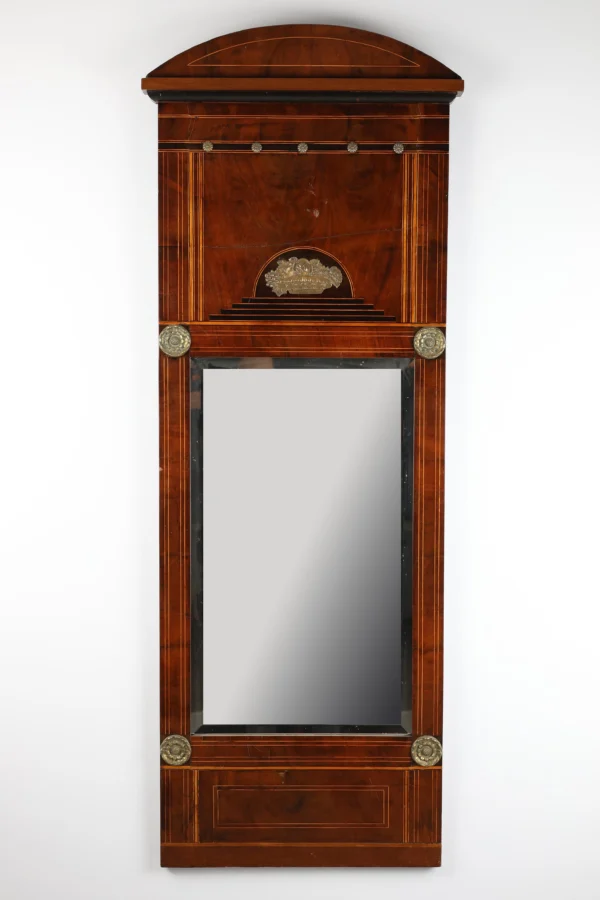
French Empire mirrors continued the neoclassical tradition into the early 19th century, adding the bolder ornament and darker tone associated with the Empire style: eagles, winged figures, heavy bronze or gilded mounts, and a sense of monumental scale that suits grand interiors.
The 19th century produced an enormous variety of mirror styles across Europe, reflecting both the diversity of the period and the relative accessibility of mirror glass as manufacturing improved through the century.
Regency mirrors from Britain combine the neoclassical influence of the late 18th century with a bolder, more decorative approach. Convex mirrors with gilded frames and ebonised accents are a classic Regency form. So are overmantel mirrors in mahogany or gilt, with architectural frames and divided glass panels.
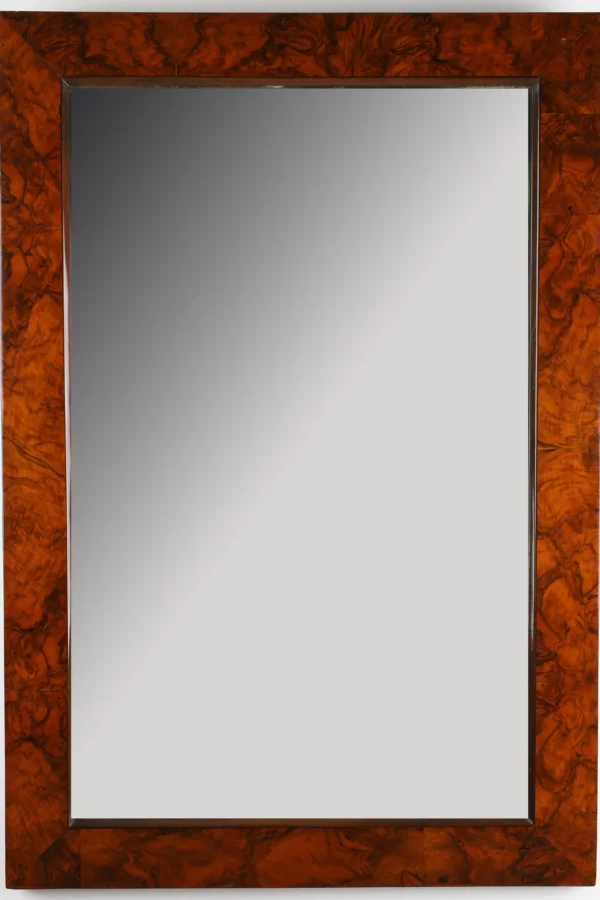
Victorian mirrors are more varied still. A large Victorian mahogany mirror with carved detail and its original beveled glass is a handsome, substantial object. Victorian gilt mirrors tend toward more elaborate ornament than their Regency predecessors, often with deeply carved frames featuring floral and foliate decoration. Antique Victorian mirrors in oak or walnut frames have a solidity and presence that works well in hallway or cabinet settings.
Biedermeier mirrors, produced in the German-speaking world from the 1820s onwards, take a very different approach. The frames are cleaner, the ornament minimal, the wood, often cherry, walnut, or maple, is the decorative source. A Biedermeier mirror circa 1830 has an understated elegance that sits as comfortably in a contemporary interior as in a period one.
Art Nouveau and Art Deco mirrors close out the 19th century and open the 20th. Art Nouveau frames use organic, intricately worked ornament: flowing lines, naturalistic forms, repoussé metalwork. Art Deco mirrors move in the opposite direction, toward geometry, lacquer, and the kind of streamlined sophistication that defined the interwar period. A good Art Deco mirror with beveled glass and a clean, architectural frame is as much a design object as a piece of furniture.
The frame is where the craftsmanship lives in an antique mirror. A giltwood frame, whether carved pine, oak, or a hardwood base, was built up in multiple stages: the carved wood form, then layers of gesso, then gilding applied by hand. The finish on a well-preserved 19th century frame has a depth and irregularity that mirrors are handcrafted to produce, and that no factory process can replicate.
Wooden mirror frames in mahogany, oak, walnut, and painted wood appear throughout this category. A painted frame, whether in the neoclassical manner of a painted trumeau or the simpler painted finish of a Biedermeier or Scandinavian mirror, is its own form of craftsmanship. The paint itself, and the way it has aged, is part of what you are buying. Stripping or repainting a period frame removes the very thing that makes it antique.
Silver and silvered frames, while less common than gilt, appear in the Italian and Venetian tradition in particular. A Venetian mirror with a silvered or repoussé silver frame, using silvering techniques passed down for generations, is among the most decorative of all antique mirror forms.
The glass in an antique mirror tells you a great deal about its age and authenticity. Original glass, produced before the industrialisation of mirror manufacture, was made differently from modern glass. It is thinner, slightly uneven, and has a particular reflective quality that creates a softer, more atmospheric illusion than contemporary mirror glass. The backing, the silvering applied to the reverse, oxidises over time, producing the characteristic spotted or foxed patina that is one of the surest signs of a genuinely old mirror.
This patina is not a flaw. It is evidence. A mirror with heavily foxed original glass and an intact original backing is almost always more desirable than one where the glass has been replaced, even if the new mirror glass is cleaner and brighter. Where replacement glass has been fitted to a mirror in this category, it is because the original was too damaged to retain, and this is always disclosed.
Circa 1890 mirrors in particular often retain their original glass in good condition. The manufacturing standards of the late 19th century were high, and the glass produced in France, Italy, and Britain during this period has survived well. If you are looking to decorate a hallway, a reception room, or any space where a large antique mirror would serve as an accent and a focal point, a late 19th century example with original glass is an excellent place to start. Browse the full selection above, or contact us if you need help to find the perfect match for your space.