Worldwide Insured Shipping
Hand-Restored in our Atelier
Professional Custom Crating

Worldwide Insured Shipping
Hand-Restored in our Atelier
Professional Custom Crating
A vitrine is a display case built around the idea that some objects deserve to be seen clearly and protected at the same time. Glass doors, glass shelves, a mirrored back, these are the features that define the form, and in a well-made antique vitrine cabinet they are executed with a precision and elegance that modern display cabinets rarely approach.
The antique vitrines in this collection are primarily French in origin, spanning the late 18th century through the early 20th century. Louis XV, Louis XVI, Directoire, Napoleon III, and Art Deco examples are all represented, along with English and Continental pieces that follow related traditions. Each vitrine has been examined individually, and where restoration has been carried out in the atelier, the work addresses the glazing, the locks, and the surface finish without altering the character of the piece.
The French Louis XV vitrine is one of the most recognizable forms in European antique furniture. Built during and after the reign of Louis XV, these cabinets feature the characteristic Rococo curve of the period, with shaped glazed doors, cabriole legs, and ormolu or gilt bronze mounts that catch the light. The front and sides are typically veneered in kingwood, rosewood, or tulipwood, often with parquetry or floral marquetry inlay, and the interior is fitted with glass shelves and a mirrored back to maximize the display of whatever is placed inside.
A 19th century Louis XV style vitrine made in the manner of the original period pieces is distinct from a genuine 18th century example, though the quality of the best 19th century reproductions is itself considerable. French furniture makers of the Napoleon III period produced French Louis XV vitrines of exceptional craftsmanship, sometimes incorporating vernis martin lacquer panels or Wedgwood-style ceramic plaques into the door frames. These are collectible pieces in their own right.
Vernis martin is a French lacquer technique developed in the early 18th century, named after the Martin brothers who perfected it. A Louis XV style vitrine with vernis martin panels, typically painted with pastoral scenes or floral motifs on a colored ground, is among the more decorative forms in this category. The glaze applied over the painted surface gives these pieces their characteristic depth and warmth, and well-preserved examples with intact panels are increasingly difficult to source.
Where Louis XV favored the curve, Louis XVI returned to straight lines and classical proportion. A Louis XVI style mahogany vitrine stands on tapered fluted legs, has rectangular glazed doors with gilt bronze moldings, and a restrained surface decoration that relies on the quality of the veneer and the precision of the mounts rather than elaborate ornament.
A century French Louis XVI vitrine in mahogany with gilt bronze mounts and a marble top, circa 1870 to 1890, represents the high point of this style. The 19th century Louis XVI cabinet made during the Second Empire and Napoleon III period often incorporates Carrara marble shelves or a Carrara marble top, and the glazing is typically original and intact in well-preserved examples. A Louis XVI period vitrine with its original lock, original glass, and unaltered veneer surface is a genuinely rare find.
A display cabinet with glass doors in the Louis XVI manner is one of the most versatile pieces in this collection. It functions as a bookcase for smaller volumes, a curio display cabinet for collectibles, or simply as a glass display piece that adds structure and symmetry to a room. The drawer fitted below the glazed section in many examples adds practical storage without compromising the visual line of the piece.
François Linke was the most celebrated Parisian furniture maker of the late 19th and early 20th century, working primarily in the Louis XV and Louis XVI styles at a level of technical refinement that placed his pieces in a separate category. A vitrine attributable to Linke or bearing his stamp is among the most collectible antique furniture available in the French tradition. The gilt bronze mounts on his pieces were modeled by sculptors and cast to a standard that contemporary foundries could not match, and the kingwood and rosewood veneers were selected and laid with exceptional care.
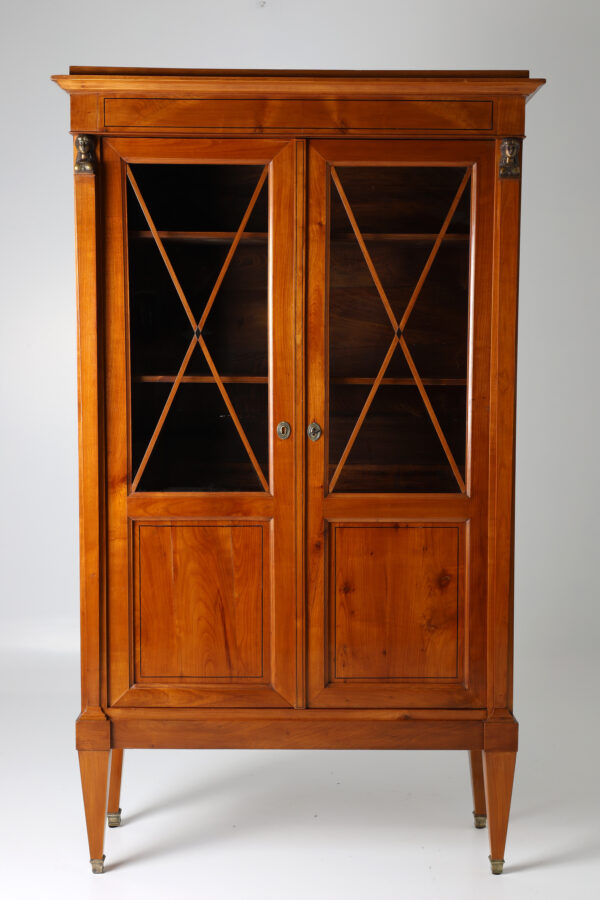
The French Directoire style, bridging the Louis XVI period and the Empire, produced vitrines of considerable restraint and quality. A French Directoire vitrine in mahogany with minimal bronze mounts and clean architectural lines is a piece that suits a contemporary interior as naturally as a period room. Early 19th century examples in this style often feature a demilune form, with a curved front and straight tapered legs that give the piece an architectural quality.
French Louis Philippe pieces from the 1830s and 1840s occupy an interesting position in the market. The style is heavier than Louis XVI but more refined than the full Empire manner, often featuring burl walnut veneer, carved giltwood details, and shaped glazed doors that retain some of the Louis XV curve. A 19th century transitional vitrine combining elements of Louis XV and Louis XVI design is common in this period and reflects the eclectic tastes of mid-19th century Parisian interiors. The Philippe period also produced some fine armoire-scale vitrines with mirrored backs and fitted interior shelves that function equally well as a display cabinet and a wall cabinet.
Mahogany dominates the Louis XVI and Empire traditions, with its deep reddish tone providing a strong contrast to gilt bronze mounts and marble surfaces. A Napoleon III period mahogany vitrine with original glass doors and interior mirror is a robust and visually striking piece of antique furniture. Late 19th century English mahogany vitrines follow a related tradition, with glazed doors, interior glass shelves, and a more architectural quality that reflects the century English cabinet making approach.
Walnut and walnut display cabinets appear more frequently in provincial French pieces and in earlier examples from the Louis XIV and Baroque periods, where the wood was used in solid rather than veneered form. A walnut display cabinet with carved giltwood moldings and glazed door panels is a substantial piece that suits a library or formal sitting room. A walnut display vitrine in the French provincial manner, with a shaped cornice and lockable glazed doors, is a practical and handsome antique French piece that works in a variety of settings.
A corner vitrine or corner curio cabinet solves a specific spatial problem while adding considerable visual interest to a room. French corner cabinets in the Louis XV manner, with shaped glazed doors, a shaped apron, and cabriole legs, are among the more elegant forms in this category. A demilune vitrine with a curved front and a marble top works particularly well in a hallway or drawing room where wall space is limited. A corner display cabinet with interior mirror and glass shelves doubles the visual depth of whatever is displayed inside it.
A vitrine table is a low display case on legs, combining the function of a side table with a glazed top and sides that allow objects inside to be seen from above. These pieces were made in significant numbers in the late 19th and early 20th century for displaying small collectibles, and a good example in mahogany or rosewood with original glazing and a lockable door is a practical and handsome piece. A small curio display cabinet with glass shelves and a mirrored interior back is a related form, wall-mounted or free-standing, that works well for displaying ceramics, glass, or smaller decorative objects.
The Art Deco period brought a significant shift in vitrine design. The elaborate mounts and curved forms of the Louis styles were replaced with geometric lines, contrasting veneers, and a minimalist approach to surface decoration. An Art Deco vitrine in black lacquer with chrome fittings, or in teak with clean rectangular glazed panels, is a piece that works in a contemporary setting without any period framing. Early 20th century chinoiserie lacquer cabinets in black lacquer with gilt decoration occupy a related but more decorative category.
Mid century and modern vintage vitrines from the mid-20th century continue the move toward cleaner forms. Scandinavian and German examples in teak or oak with simple lockable glazed doors are well-made functional pieces that suit a living room or study without demanding period consistency from the surrounding furniture. A wall cabinet with glazed door panels and interior glass shelves is among the most practical vitrine forms for a smaller space, and antique examples in mahogany or painted wood are regularly available in this vitrine selection.