Worldwide Insured Shipping
Hand-Restored in our Atelier
Professional Custom Crating

Worldwide Insured Shipping
Hand-Restored in our Atelier
Professional Custom Crating
An antique bookcase does more than store books. It organizes a room, anchors a wall, and in the best examples adds a quality of craftsmanship and material that modern shelving units simply do not offer. This collection covers antique and vintage bookcases for sale across the major periods and styles.
A genuinely well-made antique bookcase is one of the more durable pieces of furniture you can buy. Built from solid wood with proper joinery, adjustable shelves, and in many cases glazed doors that protect the contents, an antique bookcase was designed for a library or office or library that expected the piece to last indefinitely. That expectation is visible in the construction, and it is why antique bookcases outlast modern alternatives without much effort.
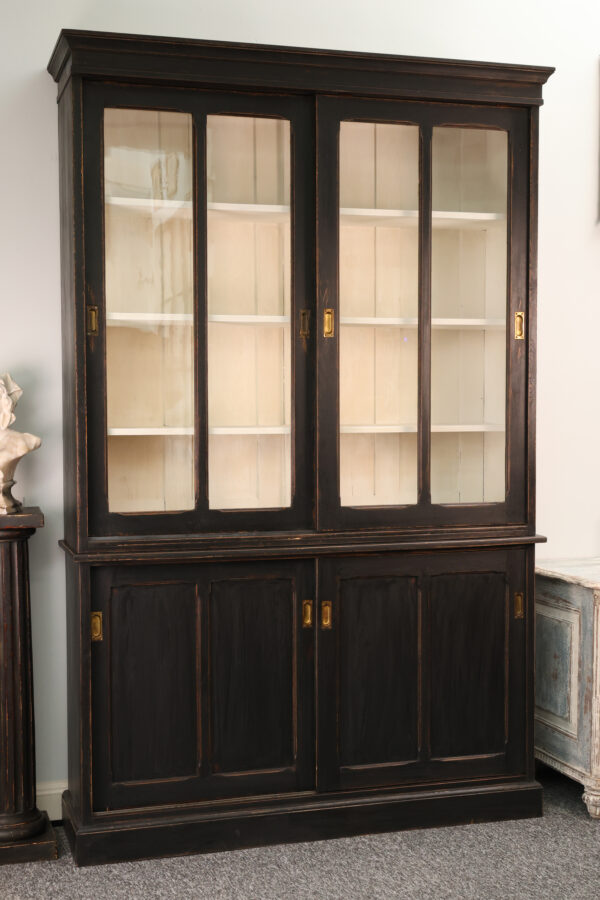
The range of antique bookcases in this collection covers open bookcases, bookcases with doors, glazed library bookcases, barrister bookcases, and breakfront designs across mahogany, walnut, oak, and dark wood finishes. Each piece has been assessed individually for the condition of the shelves, the glazed doors or cabinet doors where present, and the patina of the exterior surface. Restoration work where carried out addresses the joinery, the glass panels, and the finish without over-treating the piece.
When assessing any antique bookcase, look for the original shelving, which should show wear consistent with decades of use. Check the back panel, which in quality antique furniture is typically solid wood or early plywood rather than the thin MDF used in modern production. The wood tone and patina that highlights the natural grain of a mahogany or walnut bookcase developed over a century or more cannot be replicated.
Walnut bookcases from the 17th and 18th centuries are among the finest examples of antique shelving available. Executed in solid walnut with hand-carved detail, adjustable shelves, and in some cases glazed glass doors with beveled glass panes, these are pieces of fine furniture that belong in a room of corresponding quality. The natural grain of walnut, with its complex figure and warm brown tone, makes a walnut bookcase one of the more visually satisfying pieces of storage and display furniture available.
French walnut bookcases from the Louis Philippe period are particularly well represented in this category. A 19th century French Louis Philippe style bookcase in solid walnut, with three doors below and open shelving above, or with glazed doors fitted with beveled glass throughout, is a substantial and handsome piece of antique French furniture. The century French Louis Philippe style combines the solidity of earlier French cabinet making with a more accessible domestic scale, and these pieces work as naturally in a contemporary interior as they do in a period room.
A louis xvi style mahogany vitrine with open shelving and glazed doors bridges the categories of bookcase and display cabinet, and pieces that serve both functions are among the more practical antique bookcases available.
The 18th century library bookcase in mahogany is one of the defining pieces of English furniture. A breakfront bookcase with a projecting central section, glazed doors above fitted with glass panes in geometric patterns, and cabinet storage below with solid cabinet doors and a drawer in the frieze, was the standard library piece in significant English houses from the mid-18th century onward. The craftsmanship in the best examples is exceptional, with hand-carved detail on the cornice, precise glazing bars, and interiors fitted with adjustable shelves and sometimes a secretaire section in the lower central compartment.
Antique French bookcases from the same period follow different principles. A French bookcase in the Louis XVI manner, with straight architectural lines, fluted pilasters, and glazed doors with fine glazing bars, has an elegance and restraint that suits a formal interior particularly well. These pieces were made for the libraries of châteaux and hôtels particuliers, and they carry that origin with them.
A renaissance bookcase in dark wood with carved embellishment and arch details is a different 18th century form, heavier in its decoration and more architectural in its proportions, that suits a study or formal library where a strong piece is needed to anchor the room.
The 19th century produced antique bookcases in greater variety than any period before it. The Louis Philippe period in France, running from the 1830s to the 1840s, generated a particularly strong tradition of solid walnut and mahogany bookcases with glazed doors, adjustable shelves, and a domestic scale that suits modern rooms well. A 19th century Louis Philippe bookcase in mahogany wood with its original antique glass intact, the glass slightly rippled and uneven in the way that old glass always is, is a considerably more interesting piece than a modern bookcase with flat float glass.
English Victorian bookcases from the same period range from large library pieces in solid oak or mahogany to smaller open bookcases and display cases in walnut or rosewood. A Victorian open bookcase with carved detail and adjustable shelves is a practical and collectible piece of antique furniture that works in a living room, study, or hallway. The Globe Wernicke modular bookcase, produced from the late 19th century onward, is a different kind of 19th century antique bookcase, a modular system of stackable glazed sections in oak that can be configured to different heights. Original Globe Wernicke examples with their original glazed glass doors and the characteristic locking mechanism that holds each section to the next are genuinely collectible pieces of antique shelving.
A barrister bookcase follows similar principles to the Globe Wernicke system, with individual glazed sections that stack and lock together. Barrister bookcases in solid oak with original glass front panels and brass accented hardware are among the more practical antique bookcases for a modern home, since the modular format allows the piece to fit a range of room heights and wall widths.
Mid-century bookcases from the 1940s through the 1960s bring a different character to the category. Scandinavian examples in teak or rosewood with open shelving, clean horizontal lines, and simple brass or wooden hardware are well-made pieces that suit a contemporary interior without any period framing. A mid-century modular bookcase in teak with adjustable shelves and a combination of open shelving and cabinet storage below is a practical and handsome piece of vintage furniture that has aged well.
French mid-century bookcases in oak or walnut follow a similar direction, with cleaner forms than their 19th century counterparts and a focus on the quality of the wood rather than applied decoration. A vintage bookcase in solid oak with open bookcases above and cabinet doors below is a practical piece of antique furniture that works in a home office, living room, or study equally well.
Not every antique bookshelf needs to be a large library piece. Smaller antique bookshelves, whether a two-tier open bookcase in mahogany, a hanging wall-mounted antique shelves unit in oak, or a rustic solid oak bookshelf with simple bracket supports, are practical and affordable pieces of antique furniture that add character to a room without requiring significant floor space.
A small antique bookshelf in walnut or mahogany with adjustable shelves and a simple cornice is a piece that works on a landing, in a bedroom, or in a smaller study where a full library bookcase would be out of scale. A curio cabinet with open shelving and a glazed lower section serves as both a bookshelf and a display case, which makes it one of the more versatile small antique pieces available.
If you are looking for a specific antique bookcase that is not currently listed, write to us at contact@antiqueria-breitling.com. The warehouse holds pieces not yet photographed or catalogued, and a request for a particular size, style, or wood is often easier to fulfill than buyers expect.