Worldwide Insured Shipping
Hand-Restored in our Atelier
Professional Custom Crating

Worldwide Insured Shipping
Hand-Restored in our Atelier
Professional Custom Crating


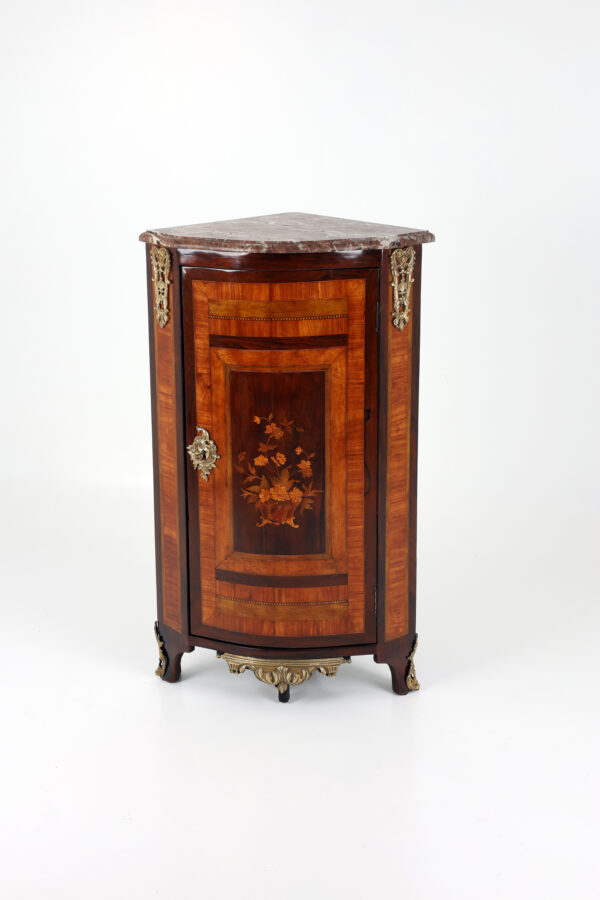
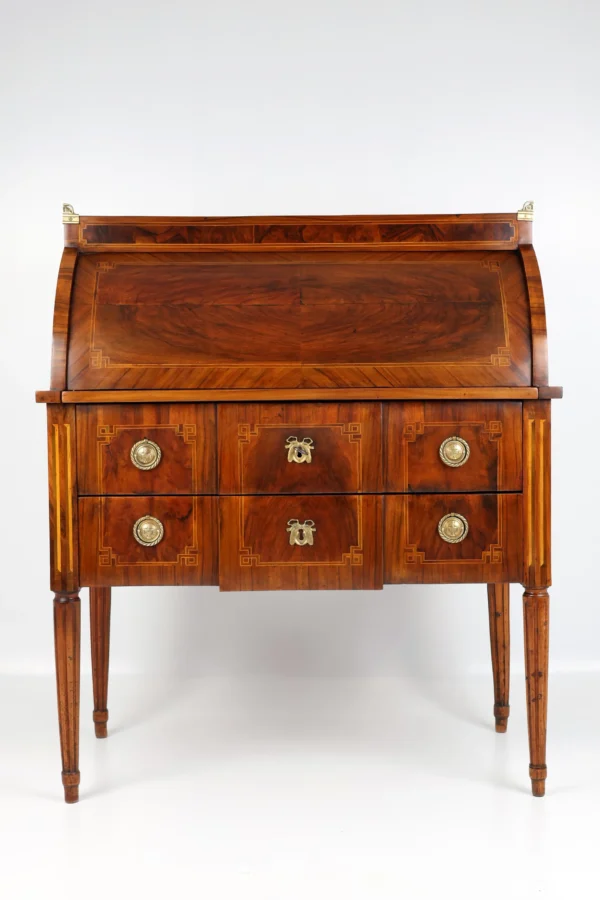

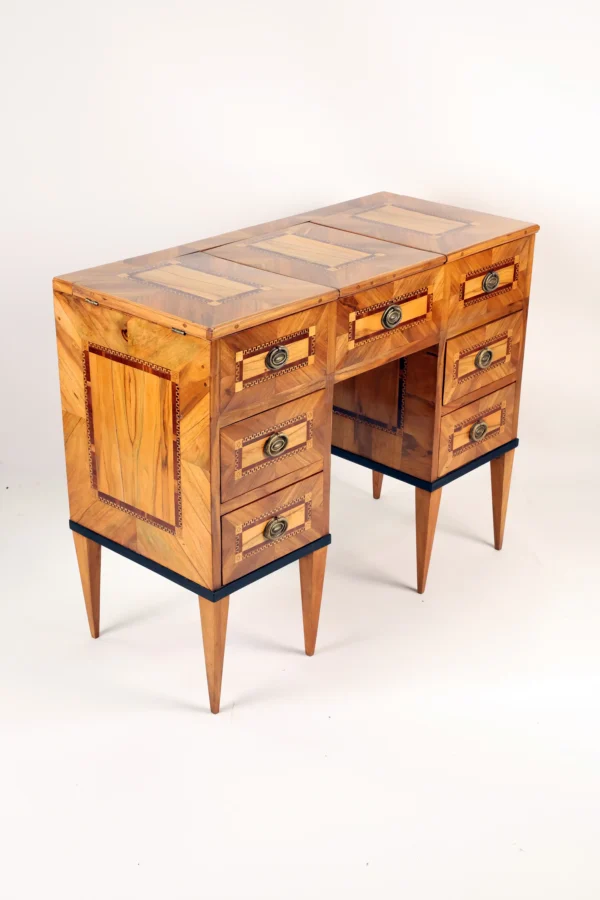
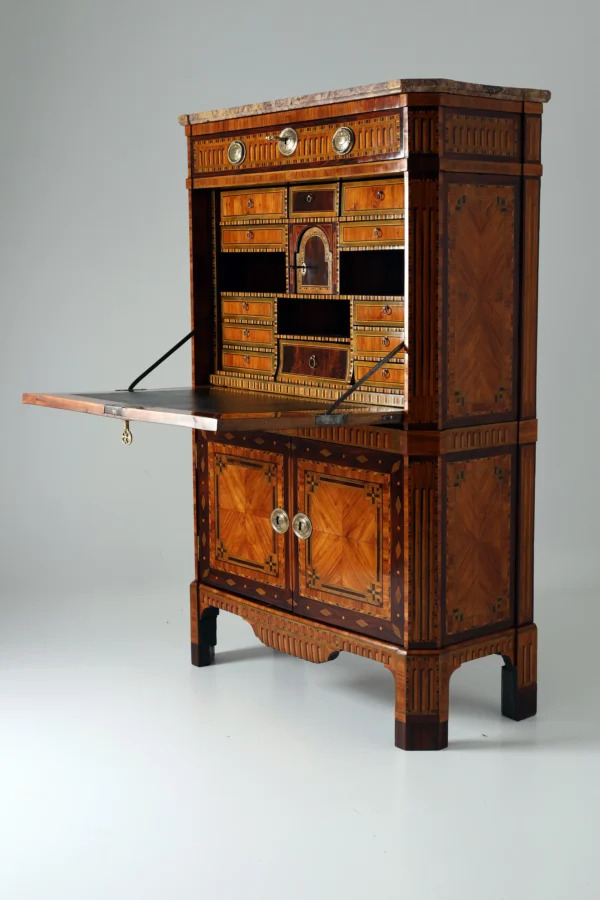
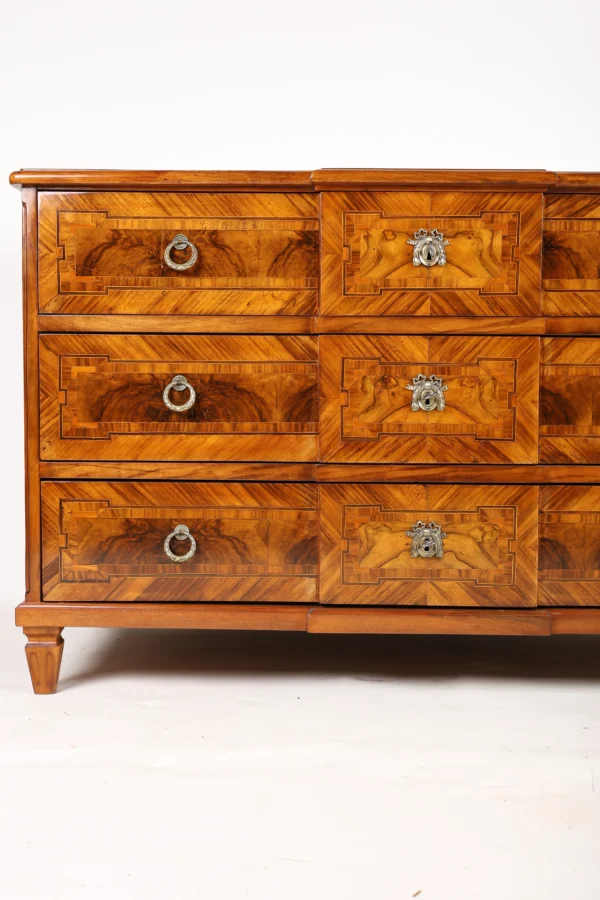
Louis XVI furniture for sale in this collection covers the full range of the French neoclassical tradition, from commodes and secrétaires in mahogany and marquetry to armchairs and sofas with fluted tapered legs, vitrines, console tables, and writing tables. Each piece has been assessed individually for the quality of the original ormolu mounts, the integrity of the veneer surface, and the condition of the original finish.
The Louis XVI period produced some of the finest furniture ever made, and the best examples available today represent French craftsmanship at its absolute apex. The style developed through the 1760s and reached its full expression by 1774 when Louis XVI ascended the throne as the last king of France before the French Revolution, and the pieces made during those decades carry the neoclassical vocabulary of ancient Greek and Roman antiquity with a precision and elegance that no subsequent period has matched.
The true engine of the style was not the king himself but Marie-Antoinette, who began replacing the aging Rococo pieces in her apartments almost immediately after arriving at Versailles, commissioning interiors of pale silk, classical arabesques, and linear woodwork that set the standard for the entire period. The archaeological discoveries at Herculaneum and Pompeii had given French designers direct access to the decorative language of the ancient world, and that language, urns, laurel wreaths, Greek key friezes, fluted columns, and classical medallions, runs through every piece of genuine Louis XVI furniture.
Each piece in this collection has been sourced and assessed with the same criteria applied across Antiqueria Breitling’s full range of French antique furniture. Original ormolu mounts, veneer integrity, estampille authenticity where present, and the condition of the original finish are the primary considerations before any piece is listed.
The distinction between Louis XV and Louis XVI furniture is fundamental for any serious collector, and the leg is the fastest way to read it. Louis XV uses the cabriole, the S-curved support that sweeps outward at the knee and tapers back inward toward the foot. Louis XVI replaces it with the effilé, a straight tapered leg often carved with vertical fluting that references a classical column directly. That single change from curvaceous cabriole to straight fluted leg signals everything else that is different between the two traditions.
On a Louis XV commode the front swells outward in the bombé form, with shaped aprons, organic rocaille ornament, and ormolu mounts that flow continuously in asymmetric patterns of shells and foliage. On a Louis XVI commode the front is flat, the façade droite replacing the swell entirely. The marquetry on the drawer fronts is geometric, diamond grids and cube patterns in tulipwood or amaranth banding rather than the organic floral marquetry of the Louis XV period. The ormolu mounts are restrained, symmetrical punctuation marks of laurel wreaths, urns, and acanthus leaves rather than cascading organic vines.
The transitional pieces from the 1760s and early 1770s carry elements of both styles simultaneously. A transitional commode might have the flat front and geometric marquetry of the incoming Louis XVI style while retaining the short cabriole legs of the outgoing Louis XV manner. These pieces reflect a specific historical moment of stylistic change and are among the more interesting in the category for that reason.
The commode is the most characteristic case furniture form of the Louis XVI period. The flat-fronted Louis XVI commode stands on straight tapered legs, often fluted, with geometric parquetry marquetry on the drawer fronts, restrained ormolu mounts of classical character, and frequently a marble top in rouge royale or white statuary that adds architectural weight without ornamental excess. The transformation from the bombé Louis XV commode to the flat Louis XVI form is one of the most visually instructive transitions in the history of French decorative arts.
The secrétaire à abattant is the defining Louis XVI desk form. Tall, vertical, and architectural in its proportions, it presents a flat facade of veneer or lacquer panels that drops forward to reveal a writing surface and an organized interior of small drawers, pigeonholes, and in the finest examples hidden compartments behind sliding panels triggered by concealed buttons. The mechanical ingenuity of these interiors reflects the period’s fascination with combining practical function with refined decorative detail.
The bonheur-du-jour, a small ladies writing table with a raised cabinet at the back for correspondence and stationery, is one of the more charming Louis XVI forms. Made for the intimate drawing room rather than the formal study, these pieces are typically in mahogany or with lacquer panels. The guéridon, a small circular pedestal table, and the demi-lune console table designed to sit flush against a wall are among the most practically versatile Louis XVI forms for contemporary use, both in terms of scale and visual character.
The vitrine with its glazed doors and interior display shelves reflects the Enlightenment’s interest in collecting and displaying natural and cultural objects, and genuine Louis XVI vitrines in mahogany with original glazing and ormolu gallery details are increasingly difficult to source in honest unaltered condition.
Louis XVI seating represents some of the most refined chair design in the European furniture tradition, and the range of forms produced during the period reflects the variety of social contexts for which furniture was designed.
The fauteuil with its oval or medallion back, carved frame in beech painted in pale grey or gilded, fluted tapered legs, and silk upholstery is among the most graceful armchair forms ever produced. The oval back, the médaillon, is the most immediately recognizable Louis XVI chair silhouette, and genuine period examples with their original carved frames and appropriate upholstery are consistently sought by interior designers working in both traditional and contemporary settings.
The bergère with its enclosed upholstered sides offers greater comfort than the open-arm fauteuil and suits a reading room or bedroom with particular ease. The chaise without arms, designed for flexible placement in a salon, is equally useful in a contemporary interior where a light occasional chair is needed without the visual weight of arms.
The canapé in the Louis XVI manner features three distinct oval or square back sections joined in a continuous straight line, topped with carved ribbon bows or classical garland details. Matched sets of Louis XVI chairs and sofas in consistent condition with compatible upholstery represent some of the most ambitious antique seating projects available, and the result in the right interior is exceptional.
Upholstery on original Louis XVI pieces has almost always been replaced at some point, and the quality of that replacement matters considerably. Silk, damask, and tapestry in the pale, refined colorways appropriate to the neoclassical period suit these frames far better than darker or more heavily patterned contemporary fabrics.
The quality of Louis XVI furniture reflects the French guild system at its most exacting. Ébénistes and menuisiers were required to stamp their finished work with their initials and the JME hallmark of the guild, and those stamps matter considerably for authentication and valuation.
Jean-Henri Riesener was Marie-Antoinette’s preferred cabinetmaker, the master of pictorial marquetry whose signature trapezoidal panel of inlaid urns and floral bouquets identifies the finest commodes of the period. Georges Jacob dominated chair production, responsible for the oval and shield-backed Louis XVI chairs that defined Marie-Antoinette’s private rooms. Adam Weisweiler produced jewel-like furniture incorporating Japanese lacquer panels and Sèvres porcelain into frames of almost impossibly refined proportion. David Roentgen, the German-born ébéniste-mécanicien to the French king, produced transformer furniture with complex hidden mechanisms that revealed drawers and writing surfaces at the turn of a key.
The ormolu standard set by bronzier Pierre Gouthière, whose hand-chased mounts of microscopic detail resemble fine jewelry rather than furniture hardware, remains the benchmark for genuine Louis XVI bronze work. Fire-gilded mercury ormolu from this period has a warm, deep, buttery luminosity that electroplated 19th century revival mounts cannot replicate, and that difference is visible and distinguishable under close examination.
Genuine 18th century Louis XVI pieces carry hand-cut dovetails in their drawer construction, hand-sawn veneer of considerable thickness, back panels of solid wood with the deep oxidation of genuine age, and hand-forged hardware with the slight asymmetries that machine production eliminates entirely. These construction markers separate authentic period pieces from the Napoleon III revival production that reproduced Louis XVI forms in considerable numbers from the 1850s onward.
The clean architectural lines, restrained classical ornament, and geometric precision of Louis XVI furniture make it among the most compatible of all antique French styles with contemporary interiors. A Louis XVI commode in mahogany with original ormolu mounts placed in a room with white walls and contemporary furnishings provides a historical presence and material quality that modern furniture never achieves. The straight lines and symmetry of Louis XVI pieces sit naturally alongside mid-century modern design in a way that the curves and organic energy of Louis XV cannot always manage.
The current resurgence of mahogany in interior design, the return of what designers are calling brown furniture after a decade of light-washed woods, directly benefits Louis XVI furniture. The deep, lustrous surface of 18th century mahogany with its original patina and the warm gold of genuine fire-gilded mounts creates a combination of materials that no contemporary production approaches.
For related pieces in the earlier French court tradition, the antique baroque furniture section covers Louis XIV and transitional pieces that preceded the neoclassical movement, and the broader French antique furniture range includes complementary forms that work naturally alongside Louis XVI pieces in a considered interior.
If you are looking for a specific Louis XVI piece, a particular form, wood, or maker tradition not currently listed, write to us at contact@antiqueria-breitling.com. The warehouse holds pieces not yet photographed or catalogued, and requests are often easier to fulfill than buyers expect. Worldwide shipping available on all pieces.


