The furniture that followed Napoleon tells you more about Europe than almost any history book. When the wars ended and the continent exhaled, an entire class of people decided, quietly and collectively, that what they wanted was not grandeur. They wanted home.
What Is Biedermeier Furniture? Origins and the Biedermeier Movement
In 1815, the Congress of Vienna redrew the map of Europe and sent the surviving aristocracy back to their palaces. What it also did, less dramatically but more lastingly, was create the conditions for a new kind of interior. The urban middle class that had grown during the Napoleonic years, merchants, lawyers, doctors, civil servants, now had money, stability, and the desire to furnish their homes with something that reflected their own values rather than borrowed imperial display.
The Biedermeier period, running roughly from 1815 to 1848, was their answer. The name itself came later, a satirical composite of two fictional philistine characters that critics used to mock the bourgeois taste of the era. The furniture outlasted the joke considerably. Cabinetmakers in Vienna, Berlin, and the German states, figures like Josef Danhauser in Vienna whose workshop produced pieces of remarkable refinement, developed a style that stripped the heaviness of Empire down to its essentials. Clean lines, fine veneer surfaces, functional forms, and a quality of construction that had nothing to prove because it did not need to.
The Biedermeier movement was not anti-decorative. It was selectively decorative, which is a different thing entirely. Every detail served the piece. Nothing was added for the sake of it.
Biedermeier Style and Design — Clean Lines, Fine Veneers and Restrained Elegance
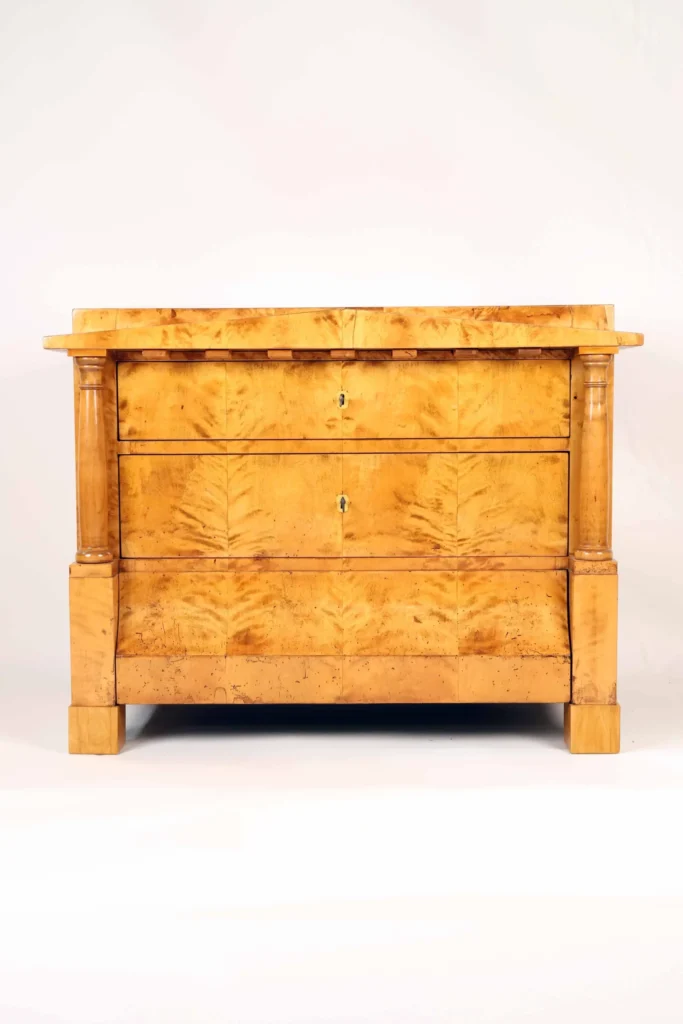
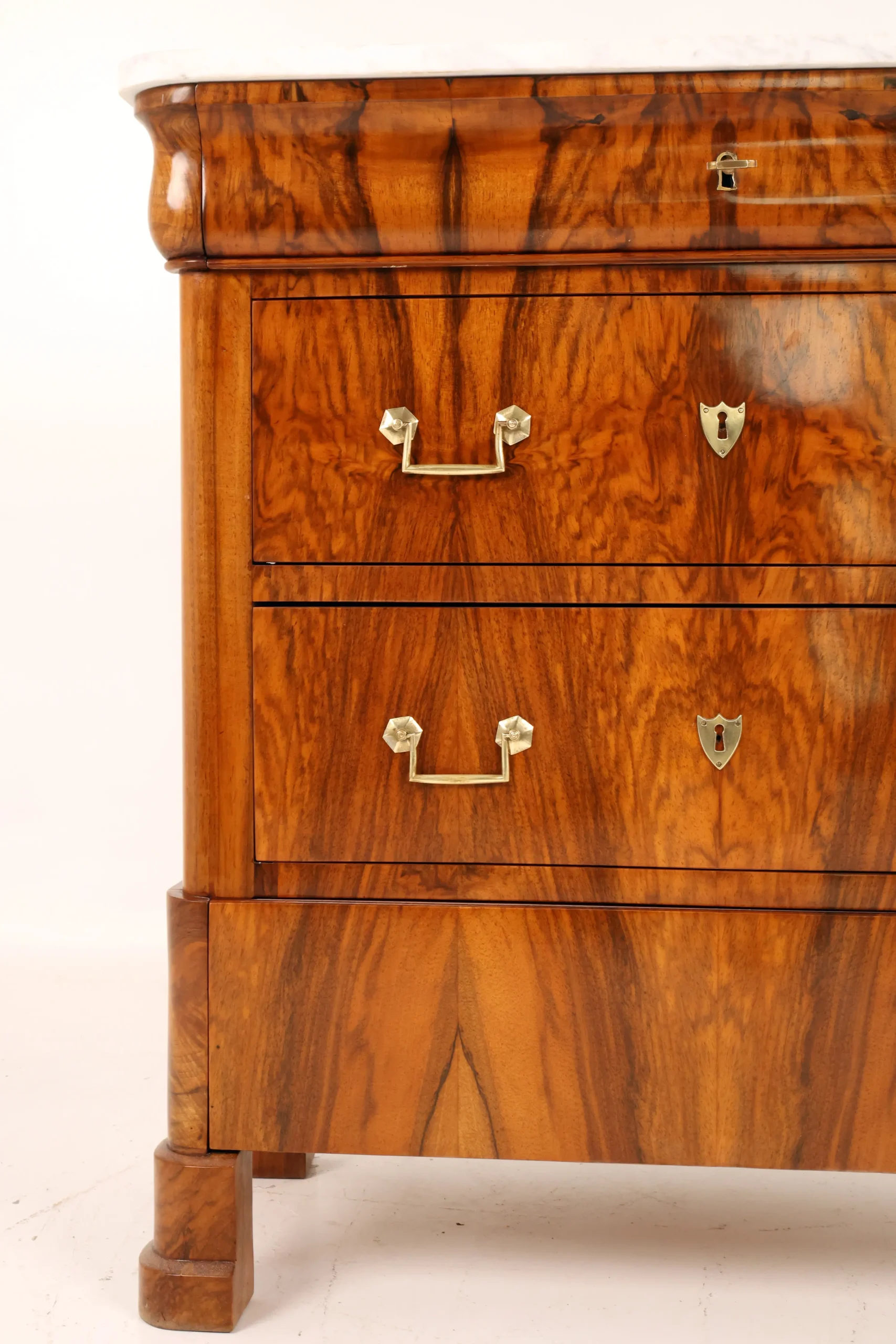
The first thing you notice about a genuine piece of antique Biedermeier furniture is the surface. Cabinetmakers of the early 19th century had mastered the application of thin veneers over solid fruitwood or walnut carcasses, and the best Biedermeier pieces use this technique to create surfaces of extraordinary visual depth. Flame walnut, burl maple, cherry with its warm reddish tone, these veneers were selected for figure and laid with a precision that makes the grain itself the primary decorative element.
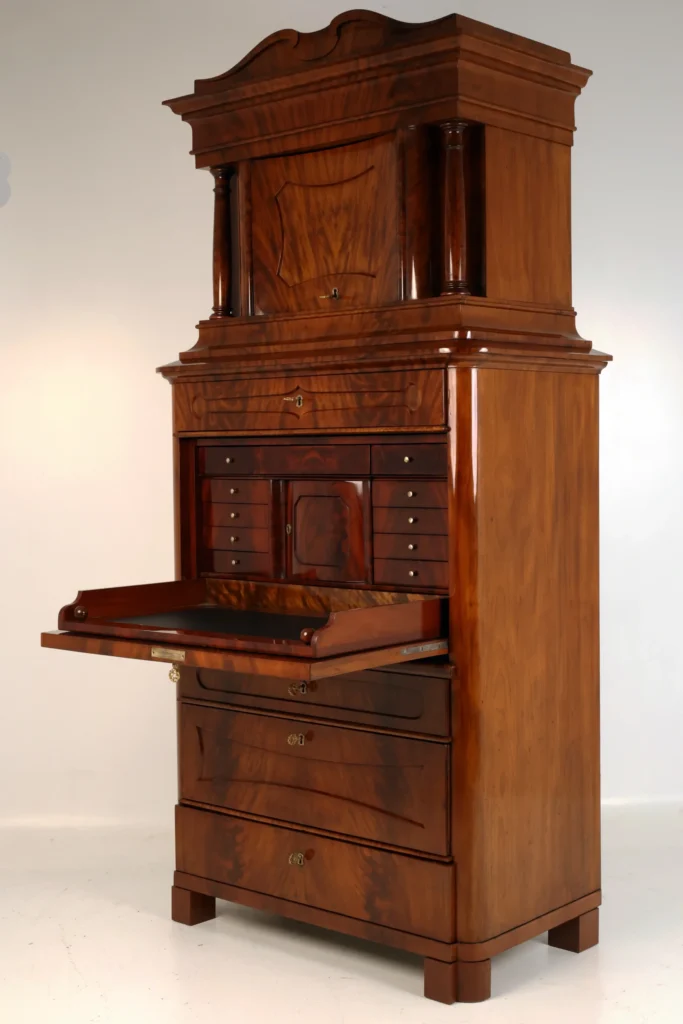
Ebonized details appear frequently, thin stringing lines, column capitals, carved feet, providing a sharp geometric contrast against the pale or honey-colored veneer. Brass hardware, typically simple ring pulls or small knob handles, is restrained and precisely fitted. The proportions of Biedermeier furniture are considered carefully. A secretaire desk from this period stands at exactly the right height. A chest of drawers has a width and depth that feels resolved rather than arbitrary.
The joinery is equally telling. Biedermeier cabinetmakers used dovetailed drawer construction, properly fitted back panels, and a standard of internal finishing that reflects the workshop tradition behind each piece. Open a drawer on a genuine early 19th century Biedermeier piece and the interior is as considered as the exterior.
Regional Variations — Austrian, Viennese, Swedish and German Biedermeier
The Biedermeier style spread quickly from Vienna and the German states across Central Europe and into Scandinavia, and each regional tradition adapted it in ways that reflect local materials and workshop practices.
Austrian and Viennese Biedermeier is the most refined expression of the style. Josef Danhauser’s Vienna workshop produced furniture of exceptional elegance, with lighter proportions, graceful curves, and a preference for cherry and maple that gives Austrian pieces a warmth that German examples do not always share. The curves in Viennese Biedermeier are particularly characteristic, scrolled armrests on sofas, shaped cabinet cornices, and the gentle swell of a chest front that stops well short of the bombé excess of earlier periods.
German Biedermeier is more robust. The proportions are stronger, the veneers often darker, and the overall character more architectural. This is not a lesser tradition, simply a different one, and German pieces from workshops in Berlin, Hamburg, and the southern states have a solidity and presence that suits a certain kind of interior very well.
Swedish Biedermeier, known locally as Karl Johan after the king who ruled during the period, favors pale birch and spare, almost severe lines that anticipate the Scandinavian modernism of a century later. A Swedish Biedermeier chair in birch with its original upholstery is a piece that looks entirely contemporary in a modern interior, which explains why Scandinavian Biedermeier has attracted renewed collector interest in recent years.
Antique Biedermeier Furniture Today — What Collectors Look For
Vintage Biedermeier furniture has been collected seriously since the late 19th century, when a revival of interest in the style brought it back into fashionable interiors across Central Europe. That interest has never really subsided, and antique Biedermeier furniture for sale in good original condition commands consistent attention from collectors, interior designers, and buyers who understand what they are looking at.
The primary thing to assess is the veneer surface. Original Biedermeier veneer has a depth and warmth that refinished surfaces do not replicate. Look for patina that has developed evenly across the piece, with the natural darkening at edges and corners that comes from decades of use and maintenance rather than applied stain. Any repairs to the veneer should be tight and color-matched, not obvious patches.
Check the ebonized details carefully. Original ebonizing on a genuine early 19th century piece has a quality that later additions do not match. The brass hardware should be original where possible, with the original fixing holes undisturbed behind the back plates. A secretaire with its original interior fittings intact, the small drawers, the pigeonholes, the fold-down writing surface, is considerably more complete and more valuable than one that has been altered.
The distinction between genuine antique Biedermeier and later 19th century revival pieces is worth understanding. The revival pieces, made from roughly the 1870s onward, followed the original forms closely but tend to be slightly heavier in proportion and less refined in their veneer work. They are not without interest, but they are different from the original 1815 to 1848 production, and the price difference reflects that.
Explore Our Collection
The Biedermeier furniture collection at Antiqueria Breitling covers the full range of forms from the period, assessed and where necessary restored by master artisans using traditional French polishing and shellac techniques. For related pieces in the same tradition, the antique cabinets and 19th century furniture sections cover complementary styles and periods that work well alongside Biedermeier in a considered interior.