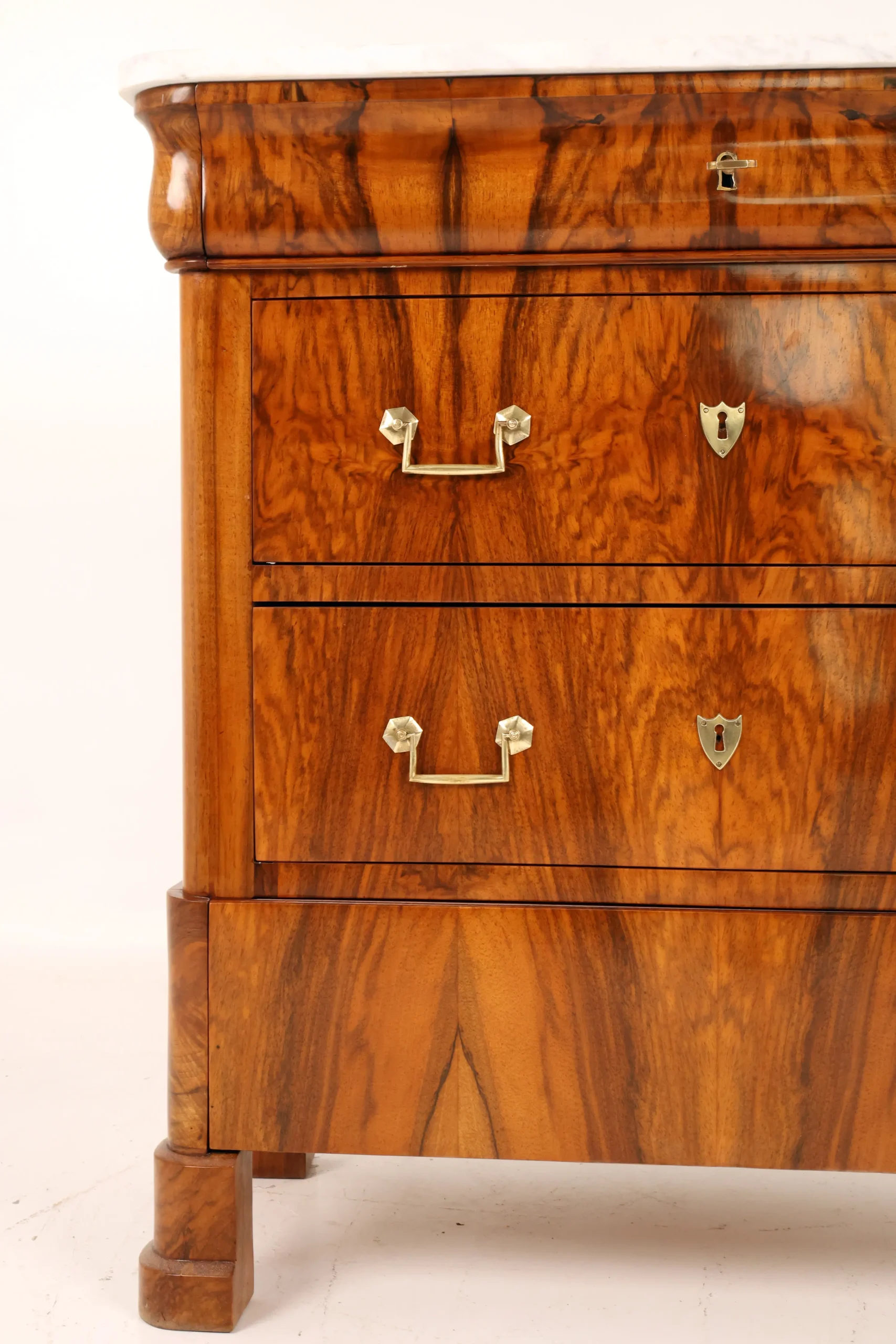
Most people who encounter a piece of Napoléon III furniture assume they are looking at Empire. They are not. The confusion is understandable, the names are similar and both styles reference imperial France, but the furniture itself could not be more different. Understanding that distinction is one of the more useful things a serious buyer can do before entering this market.
What Napoléon III Furniture Actually Is
The original Empire style belongs to Napoléon Bonaparte, the first emperor, and it was produced between roughly 1800 and 1815. It is severe, militaristic, and built entirely around the political project of linking Bonaparte’s reign to the grandeur of ancient Rome and Egypt. Dark mahogany, heavy ormolu mounts featuring eagles and sphinxes, marble tops, and the absolute discipline of neoclassical geometry. It was designed to intimidate.
Napoléon III furniture belongs to a completely different emperor, Louis-Napoléon Bonaparte, nephew of the first, who declared himself Napoléon III in 1852 and ruled France until the Franco-Prussian War ended his reign in 1870. The furniture produced during the Second Empire does not have a single unified style of its own. What it has instead is an extraordinary, deliberate eclecticism: the ability to draw simultaneously from every luxurious period of French furniture history and combine those references into something unified by sheer material opulence.
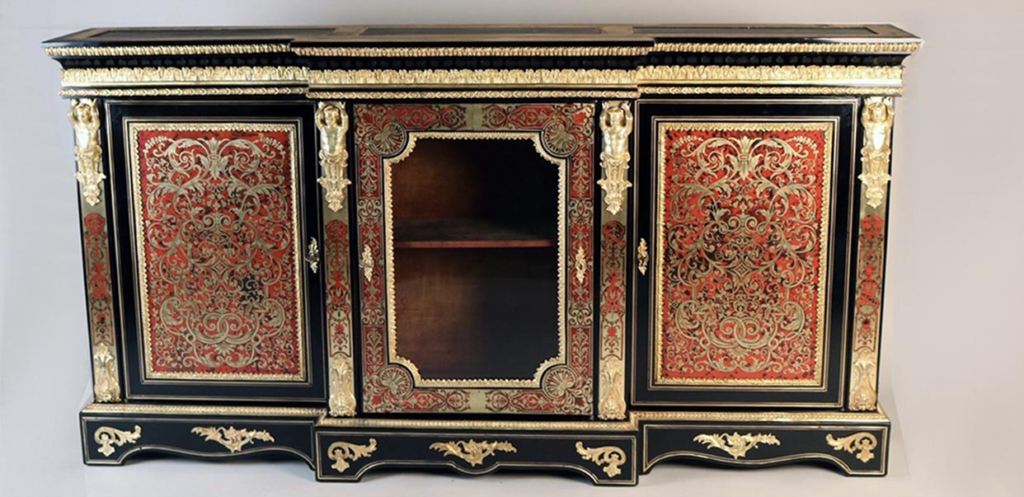
A single Napoléon III cabinet might feature the brass and tortoiseshell Boulle marquetry associated with Louis XIV, the swelling bombé curves and cabriole legs of Louis XV, and the delicate Sèvres porcelain plaques of Louis XVI. This is not confusion or inconsistency. It is a calculated statement by a society eager to display its wealth by assembling the most extravagant elements of its own past into a single object.
Design historians categorize Napoléon III furniture as an eclectic historicist revival style, and that is the most accurate description available. It is not Empire. It is not Louis XV. It is not Louis XVI. It is all of them simultaneously, executed with the ambition and the technical resources of the Industrial Revolution behind it.
The Political Logic Behind the Style
Napoléon III did not arrive at this eclectic approach by accident. The political logic was straightforward. By reviving the opulent styles of the Ancien Régime, the styles of Versailles, of Louis XIV, XV, and XVI, he was associating his regime with the cultural supremacy of pre-revolutionary France without fully committing to any single period that might invite unfavorable comparison.
The true force behind the style, however, was not the emperor but his wife. Empress Eugénie wielded enormous influence over the decorative arts of the Second Empire, and she had a personal obsession that shaped the entire period: Marie-Antoinette. Eugénie collected furniture that had belonged to the former queen, posed for official portraits in Second Empire adaptations of 18th century dress, and in 1867 personally curated a major exhibition devoted to Marie-Antoinette at the Petit Trianon. Her obsession drove a massive Louis XVI revival that runs through Second Empire furniture as a constant thread, and it explains why so much Napoléon III furniture feels like a particularly rich and maximalist version of the neoclassical tradition.
The broader social context matters equally. Baron Haussmann’s reconstruction of Paris during the same decades created vast new apartments and public buildings that needed furnishing, and the rising bourgeoisie that occupied them had the money and the desire to display it. Napoléon III furniture served that demand directly. It was furniture for people who wanted to live in rooms that announced their prosperity without apology.
The Master Workshops That Defined the Style
The Napoléon III period produced two distinct categories of furniture. Factory-made pieces for the mass market, and workshop-made pieces of extraordinary quality for the luxury end of the Parisian market. The distinction between these two categories is enormous, and it is what separates a merely decorative Second Empire piece from a genuinely collectible one.
Henry Dasson was the most celebrated cabinetmaker of the period. Originally trained as a bronze sculptor, he brought a metalworker’s precision to his furniture mounts and refused to compromise on the quality of his gilding. While most 19th century workshops had shifted to electroplating, a cheaper and safer process that deposited a thin film of gold onto bronze, Dasson continued using traditional mercury fire-gilding. This process, which involved painting a gold and mercury amalgam onto cast bronze and firing it in a kiln until the mercury vaporized, produced a warm, deep, buttery luminosity called the mercury bloom that electroplating cannot replicate. Dasson dated his stamps, which makes his pieces among the more straightforwardly documentable in the category.
Maison Béfort specialized in the Louis XIV revival, producing Boulle marquetry pieces of brass and tortoiseshell that closely followed the original workshop tradition of André-Charles Boulle. Alfred Beurdeley, representing the third generation of his family’s prestigious firm, produced what the period called meubles de haut luxe, pieces of such refined quality that they are now pursued at auction independently of any confusion with 18th century originals. Edouard Lièvre went further still, breaking away from the purely French revival tradition to produce Japonisme-influenced pieces of considerable originality, including furniture for private clients that pushed the boundaries of what the period’s eclectic vocabulary could contain.
Materials, Upholstery, and the Invention of Comfort
The material character of Napoléon III furniture is immediately recognizable. Dark woods, ebony, blackened pearwood, mahogany, kingwood, and rosewood provide the dramatic backdrop against which gleaming bronze mounts, porcelain plaques, and marquetry surfaces perform. The contrast between the dark ground and the applied decoration is more theatrical than anything produced in the 18th century, and it suits the maximalist interior design sensibility of 2025 and 2026 with considerable precision.
The upholstery is where the period made its most lasting contribution to furniture history. The invention of deep button tufting in 1838, combined with the mass production of coiled steel springs, transformed what a sofa or armchair could do physically. The quintessential Napoléon III seating form is the fauteuil crapaud, the toad chair, a low, thickly padded armchair entirely enveloped in fabric with a heavy fringe that hides the legs completely. It is the opposite of the formal, upright seating of the Empire period and the 18th century traditions it revived. It is furniture designed for sinking into, for prolonged conversation, for the kind of domestic comfort that the Biedermeier tradition had pioneered a generation earlier but that the Second Empire now dressed in considerably more expensive fabric.
The indiscret, a three-person circular sofa, and the confident, an S-shaped two-seater that placed two people facing slightly away from each other to facilitate intimate conversation in crowded salons, are further inventions of the period that reflect its particular social character. These were pieces designed for the new Haussmann apartments, for bourgeois entertaining, for a world that valued the performance of sociability.
How to Authenticate Napoléon III Furniture and Distinguish It from 18th Century Originals
Because the finest Second Empire workshops produced exact copies and close adaptations of Louis XV and Louis XVI pieces, authentication requires looking past the surface into the construction.
Veneer thickness is the primary indicator. The steam-powered circular saw, patented in 1806, allowed 19th century makers to slice veneers to paper-thin dimensions of roughly one thirty-second of an inch. Genuine 18th century veneers were hand-sawn and measure between one sixteenth and one eighth of an inch thick, with slight surface undulations that reflect the hand process. That thickness difference is visible and feelable under close examination.
The dovetail joints in the drawer construction confirm the period independently. Hand-cut 18th century dovetails show slight irregularities in spacing that machine-cut 19th century joints do not. Hardware is equally telling. Hand-forged iron screws with irregular, off-center slots confirm 18th century production. Machine-threaded screws with perfectly centered slots confirm the 19th.
The most decisive authentication indicator, however, is stylistic anachronism. A piece that combines Louis XIV Boulle marquetry with Louis XV cabriole legs, or Louis XVI neoclassical mounts with a swelling bombé form, is definitively a Second Empire piece regardless of how well it imitates any single 18th century tradition. The eclecticism is the tell, and once you see it clearly it becomes impossible to miss.
For the finest workshop pieces by Dasson, Beurdeley, or Béfort, dated maker’s stamps provide direct confirmation. These makers stamped their work as a commercial guarantee of quality, which is itself a useful authentication point: genuine 18th century pieces from the major workshops are rarely stamped, since royal appointment exempted the most important craftsmen from guild marking requirements.
Napoléon III Furniture in the Current Market and in Contemporary Interiors
The 19th century antique furniture market has shifted considerably in the past five years, and Napoléon III pieces are among the primary beneficiaries of that shift. The maximalist interior design trend, the appetite for dark woods, rich jewel-toned velvets, and heavily ornamented surfaces, aligns precisely with what the Second Empire produced at its best.
Serious collectors no longer treat high-end Second Empire pieces as mere reproductions. A Dasson cabinet with original fire-gilded mounts, a Beurdeley vitrine with intact porcelain plaques, or a Lièvre Japonisme center table with original lacquer panels are pursued for their intrinsic quality and independent historical significance. The mechanical marvels produced by makers like Antoine Krieger, furniture with spring-loaded hidden drawers and secret compartments designed in the tradition that the Biedermeier period had developed, add a further layer of collectible interest.
The relationship between Napoléon III furniture and the antique Empire furniture it is so often confused with is worth understanding clearly before any significant purchase. Empire furniture intimidates. Napoléon III furniture performs. Empire is dark, severe, and architectural. The Second Empire is theatrical, layered, and explicitly designed to impress through abundance rather than authority. Both are strong choices for a contemporary interior that wants historical weight, but they create entirely different atmospheres in the rooms that contain them.
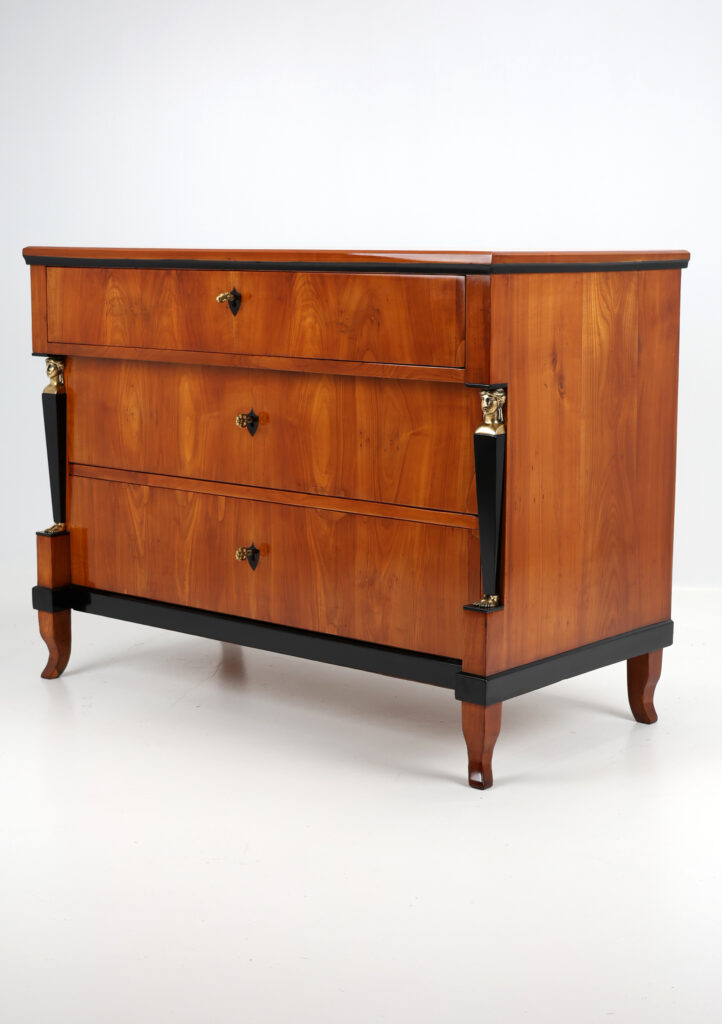
At Antiqueria Breitling, Second Empire pieces are assessed with the same criteria applied to 18th century furniture: veneer integrity, mount quality, original finish condition, and the honesty of any restoration work carried out before listing. The category rewards careful buying, and the pieces that reward it most are those where the workshop quality behind the surface decoration is as strong as the surface itself.
If you are looking for a specific Napoléon III piece not currently listed, write to us at contact@antiqueria-breitling.com. The warehouse holds pieces not yet photographed or catalogued, and requests for a particular form or maker tradition are often easier to fulfill than buyers expect.