In the space of roughly twenty years, French furniture went from celebrating the curve to eliminating it entirely. That shift, from the Rococo exuberance of Louis XV to the Neoclassical discipline of Louis XVI, is one of the sharpest aesthetic pivots in European history, and understanding it changes how you look at every piece of French furniture you encounter.
Two Courts, Two Completely Different Ideas About What Furniture Should Do
Louis XV came to the throne in 1715 after the death of his great-grandfather, the Sun King, whose reign had produced furniture designed to project absolute royal authority. The reaction was immediate and cultural. The French aristocracy left Versailles for smaller Parisian townhouses, the rooms got smaller, and the furniture had to change with them. What emerged from that shift was the Rococo, a style that rejected formality, celebrated intimacy, and prioritized the pleasure of the person sitting in the chair over the impression made on anyone watching from across the room.
The central figure in this transformation was not Louis XV himself but his official mistress, Madame de Pompadour. One of the most influential art patrons of the 18th century, she shaped French taste with the confidence of someone who understood exactly what she wanted: furniture that was romantic, organic, and entirely at ease with itself. The Rococo style she championed drew its decorative vocabulary from nature, shells, foliage, and flowing water, and its forms from the continuous curve. In a Louis XV fauteuil, the back rail flows into the armrests, which curve into the seat rail, which continues without interruption into the cabriole leg. There is not a straight line or a right angle anywhere in the composition, and that is entirely intentional.
By the time Louis XVI came to the throne in 1774, the cultural tide had turned. The archaeological excavations at Herculaneum and Pompeii had been feeding the Parisian intellectual world with images of classical antiquity for two decades, and the Enlightenment’s appetite for reason, order, and historical authority had made the organic asymmetry of the Rococo feel frivolous. The new tastemaker was Marie-Antoinette, who began replacing the curved Rococo pieces in her apartments almost immediately after arriving at Versailles, commissioning interiors of white satin, classical arabesques, and linear woodwork that communicated a completely different set of values: discipline, architectural clarity, and the quiet dignity of ancient Greece and Rome.
The Visual Grammar of Louis XV and Louis XVI — What to Look for in Each Style
The fastest way to tell a Louis XV piece from a Louis XVI piece is the leg. Louis XV uses the cabriole, a sweeping outward curve at the knee that tapers back inward toward the foot. Louis XVI replaces it with a straight tapered leg, often fluted with vertical grooves that reference classical columns directly. That single change from curve to straight line signals everything else that is different between the two traditions.
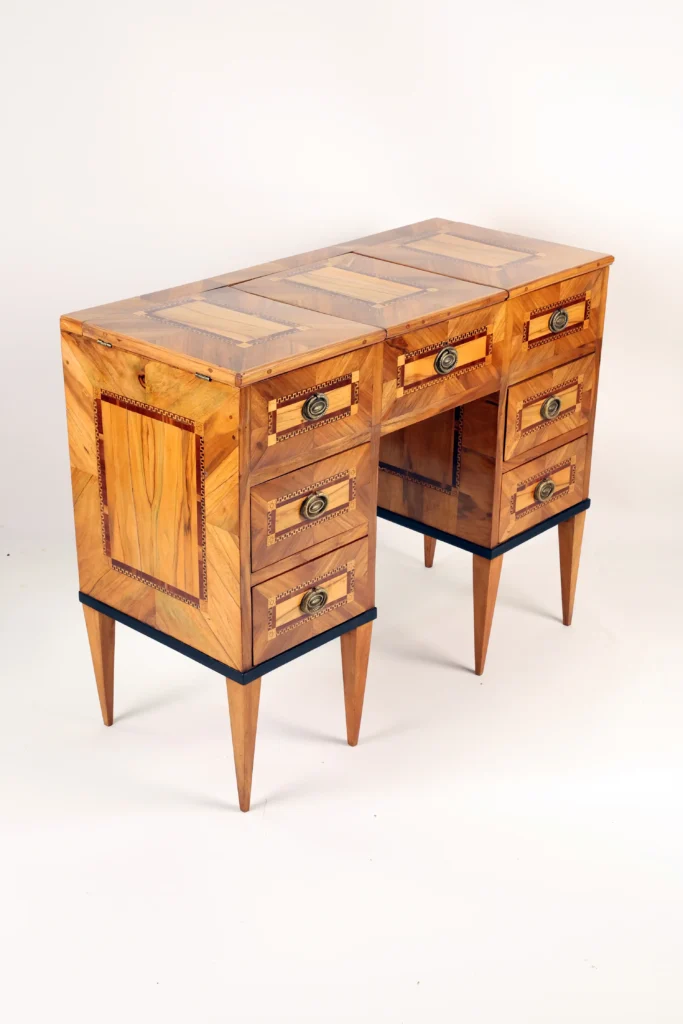
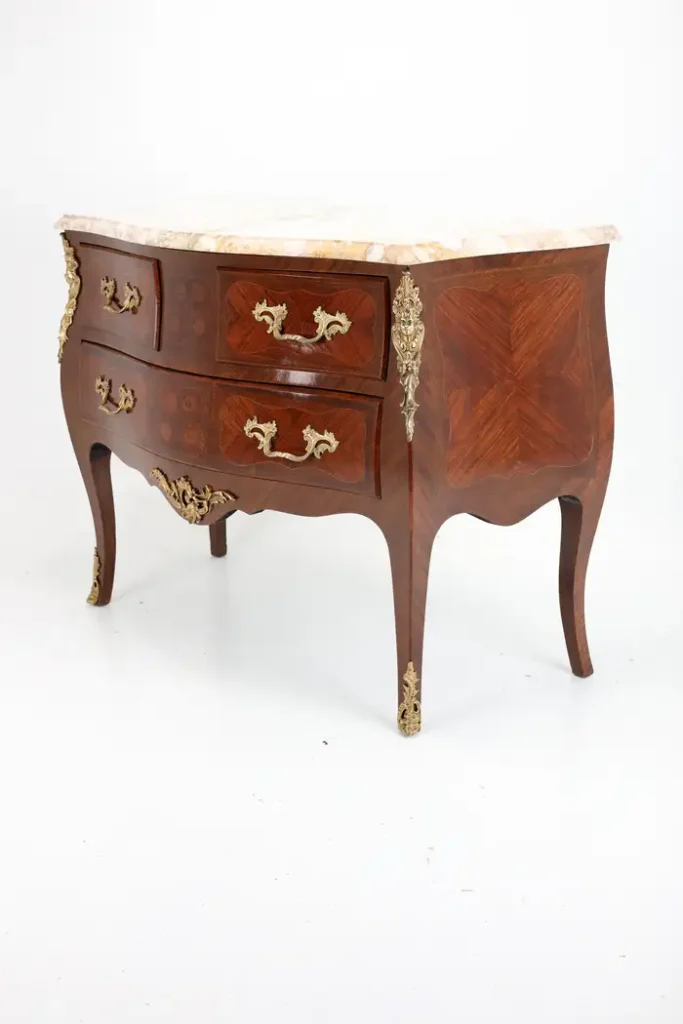
On a Louis XV commode, the front swells outward in a bombé form, the apron is shaped and scalloped, and the bronze mounts flow continuously from the marble top to the floor in organic asymmetrical patterns of shells and acanthus. On a Louis XVI commode, the front is flat or only very slightly broken, the legs are short and straight, the marquetry on the drawer fronts is geometric, and the bronze mounts are restrained, symmetrical punctuation marks of laurel wreaths and classical urns rather than creeping organic vines.
The chair backs tell the same story. Louis XV chair backs are cartouche-shaped, curved to follow the sitter’s body, and deliberately disguise the joints between the structural elements. Louis XVI chair backs are oval, shield-shaped, or square, and they celebrate the joints rather than hiding them. Where the structural rail meets the leg in a Louis XVI chair, there is typically a carved rosette set in a square block that announces the connection proudly. This is a style that has nothing to hide and wants you to know it.
The Materials That Define Each Tradition
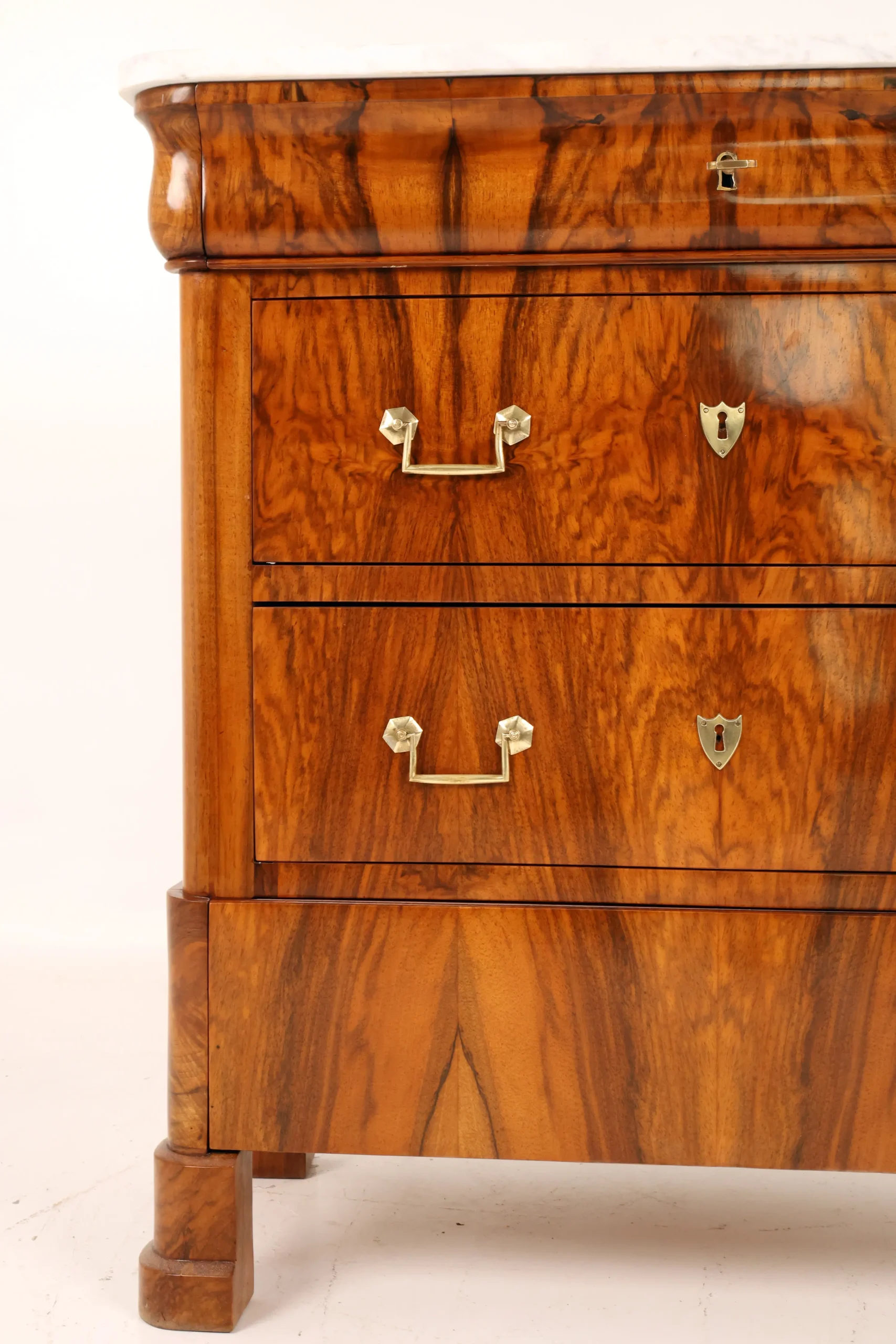
Both traditions used exotic imported woods from South America and the West Indies, but the application changed completely between the two periods. Louis XV marquetry favored kingwood and tulipwood, used to create organic floral bouquets, trailing vines, and trellis patterns that followed the swelling curves of the bombé forms. Louis XVI marquetry shifted to strict geometric parquetry: three-dimensional cube patterns, diamond grids, and checkerboard designs framed by bands of amaranth, a dense timber that oxidizes to a striking deep purple-crimson and provides exactly the kind of architectural definition the neoclassical style demanded.
Toward the end of the Louis XVI period, solid mahogany arrived as the dominant material, reflecting a wave of English influence on French taste. Mahogany’s uniform, unadorned grain suited the severe straight-lined aesthetic in a way that the more decorative exotic veneers did not, and the finest late Louis XVI pieces in mahogany have an austerity that anticipates the Empire style that would follow.
The ormolu mounts that protect the veneer edges and provide decorative detail follow the same trajectory. Louis XV bronzes by masters like Jacques Caffieri are wildly asymmetrical, heavily sculptural, cascading down the corners of commodes in organic eruptions of shells and foliage. Louis XVI bronzes by Pierre Gouthière, the undisputed virtuoso of the era, are delicate architectural jewelry: restrained garlands, precise laurel wreaths, and classical swags chased with such microscopic detail that his mounts commanded prices higher than those of the era’s most celebrated painters.
The Named Craftsmen Who Made the Finest Pieces
French furniture of this period was produced within one of the most strictly regulated guild systems in European history. Craftsmen were required to stamp their finished work with their initials and the JME hallmark of the guild, and those stamps matter enormously for authentication and valuation today.
Bernard II van Risenburgh, known only as BVRB until historians decoded his identity in the 1950s, is the greatest cabinetmaker of the high Louis XV style. His pieces, which pioneered the integration of Japanese lacquer panels into curved mahogany commodes, are held in the Metropolitan Museum of Art and the Getty. Jean-François Oeben, master of mechanical furniture and complex floral marquetry, bridges the two reigns, blending late Rococo curves with tighter geometric forms that signal the coming neoclassical shift.
For Louis XVI, Jean-Henri Riesener was Marie-Antoinette’s preferred cabinetmaker, a master of pictorial marquetry whose signature trapezoidal panel of inlaid urns and floral bouquets appears on the finest commodes of the period. Adam Weisweiler and Martin Carlin specialized in jewel-like furniture for the innermost court circle, integrating Sèvres porcelain plaques painted with classical scenes into cabinets of almost impossible refinement. Georges Jacob was the dominant chair maker of the era, responsible for the iconic oval and shield-backed chairs that defined Marie-Antoinette’s private rooms.
The Louis XVI furniture collection at Antiqueria Breitling includes pieces assessed against these maker traditions, with particular attention to estampille authenticity, veneer condition, and the quality of the original ormolu.
How to Tell an Authentic 18th Century Piece from a 19th Century Revival
Both Louis XV and Louis XVI styles were heavily revived during the Napoleon III period of the 1850s and 1860s, and the finest revival pieces are sophisticated enough to mislead buyers who have not looked closely at the construction.
Veneer thickness is the most reliable starting point. Genuine 18th century veneers were hand-sawn and measure between one sixteenth and one eighth of an inch thick, with slight surface undulations that reflect the hand process. Machine-sliced Napoleon III revival veneer is paper thin, perfectly flat, and completely uniform. That flatness is visible and feelable under close examination.
The dovetails in the drawer construction confirm the period independently. Hand-cut 18th century dovetails show slight irregularities in spacing and pin size that no machine produces. Machine-cut dovetails from the revival period are mathematically uniform. Look also at the secondary woods inside the carcass. Authentic 18th century pieces show rough hand-plane marks on the hidden surfaces, the parallel ridges of a tool worked by hand. Machine-planed surfaces are perfectly smooth.
The upholstery technology provides a definitive date check. Deep button tufting was not invented until 1838, and coiled metal springs for seat cushions were not in use during the 18th century. An original Louis XV or Louis XVI chair relied on stretched linen webbing, horsehair stuffing, and flat hand-stitched padding. Springs and tufting confirm a 19th century date regardless of what the frame looks like.
Louis XV and Louis XVI in a Contemporary Interior — Which Suits Which Buyer
The practical question for any buyer is which style suits the room and the intention behind the purchase.
The antique Louis XV furniture collection suits a buyer who wants the furniture to bring organic warmth and sculptural presence to a space. A bombé commode in kingwood with original asymmetrical ormolu in a room with contemporary furniture creates a visual tension that no straight-lined piece achieves. The curves are generous, the bronzes are alive, and the piece demands and rewards attention. It works particularly well in rooms with hard contemporary architecture where the organic forms of the Rococo provide a counterpoint.
Louis XVI suits a buyer who wants architectural discipline and quiet authority. The straight lines, geometric marquetry, and restrained neoclassical mounts of a Louis XVI commode or console sit naturally alongside mid-century modern furniture, contemporary abstract art, or any interior where the furniture is meant to complement rather than dominate. The style communicates confidence without drama.
At Antiqueria Breitling, French furniture from both periods has been central to the collection since the founding years, and the distinction between the two traditions is one that informs every assessment. A transitional piece that carries elements of both styles simultaneously, and these exist in considerable numbers from the 1760s and 1770s when the shift between the two reigns was gradual, is particularly interesting to handle and particularly rewarding to own. The hybrid quality of these pieces reflects a specific moment in French cultural history that neither pure style captures on its own.
If you are looking for a specific Louis XV or Louis XVI piece not currently listed, write to us at contact@antiqueria-breitling.com. The warehouse holds pieces not yet photographed or catalogued, and requests for a specific form, wood, or period are often easier to fulfill than buyers expect.