In 1815, the most powerful man in Europe lost everything, and European furniture design changed completely. The fall of Napoleon Bonaparte did not just redraw the map of the continent. It ended an entire way of thinking about what furniture was supposed to do, and replaced it with something entirely new.
The Politics That Created Two Opposite Styles
French Empire furniture was Napoleon’s idea as much as any general’s. He understood that the decorative arts were instruments of power, and he used them accordingly. His court architects Charles Percier and Pierre-François-Léonard Fontaine published a design manual in 1812 that codified an imperial aesthetic drawing directly on ancient Rome and Ptolemaic Egypt. The furniture they designed for Fontainebleau, Malmaison, and the Tuileries was not intended to be comfortable. It was intended to make the person looking at it feel small in the presence of the state.
Napoleon personally inspected furniture workshops. He understood that a commode flanked by massive bronze columns and crowned with a dark marble top was communicating something specific about the permanence and authority of his empire, and he wanted that message delivered consistently across every palatial interior his regime furnished.
When Waterloo ended that project in 1815, the response across Central Europe was not to replace one imperial style with another. The response was to turn inward entirely. Under Klemens von Metternich’s system of censorship and political surveillance, the urban middle class of Austria, Germany, and the surrounding states had no public sphere in which to express itself. So it built a private one. The home became the site of everything that mattered: family life, intellectual discussion, music, and the kind of slow domestic pleasure that the previous generation had never had the furniture to support. The Biedermeier style was the material expression of that retreat, and it remains one of the most radical shifts in the history of European design.
What Empire Furniture Actually Looks Like and Why
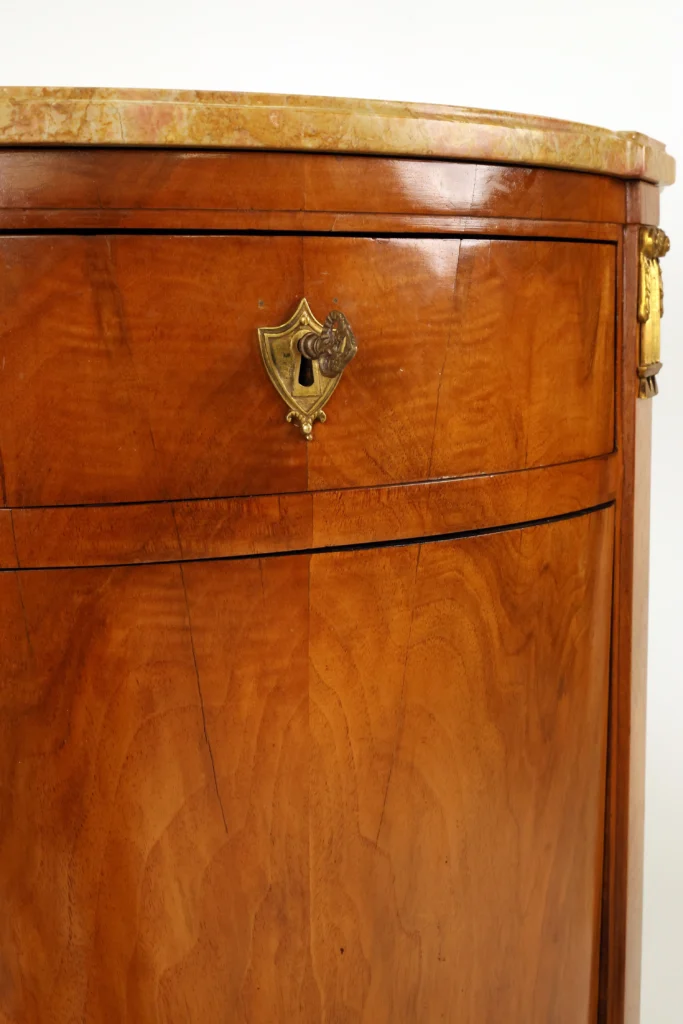
Empire furniture is immediately recognizable. The proportions are monumental. The symmetry is absolute. A secretary desk or commode from this period often resembles a small classical building, flanked by freestanding columns with chased bronze capitals and bases, crowned with a marble top, and covered in ormolu mounts featuring the symbolic vocabulary of Napoleon’s imperial program: laurel wreaths of victory, imperial eagles, Egyptian sphinxes referencing the Egyptian campaigns, and the letter N.
The wood is almost always dark mahogany, imported at enormous expense from Cuba and the Antilles before the Continental Blockade of 1806 disrupted those supply routes. The density and tight grain of old-growth Cuban mahogany allowed Empire cabinetmakers to carve three-dimensional caryatids, lion paw feet, and sphinx figures directly from the wood. The contrast between the dark polished surface and the fire-gilded bronze mounts is the defining visual character of the style: dark, heavy, gleaming, and deliberately intimidating.
The ormolu mounts on genuine Empire pieces were produced by specialist workshops, most notably that of Pierre-Philippe Thomire, and fire-gilded using a mercury amalgam process that was extraordinarily toxic. The craftsmen who applied those mounts frequently suffered severe neurological damage from mercury vapor inhalation. The gold they deposited onto the bronze has a warm, deep luminosity that modern electroplating cannot replicate, which makes it one of the most reliable authentication indicators for serious collectors today.
The antique Empire furniture collection at Antiqueria Breitling covers commodes, secretaries, console tables, and seating from the French and Central European tradition, each assessed for the quality of the original ormolu and the integrity of the mahogany surface.
What Biedermeier Furniture Actually Looks Like and Why
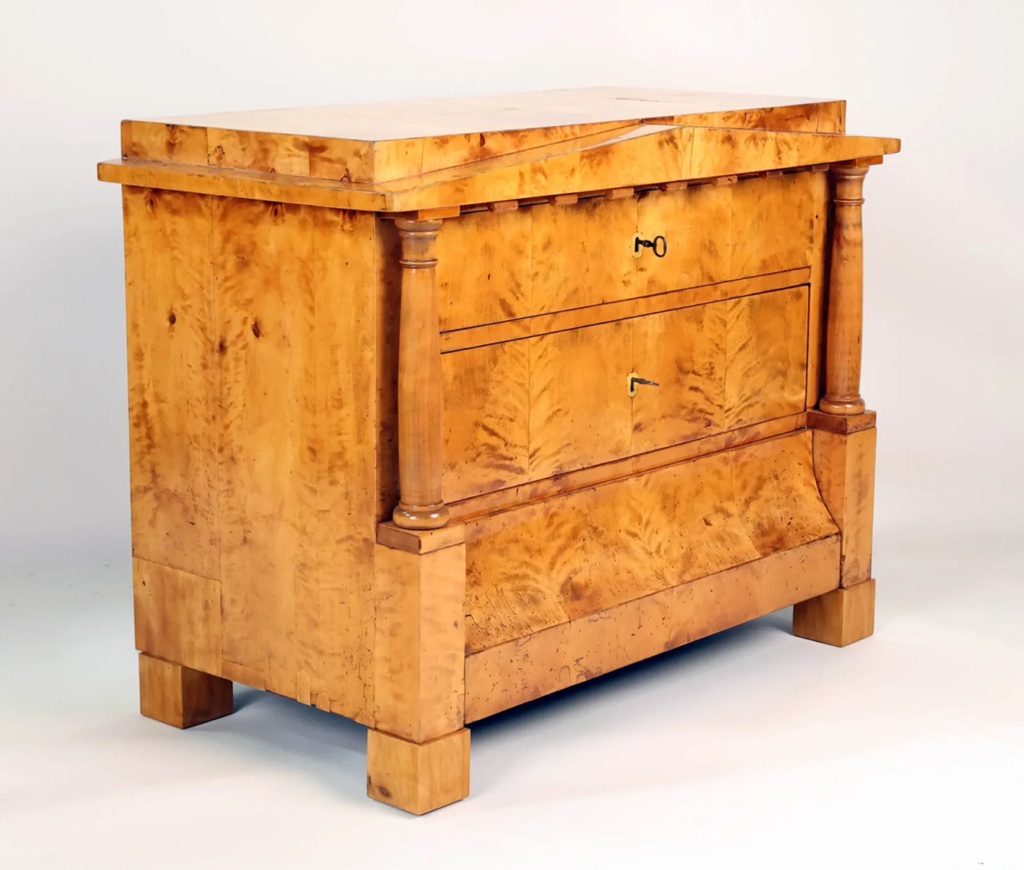
The Biedermeier commode or secretary that sits across the room from an Empire piece looks like it was made on a different planet. The wood is pale: cherry, walnut, birch, ash, or pear, all native European fruitwoods that cost a fraction of imported mahogany and were available locally after the Continental Blockade had disrupted international timber routes. The bookmatched veneer on the drawer fronts, laid in mirror-image sheets to create symmetrical grain patterns, is the primary decoration. There are no bronze mounts. There is no marble top. There is no symbolic program communicating military triumph.
What there is instead is proportion, warmth, and considerable craft intelligence. The sabre legs that support Biedermeier seating curve outward with a geometry that provides stability through form rather than mass, anticipating ergonomic principles by a century. The gondola sofa wraps around the sitter in a continuous curve. The secretary desk, closed, presents a face of complete calm, and then opens to reveal a theatrical interior of mirrored niches, contrasting veneers, and hidden compartments that served a very real function in Metternich’s surveillance state. Families kept gold coins, legal documents, and politically sensitive correspondence inside these pieces. The trick locks, which spun uselessly clockwise for anyone who did not know to turn them counter-clockwise first until a spring engaged, were not decorative gestures. They were practical security solutions.
The coil springs introduced into Biedermeier upholstery during the 1820s, developed partly through the work of Josef Danhauser’s Vienna workshop, were equally practical. For the first time, a sofa was genuinely engineered for extended comfort rather than formal display. The fabrics chosen for these interiors were vivid: aquamarine, lilac, yellow, and hand-embroidered floral patterns that filled bourgeois apartments with a cheerfulness entirely absent from the dark silk of Empire interiors.
The Biedermeier furniture collection covers the full range of forms from the period, from secretary desks and commodes to seating and side tables, sourced from Viennese, German, and Scandinavian workshops.
The Same Form, Two Completely Different Objects
The sharpest way to understand the difference between these traditions is to look at the same furniture form executed in each style.
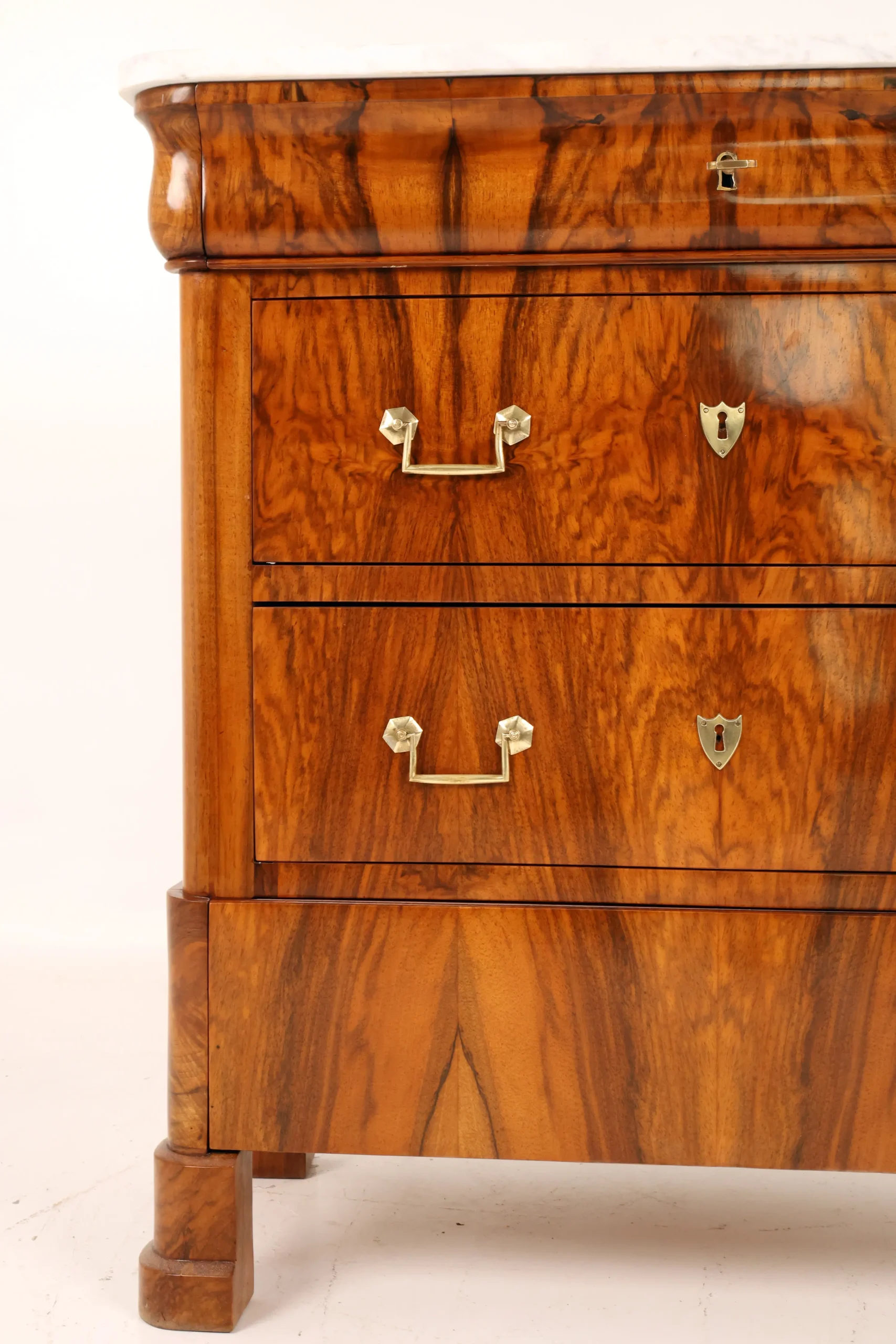
An Empire commode is a monument. Dark mahogany, massive columns at the corners, heavy marble top, symmetrical ormolu mounts on every surface. It was designed to stand against the wall of a state room and be admired from across a large space. You would not pull it into the center of a room and sit around it.
A Biedermeier commode is a domestic object. Light cherry or walnut veneer, no marble, no bronze, no columns. The bookmatched grain running across the uninterrupted drawer fronts is the only decoration, and it is sufficient. This is a piece made for a room where people actually spent time.
The secretary desk contrast is equally striking. The Empire secrétaire à abattant resembles a classical temple in miniature: dark mahogany pyramid, heavy pediment above, intimidating drop-front below, the interior fitted with spiraling ebonized columns and gleaming brass. The Biedermeier equivalent is scaled for a modest apartment, opens to reveal a warm interior of contrasting veneers and mirrored niches, and carries within it, if the maker was skilled, a series of hidden compartments that required intimate knowledge to find and open.
Regional Variations Worth Understanding Before You Buy
Both traditions produced distinct regional variations that affect both the character of specific pieces and their current market value.
French Empire furniture from Paris, made under the direct oversight of Percier and Fontaine and executed by cabinetmakers like François-Honoré Jacob-Desmalter, represents the most rigorous and expensive expression of the style. Italian Empire furniture, particularly Milanese pieces influenced by Giuseppe Maggiolini, softened the rigid French vocabulary with intricate pictorial wood inlays that reflect the Italian marquetry tradition. American Empire pieces by Duncan Phyfe and Charles-Honoré Lannuier in New York adapted the French designs for a mercantile client who wanted imperial authority without full Napoleonic severity.
Within Biedermeier, the Viennese tradition centered on Danhauser’s workshop produces the most refined and elegant pieces, with sweeping curves, warm cherry veneer, and considerable mechanical ingenuity in the secretary and cabinet forms. German Biedermeier from Berlin and Munich is more architectural and slightly heavier, reflecting the influence of Karl Friedrich Schinkel’s neoclassical discipline. Scandinavian Karl Johan Biedermeier in pale birch is the most spare of all the regional traditions, and the most directly compatible with contemporary interiors.
At Antiqueria Breitling, both Empire and Biedermeier pieces have been central to the collection since the early years of the business, and the regional distinctions described above inform every assessment. A Viennese Biedermeier secretary and a Berlin example of the same period are different objects in character, construction, and value, and treating them as equivalent would be a disservice to the buyer.
How to Authenticate Empire and Biedermeier Pieces
For Empire furniture, ormolu quality is the primary authentication indicator. Genuine fire-gilded mercury bronze is heavy, warm in tone, and shows hand-chasing marks under magnification. Electroplated 19th century revival mounts are brighter, lighter, and prone to flaking. The veneer on authentic Empire pieces was hand-sawn and is considerably thicker than the paper-thin machine veneer of Napoleon III revival production from the 1850s onward.
For Biedermeier, veneer thickness matters equally. Original pieces carry sawn veneer of three to five millimeters, with a depth and warmth that machine veneer cannot replicate. Hand-cut dovetails in the drawer construction show slight irregularities that confirm pre-industrial making. The back panel of an original piece, assembled from wide solid wood planks with hand-forged iron nails, should show the deep grey-brown oxidation of genuine age and the gaps between planks caused by two centuries of natural wood movement.
The swan motif offers one of the more poetic authentication details crossing both traditions. Under Napoleon the swan appeared in heavy gilded bronze on Empire furniture, symbolizing Apollo and imperial authority. In Biedermeier interiors a decade later the same swan was carved from warm cherry wood into the armrest of a gondola sofa, now symbolizing domestic grace and quiet loyalty. The motif is the same. Everything else about it changed.
Which Style Suits Which Buyer and Which Room
Empire furniture suits a buyer who wants a single monumental piece that anchors a space with authority. A dark mahogany commode with original ormolu in a room with white walls and contemporary furniture creates a visual tension that no modern object generates. The scale and the darkness of the wood demand the room be able to carry them, which means high ceilings and sufficient floor space matter.
Biedermeier suits a wider range of buyers and a wider range of rooms. The light wood tones, the clean geometric lines, and the domestic scale of these pieces make them compatible with contemporary interiors, Scandinavian-influenced spaces, and more traditionally furnished rooms equally. They do not impose a historical narrative on the space around them. They settle into it.
Both traditions are currently experiencing strong demand, Empire from buyers drawn to maximalist interior design trends, Biedermeier from buyers seeking warmth, functionality, and the kind of understated material quality that two centuries of careful use produces and nothing new can replicate. If you are looking for a specific piece from either tradition that is not currently listed, write to us at contact@antiqueria-breitling.com. The warehouse holds pieces not yet catalogued, and requests for a particular form or period are often easier to fulfill than buyers expect.