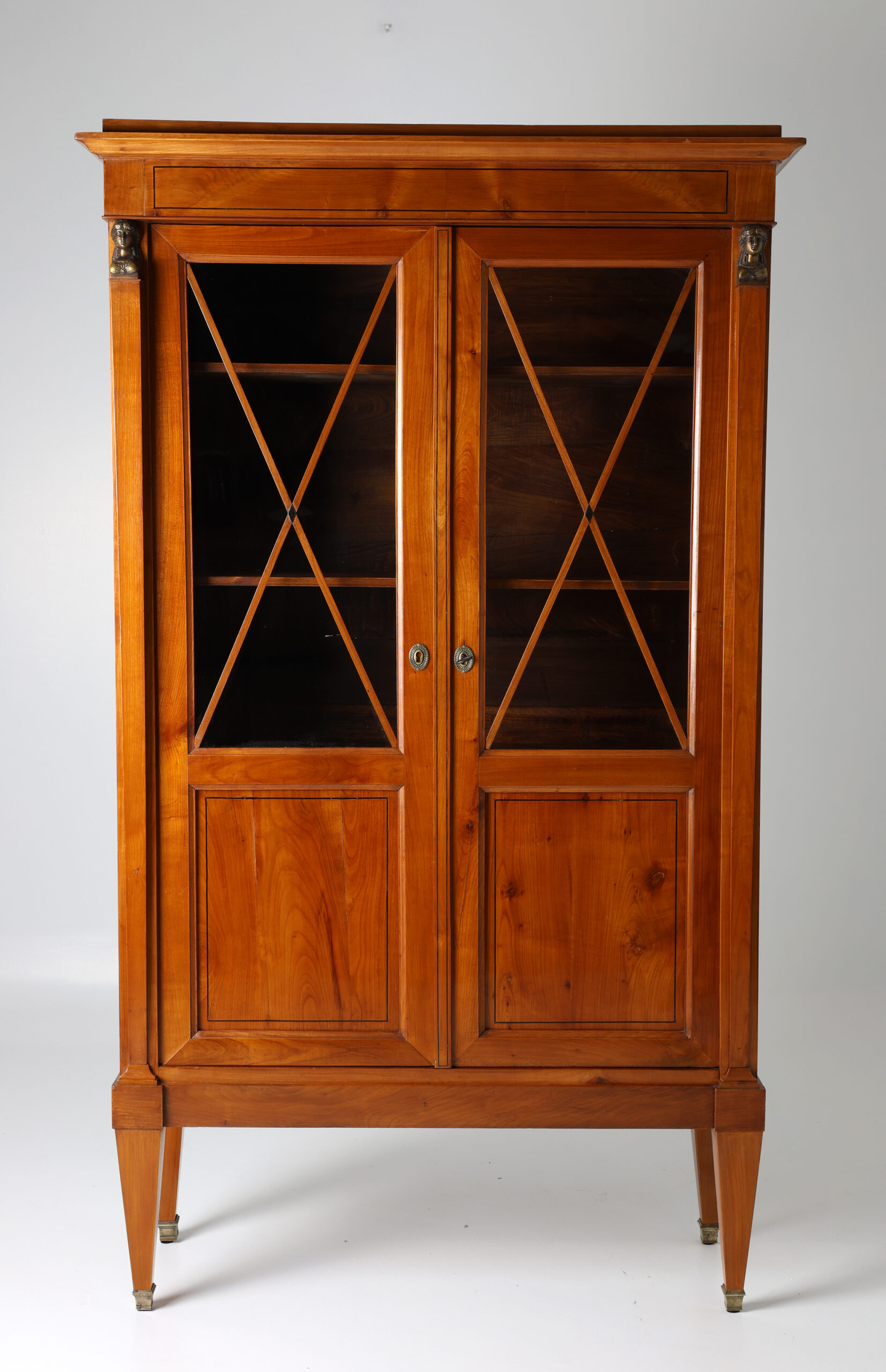
An antique marquetry table is one of the rare pieces of furniture where the art lives on the surface itself. The top is a picture built entirely from wood, cut, shaded, and fitted by hand, and for four centuries it was the surface on which a cabinetmaker proved exactly how good he was. The French had a name for it, peinture-en-bois, painting with wood, and the phrase is literal: the maker composes colour, light, and shadow not with pigment but with the natural tones of boxwood, walnut, olive, and maple. At Antiqueria Breitling we restore marquetry and inlay in our own atelier, so we read these tops closely, and the finest of them, above all the Italian ones, reward that attention.
What Marquetry Actually Is
Marquetry is the technique of cutting thin pieces of wood veneer, each chosen for its colour and grain, and fitting and gluing them onto a solid secondary carcass to form a pattern or a picture. Sometimes the wooden palette is joined by other materials, brass, pewter, tortoiseshell, mother-of-pearl, or bone, set in for contrast or a flash of light. The visible surface is a jigsaw skin of veneer, with no solid show-wood beneath it, and in period pieces that veneer runs roughly one and a half to three millimetres thick.
The craft has ancient roots, with veneered decoration reaching back thousands of years, but the decisive shift from carving solid wood to laying delicate surface veneer happened in the Italian Renaissance. The refinement of the fine-toothed fretsaw blade was the catalyst, letting artisans cut several layers of veneer at once with real precision. Instead of generating shadow by deep relief carving, which limits colour, cabinetmakers began using the contrasting natural tones of rare imported woods to create depth, perspective, and volume on a flat plane. The early Italian masters were so skilled at this illusion that they became known as masters of perspective, and the table top, large, flat, and uninterrupted, became the ideal canvas to show it off.
Marquetry, Parquetry, and Intarsia
Three words are constantly muddled, and a collector should keep them straight. Marquetry proper is pictorial or floral, a veneer composition of scenes, figures, bouquets, or trophies laid over a carcass. Parquetry uses exactly the same veneering method but is strictly geometric, building repeating patterns of cubes, diamonds, lozenges, trellis, and radiating stars, and prizing optical effect over imagery. Intarsia is the older method, and the one Italy made its own, where the design is cut and recessed directly into solid wood rather than applied as a thin skin over a substrate.
A particularly Italian subset is intarsia certosina, named for the Carthusian monasteries of Lombardy, in which long rods of contrasting materials, often ebony, bone, ivory, and horn, are glued into a block, sliced across, and set into a solid ground as tight geometric mosaic. The distinction matters when you stand in front of a piece. A figurative scene is marquetry, a radiating starburst is parquetry, and a design sunk into solid timber rather than laid over it is intarsia. The great Italian workshops happily combined them, a pictorial centre framed by geometric banding, which is exactly what the best nineteenth-century tables do.
How the Picture Is Made
The work behind a marquetry top is slower and more demanding than it appears. The traditional tool is the chevalet de marqueterie, the marquetry donkey, a foot-operated sawing easel the artisan straddles like a horse. A pedal opens and closes a vice that holds the veneer packet at eye level while a carriage guides the saw frame perfectly horizontally, keeping the blade exactly perpendicular to the wood. The accuracy is such that a piece cut from the front of a stacked packet drops flawlessly into the void at the very back. By sawing away the precise width of the drawn line, a skilled cutter eliminates the saw kerf entirely, and a single cut yields a motif and its exact negative, a light design on a dark ground and its mirror twin, the première-partie and the contre-partie.
Colour and depth come from the wood and from a few quiet tricks. To shade a curve, a petal, or the flank of a horse, the cutter dips the edge of the veneer for a few seconds into a pan of scorching hot sand, burning a soft gradient into it so the flat piece suddenly reads as rounded. Each species chars at its own rate, so the artisan has to know exactly how long each wood can bear the heat without catching. The finest details, the strings of a lyre, the spokes of a wheel, a face in profile, are engraved as hair-thin lines and filled with a dark mastic of ink and shellac, effectively drawing onto the wood. The whole skin is then laid down in hot animal hide glue, the reversible adhesive that has held these tops for centuries and, crucially, lets a conservator soften the bond with gentle heat to lift and relay a loose shard without damage. That single fact is why a genuine marquetry top can be repaired rather than ruined.
The Figurative Tradition
When marquetry is used for pictorial scenes, the craft reaches its most demanding and expressive form. Figurative tops were the centrepiece of a salon, made to be studied up close, and their subjects followed the taste of the age: floral bouquets, mythological scenes, classical ruins, theatrical masks, musical trophies, pastoral landscapes. The skill is hard to overstate, because where a painter mixes any hue he likes, the marqueteur is restricted to the colours the forest provides, reaching for the pale waviness of sycamore to suggest a cloudy sky, or the chaotic grain of burred walnut to mimic crumbling stone. The neoclassical taste of the late eighteenth century, spurred by the excavations at Pompeii and Herculaneum, sent a wave of antique subjects across table tops, chariots, deities in profile, allegories of virtue, all sand-shaded to imitate the depth and drapery of classical marble.
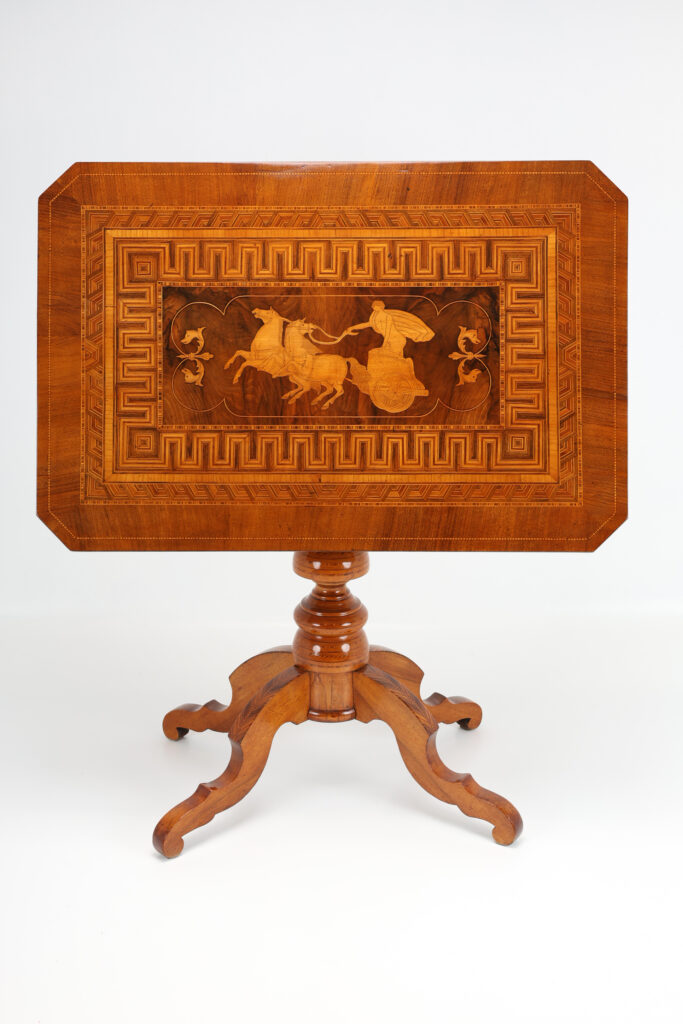
This 19th-century Italian tilt-top centre table, made between 1850 and 1870, shows that figurative tradition at full strength. It is built from solid walnut and inlaid with veneers of various fine woods, and its top carries a marquetry scene of the Sun Chariot, a charioteer driving plunging horses, framed by a bold Greek key border with dolphin motifs to the sides, the pale figures set against the warm walnut ground exactly as the neoclassical makers intended. The whole top tilts upright on a turned central column that rises over four carved legs, and the tilt mechanism lets the top lift away from the base entirely. It has been thoroughly restored and the top hand-polished with shellac, the finish that gives period marquetry its depth and glow, and it measures ninety centimetres wide and sixty deep. It is precisely the sort of piece our atelier is built to care for, where a single lifted sliver of veneer is a repair rather than a loss.
The Geometric Tradition
If figurative marquetry is painting, parquetry is mathematics made visible. Its power is pure pattern, contrasting woods cut so precisely that flat veneer seems to tilt and project, the eye reading three dimensions where there are only two. The tumbling-block illusion, three diamonds of light, medium, and dark wood, makes stacked cubes that seem to flip as you move around the table. On table tops, especially octagonal, round, and tilt-top forms, the classic device is a great central radiating star or rosette, ringed by concentric banding, stringing, and a Greek key border. Success depends entirely on chromatic contrast and unforgiving accuracy, because where a slightly misshapen leaf does no harm in a figurative scene, an error of a fraction of a degree at the centre of a sixteen-point starburst compounds outward into visible chaos at the rim. Fine parquetry is a triumph of measurement as much as of taste.
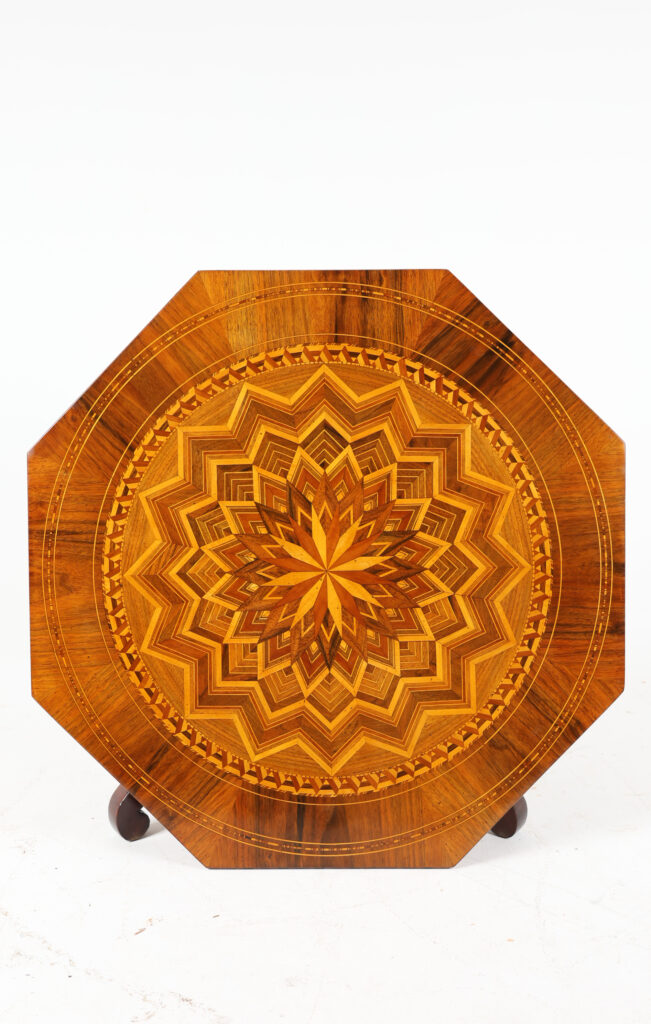
The second of these Italian tables, also nineteenth century, is a clear demonstration of that geometry. Its octagonal top is centred on a many-pointed star that radiates outward in alternating light and dark woods, closed by concentric decorative borders, the whole composition resting on a turned pedestal over a scrolled base. The pattern is built entirely from the contrast of pale and dark timbers, and the precision where the points meet is exactly what marks out careful geometric work. Where the chariot table tells a story, this one works through rhythm and symmetry, the two great traditions of the craft sitting side by side.
Why Italy Led the Art
Any honest account of the marquetry table has to put Italy at its centre, because Italy is the historical crucible of wood inlay and held its lead from the Renaissance onward. In late eighteenth-century Milan, Giuseppe Maggiolini was hailed across Europe as the master of inlay, turning Lombard furniture away from Rococo curves toward sober neoclassical line, and reputedly keeping up to eighty-six different woods in his workshop to achieve his painterly effects, refusing artificial dyes in favour of the natural hues of the timber itself. In Florence, wood marquetry grew up alongside the city’s famous pietre dure hardstone inlay, the workshops often setting dense floral bouquets against very dark or ebonised grounds in deliberate imitation of the black stone used beneath the finest stone mosaics.
By the nineteenth century the centre of decorative, export-driven Italian marquetry had shifted south to Sorrento, on the Bay of Naples, whose workshops served the grand tour trade. The Sorrento makers, names like Michele Grandville and the Gargiulo family among them, ran a clever double business, turning out countless small souvenir boxes and game boards on one hand and exhibition-quality furniture on the other, Grandville himself taking a gold medal at the 1862 London exhibition. The archetypal Sorrento table was an octagonal or tripod centre table with concentric star parquetry and Greek-key borders, its cartouche often filled with a classical chariot or a Neapolitan scene. Both of your tables sit squarely in that nineteenth-century Italian world, one figurative and one geometric, and that lively period production is itself highly collectible today. Pieces like these turn up among our antique side tables from time to time, and they are among the most decorative things we handle.
The Tilt-Top and the Table as Canvas
The form of the table was chosen to serve the top. A flat surface is only fully seen from directly above, so makers devised forms that solved the problem, and the tilt-top is the most elegant of them. A catch releases the top to swing vertical, which saved floor space in a crowded room and, more to the point, turned the marquetry into a picture on an easel, shown flush against the wall like a framed painting. It was the favourite form for the pictorial tops of the Italian grand tour tradition, where a narrative scene asks to be met face to face. The octagonal top gave geometric patterns their natural frame, the round guéridon let a radial design be read from every side as guests moved around it, and the pedestal or tripod base kept the focus on the overhanging top rather than on legs at the corners. The form, in every case, exists to display the wood.
Woods, Construction, and How to Read a Genuine Piece
Beneath the thin show-skin sits the unsung hero, the carcass, almost never solid exotic wood, which would cost a fortune and warp, but a stable secondary timber such as pine, poplar, or common oak. The decorative veneer was laid over it, and the way it was prepared betrays the age of a piece. Before machine sanding, both the carcass and the glue-side of the veneer were deliberately scored with a toothing plane, a steeply pitched serrated blade that scraped fine parallel grooves to level the surface and give the hide glue something to grip. Those parallel tooth marks, hidden under the veneer and sometimes visible on the back of a lifted shard, are a near-certain sign of genuine pre-industrial work.
The single clearest indicator of age, though, is the thickness of the veneer. Before the circular veneer saw arrived around 1805 and steam slicing followed in the 1830s, all veneer was hand-sawn by pit sawyers, and period veneer runs a substantial one and a half to three millimetres, where later machine-cut veneer is often under a millimetre, thin and dead and uniform. Beyond age, value rests on the crispness of the cutting and the quality of the shading: tight joints with no gaps, smooth gradient sand-shading that adds volume without looking charred. Honest age is to be welcomed, a deep oxidised patina, slight shrinkage cracks where the carcass moved against the cross-grain of the veneer, the small lifting that comes as old hide glue crystallises. Minor lifting is an easy, reversible repair; widespread losses that need whole sections recut are far more serious and cut into value. It is also worth saying that fine nineteenth-century Italian work is genuinely collectible in its own right, so an honest period piece is not the same thing as a crude later tourist reproduction with sloppy cuts, artificial stain, and synthetic glue. Every marquetry table that comes through Antiqueria Breitling is assessed against exactly these markers and stabilised in our atelier where it needs it.
The Marquetry Table in the Modern Room
A marquetry table earns its place in a contemporary interior precisely because it is decorative without being loud. A tilt-top can stand against a wall with its top raised, read as a picture, then be brought into use when wanted, while an octagonal geometric top makes a quietly hypnotic surface in a hall or sitting room. Against sleek modern furnishings, the organic colour of the wood and the visible evidence of an artisan’s hand provide exactly the anchor that mass-made pieces cannot. The collector market for fine Italian examples, figurative and geometric alike, stays strong, and value tracks the complexity and botanical range of the marquetry, the workshop or centre behind it, the period, and above all the originality and condition of the top, its patina, its thick hand-sawn veneer, its intact carcass.
If you are drawn to furniture where craftsmanship is the entire point, a marquetry table is hard to beat, and our current antique tables are the best place to see what we have. Write to us at contact@antiqueria-breitling.com for pieces not yet listed, with worldwide insured shipping on everything we offer.