Worldwide Insured Shipping
Hand-Restored in our Atelier
Professional Custom Crating

Worldwide Insured Shipping
Hand-Restored in our Atelier
Professional Custom Crating
Antique wardrobes and armoires for sale in this collection span four centuries of European craftsmanship, from monumental 17th century Dutch Baroque kasten in solid oak to Biedermeier wardrobes in bookmatched walnut, French armoires in carved provincial oak, Empire mahogany pieces, and early 20th century Arts and Crafts examples. Each piece provides genuine storage space for clothing or linens while functioning as a work of art in its own right.
The standing wardrobe has a history worth understanding before you buy one. The word armoire descends from the Latin armarium, originally describing a room for storing armor. As European domestic life became more settled and the preservation of expensive silk gowns and embroidered coats became a daily concern, the room shrank to a piece of furniture that absorbed its name. By the 1700s, the freestanding wardrobe had become the most significant piece of furniture in a prosperous household, the object that demonstrated taste, wealth, and the quality of a family’s linen and clothing. That history is present in every genuine antique armoire in a way that no modern storage cabinet replicates.
Browse this collection and you will find antique wardrobes and armoires across the full range of European periods and traditions. The selection covers pieces in walnut, mahogany, solid oak, rosewood, cherry, birch, and painted finishes, with interior configurations ranging from simple hanging bars and fixed shelves to fitted linen press sections with sliding trays and decorative drawer arrangements.
Every piece passes through the restoration atelier at Antiqueria Breitling before it is listed. The work carried out by the ten-person specialist team addresses the hinges, the locks, the interior fittings, and the surface finish without over-treating the piece. An antique wardrobe with its original patina intact, its dovetail joints tight, and its veneer surface unstripped is a considerably more interesting and more valuable object than one that has been aggressively refinished. That distinction informs every decision made about the pieces in this collection.
The Biedermeier wardrobe is among the most compatible antique storage pieces with contemporary interiors, and the reasons are rooted in the history of the style itself. After the Napoleonic wars, the urban middle class of Central Europe turned away from the dark mahogany, heavy ormolu mounts, and imperial symbolism of the Empire style and built their domestic world around native materials, clean geometry, and functional warmth. The wardrobe that emerged from that shift looks nothing like its predecessor.
A Biedermeier wardrobe is typically constructed on a Blindholz carcass of stable softwood, covered with hand-sawn veneers of three to five millimeters in walnut, cherrywood, birch, or pear. The bookmatched walnut veneer on the doors, where consecutive sheets from the same log are opened like pages to create mirror-image grain patterns, makes the wood grain itself the primary decoration. Ebonized column details and simple escutcheons provide geometric contrast without bronze mounts or carving. The interior typically offers three fixed shelves or a combination of hanging bar and shelf space suited for the storage of clothing or linens.
Regional variations within the Biedermeier wardrobe tradition are significant. Viennese examples in cherrywood have a warmth and organic grace that suits contemporary interiors immediately. German examples from Berlin and Munich are more architectural in character, with harder edges and stronger proportions that reflect the influence of neoclassical design. Scandinavian Biedermeier wardrobes in pale Karelian birch are the most spare, anticipating Scandinavian minimalism by a century.
The Biedermeier wardrobes section covers the full range of Biedermeier wardrobe forms, with detailed condition notes and regional attribution for each piece.
The French armoire tradition produced some of the most distinctive storage furniture in the European decorative arts, and the regional variations within that tradition are as significant as the differences between periods.
A French provincial armoire in solid walnut or solid oak from the 18th century is a different object from a Parisian court piece of the same decade. Provincial armoires were made in rural workshops for families who valued durability over fashion, and they were built accordingly: solid wood construction with pegged mortise and tenon joinery, deeply carved panels, and hardware of hand-forged iron that has developed its own patina over three centuries. A Norman armoire in solid oak with the characteristic chapeau de gendarme cornice, its double-curve top that became the regional hallmark of Normandy, carved wheat sheaves and lovebird motifs on the panels, and original iron hinges, is a piece that carries its provenance directly on its surface.
The Louis XV armoire represents the Rococo tradition at its most fluid. The bombé form, where the doors curve outward with an organic movement that suggests growth rather than construction, sits on cabriole legs with scrolled feet. Carving draws from the natural world: C-scrolls, rocaille shells, floral garlands. The type of wood varies by region and period, but walnut armoire and fruitwood examples are the most characteristic, occasionally with lacquer panels or inlay work on the finest court pieces.
The Louis XVI armoire pulls all of that back toward order. Straight tapered legs replace the cabriole, fluted pilasters replace organic carving, symmetrical neoclassical ornament replaces the asymmetric shells and scrolls. Mahogany becomes the prestige material, its dark tone providing a sober backdrop for restrained ormolu mounts of laurel wreaths and classical medallions. A Louis XVI armoire has the architectural clarity of a small classical building, which is exactly what its designers intended.
The bonnetier, a tall narrow French armoire originally designed for storing bonnets and hats, is a related form worth knowing. These slender two-door cupboards with their elegant proportions suit contemporary rooms where a full-width armoire would be out of scale, and genuine 18th century examples in walnut or painted finish are increasingly collectible.
Antique wardrobes from the 17th century are among the most monumental pieces of domestic furniture ever produced, and they were designed to be exactly that. In the Dutch Republic at the height of the Golden Age, the Kussenkast, named for its deeply projecting paneled doors that resemble cushions or faceted gemstones, was a statement of merchant wealth built from solid oak carcasses veneered with exotic rosewood and ebony brought in through VOC trade routes. The carving on the finest Dutch examples, the auricular forms with their strange organic cartilaginous quality, the lion mascarons and human figures on the pilaster capitals, reflects a tradition of decorative woodwork that was producing some of the most ambitious furniture in Europe.
German Baroque wardrobes, the Schrank, followed their own distinct tradition. The Frankfurt Wellenschrank with its rhythmically undulating facade of alternating convex and concave curves is among the more extraordinary furniture forms of the period. Many of these massive pieces were built with knock-down construction using wooden wedges, allowing them to be disassembled and moved between grand halls without glue or tools.
Both Dutch and German Baroque wardrobes require a room with the architectural scale to contain them. In a contemporary open-plan living space with high ceilings, a Dutch Baroque kast or a South German Schrank in solid walnut becomes a sculptural anchor of considerable presence. In a smaller room, these pieces overwhelm. Scale is the primary consideration before purchase, and the individual listings in this collection include detailed measurements for exactly that reason.
Vintage wardrobes and armoires from the 19th and early 20th centuries cover a wide range of forms and periods, and each tradition has its own character and its own collector appeal.
Regency wardrobes in mahogany, with their restrained neoclassical lines and brass inlay details, are among the most elegant storage pieces the English tradition produced. The proportions are resolved, the hardware is original, and a well-preserved Regency wardrobe with its original interior fittings of hanging bar, linen press trays, and drawer section at the base is a practical and handsome piece of antique bedroom furniture.
Victorian era wardrobes are more various. Early Victorian pieces in solid walnut or mahogany, with their turned columns, carved ornament, and the widespread introduction of mirror panels on the central door, are substantial pieces of genuine quality. The large three-door Victorian wardrobe with a central mirrored door, flanked by carved panels with knob and hinge hardware original to the piece, is the form most associated with the period and the one that suits a bedroom of corresponding scale most directly.
Arts and Crafts wardrobes from the late 19th and early 20th centuries are built on a completely different set of principles. Rejecting the machine-made ornament of Victorian production, Arts and Crafts makers returned to visible joinery, solid oak construction, and honest handcraft. These wardrobes are recognizable by their structural simplicity, their exposed pegged construction, and their plain but high-quality hardware. They suit contemporary interiors that value material honesty and the evidence of hand work.
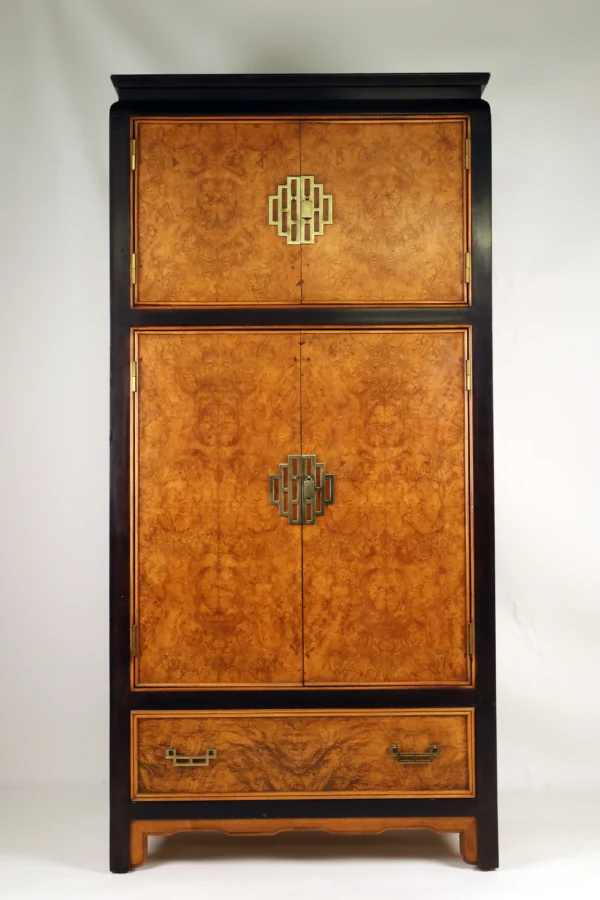
Art deco armoires and wardrobes bring a different character entirely. Contrasting veneers in walnut and maple, geometric inlay patterns, chrome or bakelite hardware, and the clean horizontal emphasis of the style make art deco wardrobes among the most visually distinctive vintage storage pieces available. A midcentury walnut wardrobe with original art deco details and working interior circa 1930 is a collectable piece that suits a contemporary bedroom without requiring any period framing from the surrounding furniture.
The interior of any antique wardrobe tells you as much as the exterior. Open the doors and pull out any drawers. The dovetail joints connecting the drawer sides should show the slight irregularities of hand cutting. The back panel, assembled from wide solid wood planks, should show the deep grey-brown oxidation of genuine age. The hinges should carry patina consistent with the rest of the piece.
Check the veneer on the doors carefully. Original hand-sawn veneer of three to five millimeters has a depth and surface variation that machine veneer does not. Where a chip has occurred at an edge, the depth of that loss tells you which era produced the piece. Paper-thin machine veneer identifies 19th century or later production regardless of the visual style.
The craftsmanship in the carving, where present, is equally telling. Hand-carved ornament on an 18th century French provincial armoire has slight variations in depth and line that mold-cast ornament never produces. The garlands, wheat sheaves, and rococo curves on a genuine provincial piece reward close examination in a way that reproduction carving does not.
Antiqueria Breitling has been sourcing and assessing antique wardrobes and armoires across European traditions since the 1990s, and the pieces in this collection reflect that accumulated knowledge. Global shipping is available on all pieces, handled through specialist fine art carriers experienced in moving large antique storage furniture safely.
If you are looking for a specific antique wardrobe or armoire, a particular period, wood, regional tradition, or interior configuration not currently listed, write to us at contact@antiqueria-breitling.com. The warehouse holds pieces not yet photographed or catalogued, and requests are often easier to fulfill than buyers expect.