Worldwide Insured Shipping
Hand-Restored in our Atelier
Professional Custom Crating

Worldwide Insured Shipping
Hand-Restored in our Atelier
Professional Custom Crating
In this collection cover the full range of European game furniture, from Georgian mahogany card tables with fold-over tops and baize-lined interiors to French tric-trac and bouillotte tables, Regency chess tables with inlaid tops, Biedermeier fold-out game tables in walnut and fruitwood, and Victorian compendium pieces combining chess and backgammon in a single piece of furniture. Each piece has been assessed individually for the integrity of the playing surface, the condition of the original mechanism, and the quality of the inlay work.
The antique game table occupies a distinctive position in the furniture market because it is both a decorative object and an actively usable piece. A Georgian card table or a French bouillotte table serves as a side table or accent table when closed and opens to provide an authentic playing surface for cards, chess, or backgammon during gatherings. That duality makes these pieces among the most practical antique furniture purchases available.
Dedicated game furniture emerged gradually from the late 17th century onward as European domestic life became more organized around specific activities. Before purpose-built game tables existed, boards for chess and backgammon were simply placed on whatever surface was convenient. As the specialized room replaced the great hall in prosperous households, furniture followed: card rooms, salons, and private libraries generated demand for tables designed specifically for the games played in them.
In France, tric-trac and bouillotte tables became fixtures of aristocratic salon culture. The bouillotte table, developed in the late 18th century for the card game of the same name, combined a marble top with a pierced brass gallery, drawers for counters and game pieces, and pull-out leather slides, creating a piece of furniture that was as much a social object as a gaming surface. In England, the card table evolved into a standard element of the Georgian drawing room, its fold-over top revealing a baize-lined interior with dished corner wells for candles and guinea wells for coins, reflecting the central role of gambling in Georgian social life.
Chess, with its long association with intellectual culture and elite sociability, generated its own furniture tradition. Voltaire and Napoleon frequented the Café de la Régence in Paris specifically for chess, and the desire to display refined taste through the game drove the commissioning of dedicated chess tables with inlaid board tops from the 18th century onward.
The antique card table is the most commonly encountered game table form on the market, and the quality of its fold-over mechanism is the primary condition indicator for any serious assessment.
Concertina-action card tables use an expanding hinged underframe that opens accordion-style when the top unfolds, providing a leg at each corner and excellent stability. These are generally considered the superior construction and are associated with the finest Georgian and Regency production. Gateleg card tables rely on one rear leg swinging out to support the opened top, a simpler mechanism that appears on quality examples but is generally considered less refined.
Georgian card tables in mahogany or walnut, with serpentine or D-shaped tops, carved cabriole legs, and rich veneers in the Chippendale tradition, are among the most sought-after forms. Later Sheraton and Hepplewhite influenced examples move toward straighter tapered legs with stringing and crossbanding, and the envelope card table, where the top unfolds in four triangular sections like an envelope, is a particularly elegant Regency variation.
Original baize on an antique card table is tightly woven, slightly faded, and secured with hand-tacked edges. Replaced baize is brighter, more uniform, and typically attached with modern adhesives. That distinction matters considerably for valuation, though honest documented restoration is preferable to deceptive refinishing.
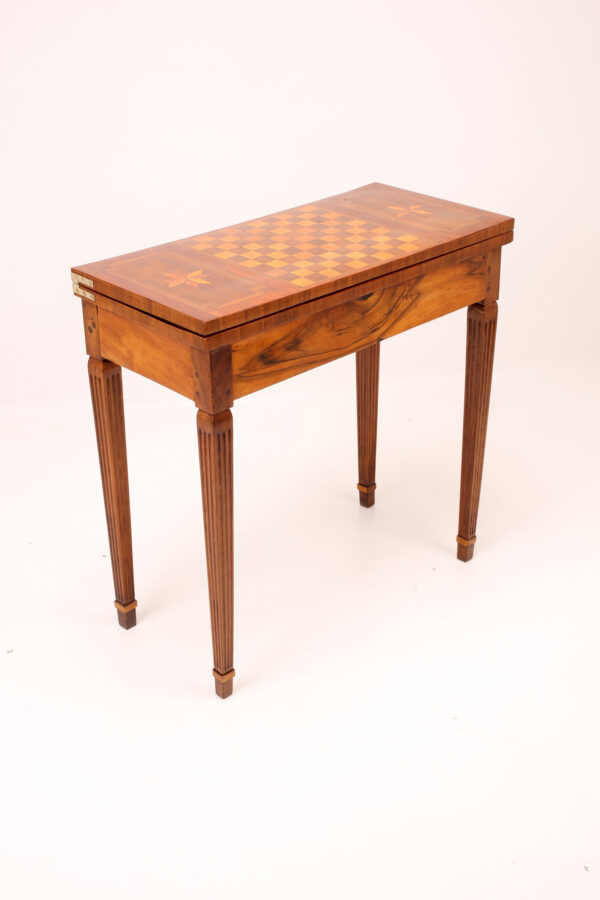
Chess tables as a distinct furniture form appear from the 18th century onward, typically presenting a fixed or removable inlaid board top in contrasting woods or materials, with drawers in the apron for the game pieces. The finest examples use ebony and boxwood for the chess board squares, occasionally with ivory or bone substituted for one color in luxury pieces. Regency and early 19th century chess tables in mahogany or rosewood with inlaid tops and sabre legs are among the more elegant forms available, and genuine period examples with their original inlay work intact are increasingly rare.
Many antique chess tables double as backgammon tables through a reversible or removable top mechanism, with a backgammon well recessed below and a drawer in the frieze for counters and dice. These chess and backgammon combination tables are among the more practical game table forms for contemporary use, offering a variety of games within a single compact piece of furniture.
Backgammon tables and burlwood backgammon tables in the Victorian and later traditions offer a different character. Heavy turned supports, rosewood or walnut veneers, and fitted interiors with original game pieces intact characterize the finest Victorian examples. Marquetry backgammon tables in the French tradition, with their tric-trac wells in contrasting inlaid wood or ivory, suit a more formal interior context.
Mahogany dominates the antique game table category across all major periods, and the quality of the mahogany used tells you immediately which level of the market a piece occupies.
A Regency mahogany games table with a fold-over top, sabre legs on brass castors, and a baize-lined interior is one of the most practically useful antique furniture purchases available. The proportions suit a contemporary interior, the mechanism is robust, and the warm depth of genuine old-growth mahogany has a quality that modern production cannot approach. A Regency card table in mahogany and rosewood with original crossbanding and stringing is a particularly refined combination.
Georgian mahogany card tables with concertina action, figured veneers, and the characteristic dished corner wells represent the high point of English game table production. The early 18th century examples with carved cabriole legs and pad or claw-and-ball feet suit a more traditionally furnished room, while the later Sheraton-influenced forms with their lighter tapered legs suit contemporary spaces considerably better.
Victorian game tables in mahogany, walnut, or rosewood with swivel tops revealing chess and backgammon surfaces, and checkers tables with inlaid tops, represent the mechanical ambition of the period applied to game furniture. The mahogany games table in the Victorian manner, with its substantial proportions and fitted interior, is a practical and handsome piece that suits a library or study.
The 20th century produced game tables of considerable quality and considerable variety, and the best examples from the Art Deco and mid-century modern periods are now genuinely collectable.
Art Deco game tables from the 1920s and 1930s bring the geometric aesthetic of the period to the game table form: contrasting veneers in walnut and burlwood, chrome fittings, and the clean horizontal emphasis of the style. A genuine Art Deco game table in burlwood or rosewood with an inlaid top and original chrome hardware is a striking piece that suits a contemporary interior without any period framing.
Mid-century modern game tables in teak or walnut with clean lines and simple fold-out mechanisms suit a Scandinavian-influenced interior with particular ease. These vintage game tables function naturally as side tables when not in use and provide a playing surface of genuine quality when opened.
Shop vintage game tables and authentic antique game tables are both represented in this collection, and the condition notes for each piece address the playing surface, the mechanism, and the hardware with the same detail applied to all pieces at Antiqueria Breitling. For related occasional table forms, the antique tables section covers side tables, console tables, and occasional tables from the same periods and traditions.
If you are looking for a specific antique game table, a particular game, mechanism, period, or wood not currently listed, write to us at contact@antiqueria-breitling.com. The warehouse holds pieces not yet photographed or catalogued, and requests are often easier to fulfill than buyers expect. Worldwide shipping available on all pieces.