There is a moment in the history of European furniture when collecting stopped being private hoarding and became a kind of theatre, and the antique vitrine is the piece that made it possible. A vitrine is a glazed display cabinet, its defining feature glass doors and often glazed sides, and the name comes straight from the old French for a pane of glass. Unlike the solid-door Kunstkammer cabinet that hid its treasures in darkness until someone opened it, the vitrine kept precious things safe behind glass while letting them be admired at every moment. At Antiqueria Breitling a fine vitrine is one of the most rewarding things to own, because it does two jobs at once: it protects a collection and it puts it on stage.
Why the Vitrine Needed Glass First
The whole history of the vitrine begins with glass, because for a long time clear glass was the expensive, limiting ingredient. In the seventeenth and early eighteenth centuries glass was made by the crown and cylinder methods, spinning or blowing molten glass into relatively small panes marked by ripples, faint striations, and the occasional bubble. Large flawless sheets were simply not economic, so early cabinetmakers had no choice but to divide a glazed door into a grid of small panes held by wooden glazing bars, the muntins or astragals that give early display cabinets their architectural rhythm.
As glassmaking improved across the century the bars grew finer and less obtrusive, and only with industrial plate glass and later float glass in the nineteenth and twentieth centuries could makers finally use large, uninterrupted sheets and let the bars vanish altogether. That progression is also a dating tool. Original hand-made crown or cylinder glass, with its gentle distortions and seeds, tells you a piece is early, where flat, sterile modern glass signals later replacement and quietly lowers value. The most demanding achievement of all was curved glass, hot-bent over a mould to follow a serpentine carcass, which is why an intact bowed pane on a later French vitrine is so prized.
The Forms the Vitrine Took
As collecting spread from aristocrats to the prosperous middle class, the vitrine diversified to suit different rooms and different collections. The upright single-door vitrine is tall and narrow, often with glazed sides to let in light, made to stand in an alcove or between windows for a vertical display. The breakfront vitrine is monumental, its central section projecting past the wings beneath an architectural pediment, the centrepiece of a grand dining room or library. The vitrine on stand lifts a glazed display case onto legs so that small, delicate objects sit at eye level while the piece stays visually light.
There are smaller and cleverer forms too. The table vitrine, or bijouterie, is a low glazed-topped table lined with silk or velvet, made so guests can look down into a collection of jewellery, snuffboxes, or miniatures. The corner vitrine nestles into the angle of a room to soften it and win display space in a smaller parlour. And the hybrid form, a glazed upper section resting on a cupboard, chest, or bombé base, offers the practical duality of hidden storage below and theatrical display above. The interior fittings matter as well, whether the shelves are wood or glass, and whether the back is mirrored to bounce light through the objects.
From the Baroque to Neoclassical Refinement
The earliest glazed cabinets, from the late seventeenth and early eighteenth centuries, were heavy and architectural, built in dark walnut, oak, and ebony with bold cornices and bun feet. As Europe fell in love with imported Asian porcelain, the Dutch display cabinet became a dominant form, typically a sculptural bombé lower chest covered in floral marquetry beneath a multi-paned glazed top. In England, Chippendale codified the porcelain cabinet in his 1754 Director, publishing monumental mahogany china cases with pagoda crestings, blind fretwork, and elaborate glazing bars.
It was France, though, that pushed the vitrine to its highest refinement, largely through the marchands-merciers, the luxury dealers who coordinated cabinetmakers, joiners, and bronze casters into new forms. The eighteenth-century French vitrine became a vehicle for spectacular surface decoration, including the brilliant imitation lacquer known as Vernis Martin, painted in luminous chinoiserie scenes directly onto curved carcasses, while in Italy craftsmen pursued a related effect with Arte Povera, gluing cut printed engravings to the surface and sealing them under yellowish varnish. When the Rococo gave way to Louis XVI Neoclassicism, the vitrine straightened out into clean lines, fluted tapering legs like classical columns, and restrained symmetrical gilt-bronze, often in mahogany with geometric parquetry.
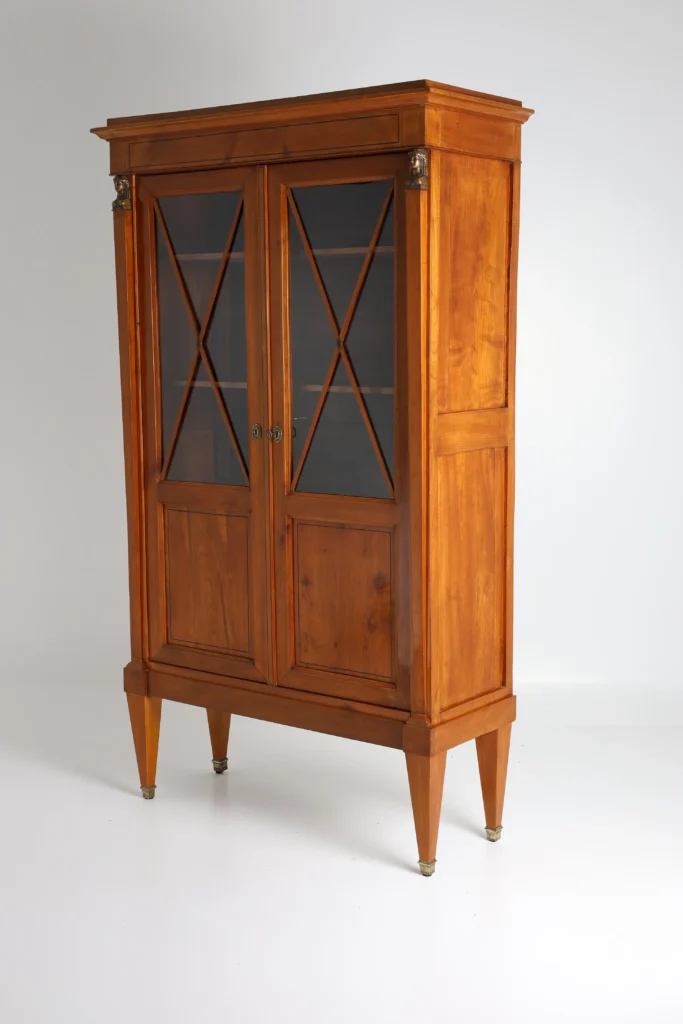
A cherrywood neoclassical display cabinet from the second half of the nineteenth century shows how long and how beautifully that neoclassical language survived. Built in warm, figured cherrywood with a naturally developed patina, its upper section carries a pair of glazed doors with delicate geometric glazing bars forming a striking crossed motif, ideal for presenting books, ceramics, or objects on the shelved interior, while panelled doors below give discreet storage. The form is architectural and clean, framed by classical detailing with decorative mounts at the upper corners, and it stands on slender tapered legs finished with brass-capped feet that lend it a light, sophisticated presence. It is exactly the kind of glazed cabinet that bridges the period and the contemporary interior with ease.
Empire Grandeur and Biedermeier Intimacy
The early nineteenth century split European design into two opposed philosophies, and the vitrines of the age capture the divide perfectly. In Napoleonic France the Empire vitrine became an instrument of state grandeur, a severe architectural block in dark Cuban mahogany serving as a backdrop for heavy fire-gilded bronze in militaristic and classical motifs, sphinxes, eagles, laurel, and caryatids, connecting the new regime visually to ancient Rome and Egypt.
In the German-speaking states the same years produced the opposite mood. Under Metternich’s conservative order the middle class withdrew into the warmth and privacy of the home, and the Biedermeier vitrine answered with calm instead of display. Makers stripped away the ormolu and dark mahogany, building on a stable softwood carcass covered in thick hand-sawn veneers of pale native fruitwoods, cherry, walnut, birch, pear, and maple, and let beauty come from the wood itself through careful bookmatching, with contrast supplied only by sparse ebonized detail and simple brass escutcheons. Regional character was pronounced: Viennese vitrines from the Danhauser circle favoured gentle convex fronts and organic warmth, Berlin and North German pieces under Schinkel’s influence were harder-edged and more architectural, and Munich makers pushed minimalism so far they sometimes replaced even the brass escutcheon with a flush wooden lozenge. Behind that quiet glass, families displayed their own curated autobiographies, their Ranftbecher glasses, their porcelain, their botanical specimens, a portrait of an educated and rational household rather than aristocratic excess.
The Ebonized Biedermeier Vitrine
Among Biedermeier vitrines, the fully ebonized example is the rare and dramatic exception, and it deserves its own moment. Ebonizing is the technique of staining and finishing a fine native wood so that it reads as deep black, an old way of achieving the look of costly ebony without solid ebony itself, and on a Biedermeier piece the result is startlingly graphic against the period’s usual pale fruitwood. The great majority of Biedermeier relied on light figured veneer, so a piece where the whole surface is black was always a minority, which is exactly why collectors and decorators prize it now.
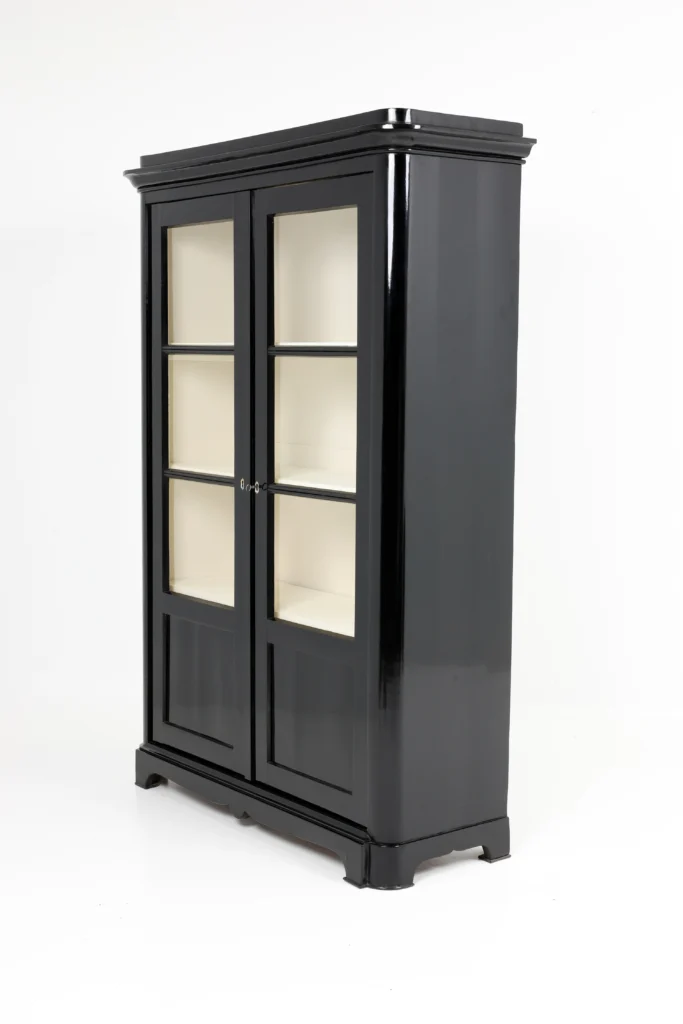
This rare ebonised Late Biedermeier display cabinet, circa 1835, is a fine example of that exception. Its deep black ebonised surface sets up a striking contrast with the light-coloured interior, so that anything placed inside seems to float against the pale ground, and the architecture is pure Late Biedermeier: a pair of glazed doors divided by delicate muntins, panelled sections below, gently rounded front corners, a subtly moulded cornice, and softly shaped bracket feet. The clean lines and the near-total absence of ornament are the whole point, letting proportion and surface do the work. Professionally restored with respect for its character, it has a quiet, almost modern presence that suits a contemporary room as naturally as a period one, and as ebonised Biedermeier is considerably rarer than the familiar cherry or walnut, it is an especially desirable piece. It also shows how close the Biedermeier vitrine can sit to the rest of the period’s output, which is why it belongs in the wider story of Biedermeier furniture rather than apart from it.
Revival, Curved Glass, and the Master Ébénistes
The second half of the nineteenth century, through the Louis Philippe, Napoleon III, and Belle Époque years, brought an era of eclectic historicism in which the industrial bourgeoisie wanted the aristocratic styles of the old regime. The French vitrine was reborn, and the master ébénistes produced revival pieces of a quality that frequently rivalled their eighteenth-century models. Paul Sormani, working in Paris from 1847 and patronised by Empress Eugénie, became the great Napoleon III cabinetmaker, famous for the crispness of his bronzes. François Linke triumphed at the 1900 Paris Exposition with extravagant curved-glass vitrines that fused Rococo line with Art Nouveau movement. The Beurdeley dynasty supplied exact, superbly cast copies of royal models to clients as grand as the Vanderbilts, and Henry Dasson, trained as a bronze sculptor, made vitrines celebrated for the sharpness of their gilt-bronze. These late vitrines often used technically demanding curved glass to follow the serpentine Louis XV line, turning the cabinet into a jewel-like enclosure for porcelain, Sèvres plaques, and silver.
How to Read a Genuine Antique Vitrine
Authenticating a vitrine starts, fittingly, with the glass. Period glass shows ripples, tiny seeds, and an uneven refraction that catches the light, where modern float glass is flat and sterile, and on a curved-glass vitrine an original bowed pane is especially valuable because replacing it is so difficult and expensive. From there the examination follows the same logic as any fine case piece. The secondary woods point to origin, oak in French and English work, pine or spruce in Biedermeier and German furniture, and you want hand-cut dovetails, naturally oxidised back panels, and veneer of honest thickness rather than the paper-thin machine-cut veneer of later production. The gilt-bronze mounts should read as period fire-gilding, warm, deep, and crisply hand-chased, not the thin uniform brightness of electroplating, and a French bronze may even carry the crowned C tax mark used between 1745 and 1749. Where guild marks survive, the maker’s estampille and the JME stamp settle attribution, and on later pieces makers like Linke and Sormani often signed the lockplate or stamped the bronze. The condition issues specific to vitrines are worth checking too: replaced glass, cracked or repaired panes, replaced shelves, and restored mounts all matter, and on a Biedermeier vitrine in particular the intact original surface and bookmatched veneer are everything, because the whole effect depends on the uninterrupted wood. Every vitrine that comes through Antiqueria Breitling is assessed against exactly these markers before it is offered.
The Vitrine in the Modern Room
In a contemporary interior the vitrine does precisely what it has always done, only now it also brings a note of vertical architecture and historical depth into a modern space. Designers like it because the glass keeps a tall cabinet from feeling heavy, reflecting light rather than blocking it, and the collector uses it exactly as collectors did three centuries ago, to organise, protect, and show a collection of ceramics, glass, books, or objects. The market is selective and rewards the right things: provenance, the originality of the glass, intact original fire-gilding, and the purity of the cabinetwork, with fine signed French vitrines and unstripped Biedermeier examples with original patina at the top. If you are drawn to the idea of furniture that turns a collection into theatre, our antique vitrines are the best place to start, and you are welcome to write to us at contact@antiqueria-breitling.com for pieces not yet listed, with worldwide insured shipping on everything we offer.