


Before electricity, a large mirror was one of the most expensive objects a household could own. Not for vanity. For light.
Before the Mirror Was Commonplace — Light, Status and the Pier Glass
In a world lit by candles and fireplaces, a large reflective surface was not a luxury in the modern sense of the word. It was a technology. The pier glass, a tall mirror designed to hang on the narrow section of wall between two windows, was invented specifically to amplify candlelight. Candles placed on sconces directly in front of the glass would bounce their light deep into the dark corners of a room, doubling the effective illumination of a space that would otherwise have remained in shadow.
Before the 19th century, manufacturing large panes of flat, clear glass was extraordinarily difficult. The technical constraints of the glassmakers’ craft meant that a substantial mirror required exceptional skill to produce and exceptional wealth to acquire. In a grand 18th century interior, a tall giltwood mirror was a declaration of status as direct as any painting or piece of silver, and considerably more expensive than either.
That combination of functional necessity and social meaning gave the antique mirror a complexity that purely decorative objects rarely achieve. Understanding that history changes how you look at the pieces themselves.
Rococo Giltwood Mirrors — French Extravagance and the Art of the Asymmetrical Frame
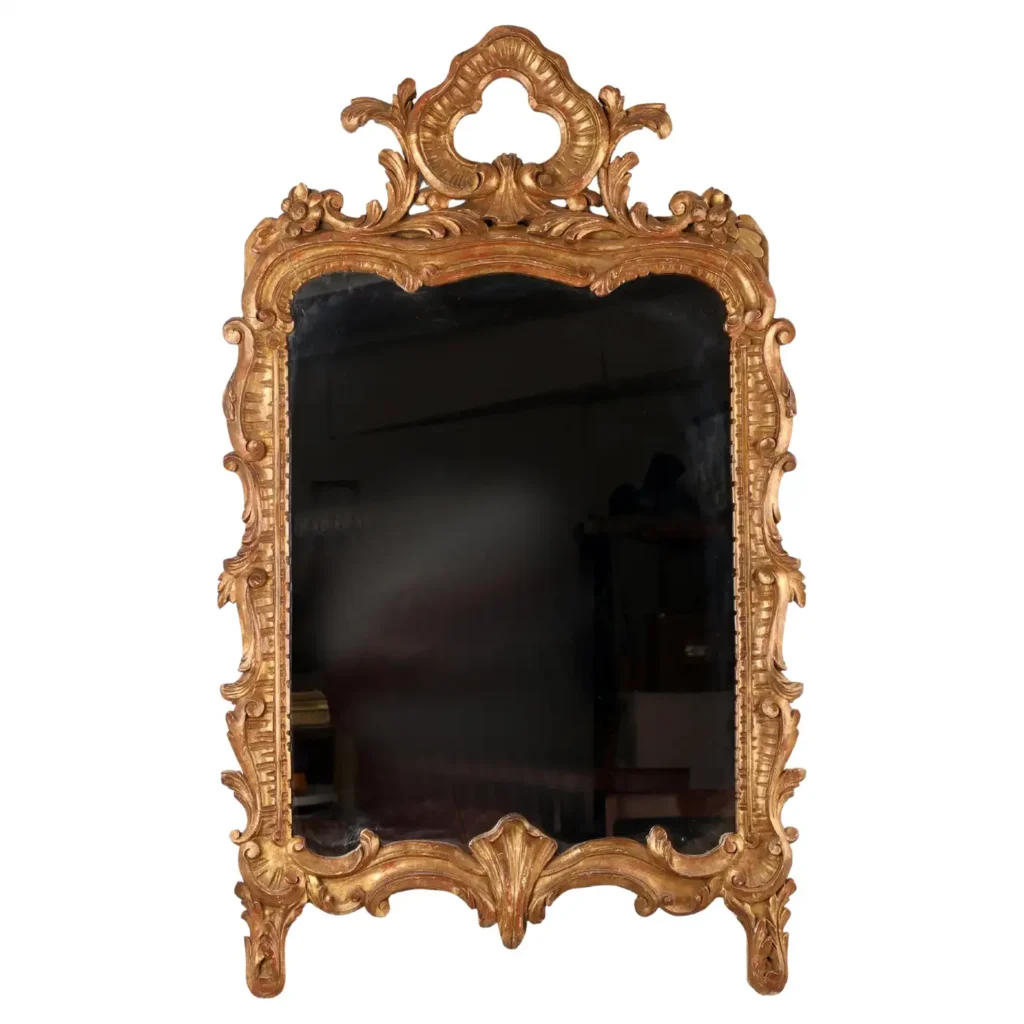
The Rococo mirror is the most immediately recognizable form in the category, and the most copied. Nothing in the subsequent history of mirror design has matched the inventive energy of the French giltwood frames produced during the reign of Louis XV, roughly 1730 to 1770, and the best originals remain among the most sought-after pieces in the antique mirrors collection.
What defines the Rococo frame is its rejection of the strict bilateral symmetry that the Baroque had demanded. A great Rococo mirror frame is deliberately asymmetrical, with C and S scrolls that cascade differently on each side, floral garlands that trail and curl in ways that no mathematical formula could predict, and rocaille motifs drawn from natural forms: rocks, broken shells, and the organic textures of the natural world. The carver’s hand is everywhere visible, and the slight irregularities between left and right are not mistakes but evidence of the process.
These frames were carved from solid pine or oak, then built up with gesso, a thick mixture of calcium carbonate and rabbit-skin glue, to create a surface smooth enough for gilding. The gilding itself, applied as microscopically thin sheets of 22-karat gold leaf, was laid over a colored clay base called bole, typically red or brown. Where the gold wears away over centuries on the raised high points of the carving, the warm clay beneath shows through. That transition from gold to bole is one of the most reliable indicators of genuine water gilding, and one of the most beautiful effects in antique furniture.
The trumeau mirror is a related French form worth knowing. Taller than a standard wall mirror, the trumeau features a painted or carved wooden panel above the glass, typically showing a pastoral scene, architectural view, or allegorical figure. These were designed as complete interior elements for the paneled rooms of French hôtels particuliers, and original examples in good condition are increasingly difficult to source.
Georgian and Neoclassical Mirrors — Restraint, Symmetry and Robert Adam
The English response to Rococo exuberance was characteristic. Where French designers reveled in asymmetry and organic ornament, English Georgian mirror makers returned to symmetry, architectural discipline, and classical reference. The influence of Robert Adam, who drew directly on the archaeological discoveries at Pompeii for his decorative vocabulary, produced mirrors of considerable elegance and restraint.
A Georgian neoclassical mirror typically features a rectangular frame with a pediment at the top, carved with laurel wreaths, urns, and fluted column details. A carved eagle at the crest appears frequently, particularly in Regency period examples where the bird becomes almost heraldic in its treatment. The overall effect is of a piece designed to complement an architectural interior rather than dominate it.
Regency mirrors extend the vocabulary in interesting directions. The oval mirror and the circular convex mirror with its gilt frame and distinctive eagle or sunburst crest are characteristic Regency forms that work in contemporary interiors with particular ease. Sunburst and starburst designs, with their radiating gilt rays, bring a graphic quality to the Regency tradition that suits both period and modern rooms. Faux bamboo frames appeared in the Regency period as part of the broader fashion for chinoiserie, and original examples in this manner are among the more unusual pieces available in 18th century antique furniture.
Beveled glass edges became standard during the Georgian period, adding visual weight and a jewel-like quality to the glass itself that flat-edged panes do not provide.
The Venetian Tradition — When the Frame Is Made of Glass
The Venetian mirror occupies a completely separate tradition from every other form discussed here. The glassmakers of Murano, working within a guild tradition that had dominated European glassmaking for centuries, developed a mirror form in which the frame itself is constructed from glass rather than wood.
Venetian frames are assembled from meticulously cut, beveled, and etched glass pieces arranged around the central mirror plate. Floral engravings on the glass panels, mythological figures, and multicolored glass paste rosettes held together by delicate wire constructions create frames of extraordinary intricacy. There is no gesso, no gilding, no carved wood beneath. The entire decorative effect comes from the material itself.
The result is unlike any other mirror in the European tradition. Light passes through the frame rather than reflecting off it, which gives a Venetian mirror a quality that is genuinely difficult to describe in words and immediately apparent in a room. Original Venetian mirrors from the 18th and early 19th centuries are among the most collectible pieces in [link: French antique furniture] and the broader European decorative arts market, partly because the technique requires skills that have largely disappeared and partly because no reproduction has convincingly replicated the quality of the originals.
Empire Mirrors — Napoleon’s Reflection
Napoleon Bonaparte understood that the objects in a room communicate power, and the Empire mirrors produced by his court architects Charles Percier and Pierre-François-Léonard Fontaine were designed with that understanding at their core.
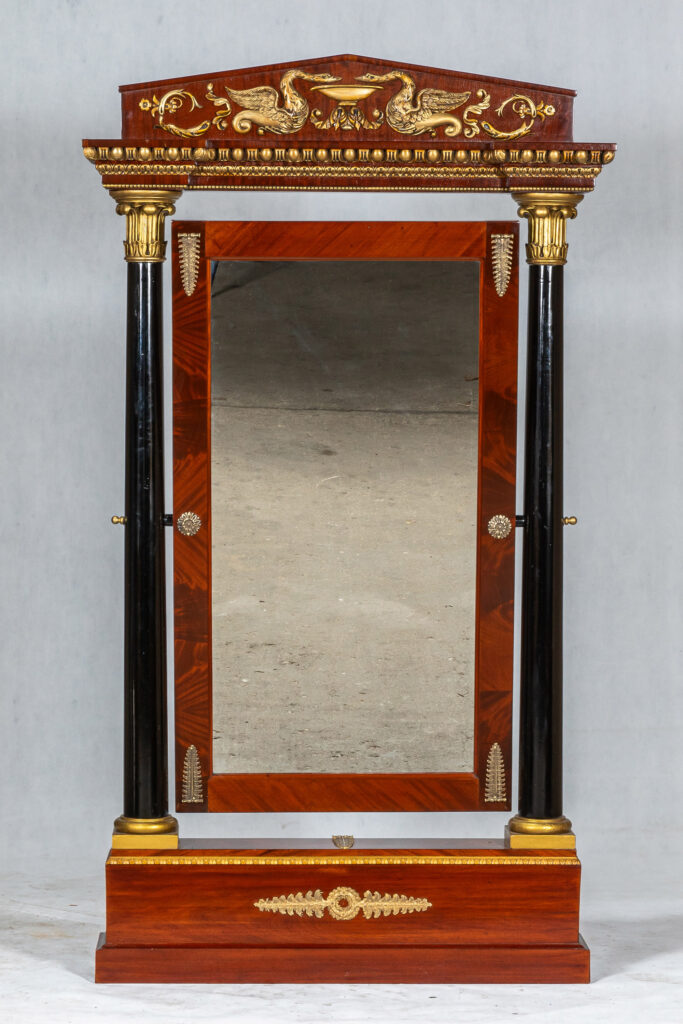
An Empire mirror is monumental in scale, severe in its geometry, and entirely uninterested in domestic warmth. The frames rely on broad flat surfaces in dark mahogany, heavy carved columns or caryatids at the sides, and ormolu mounts of deliberate symbolic content. Napoleonic eagles appear at the crest. Egyptian sphinxes, referencing the campaigns in Egypt, flank the glass. Laurel wreaths of victory, the letter N, and classical deities complete a visual program that leaves no room for ambiguity about what the mirror is meant to communicate.
Empire overmantel mirrors were designed to command the rooms they occupied, and they do. The [link: Empire furniture] tradition produces pieces that work in contemporary interiors precisely because their scale and authority create an immediate focal point that modern mirrors cannot generate. Placed above a fireplace in a room with otherwise restrained furnishings, a large Empire mirror does not compete with anything. It simply ends the visual conversation.
Biedermeier Mirrors — Simplicity as a Design Statement
The Biedermeier mirror arrived as a direct rejection of everything the Empire mirror represented, and the contrast between the two traditions is one of the most instructive in the history of decorative arts.
After Napoleon’s defeat and the political settlement of 1815, the urban middle class of Central Europe withdrew from public life and invested their energy in the domestic interior. The Biedermeier furniture collection that emerged from this period has a warmth and an honesty of material that the Empire style never attempted.
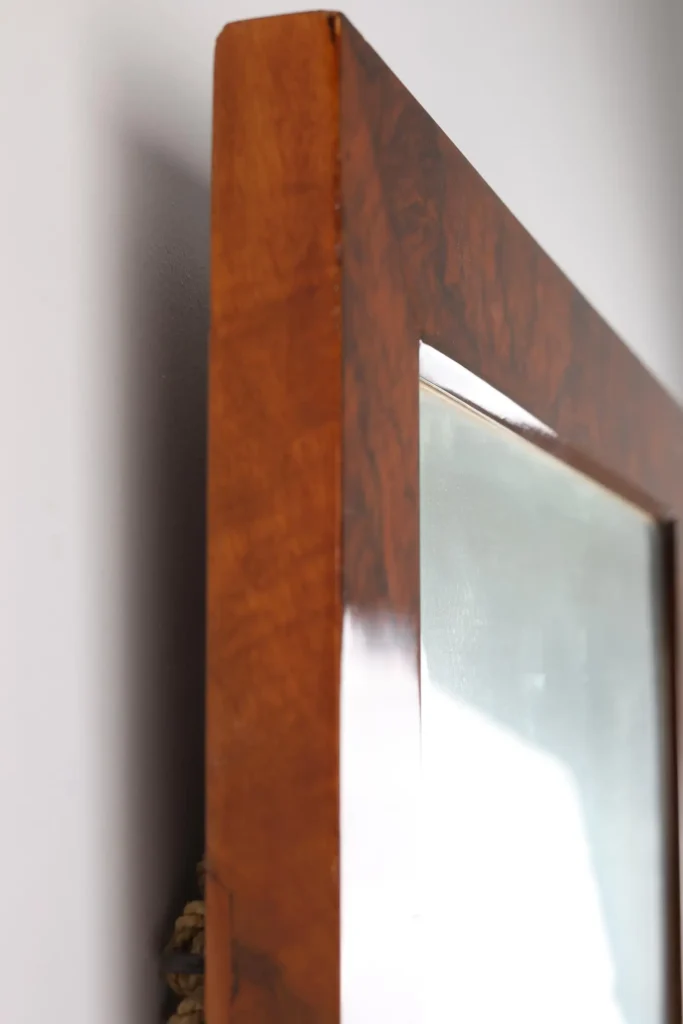
Biedermeier mirrors are built from native fruitwoods, cherry, walnut, birch, and pear, selected for the figure and warmth of their grain rather than for prestige. The book-matching technique, applied to the veneer panels of the frame, makes the wood grain itself the primary decorative element. Heavy ormolu mounts are entirely absent. Where contrast is needed, ebonized wooden columns or thin black inlay lines provide a geometric counterpoint to the pale veneer without any applied metal.
The result is a mirror that is sleek, gracefully curved or geometrically pure depending on the regional tradition, and designed to bring light and warmth into a comfortable room rather than to intimidate the person standing in front of it. Viennese Biedermeier examples in cherry with their characteristic soft curves are the most refined. German examples are more architectural. Scandinavian Karl Johan mirrors in pale Karelian birch are the most spare, anticipating a design language that became internationally recognized a century later.
How to Authenticate an Antique Mirror — Glass, Gilding and the Gesso Test
The most reliable authentication indicators for an antique mirror are in the glass, the gilding, and the back of the frame, in roughly that order.
The glass tells you the most. Before 1835, mirror glass was backed with a tin-mercury amalgam, a highly toxic process that produced a reflective surface with a slightly cool, bluish quality. Over centuries, mercury glass degrades organically, developing characteristic clouding, crystalline effects, and dark irregular spots concentrated near the bottom where moisture accumulates. Post-1835, German chemist Justus von Liebig’s silver nitrate process replaced mercury. Silver-backed glass reflects more light and tarnishes to a warm yellow-brown tone rather than the cooler grey spots of mercury glass.
The paper test is a practical way to distinguish the two. Place a thin white piece of paper against the mirror surface. Over a silver-backed mirror the paper appears noticeably brighter. Over mercury glass the effect is less pronounced. Combined with the characteristic waviness of crown glass, which shows concentric ripples and occasional bullseye marks from the blowing process, or cylinder glass with its parallel undulating distortion, the glass alone can confirm or challenge a mirror’s claimed age. Perfectly flat, optically clear float glass in an antique frame is a reproduction.
The gilding requires equally careful attention. Water-gilded frames, built up over gesso and bole clay, show genuine gold leaf on the recessed areas and warm red or brown clay where the gold has worn through on the raised high points. Genuine gold does not tarnish. Bronze paint and brass alloy reproductions oxidize to a dull brownish-green and show visible brushstrokes under examination.
The back of the frame settles remaining questions. Solid oxidized wood planks, hand-planed with their characteristic subtle ridges, and no modern fixings confirm a genuine piece. Cast resin reproductions, increasingly sophisticated in their surface detail, are identifiable by their weight, their lack of carved depth in the recesses, and the faint straight mould seam lines that hand carving never produces.
Antique Mirrors in Modern Interiors
Antique mirrors are among the most versatile pieces in the 19th century decorative arts category, compatible with a wider range of contemporary interiors than almost any other antique form. A large Rococo giltwood mirror in a room with white walls and minimal modern furniture creates a visual tension that no mass-produced contemporary mirror approaches. The complexity of the carving demands examination in a way that simple reflective surfaces do not, and the worn gilding and mercury spots that earlier generations might have considered flaws are now read as evidence of history.
The Neo-Baroque minimalism trend that has driven interior design in 2025 and 2026 relies heavily on exactly this dynamic. A single large giltwood antique mirrors piece as the focal point of an otherwise restrained room is one of the most effective design moves available, and the antique market has responded accordingly.
Biedermeier mirrors, by contrast, suit smaller contemporary spaces and Scandinavian-influenced interiors where the light wood tones and clean geometry read as entirely current rather than period-specific. Both traditions have their place, and both are considerably easier to live with than the period rooms they originally furnished.
Explore Our Collection
The antique mirrors in this collection cover the full range described above, from Rococo giltwood frames and trumeau mirrors to Regency convex pieces, Empire overmantel mirrors, and Biedermeier framed examples in cherry and walnut. For related decorative pieces from the same periods, French antique furniture covers the broader French tradition, and the category of antique furniture from the 18th and 19th centuries includes complementary pieces that work naturally alongside a significant mirror in a considered interior.

