


Before 1815, furniture stood against walls. The Biedermeier period moved it to the center of the room, and in doing so invented a new way of living that required an entirely new category of furniture.
Why the 19th century Biedermeier Side Table Changed How Europe Lived
The concept that drove this shift had a name: Wohninsel, the living island. Instead of arranging furniture formally along the perimeter of a room for ceremonial effect, the urban middle class of Central Europe began grouping chairs, sofas, and small tables together in the center of the room or in intimate corners, creating clusters designed for conversation, hobbies, and shared domestic life.
The political conditions that produced this shift are worth understanding. Under Klemens von Metternich’s system of censorship and political repression, the bourgeoisie had no real public sphere to occupy. Intellectual life, social life, and cultural life all retreated into the private home. Letter writing required a proper writing surface. Sewing and embroidery needed a table of the right height with storage for materials. Musical evenings and card games demanded furniture that could be moved, folded, and repurposed. The Biedermeier side table was not a luxury. It was a direct response to how people actually lived.
This was also the first furniture movement in European history created specifically by and for the middle class rather than dictated by royal courts or aristocratic taste. The pieces that emerged from it reflect that origin in every decision about scale, material, and function.

The Design Language of Biedermeier Side Tables — Clean Lines, Warm Wood and the End of Bronze
The Biedermeier side table is a direct refusal of everything the Empire style had celebrated. Where Empire used dark imported mahogany, heavy gilt bronze ormolu mounts, and the symbolic vocabulary of Roman and Egyptian power, Biedermeier stripped all of that away and started from the wood itself.
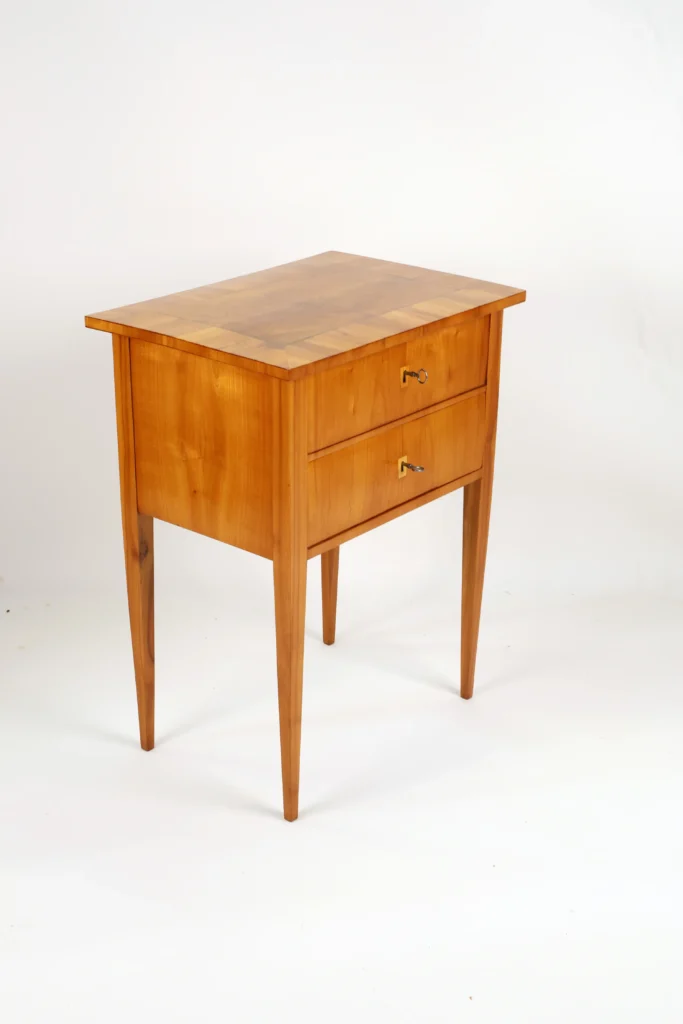
Native European fruitwoods replaced imported exotics. Cherry, walnut, birch, ash, and pear were selected for the warmth and figure of their grain rather than for prestige. The bookmatching technique, laying consecutive veneer slices as mirror images across the table surface, made the grain the primary decorative element. A well-chosen walnut veneer on a Germany circa 1820 side table, with its flame pattern running symmetrically across the top, is more visually compelling than any applied ornament.
Ebonized wooden details, thin columns, keyhole escutcheons, structural accents in black-stained wood, provided contrast without metal. The pedestal column on a tripod base and the sabre leg on a small rectangular top are the two most characteristic structural forms, both reflecting the neoclassical influence that Biedermeier absorbed and then simplified.
The finish on authentic pieces is shellac or traditional French polish, applied by hand and built up over multiple coats. Circa 1825 Austrian examples in cherrywood with their original shellac surface intact develop a warm, deep patina over centuries that modern synthetic varnishes cannot replicate and that tells you immediately you are looking at an original piece.
The Remarkable Typology — Sewing Tables, Globe Tables and Game Tables
The variety of Biedermeier side table forms reflects the variety of domestic life they were designed to serve, and some of these forms are extraordinary pieces of furniture by any standard.
The sewing table, known in German as the Nähtisch, is among the most common Biedermeier forms and among the most considered. A hinged lid lifts to reveal a fitted interior with compartments for fabrics, threads, and needles, organized with the same precision that a cabinetmaker would apply to a secretary desk. These were not afterthoughts. The domestic work they supported was taken seriously, and the furniture reflects that.
The game table with its fold-out top solved the space problem of a modest bourgeois home with considerable ingenuity. Closed, it reads as a simple side table. Open, it provides a proper playing surface for cards or chess. The fold-out mechanism in original examples is typically smooth and precise, which is one of the things to check when assessing condition.
The Globustisch is in a category of its own. The globe table, produced primarily in Viennese workshops, is constructed to resemble a large terrestrial globe resting on a neoclassical tripod support. The top half of the wooden sphere rotates upward on a hinge to reveal a fitted interior of hidden compartments, designed for sewing materials or writing implements. The engineering required to make a hollow sphere from veneered wood, hinge it precisely, and fit it with a functional interior while maintaining the visual illusion of a globe is remarkable. These pieces are considered masterworks of Biedermeier cabinetmaking and are among the most collectible forms in the Biedermeier furniture collection.
The flower stand, or Blumenständer, is a simpler but equally characteristic form. A pedestal table designed specifically to hold a floral arrangement, it reflects the period’s deep interest in bringing natural beauty into the domestic interior. The circular pedestal table in its various sizes is the most common Biedermeier form overall, and the quality of these pieces ranges from simple workshop production to exceptional examples with marquetry tops and elegant column details.
Austrian, German and Swedish Biedermeier Side Tables — Three Regional Traditions
The Biedermeier style spread across Central Europe and into Scandinavia, and each regional tradition adapted it in ways that reflect local materials, workshop practices, and cultural sensibility.
Viennese Biedermeier is the most refined expression of the form. The workshops of Vienna produced side tables of poetic softness and grace, favoring cherry and walnut with curves that give even a small table a sense of movement. The most intricate mechanical forms, including the Globustisch, came primarily from Viennese cabinetmakers who combined exceptional technical skill with an appetite for ingenious design. Early 19th century Austrian antique Biedermeier pieces, particularly those dating to around 1820 and around 1825, are among the most sought-after in the category.
German Biedermeier from Berlin and Munich is more architectural in character. The influence of Karl Friedrich Schinkel’s neoclassicism is visible in the stronger proportions, straighter lines, and darker veneers that distinguish 19th century German antique Biedermeier side tables from their Viennese counterparts. A table from southern Germany around 1820 in walnut with clean architectural lines and ebonized column supports has a solidity and presence that suits a different kind of interior from the lighter Viennese pieces. Both traditions are represented in the [link: antique side tables] category.
Scandinavian Biedermeier, the Karl Johan style named after the Swedish king of the period, takes the lightness of the Austrian tradition and extends it further. Tables in pale Karelian birch, with its characteristic flame pattern, have a visual airiness that suits contemporary Scandinavian-influenced interiors with particular ease. Late 19th century Swedish antique revival pieces exist and are worth distinguishing from the earlier originals, which have a refinement of proportion that the later production does not always match.
How to Identify an Authentic Antique Biedermeier Side Tables
Authentication begins with the veneer. Original Biedermeier veneer was sawn by hand, producing slices of three to five millimeters. The visual depth and warmth of sawn veneer, with its slight surface variation, is immediately different from the paper-thin rotary veneer of the revival period, which is flatter and more repetitive in its grain pattern.
Check the underside of the table and the inside of any drawer. Hand-planed surfaces show subtle parallel undulations, the physical trace of the tool that smoothed the timber. Machine-sanded boards are perfectly flat. Hand-cut dovetails on drawer construction show slight irregularities in spacing and depth, with faint scribe lines from the marking gauge visible in the corners of the joint. Machine-cut dovetails are mathematically uniform.
The finish is equally telling. Original shellac or French polish develops a warm, amber depth over two centuries that no modern varnish replicates. Run a finger across the surface of an authentic piece and the quality of that finish is immediately apparent. A synthetic varnish, even a well-applied one, has a different surface tension and a cooler, less organic appearance.
Condition and provenance both matter significantly for valuation. A walnut veneer side table in original condition with its shellac finish intact, original hardware, and documented history is worth considerably more than a comparable piece that has been refinished or had its hardware replaced. The secondary woods, the structural timber beneath the veneer on the underside and back, should show consistent oxidation appropriate to their age, a deep grey-brown that develops over decades of exposure and cannot be artificially replicated convincingly.
Rosewood appears occasionally on luxury examples, particularly in the early production around 1820, and its presence on a well-documented piece adds to its interest.
Vintage Biedermeier Side Tables on the Modern Market — What Collectors Look For
The market for antique and vintage Biedermeier side tables in 2025 and 2026 reflects two distinct buyer groups, and understanding both helps explain why prices for the best pieces have remained consistently strong.
Serious collectors focus on the rare mechanical forms, the Globustisch above all, followed by well-documented sewing tables with intact compartments and game tables with functioning fold-out mechanisms. For these buyers, the integrity of the original veneer, the preservation of the shellac patina, and the presence of unaltered hand-cut joinery are the primary considerations. A piece that has survived two centuries without aggressive restoration is worth significantly more than one that has been stripped and refinished, regardless of how clean the result looks.
Interior design buyers approach the category differently, looking for antique Biedermeier furniture for sale that integrates naturally into contemporary spaces. Biedermeier side tables are among the most compatible antique pieces with modern interiors precisely because their clean geometry, light wood tones, and modest scale work alongside Mid-Century Modern and contemporary Scandinavian furniture without visual conflict. A cherrywood pedestal table from around 1830 beside a contemporary sofa looks entirely deliberate.
Both buyer groups are increasingly drawn from younger demographics. Millennial and Gen Z buyers who reject fast furniture in favor of pieces with genuine history and material quality have found Biedermeier side tables to be a natural fit for their priorities. The handcraft, the authentic period construction, and the sustainability argument for buying furniture that has already lasted two centuries all resonate with a generation that thinks carefully about what it brings into its home.
For vintage Biedermeier pieces in the revival tradition, made from the 1870s onward, the same forms exist at more accessible price points. Knowing the difference, primarily through veneer thickness and joinery inspection, allows a buyer to make an informed decision rather than paying original prices for later production.
Explore Our Collection 19th century german antique biedermeier
The 19th century furniture section at Antiqueria Breitling includes Biedermeier side tables from Austrian, German, and Scandinavian workshops, each assessed for veneer integrity, original finish, and construction quality. For the broader Biedermeier tradition, the Austrian Biedermeier collection covers related pieces from the Viennese workshops that produced the most refined examples of the period.

