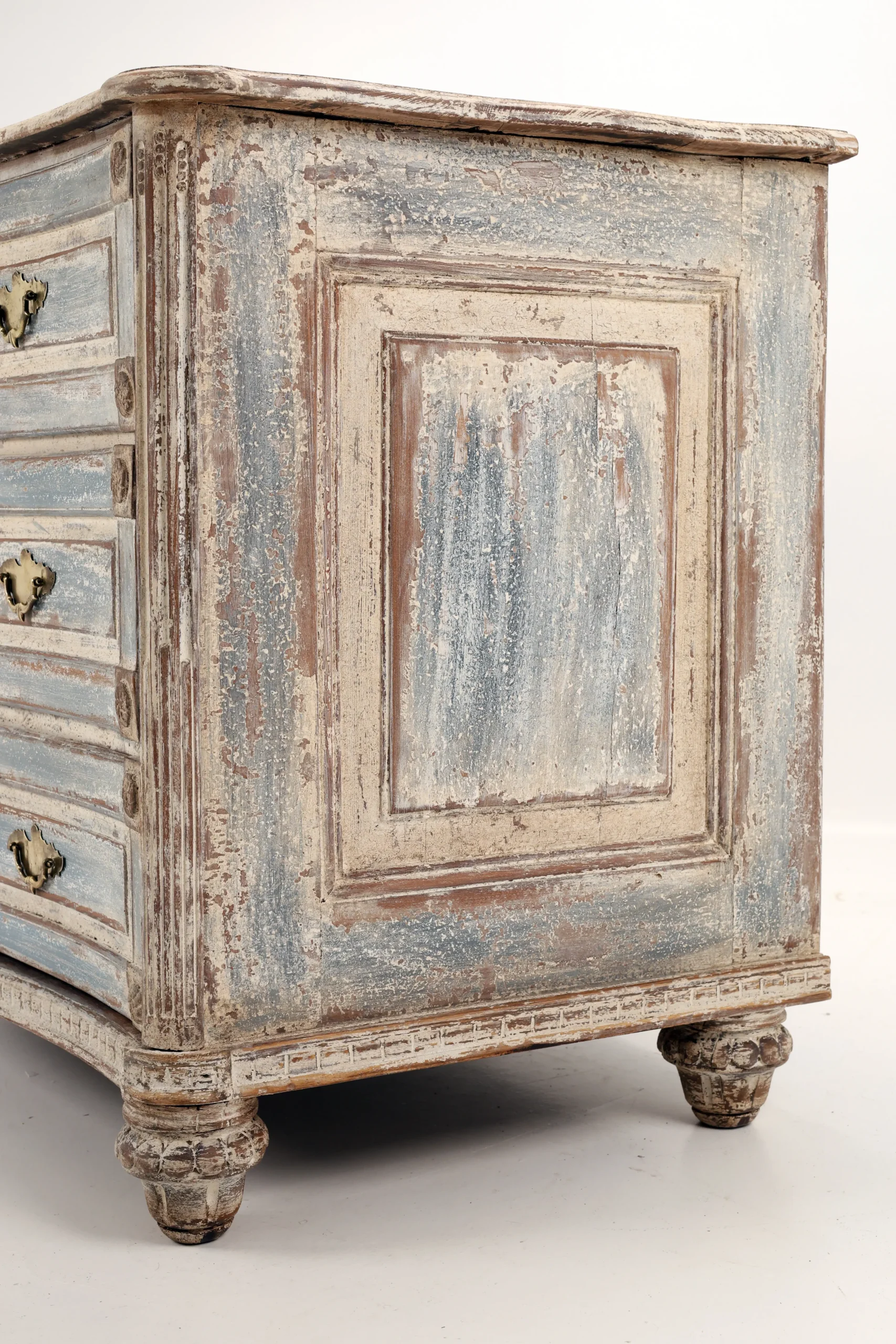
Most furniture is made to be seen from every side. A console table is not. It was built to stand against a wall, finished beautifully at the front and left plain at the back, conceived as part of the architecture of the room rather than as a free object within it. The Biedermeier console table is the most architectural form of the entire Biedermeier interior, the piece that completed the wall, gathered the light, and gave the bourgeois room its rhythm. And of all its variations, the cherrywood demilune, the elegant half-moon, is the most refined and the most collectible, especially when it survives, as it sometimes does, as an original matched pair. At Antiqueria Breitling, these are among the most rewarding Biedermeier pieces we handle, because they do something no other form quite does: they finish a room.
What a Console Table Really Is
The word console comes from architecture, where a console is a load-bearing bracket or corbel projecting from a wall to carry a cornice, a balcony, or a bust. In furniture, the console table kept that logic. It is a piece anchored to the wall, finished at the front and sides but plain and unfinished at the back, never meant to stand free in the middle of a room or to be seen from behind. The Biedermeier console inherited this strict architectural philosophy from the French Louis XVI and Empire traditions, but it transformed the form in both material and spirit, trading aristocratic marble and gilding for the warm woods and clean restraint of the bourgeois home.
Within the category, a few distinct types emerged. The standard console anchored a long expanse of wall with a rectangular or shaped top. The pier table, the Pfeilertisch, was the narrower form made to sit in the pier, the section of solid wall between two tall windows. And the demilune, from the French for half-moon, used a precise semi-circular geometry to soften the right angles of a room and ease movement through a narrow hall. Whatever the profile, the console was never just a surface for display. It was the architectural anchor from which the whole decorative treatment of the wall grew upward.
The Console and the Mirror
A Biedermeier console can never really be understood on its own, because it was almost always conceived as the lower half of a pair with a mirror above it. Before electric light, an interior depended on catching daylight and then, at night, on the weak glow of candles. The console and mirror together acted as an optical engine for the room. A tall mirror above the console threw daylight from the opposite windows back across the space, amplifying its depth and brightness, and in the evening candlesticks set on the console top were doubled by the mirror behind them, their light then caught again by the luminous shellac surfaces of the surrounding furniture.
This served a strict aesthetic discipline too. Biedermeier interiors prized symmetry and order, treating the home as a calm sanctuary against the political world outside, so consoles were often placed in pairs to give a long wall its equilibrium, to frame a doorway, or to anchor the two ends of a salon. Through this console-and-mirror ensemble, the bourgeois interior adapted the grand aristocratic tradition of the mirrored gallery, the Hall of Mirrors at Versailles in miniature, to an intimate domestic scale. The console did not merely furnish the floor; it resolved the wall, bridging the horizontal plane of the floor to the vertical of the mirror and drawing the eye upward.
The Elegance of the Demilune
Among all these forms, the demilune is the most refined. The half-moon shape has a practical origin in the narrow corridors and antechambers of eighteenth-century French palaces, where rectangular tables with sharp projecting corners disrupted the flow of movement and snagged wide silk dresses. Cabinetmakers engineered the demilune to give a generous surface on the smallest possible footprint, its curving front letting people pass freely. As the form moved into the townhouses of the rising merchant class, that space-saving ingenuity made it indispensable in the narrower bourgeois hallway and the intimate living room.
In Biedermeier hands the demilune reached a perfect balance of architectural geometry and warm material. The typical example has a flat, unadorned top that lets the continuous sweep of the curved front apron speak for itself, supported on anything from slender tapering legs that give a sense of lightness to fuller neoclassical columns that add gravity. Because the piece projects gracefully into the room while staying anchored to the wall, it softens the rectilinear severity of a square room, introducing a fluid line into the architecture.
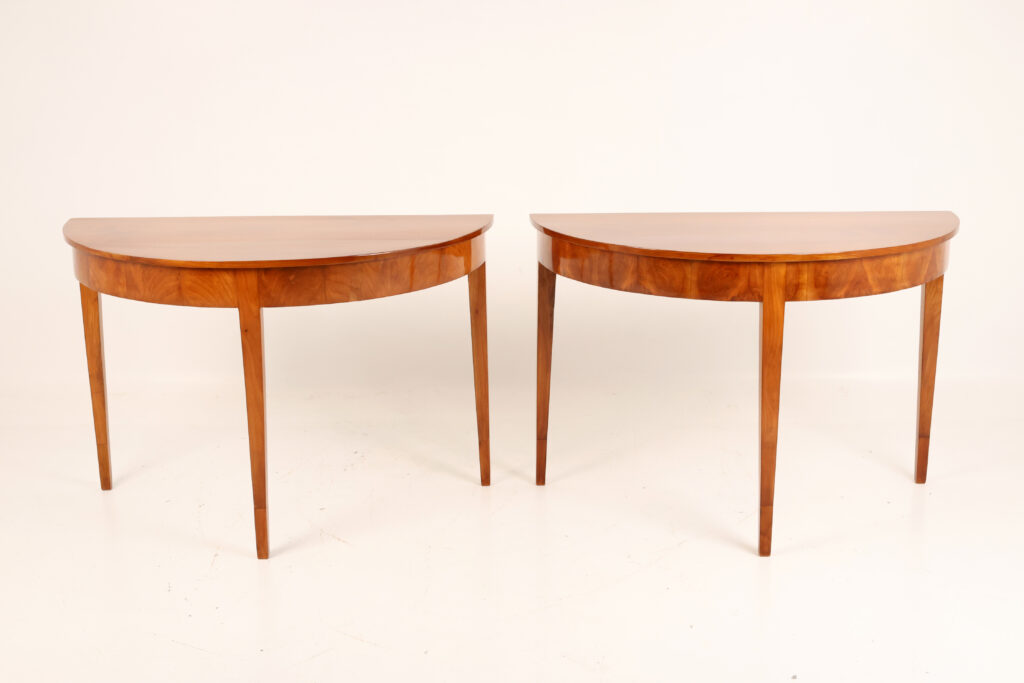
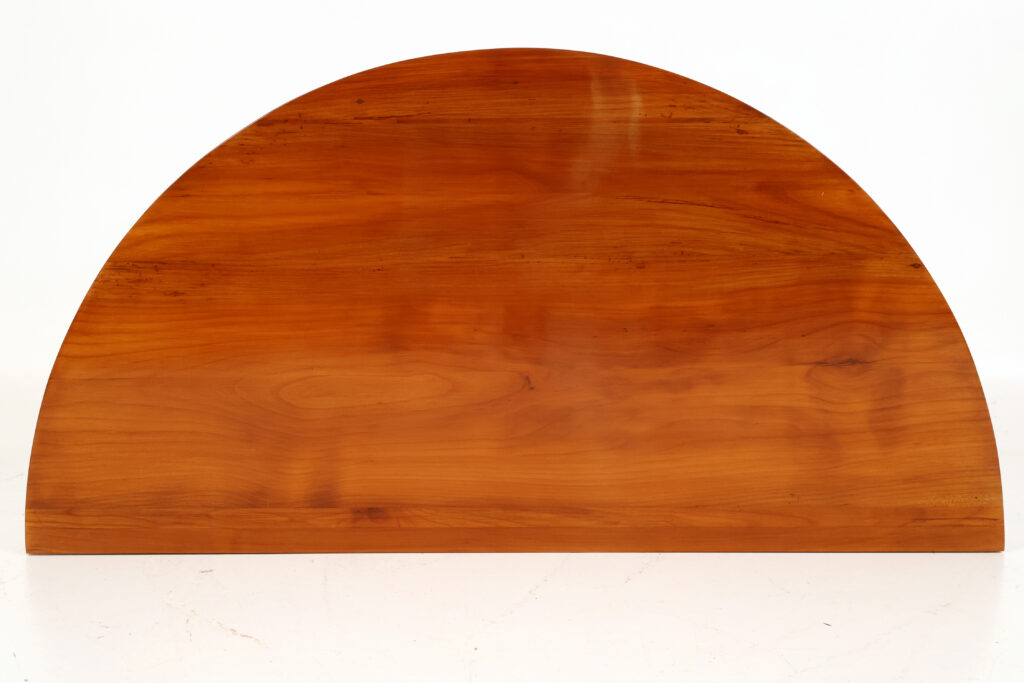
This is exactly the character of a pair of Biedermeier demilune tables in cherrywood, dating to around 1820. Each has a graceful semi-circular top in finely figured cherry veneer, with a warm tone and attractive natural grain, the gently curved frieze elegantly proportioned and carried on slender tapering legs that give the whole a light, harmonious silhouette. They have been restored and finished with a traditional hand-applied shellac polish that deepens the natural beauty of the wood while preserving their authenticity. As a genuine original pair, surviving together after two centuries, they sit at the very top of Biedermeier collectibility.
When Two Become One
The cleverest thing about this particular pair is what they can do together. Demilunes were frequently made in pairs during the Biedermeier period, and the most ingenious cabinetmakers designed them so the two straight back edges could be brought together in the center of the room to form a single circular table, ideal for dining, cards, or coffee. This pair keeps its original joining mechanism, the very piece of hardware that makes the transformation possible, which is a rare survival in itself.
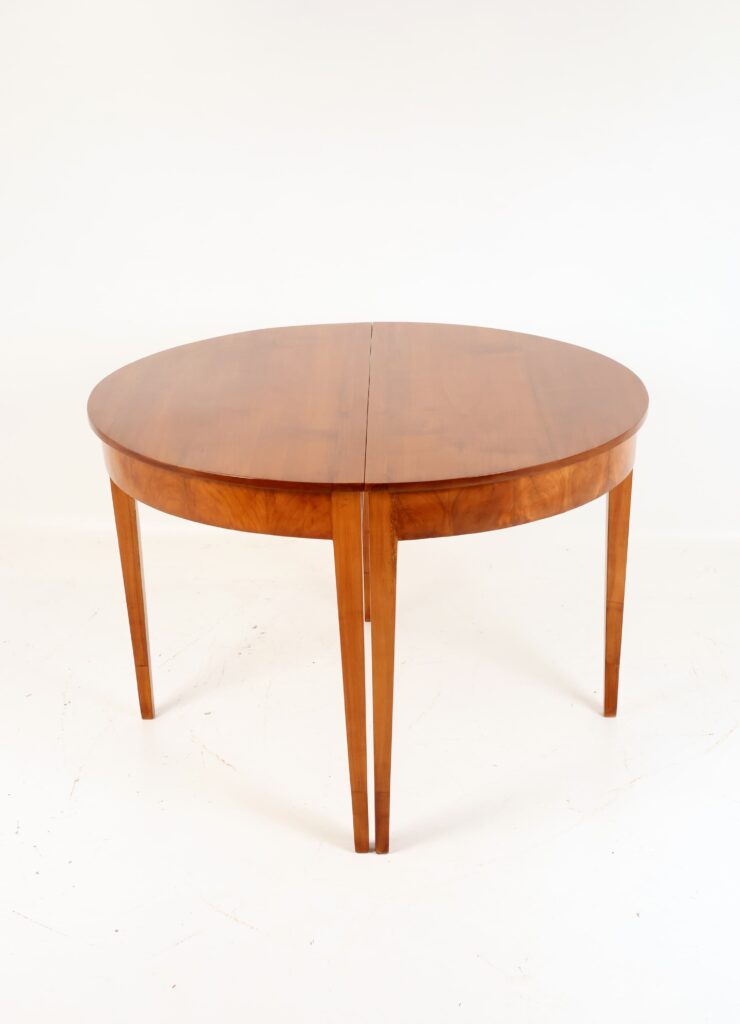
That dual purpose captures the whole Biedermeier spirit. Here is a form that stands as two refined console tables against the wall on ordinary days, finishing the architecture exactly as a console should, and then converts into a full round dining table when guests arrive. It is exquisite form that never sacrifices practical use, the bourgeois commitment to space-conscious, multi-functional living expressed in a single elegant object. For a modern home, where flexibility matters as much as it did in a nineteenth-century townhouse, it is hard to imagine a more useful pair of antiques.
The Warmth of the Wood
The defining visual signature of Biedermeier, and its sharpest break from the Empire style that preceded it, is its celebration of natural wood grain. Rejecting the dark imported mahogany and heavy gilt bronze of Napoleon’s France, Biedermeier cabinetmakers turned to indigenous light fruitwoods, a shift forced at first by the Napoleonic naval blockades that cut off exotic timber, but quickly embraced as a deliberate aesthetic that warmed the whole atmosphere of the interior.
Cherry, Kirschbaum, is the most iconic of these woods and the most recognisable face of the style. It has a natural warmth, a honey-to-reddish-brown tone that deepens into a luminous, complex patina over decades of exposure to light and air, which is exactly why a cherry demilune feels so alive. Alongside cherry, makers used pear, apple, light walnut, birch, and ash, with fine flame mahogany reserved for prestige pieces in the northern trading ports. Rather than carving solid slabs, they sliced these figured woods thin and laid them as veneer over a stable softwood carcass, bookmatching successive leaves so the grain opened into mirror-image patterns. The wood itself became the ornament, replacing the gilt bronze of earlier eras.
To keep these pale, warm surfaces from looking flat, Biedermeier makers used their second signature, ebonized detail. By darkening tight-grained pear wood with an iron solution until it turned a deep, permanent black, they could imitate costly ebony and apply it with architectural precision, black columns, dark stringing, blackened capitals and bases, sharp graphic lines against the glowing cherry. Those black accents work like the ink lines on an architect’s drawing, articulating the structure and giving the piece a crisp, almost modern definition, and they did away entirely with the need for expensive imported ormolu. You can see the breadth of this material language across our Biedermeier furniture collection.
From Berlin Severity to Viennese Lyricism
Biedermeier was never one single look, because it was made across a decentralised patchwork of German and Austrian states, and the console table was interpreted differently in each. The North German and Berlin tradition, shaped by the architect Karl Friedrich Schinkel, is the most severe and architectural, a console that presents as an unyielding block with right angles, heavy cornices, and a monumental stance, often in mahogany or pale birch and ash with stark ebonized columns. The South German tradition, around Munich and Bavaria, is warmer and more intimate, dominated by cherry and walnut, with lighter, more vertical silhouettes, gently curved transitions, and a minimal restraint that lets the bookmatched cherry take center stage. The cherry demilune belongs squarely to this southern world, and it is arguably the most livable and universally loved face of the whole style. The Viennese tradition, centered on the great Danhauser workshop in the Habsburg capital, is the most lyrical, full of swept supports, bowed fronts, and lyre bases that reflect the city’s love of music and theatre.
How to Read a Genuine Biedermeier Console
Authenticating a Biedermeier console begins, fittingly, at the back. Because the piece was built to stand against a wall, the back of a genuine console was left plain and unfinished, and over two centuries that bare pine or spruce develops a deep, mellow oxidation from exposure to air, smoke, and dust. Bright raw wood, or a muddy uniform stain meant to fake age, is an immediate warning. The hidden surfaces, the back, the inside of the carcass, the undersides, should also show the slightly uneven, scalloped chatter marks of a hand smoothing plane, ripples you can feel with your fingers, where perfectly flat surfaces or uniform parallel lines betray industrial machinery.
The veneer is the next test. Period Biedermeier veneer was cut by hand from a log with a frame saw, leaving it relatively thick at three to five millimeters, which gives the finish its depth and lets the surface be polished over centuries without wearing through to the carcass. The paper-thin rotary veneer of the later Biedermeier Revival wears through easily and gives the game away. Drawers should show hand-cut dovetails with unequal pins and tails and chamfered, sloping bottoms, not the uniform machine-cut joints and square-edged bottoms of post-1850 work. The ebonized detail should be a penetrating chemical stain, not a surface paint that chips to reveal pale wood beneath.
There is one deception specific to this form worth knowing. Because demilune pairs are so prized, an unscrupulous dealer may cut a single round Biedermeier center table in half to fake two demilune consoles. The trick is detectable: a cut-down table lacks the deep, two-century oxidation on the freshly severed back edge, its tool marks do not align with a piece originally built for a wall, and its apron veneer does not wrap and terminate naturally at the rear. This is one reason a genuine, undivided original pair like a true cherry demilune set is so valuable, and why every piece that comes through Antiqueria Breitling is read against exactly these markers before it is offered.
The Biedermeier Console in the Modern Room
Two centuries on, the Biedermeier console still does its original job. Its shallow footprint makes it ideal for modern spaces that want historical weight and visual impact without sacrificing floor area, and it appears today in entrance halls holding keys and flowers, behind floating sofas to ground a seating group, or in dining rooms as an elegant serving surface. The tradition of pairing it with a mirror remains alive, often now with a sleek or even deliberately irregular modern mirror set against the console’s classical lines for a bit of productive tension. A warm cherry demilune brings depth and historic intelligence to a stark white minimalist room without disturbing its clean lines, which is exactly why designers reach for these pieces as they move away from matched suites toward more curated, individual interiors.
The market reflects all of this. Demand for fine Biedermeier is strong, helped by a growing appreciation that an antique built from solid woods, thick sawn veneer, reversible hide glue, and natural shellac is the original expression of a circular, sustainable economy, made for centuries of use and repair. Value is driven by the drama of the bookmatched grain, the originality of the shellac finish and the ebonizing, the structural integrity of the form, and above all, for this particular form, by whether a piece is a single or a pair. Because symmetry was so central to the Biedermeier interior, consoles were often made in pairs, and over two centuries of inheritance and upheaval those pairs were nearly always separated, so an intact original pair commands a substantial premium over a single, often several times the price. At Antiqueria Breitling, fine Biedermeier consoles and demilunes are restored in-house with respect for their original surfaces and assessed against every marker above. Whether you are drawn to a single half-moon against the wall or a rare matched pair that doubles as a round dining table, the full range can be browsed in our antique console tables collection. Write to us at contact@antiqueria-breitling.com for pieces not yet listed, with worldwide shipping available on everything we offer.