Before 1815, the dining chair was not designed for the person sitting in it. It was designed for the room. Comfort was beside the point. Then everything changed.
When Comfort Became Radical — The World That Created the Biedermeier Dining Chair
The Congress of Vienna in 1815 ended the Napoleonic Wars and sent the aristocracy back to their palaces. What it left behind was an urban middle class with stable incomes, growing families, and a domestic life that needed furnishing. Not for display. For living.
The political conditions of the following decades made that domestic retreat almost mandatory. Under Klemens von Metternich, Central Europe operated under strict censorship and political surveillance. With the public sphere effectively closed, the bourgeoisie concentrated its energy on the home. Dinner parties, letter writing, musical evenings, the intimate gatherings that became known as Schubertiades after Franz Schubert’s famous private concerts, all of these took place in furnished rooms where the quality of the seating was no longer incidental.
The concept that emerged from this shift was called the Wohninsel, the living island. Furniture stopped being arranged formally along the walls of a room for ceremonial effect and moved to the center, grouped around dining tables and conversation areas. The chair had to work differently now. It had to hold a person comfortably through a long evening of music and conversation, not simply demonstrate the owner’s taste from across the room.
That practical demand produced one of the most quietly revolutionary objects in the history of furniture design.
The Architecture of the Chair — Sabre Legs, Balloon Backs and the Geometry of Ease
The Biedermeier dining chair looks simple. That simplicity is the result of considerable thought.
The most immediately visible departure from the chairs that preceded it is the leg. Empire dining chairs stood on rigid straight legs with heavy classical ornament derived from Greek and Roman sources. The Biedermeier sabre leg sweeps outward in a gentle curve, providing stability through geometry rather than mass. The visual effect is one of lightness, and the structural effect is a chair that sits securely on an uneven floor without wobbling.
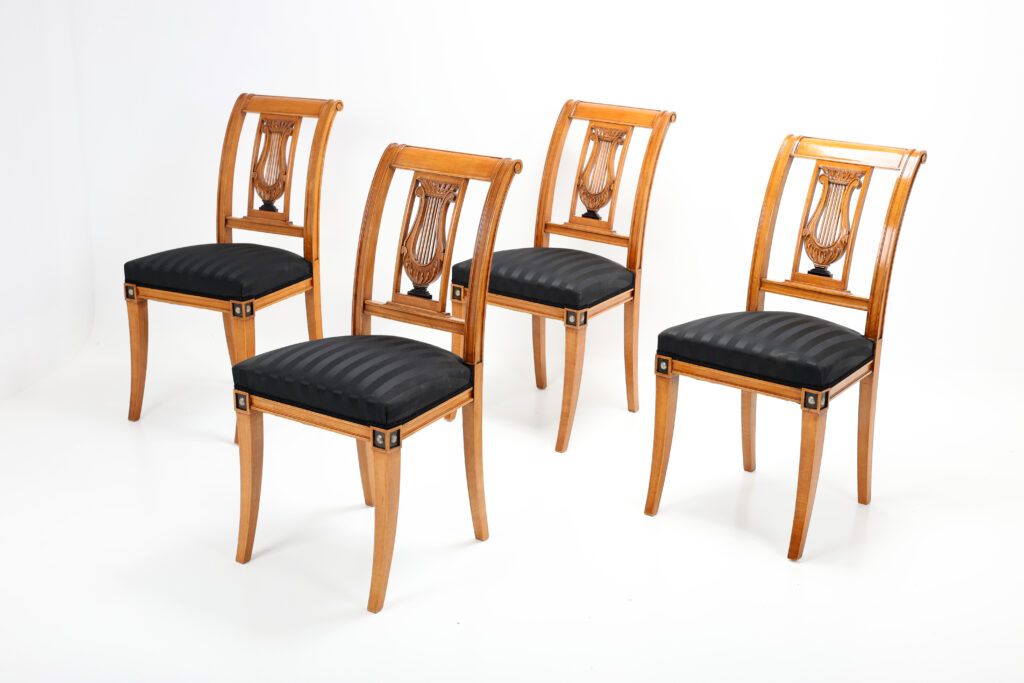
The backrest is where Biedermeier craftsmen showed the full range of their invention. Having stripped away carving and bronze ornament, they put all their creative attention into the silhouette of the back splat, and the results are extraordinary in their variety. The balloon back curves gently around the sitter’s upper body. The lyre shape, one of the most recognizable Biedermeier forms, references the musical culture of the period directly, a chair whose back echoes the instrument that was played in the same room on the same evenings. The fan splat opens upward from the seat rail in a spread of thin wooden elements. The gondola or shovel back wraps around the sitter’s body in a continuous curve that anticipates ergonomic thinking by about a century.
None of these forms uses carving in the heavy sense of the preceding period. The shapes themselves carry all the decorative weight. The wood grain, book-matched where veneer was used, provides the surface interest. The geometry does the rest.
Wood, Upholstery and the Materials That Define an Original
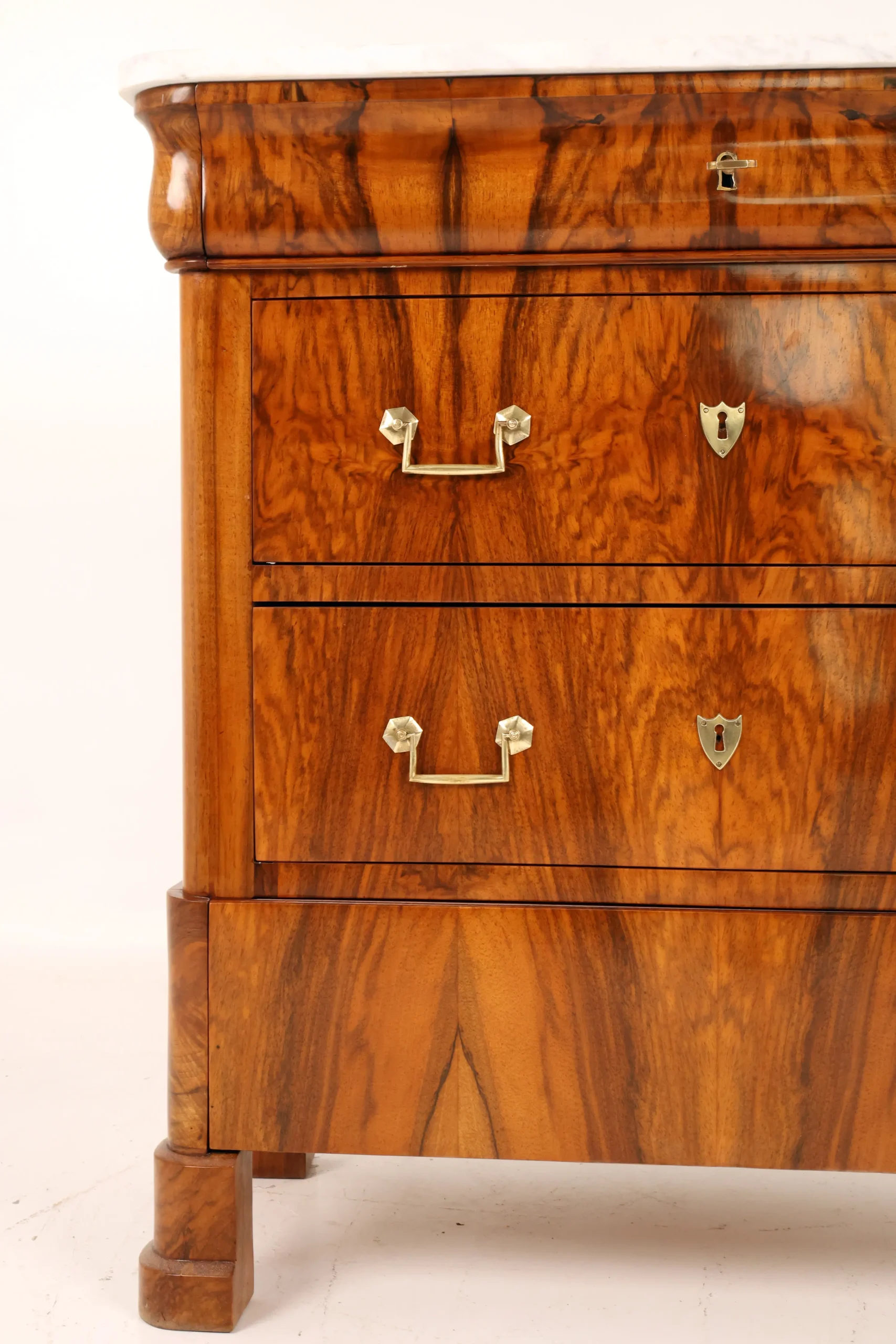
Biedermeier dining chairs are built from native European woods. The rejection of imported mahogany and ebony was partly economic, those timbers had become expensive after decades of war, and partly a deliberate aesthetic choice for lighter, warmer interiors. Cherry, walnut, ash, pear, and birch were the dominant materials, with Karelian birch, its surface marked with characteristic flames and eyes, appearing in northern workshops where the figured timber was locally available.
Ebonized details provide contrast without applied ornament. A thin banding of black-stained wood around the seat rail, a diamond-shaped ebonized escutcheon at the keyhole of a cabinet, these small geometric accents are characteristic of the period and entirely consistent with its design philosophy: visual richness through material quality and proportion, not through decoration.
The upholstery of original Biedermeier dining chairs is worth understanding even if the original fabric rarely survives intact. The Biedermeier period was when dining seating became genuinely comfortable for the first time. Horsehair stuffing over a foundation of stretched jute webbing and burlap provided a seat that held its shape for decades. The early 19th century also saw the introduction of copper coil springs, hand-tied into the seat matrix, which gave Biedermeier chairs a responsiveness that earlier furniture simply did not have. Original Biedermeier dining rooms were brightly colored, with chairs upholstered in rich silks, velvets, and calico that modern reproductions rarely attempt to match.
How to Identify an Authentic Biedermeier Dining Chair
The distinction between a genuine early 19th century Biedermeier dining chair and a later revival piece or modern reproduction is visible in the construction, not the silhouette. Revival makers followed the original forms closely. What they could not replicate was the method.
Original Biedermeier chair frames were assembled using traditional mortise-and-tenon joints, secured with wooden pegs and animal hide glue. If a chair frame is held together primarily by perfectly uniform machine-made round dowel pins, it is a product of later mass production. Original joints show slight irregularities in the peg placement and tool marks from hand finishing that machine production never replicates.
Look underneath the seat rails. An authentic chair will show faint, slightly irregular marks from a hand plane or drawknife on the inner surfaces of the frame. Machine-produced revival pieces have perfectly smooth surfaces or the circular marks of powered saws.
Where veneer is used on the frame or splat, the thickness matters. Original Biedermeier veneer was sawn by hand, producing slices of three to five millimeters. Industrial rotary veneer from the revival period is under one millimeter and has a more repetitive, less naturalistic grain pattern that is recognizable once you know what to look for.
The patina of the wood is the final and in some ways most important indicator. Original Biedermeier wood has developed its color from the inside out over two centuries of maintenance and use. That warmth cannot be applied or accelerated. A chair that has been stripped and refinished has lost something that no subsequent treatment can restore.
From Danhauser to Thonet — The Makers Behind the Movement
The most important name in Viennese Biedermeier chair production is Josef Ulrich Danhauser. His furniture factory in Vienna employed up to 350 workers at its peak and produced chairs of exceptional quality across an extraordinary range of designs. The Museum of Applied Arts in Vienna, the MAK, still holds over 2,500 original design sketches from the Danhauser factory, covering hundreds of variations of backrest shapes, leg profiles, and upholstery configurations. The balloon back and lyre shapes most closely associated with the Viennese tradition can be traced directly to his workshop.
The other name that belongs in any serious discussion of Biedermeier chairs is Michael Thonet. The man who later transformed furniture manufacturing with his mass-produced No. 14 Vienna Coffee House Chair began his career in the 1830s experimenting with steam-bent wood during the Biedermeier period. Thonet’s early experiments with boiling and bending light woods to create the sweeping curves that Biedermeier design demanded laid the direct technological groundwork for modern furniture production. The chair that changed the world started here.
These are not simply historical footnotes. A set of antique Biedermeier dining chairs from a Viennese workshop of this period, with documented provenance and original construction intact, represents the output of one of the most inventive furniture-making traditions in European history. The designs that Danhauser’s draftsmen sketched and his craftsmen built in the 1820s and 1830s have never really been superseded. Interior designers still use them for exactly the reason they were made: they are comfortable, they are well-proportioned, and they work in almost any room.
Explore Our Collection
The Biedermeier furniture collection at Antiqueria Breitling includes antique Biedermeier dining chairs from Viennese, German, and Scandinavian workshops, assessed individually for frame integrity, original construction, and patina. The antique chairs section covers related seating from other periods, and 19th century furniture includes complementary pieces from the same tradition that work naturally alongside Biedermeier dining chairs in a considered interior.