In 1840, a cabinetmaker named Vinzenz Hefele spent eighteen months building a single piece of furniture. From the outside it looked like a standard Biedermeier cabinet. Inside, it contained 105 hidden drawers. Most of them invisible.
A Cabinet Built for Secrets — The World That Created the Biedermeier Secretary
After the Congress of Vienna in 1815, Europe exhaled. The Napoleonic Wars were over, the borders were redrawn, and the urban middle class, merchants, lawyers, civil servants, found itself in possession of something it had not had before: a stable domestic life worth furnishing.
The political conditions of the following decades shaped that interior life in ways that went beyond aesthetics. Under Klemens von Metternich, Austria and much of Central Europe operated under a system of censorship and political surveillance that made private correspondence genuinely dangerous. Letters to the wrong person, a pamphlet kept in a drawer, a document that questioned the regime, any of these could attract the attention of Metternich’s intelligence network. The bourgeoisie needed somewhere to put things that should not be found.
They also needed somewhere to put their money. Reliable banking institutions for the middle class did not yet exist in any meaningful sense, which meant that gold coins, jewelry, and property documents lived at home. The Biedermeier secretary became the family vault as much as the family desk.
Franz Schubert and his circle held their famous Schubertiades, intimate musical gatherings in private apartments, in rooms furnished with exactly these pieces. The secretary, closed, was a wall of quiet restraint. Open, it was the intellectual center of the home, the place where letters were written, accounts kept, and private life conducted.
The Architecture of Restraint — Design, Materials and What the Surface Reveals
A Biedermeier secretary presents an exterior of almost architectural calm. The form is typically vertical and rectangular, resembling a small building more than a piece of furniture. Below, two or three substantial drawers. In the middle, the drop-front writing flap, closed and flush with the case. Above, further storage behind doors or a cornice that appears purely structural but frequently is not.
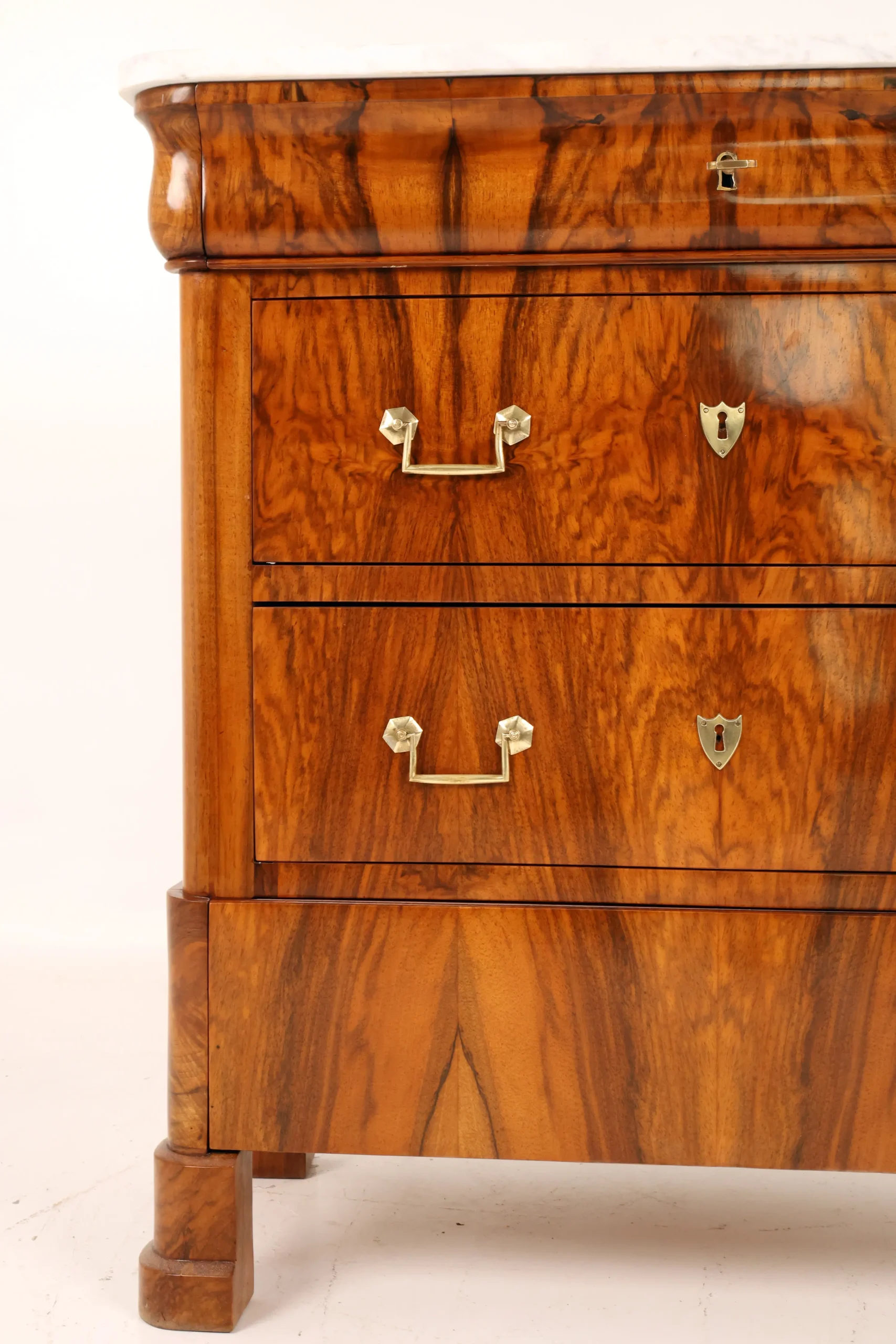
The surface is where the maker’s skill is most visible. Biedermeier cabinetmakers rejected the dark imported mahogany and extravagant gilt bronze mounts of the Empire style that preceded them and turned instead to native European woods: cherry, walnut, birch, ash, pear, and applewood. These lighter, warmer materials were chosen partly for economic reasons, imported timber had become expensive after the wars, and partly because they suited the domestic intimacy the period valued.
The veneer technique used on the finest secretary desks is called book-matching. Consecutive slices from the same log are opened like the pages of a book and laid side by side, creating a perfectly mirrored grain pattern that runs uninterrupted across the drawer fronts and cabinet doors. The wood becomes the decoration. Ebonized details, thin stringing lines, small column accents, escutcheons of bone or ebonized fruitwood, provide geometric contrast without interrupting the surface.
The result is a piece that looks simple from a distance and rewards close attention entirely.
Behind the Writing Flap — The Theatrical Interior of a Biedermeier Secretary
Lower the writing flap and the secretary changes completely.
Where the exterior was restrained to the point of severity, the interior is a miniature theater. Cabinetmakers who had suppressed every decorative impulse on the outside concentrated all of it here, behind the closed flap, visible only to the person sitting at the desk. Small columns in contrasting wood, often twisted or fluted. Miniature arched niches. Parquet floors of geometric inlay. A mirrored back wall that doubles the apparent depth of the interior. Dozens of small drawers and compartments fitted with precision into a space that somehow contains far more than its exterior dimensions suggest.
The contrast between materials was often deliberate and dramatic. An exterior in pale birch or cherry would open to reveal an interior lined in rich mahogany. The warmth of the outer case and the depth of the inner one worked together in a way that made opening the secretary feel like an event.
And then there were the things that were not immediately visible at all.
Blind drawers were concealed within the cornice, the heavy architectural molding across the top of the piece, with no handle and no keyhole. They opened only by pressing a hidden wooden peg accessible through the drawer below. False bottoms in the visible drawers concealed spring-loaded compartments that released with precise pressure, revealing velvet-lined spaces for coins or documents. A central mirror panel in the interior theater could slide sideways to reveal a further set of drawers behind it. Columns that appeared fixed could rotate.
The trick lock was the final layer of protection. A thief who inserted the key and turned it clockwise would find it spinning endlessly, the mechanism apparently broken. The owner knew otherwise: a half-turn counter-clockwise until a faint click engaged the internal spring, then the key could be turned to draw the bolts. The entire system worked because it looked like it did not work.
Vinzenz Hefele built his guild masterpiece in 1840 with 105 drawers concealed behind mechanisms of this kind. It took him eighteen months. The piece is now held by the MAK in Vienna, and it remains the most extreme expression of a design philosophy that ran through every Biedermeier secretary ever made: maximum internal complexity, invisible from the outside.
How to Identify an Original — Veneer, Joinery and the Signs That Matter
The distinction between an authentic early 19th century Biedermeier secretary and a later revival piece made from the 1870s onward is not always obvious from the front. It is almost always clear from the construction.
Veneer thickness is the most reliable starting point. Original Biedermeier veneer was sawn by hand or with early steam-powered equipment, producing slices typically between three and five millimeters thick. When the Biedermeier revival arrived in the later 19th century, industrial rotary cutting produced veneer of under one millimeter. The visual difference is real: sawn veneer has depth, warmth, and natural irregularity that machine veneer does not approach.
The drawer construction tells a corresponding story. Genuine Biedermeier joinery uses hand-cut dovetails, and specifically the half-blind dovetail at the drawer front, where the interlocking tails are visible from the side of the open drawer but do not penetrate the face. Hand-cut joints have slight variations in spacing, faint scribe lines from the marking gauge, and the characteristic marks of chisels in the corners. Machine-cut dovetails from revival pieces are perfectly uniform, which is exactly what makes them identifiable.
The back panel is equally revealing. An original secretary will have an unfinished back of several wide solid wood planks, fixed with hand-forged iron nails. After two centuries of exposure, the wood develops a deep, matte grey-brown oxidation that is uniform and organic. Gaps between the planks, caused by centuries of natural wood movement, are entirely normal and in fact reassuring. A tight, clean back panel on a supposedly 19th century piece should prompt further questions.
Two Exceptional Examples from Our Collection
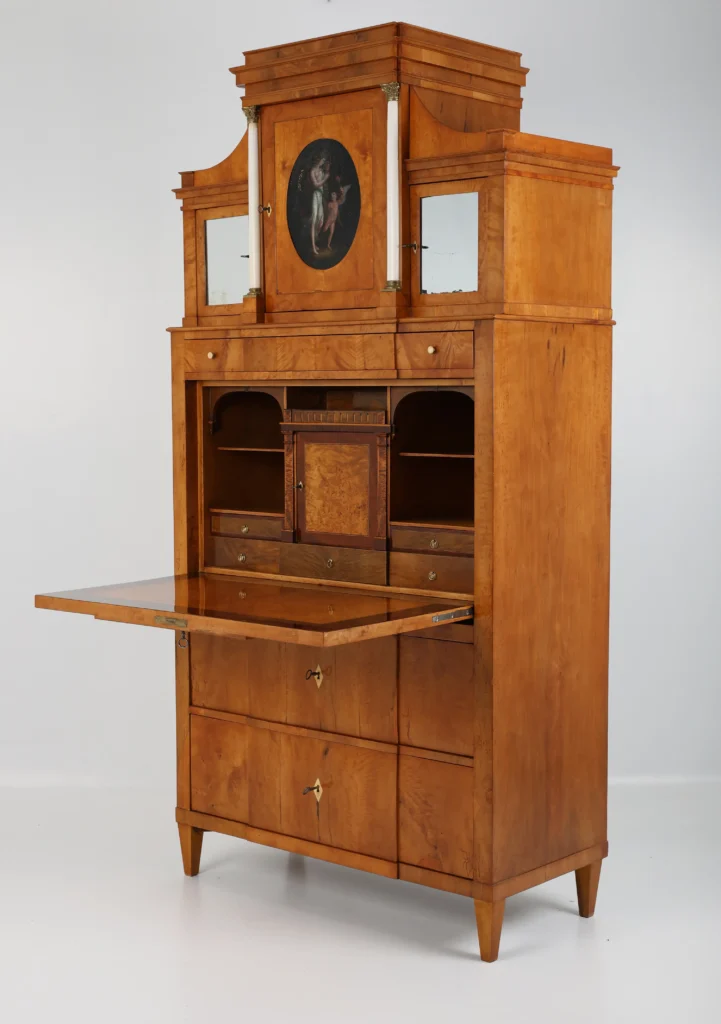
The first is a secretary from Braunschweig, circa 1820, built in birch and birch root veneer with pear wood detailing. The lower section contains two large drawers and the writing flap, which opens to reveal eight drawers and a further upper drawer. The upper section has a central door decorated with detailed painted work, flanked by two alabaster columns, with two additional doors connected by curved arches. The cornice is layered and profiled in the Biedermeier manner, and the diamond-shaped escutcheons at the keyholes are a characteristic regional detail. This piece is documented in Wolfgang L. Eller’s reference work Biedermeier-Möbel on page 236, which provides independent confirmation of its origin and period.
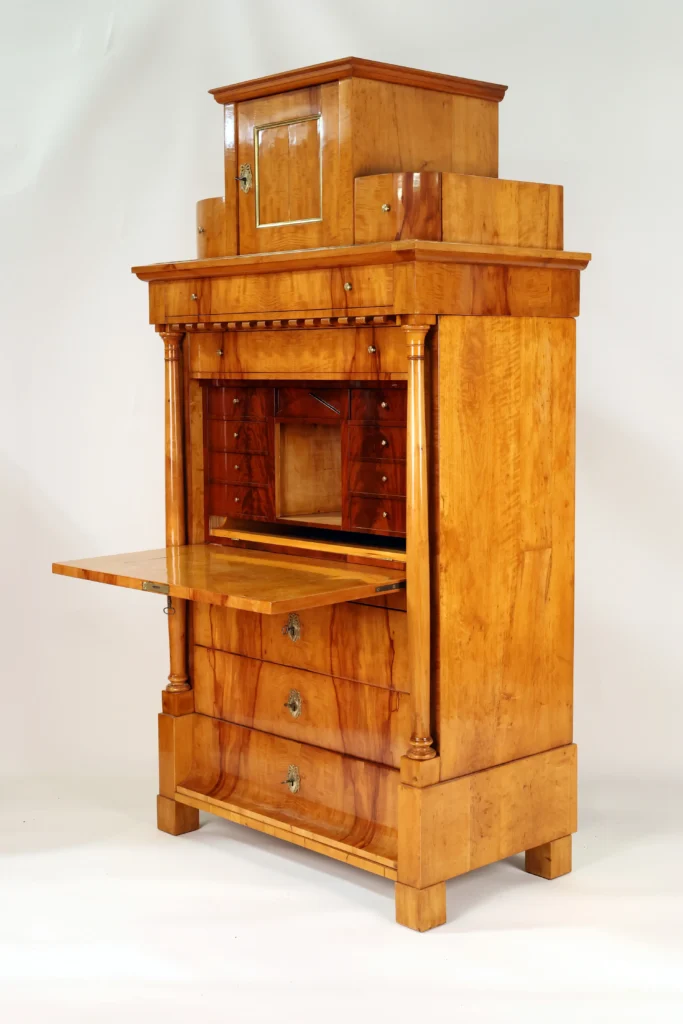
The second is a German secretary also from circa 1820, built in applewood with a mahogany interior, and the contrast between the two materials is one of its defining qualities. The warm, reddish tone of the applewood exterior and the deep richness of the mahogany interior create a visual tension that makes opening the writing flap feel genuinely theatrical. The upper section has a central cabinet door with a brass surround and two small drawers, with a projecting drawer fitted with brass knobs and a decorative dentil molding. The interior contains numerous small drawers, compartments, and a central mirrored niche. A pull-out writing surface below the main flap extends the workspace further. The three large drawers at the base retain their functioning locks, and five original keys are included. The piece has been carefully restored and hand-polished with shellac in the traditional manner.
Explore Our Collection
The Biedermeier furniture collection at Antiqueria Breitling includes authenticated secretary desks and related pieces from German and Austrian workshops, each assessed for veneer integrity, original construction, and condition of the interior mechanisms. The antique secretary desks section covers related forms from other periods, and the 19th century furniture and German Biedermeier furniture categories include complementary pieces from the same tradition.