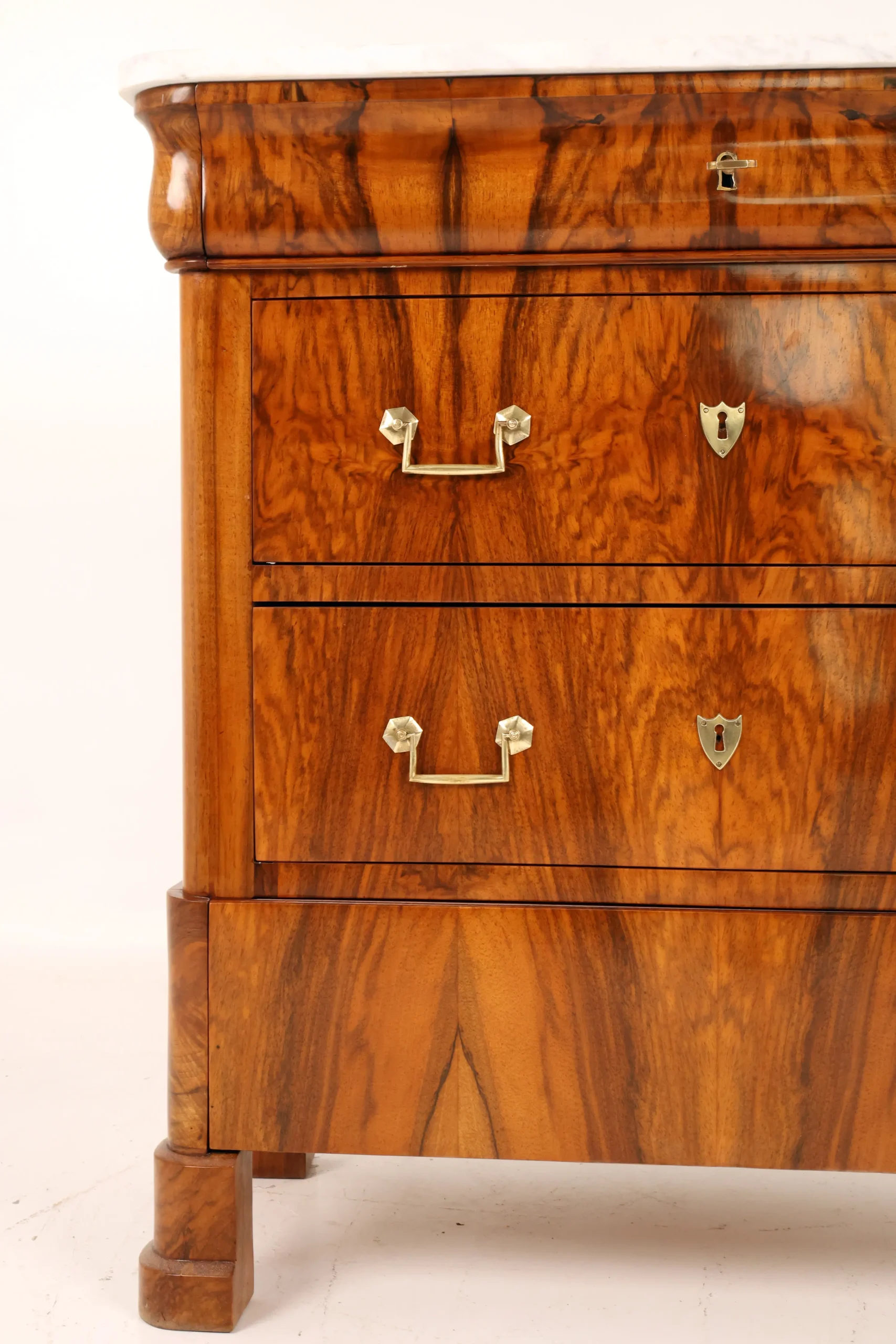
Imagine two rooms. In the first, the walls are paneled in dark wood, the furniture is covered in gilded bronze mounts and tortoiseshell marquetry, and the candlelight bounces off polished surfaces in ways that make everything seem to move. In the second, the walls are pale grey, the furniture is painted in chalky white with slender fluted legs, and the winter light falls softly across surfaces that seem to gather and hold it rather than reflect it back. Both rooms are masterpieces. They were designed for entirely different kinds of power
The Sun King and the Northern Light — Two Monarchs Who Built a Style
Louis XIV of France did not simply commission furniture. He weaponized it. When he moved the French court to Versailles in the 1680s, he housed roughly a thousand nobles in a palace designed to keep them under his direct observation, and every piece of furniture in those rooms communicated exactly where each person stood in the hierarchy. An armchair with carved gilded arms and lion paw feet was reserved for the highest aristocracy. A plain stool said everything else. The furniture was the social order made physical, and it was designed by the most powerful state apparatus in Europe to function precisely that way.
Jean-Baptiste Colbert, Louis XIV’s finance minister, established the Gobelins Manufactory in 1663 to centralize luxury production and ensure French design would dominate European taste for generations. Global trade routes provided the materials: ebony from Gabon, tortoiseshell from tropical seas, ivory, Asian lacquer, and lapis lazuli. The craftsmen who applied the fire-gilded mercury ormolu mounts to these pieces frequently died from mercury poisoning. The furniture they made has lasted three and a half centuries.
King Gustav III of Sweden arrived at Versailles on his Grand Tour in 1771 and saw the emerging Louis XVI Neoclassical style already pulling away from Baroque excess toward cleaner, more archaeological forms. He returned to Sweden determined to transform Stockholm into the Paris of the North. What he found at home, however, was a country shaped by Lutheran austerity since 1536, long dark winters with minimal daylight, and an economy that could not sustain the material excesses of the French court even if the culture had wanted them. The result was not imitation. It was adaptation, and what emerged from that adaptation is one of the most distinctive and enduring furniture traditions in European history.
What These Two Styles Are Actually Trying to Do
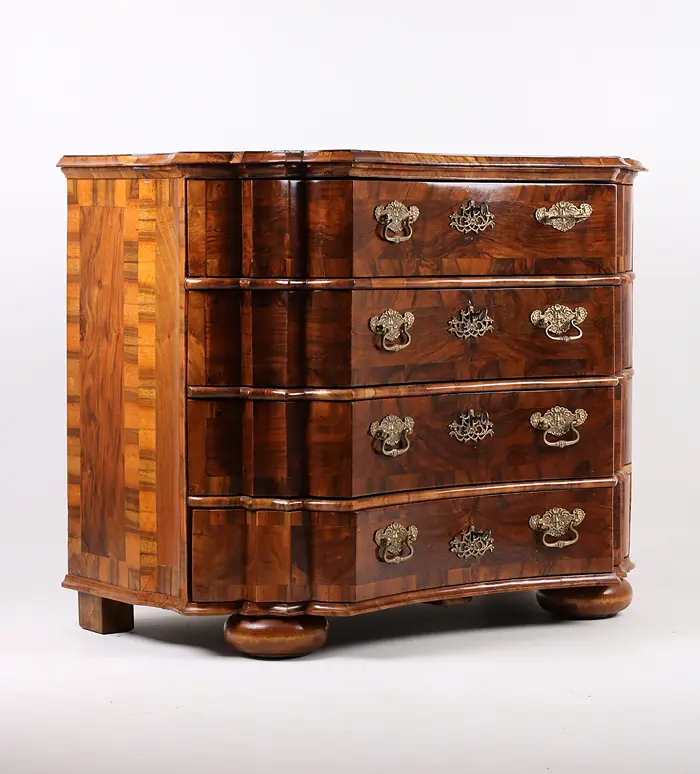
A French Baroque cabinet or writing desk arrives in a room with the confidence of an absolute monarch. The forms are monumental and architectural, with heavy columns, carved pediments, and deep relief ornament: thick acanthus leaves, putti, lion paw feet, mythological figures in full relief. The surfaces are dark, polished to a high gloss, and the ormolu mounts cast in bronze and fire-gilded to a warm luminosity that no modern electroplating comes close to replicating. In candlelight these surfaces perform. They were designed for dark rooms where the furniture was the spectacle.
The Boulle marquetry that defines the finest French Baroque pieces is among the most technically demanding decorative work ever applied to furniture. André-Charles Boulle, the royal cabinetmaker who lived within the Louvre under royal appointment and was therefore exempt from the guild regulations that governed every other craftsman in Paris, stacked sheets of brass and tortoiseshell and cut through them simultaneously with a fine fretsaw following an intricate design. The result was two perfectly complementary sets of interlocking veneers. The surfaces that emerged seem to move in candlelight, which was the intention. These were rooms lit by candles, and the furniture was engineered to perform in them.
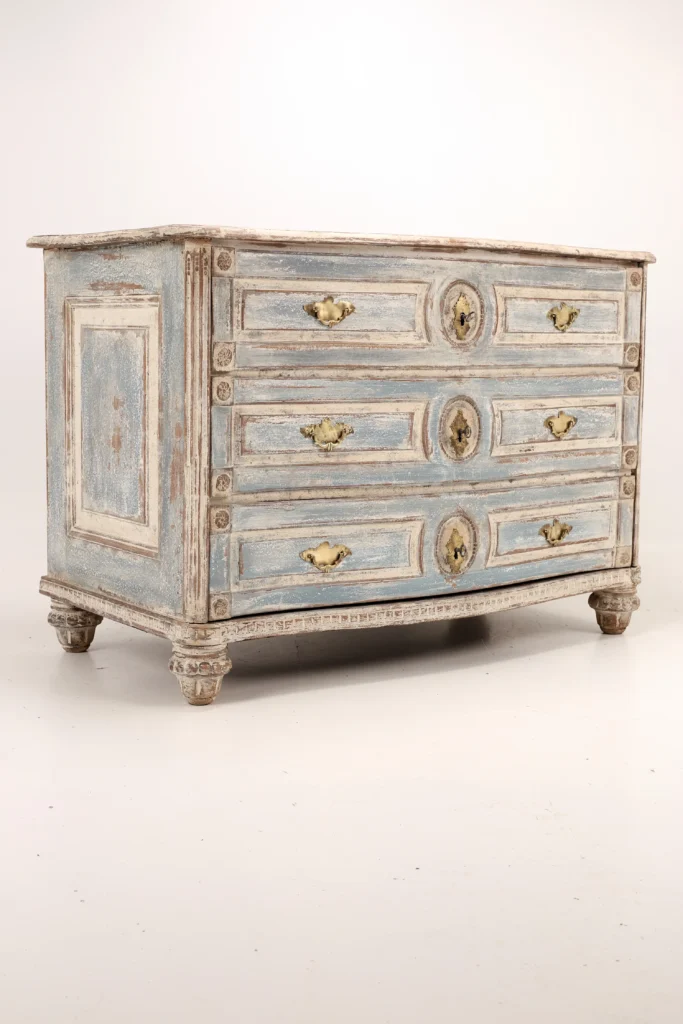
A Gustavian chair or commode does something entirely different. The forms are architectural in a different register: straight lines, flat case fronts, fluted legs that reference Greek columns without imitating them. The surfaces are painted in chalky distemper, a traditional mixture of chalk, water, and animal glue that produces a matte finish which scatters light diffusely rather than throwing it back. The colors, pale greys, soft blues, dusty off-whites, were not chosen for decoration. They were chosen because Sweden has long dark winters, and these tones have the highest capacity to gather and reflect whatever light exists in a northern room.
Where French Baroque furniture consumes a room, Gustavian furniture creates space within one. That distinction is rooted in geography as much as aesthetics, and it explains why the two traditions feel so fundamentally different even when they reference the same classical sources.
The Materials and What They Reveal
French Baroque cabinetmakers worked with the products of global trade and military power. Dense tropical hardwoods, tortoiseshell, ivory, mother-of-pearl, and Asian lacquer panels were available to Parisian ébénistes because France had the naval reach and the commercial networks to acquire them. Beneath these spectacular surfaces the joinery was in solid oak or walnut, precise and durable, with hand-cut dovetails showing the slight irregularities of pre-industrial craft.
Swedish craftsmen worked with what their own forests provided: pine, birch, alder, and beech. These are humble materials by the standards of French court furniture, and the Swedes understood that completely. Their answer was to paint them, and the paint became the art. Distemper ages in a way that no subsequent coating replicates. It chips and wears at the edges and corners where hands have touched it over generations, revealing pale wood beneath, while remaining thicker and slightly darker in carved recesses where no one has touched it. That organic wear pattern is the primary indicator of a genuine piece, and it cannot be faked convincingly.
A detail that matters for any serious buyer: it is almost impossible to find a Gustavian piece in its original first paint. Pine and birch are softwoods that needed regular repainting, and most genuine 18th century examples carry multiple later paint layers over the original distemper. Serious restorers remove these later layers chip by chip with surgical scalpels to reveal the 18th century surface beneath. A piece with a perfectly uniform machine-distressed finish is a modern reproduction regardless of how it presents at first glance.
The antique hand painted furniture section covers pieces from the Gustavian and related Scandinavian traditions where the painted surface is itself the primary decorative element, assessed individually for paint layer authenticity and underlying construction.
Regional Variations That Serious Buyers Should Know
Neither tradition was uniform, and the regional variations within each tell their own stories.
French provincial furniture from Normandy adapted the Baroque vocabulary to local oak and local sensibility. Norman armoires with carved wheat sheaves and lovebird motifs, shaped cornices that evolved over time into the chapeau de gendarme curve, are warm and direct in a way that Parisian court furniture deliberately is not. Breton pieces, shaped by Celtic traditions, have a squareness and density of carved ornament that is entirely their own. These provincial pieces suit contemporary interiors that find the full Baroque register too demanding, and they are considerably more available and more affordable than the finest Parisian production.
Within the Gustavian tradition, the Stockholm workshops produced the most refined courtly pieces, occasionally using mahogany and elaborate faux-marbling. The farming community of Lindome in southern Sweden developed an entirely separate tradition of chairmaking for the wealthy merchant class of Gothenburg, with carved hop flowers on the crest rail as their signature. These chairs were shipped from the workshops unpainted, because the rough roads would have chipped any finish before delivery. The buyer painted them, which explains the extraordinary variety of colors seen on authentic Lindome pieces today.
How to Tell an Original from a Revival or Reproduction
For French Baroque pieces, veneer thickness is the most reliable starting point. Genuine 17th century veneers were hand-sawn and are relatively thick, typically between one eighth and one quarter of an inch. Industrial machine veneer from the 19th century Napoleon III revival period is paper thin and lifts and cracks in ways that period veneer does not. The ormolu mounts tell a parallel story. Original fire-gilded bronze has a warm, deep glow and shows hand-chasing marks under magnification. Electroplated 19th century mounts are brighter, lighter in weight, and prone to flaking.
A counterintuitive authentication detail: genuine pieces from Boulle’s workshop are almost never stamped. His royal appointment exempted him from the guild regulations requiring marks. A prominent maker’s stamp on a supposedly 17th century Boulle piece is a significant red flag rather than a reassurance.
For Gustavian pieces, the logic is different. Construction technique is the first indicator. Authentic 18th century pieces use mortise and tenon joints secured with hand-carved wooden pegs. The back panels of genuine cabinets and armoires show hand-planing marks, subtle rhythmic ridges that machine finishing never produces. The paint assessment requires experience, but the fundamental principle is consistent: authentic wear is logical and gradual, heaviest where human contact was greatest, lightest where it was not.
Which Tradition Belongs in Which Interior
The practical question for any buyer is straightforward: what do you want a room to feel like, and which tradition serves that feeling?
The antique baroque furniture in this collection suits spaces with architectural scale, high ceilings, and a buyer who wants the furniture to be the unambiguous focal point of the room. A Boulle commode or carved giltwood console in a room with white walls and minimal contemporary furniture creates a visual tension that no modern object achieves. The darkness of the wood, the warmth of the ormolu, and the complexity of the marquetry surface demand sustained attention, and in the right setting that demand is entirely rewarding.
The Gustavian furniture collection suits almost any interior, which is a quality few antique traditions can honestly claim. The pale painted surfaces, clean geometric lines, and domestic scale of these pieces make them compatible with contemporary Scandinavian design, with minimalist interiors, and with more traditionally furnished rooms where a piece of quiet historical character is needed without period-room commitment. A Gustavian trumeau mirror in a white-painted hallway looks entirely at home. So does a pair of fluted demilune consoles in a contemporary living room.
At Antiqueria Breitling, both traditions have been part of the collection since the founder began sourcing European pieces in the 1980s. The pieces selected from each tradition reflect four decades of looking at a great deal of furniture and developing a clear sense of what honest condition, authentic construction, and genuine age actually look like in each context. That accumulated knowledge informs every assessment before a piece is offered for sale.
The choice between French Baroque and Gustavian ultimately comes down to a single question about what you want a room to communicate. French Baroque tells the room who is in charge. Gustavian asks the room to breathe.