The Biedermeier period produced some of the most quietly intelligent furniture in European history, and it did so across a wide geography with considerably different results depending on where and by whom the pieces were made. Austrian Biedermeier and German Biedermeier share the same historical moment, the same rejection of Empire excess, and the same commitment to native materials and honest construction. Beyond that, they are distinct traditions, and understanding the difference changes how you look at every piece.
The Political World That Produced Two Different Biedermeier Traditions
After the Congress of Vienna in 1815, Metternich’s system of censorship and political surveillance settled over Central Europe and forced the urban middle class inward. The home became the center of intellectual and social life because the public sphere had effectively closed, and furniture had to serve that new domestic reality. But the political geography of the German-speaking world was not uniform, and the furniture that emerged from it was not uniform either.
Vienna was the administrative capital of the Habsburg Empire, a centralized city with a dense, affluent bureaucracy and a merchant class that wanted coherent, beautiful interiors. The Danhauser factory, founded by Josef Ulrich Danhauser in 1804 and continued by his son Josef Franz, became the engine of Viennese Biedermeier production, employing over 350 craftsmen at its peak and publishing illustrated pattern books that disseminated the Viennese aesthetic across the entire German-speaking world. What Vienna produced was internally consistent, commercially sophisticated, and driven by a single dominant workshop tradition.
The German states were different. Berlin, Munich, Hamburg, and Braunschweig each developed distinct stylistic identities shaped by local materials, trade routes, and in Berlin’s case, the overwhelming architectural influence of Karl Friedrich Schinkel. Where Vienna radiated a single aesthetic outward, Germany produced regional variations that reflected the decentralized, fragmented nature of the confederation itself.
What Viennese Biedermeier Actually Looks Like
The defining quality of Viennese Biedermeier is organic warmth. Where the Empire style that preceded it had imposed straight lines, heavy column supports, dark mahogany, and gilt bronze mounts communicating imperial authority, the Vienna workshops stripped all of that away and replaced it with light native fruitwoods, gentle curves, and surfaces that relied entirely on the figure of the wood grain for their visual character.
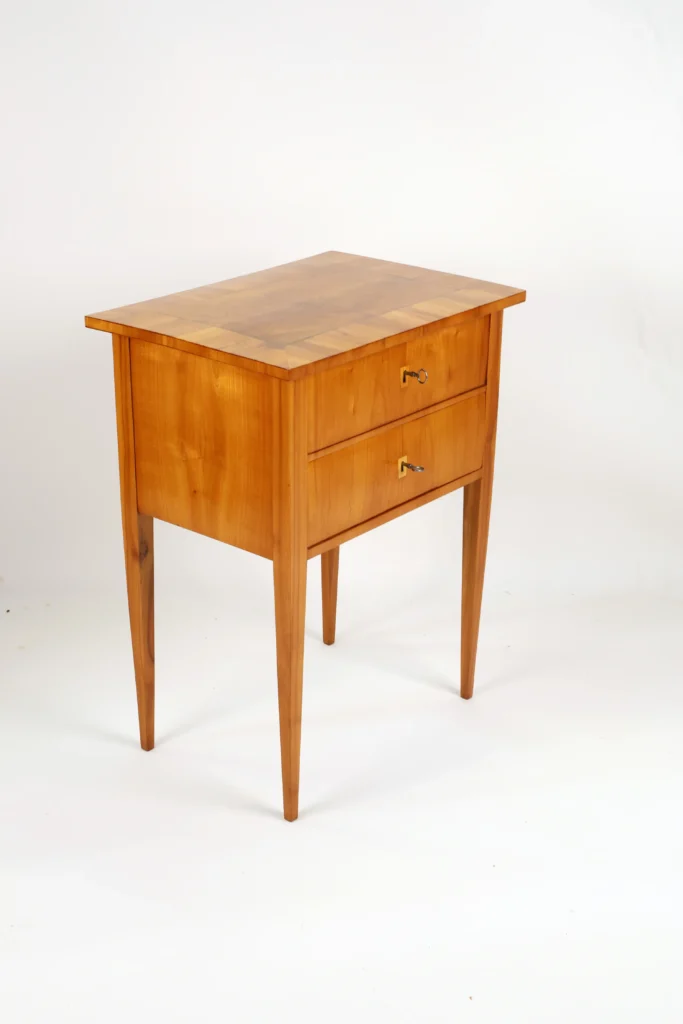
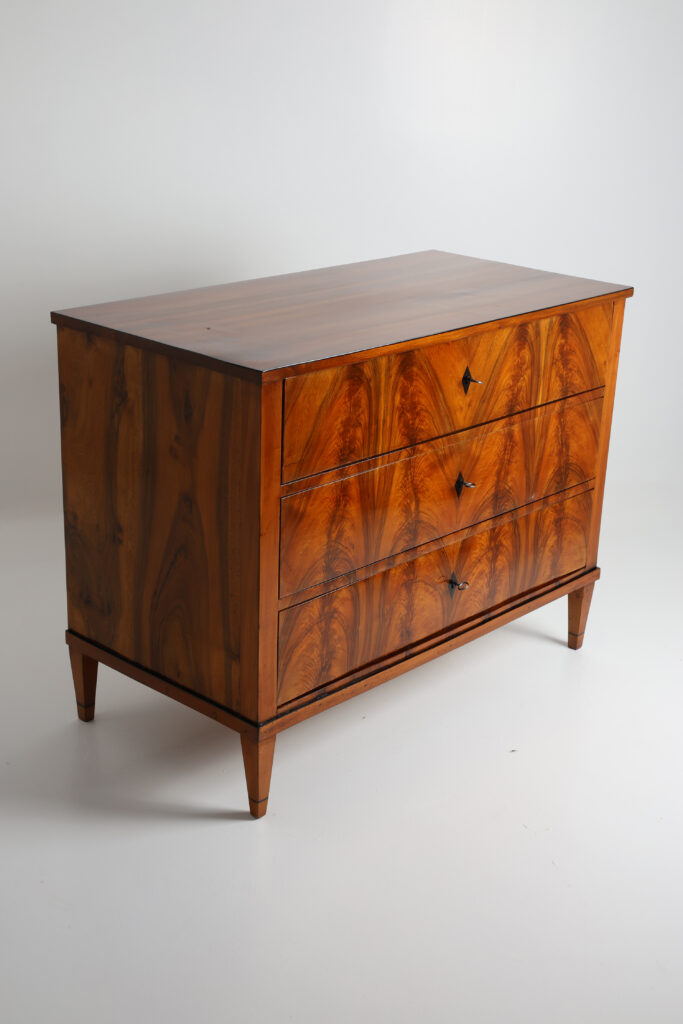
Cherry and walnut were the dominant veneers, selected for the warmth and depth of their grain and applied in bookmatched sheets that created mirror-image patterns across drawer fronts, secretary desk flaps, and cabinet doors. Ebonized details in black-stained pear or maple provided geometric contrast without metal ornament. The lyre shape, referencing the musical culture of the Viennese salon, appeared in chair splats, table supports, and secretary desk interiors with a delicacy that anticipates 20th century design thinking rather than looking back at classical precedent.
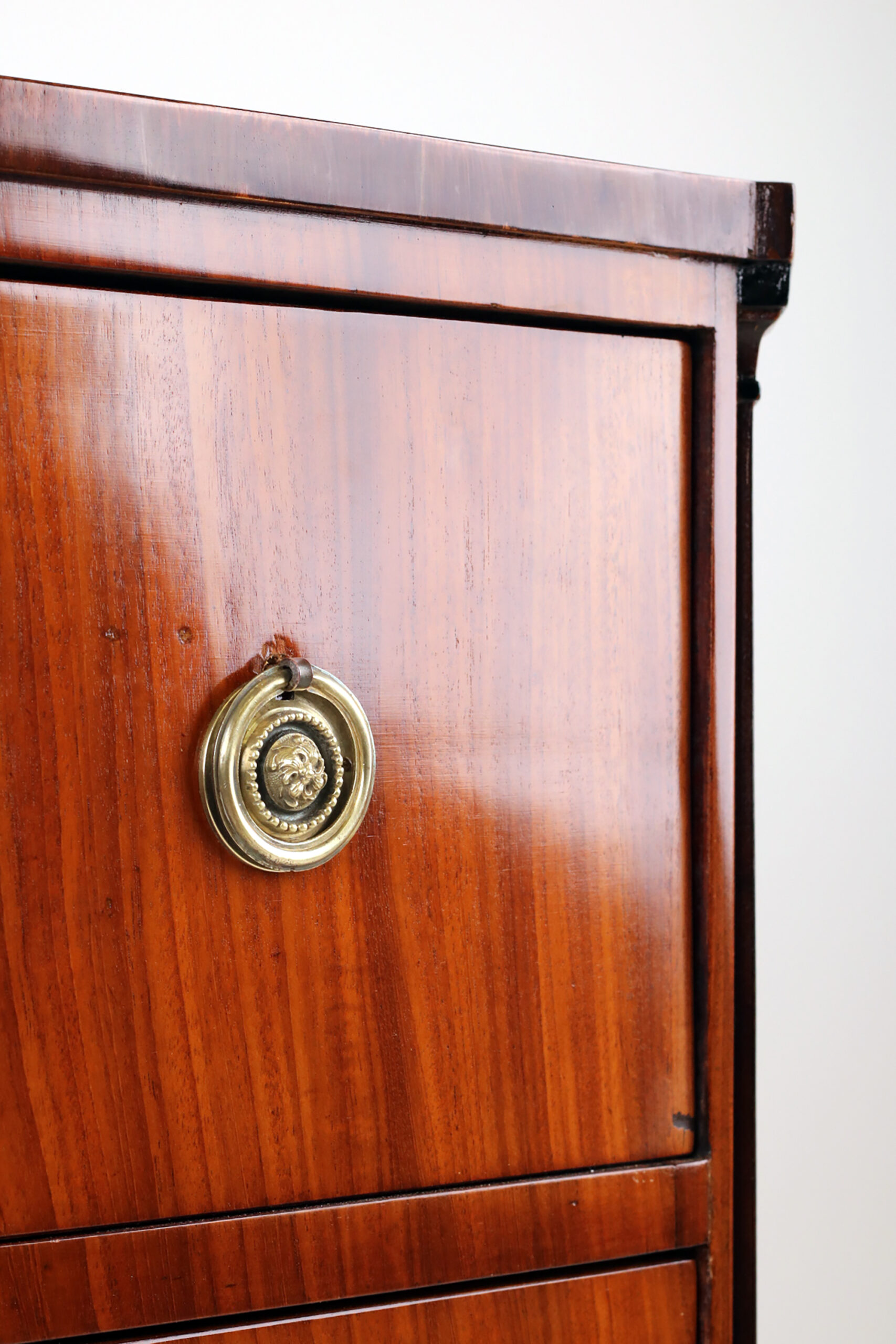
The shellac finish applied to Viennese pieces was built up in hundreds of thin layers applied with a cloth ball and rubbed to a high-gloss surface. A museum-standard Viennese polish can take over a hundred hours to complete. The result gives the veneer pattern a depth that makes the wood appear to be under glass, and it is one of the most immediately recognizable qualities of a fine Viennese piece in person.
Upholstery in Vienna was equally innovative. The Danhauser workshop pioneered the use of coil springs in seating during the 1820s, providing a comfort that earlier furniture entirely lacked. The fabrics chosen were vivid, aquamarine silks, bright calico, and printed velvets in colors influenced by Goethe’s 1810 Theory of Colors. Viennese Biedermeier interiors were not the muted, restrained spaces that modern reproductions sometimes suggest. They were warm, colorful, and designed for extended domestic pleasure.
What German Biedermeier Actually Looks Like
German Biedermeier divides further into regional traditions, and each has a distinct character.
Berlin Biedermeier is inseparable from Karl Friedrich Schinkel, the preeminent architect of Prussian Classicism. Schinkel designed furniture to harmonize with the buildings he constructed, the Altes Museum being the most famous, and his pieces carry that architectural discipline into the domestic scale. Berlin commodes, secretaries, and chairs favor linear purity, harder edges, and stronger proportions than their Viennese counterparts. The geometry is celebrated rather than softened. Schinkel worked with master cabinetmakers Karl Wanschaff and Johann Christian Sewining on royal commissions, and even his most luxurious pieces maintain the period’s commitment to essential form. He was also among the first to experiment with cast iron as a furniture material, producing modular garden chairs at the Royal Ironworks in Berlin that link the classical past with the industrial future in a way that anticipates the Bauhaus by a century.
Munich and South German Biedermeier occupies a middle ground. Pieces from these workshops are built more strictly than Viennese production but maintain the preference for light fruitwoods, particularly cherry and walnut, that characterizes the southern German tradition. Court joinery workshops in Munich focused on commissioned pieces that emphasized the beauty of bookmatched veneers and smooth, unadorned surfaces. The warmth of South German cherry veneer is immediately recognizable and gives these pieces an approachability that Berlin’s more architectural production does not always share.
Hamburg and the northern Hanseatic ports developed a heavier, sturdier Biedermeier influenced by trade with England and Denmark. Because Hamburg was a major import port, mahogany remained popular in the north long after it had been replaced by local fruitwoods in the south. Northern German Biedermeier has a maritime solidity to it, with more rectilinear forms, tapered legs showing English Georgian influence, and a utilitarian elegance that suits practical domestic use rather than salon display.
The Construction Details That Distinguish the Two Traditions
Both traditions use the Blindholz system, a solid softwood core of spruce or pine covered with a hardwood veneer, and both rely on bookmatching as the primary decorative technique. The differences are in the application.
Viennese pieces typically show sawn veneer of three to five millimeters with the depth and surface variation that reflects hand production. The curves in Viennese furniture, the gentle swell of a commode front, the lyre supports of a sewing table, required considerable skill to veneer cleanly, and the quality of that veneering is what separates the finest Vienna workshop pieces from their imitators. The ebonized details are precise and consistent, integrated into the architectural logic of the piece rather than applied as decoration.
German pieces, particularly from Berlin, show the influence of architectural drawing in their construction. The joinery is precise and deliberate, the proportions are calculated rather than felt, and the hardware, where present, reflects the period’s restraint with simple stamped brass or ebonized wood escutcheons rather than the applied metalwork of the Empire tradition.
Authentication for both traditions follows the same fundamental logic. Sawn veneer of three to five millimeters, hand-cut dovetails with slight irregularities, back panels of wide solid wood planks showing deep grey-brown oxidation, and original shellac or wax finish confirm period production. Machine-cut dovetails and paper-thin rotary veneer under one millimeter identify later revival pieces regardless of how accurately they follow the visual forms of the originals.
Which Tradition Suits Which Collector and Which Interior
The practical question for any buyer is straightforward once you understand the character of each tradition.
Viennese Biedermeier suits an interior that values warmth, organic elegance, and the quiet domesticity that the Danhauser workshop understood so well. A Viennese cherry commode or a lyre secretary desk in walnut with its original shellac finish intact brings a quality of light and warmth into a contemporary room that cooler, more architectural furniture does not produce. These pieces are the most compatible of all antique furniture with Scandinavian-influenced contemporary interiors, because the pale fruitwoods, clean geometry, and absence of applied ornament speak the same visual language.
German Biedermeier, particularly Berlin pieces with Schinkel’s architectural influence behind them, suits a buyer who wants discipline and presence. These pieces anchor a room rather than warming it, and they work particularly well in spaces where the furniture is meant to provide structure alongside contemporary art or more restrained modern furnishings.
At Antiqueria Breitling, both traditions have been part of the collection since the founding years, and the distinction between them informs every assessment. The founder began sourcing Central European pieces in the 1980s when the Biedermeier category attracted considerably less attention than it does today, and four decades of selective buying is reflected in the range and quality of what is currently available.
The Biedermeier furniture collection covers the full range of forms across both traditions. For the most characteristic case furniture forms of the period, the Biedermeier chest of drawers section covers commodes and dressers in walnut, cherry, and birch from Viennese, German, and Scandinavian workshops, and the Biedermeier secretary desk section covers drop-front secretaires and writing desks assessed for interior completeness, original hardware, and veneer integrity.