Worldwide Insured Shipping
Hand-Restored in our Atelier
Professional Custom Crating

Worldwide Insured Shipping
Hand-Restored in our Atelier
Professional Custom Crating


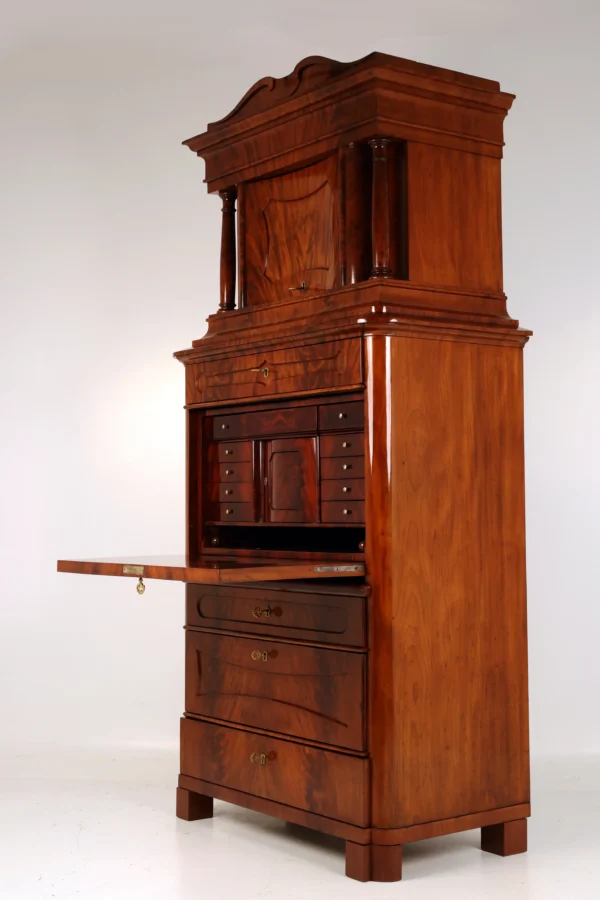
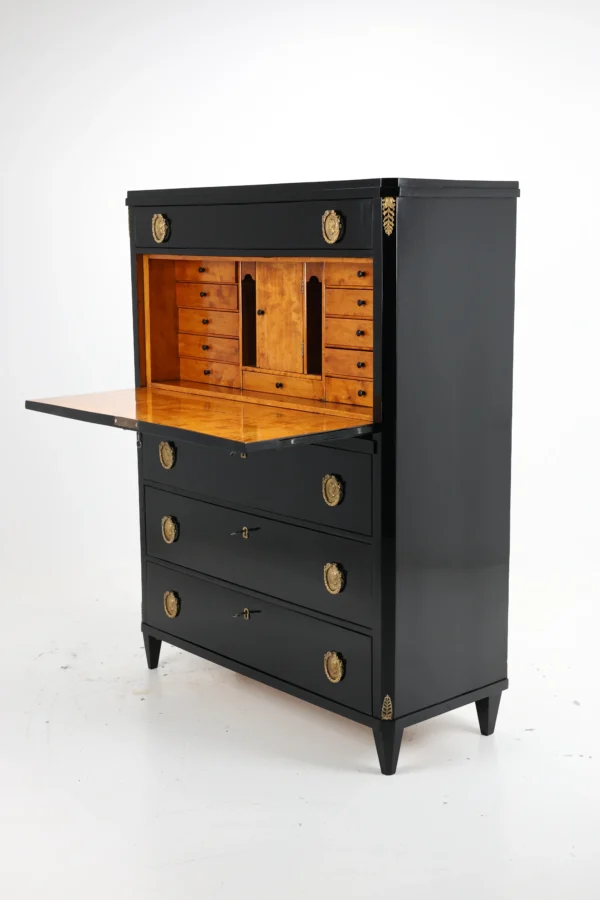
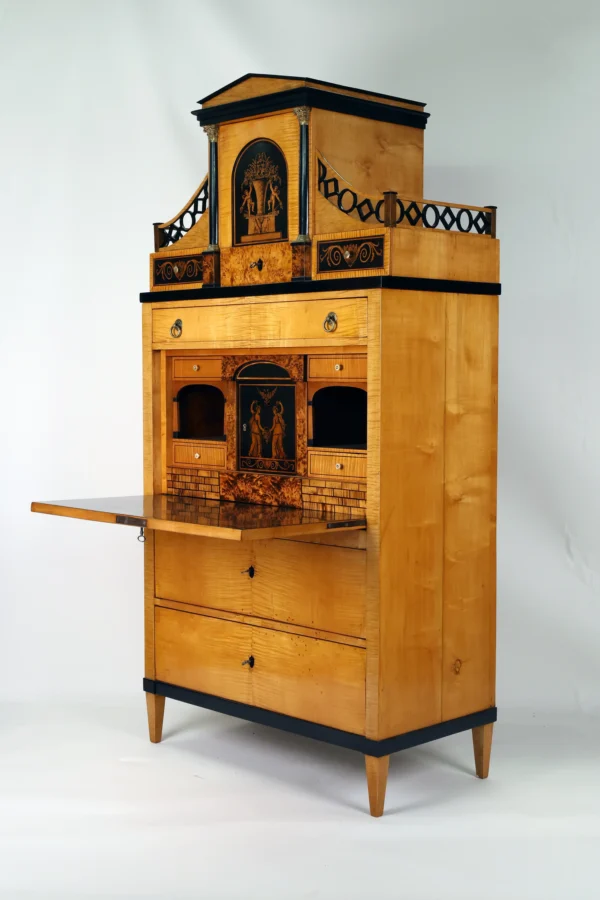
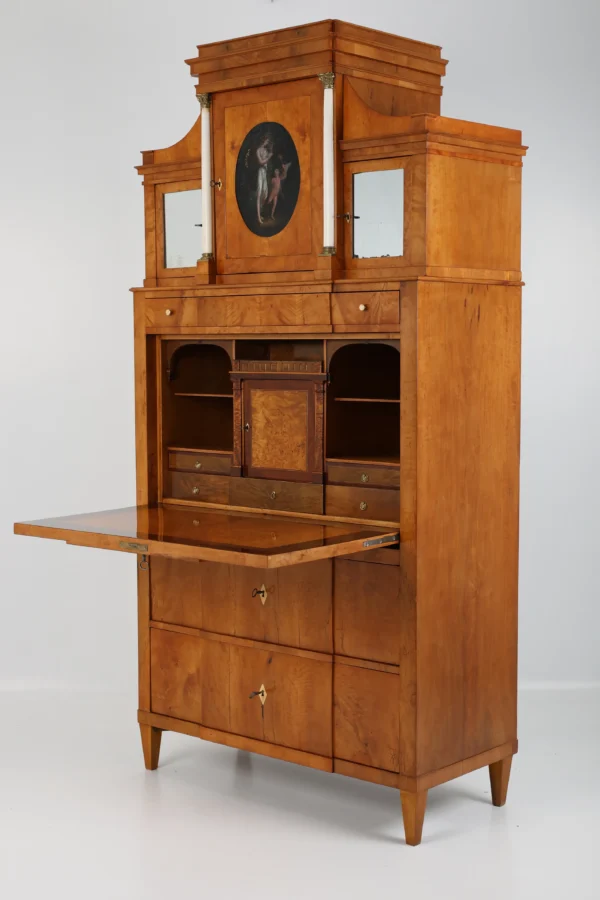
in this collection cover the full range of the tradition, from early 19th century Viennese secretaires in cherrywood and walnut to German Biedermeier examples in birch and maple from Berlin and the surrounding workshops. Each desk has been assessed individually for the integrity of the veneer surface, the condition of the drop front mechanism, the functioning of the original hardware, and the completeness of the fitted interior.
The Biedermeier secretary desk is the most personal piece of furniture the period produced. Where a chest of drawers stores linens and clothing, a secretary desk stores the private life of its owner: correspondence, financial documents, personal diaries, and in Metternich’s Europe of political surveillance, anything that needed to be kept from view. The hidden compartments, false panels, and trick locks built into the finest Biedermeier secretaires were not decorative gestures. They were practical security solutions for a middle class that had no reliable banking system and lived under a regime of state surveillance that made private correspondence genuinely dangerous.
The exterior of a Biedermeier secretary desk presents a face of complete calm. A vertical rectangular case, typically veneered in flame walnut or birch with ebonized column details and simple brass escutcheons, stands on a plinth base or small bracket feet with nothing to announce the complexity behind the closed flap. The drop front, when lowered, reveals a fitted interior that is an entirely different register from the restrained exterior: contrasting veneers, mirrored niches, small drawers in graduated sizes, and in the finest examples hidden compartments accessible only through a memorized sequence of mechanical triggers.
This duality, severe public exterior and theatrical private interior, is the defining characteristic of the Biedermeier secretary desk, and it reflects the political and social conditions of the period more directly than any other piece of Biedermeier furniture.
The finest Biedermeier secretary desks were produced in the decades immediately following the Napoleonic wars, roughly 1815 to 1840, when the style was at its most disciplined and its cabinetmakers were working at the highest level of their craft. An early 19th century antique Biedermeier secretary from this period carries the full intelligence of the tradition: sawn veneer of three to five millimeters with depth and warmth that machine production never achieves, hand-cut dovetails in the small interior drawers, and a shellac or French polish finish applied by hand that has developed over two centuries into something entirely its own.
A Biedermeier secretary desk from circa 1820 in Vienna or the surrounding Austrian workshops represents the most refined expression of the form. Viennese cabinetmakers favored cherrywood and walnut, applied in bookmatched sheets across the drop front and the case panels, with ebonized column details flanking the flap and a fitted interior of considerable ingenuity. The proportions are human in scale, designed for a modest urban apartment rather than a palatial state room, and that domestic intelligence gives these pieces a compatibility with contemporary interiors that larger and more formal furniture traditions do not always achieve.
The empire style that preceded Biedermeier had produced secretaires of considerable grandeur: dark mahogany, heavy French Empire column supports, marble tops, and gilt bronze mounts communicating military authority. The Biedermeier secretary desk rejected every one of those choices. Light native fruitwood replaced dark mahogany. Ebonized wooden details replaced bronze mounts. The fitted interior became a space for private life rather than state display.
German Biedermeier secretary desks from Berlin, Munich, and the surrounding workshops have a character distinct from their Viennese counterparts, and understanding that distinction helps considerably when assessing a specific piece. The influence of Karl Friedrich Schinkel’s architectural neoclassicism is visible in the stronger proportions, harder edges, and more disciplined geometry of German examples. Where Viennese desks tend toward warmth and gentle curves, German Biedermeier secretary desks are more architectural and more austere, with a precision of line that reflects a different cultural sensibility.
Birch and maple are the dominant veneers in German production, giving these pieces a cooler, paler character than the warm cherry and walnut of Vienna. The fitted interiors of antique German Biedermeier secretaires are typically more restrained in their decorative ambition than Viennese examples, with cleaner architectural organization of the small drawers and compartments and less theatrical use of contrasting veneers. The overall effect is one of considerable refinement achieved through discipline rather than warmth.
A Biedermeier mahogany secretary from a German workshop, in original condition with its hardware intact and its interior fittings complete, is a genuinely rare find. Mahogany was expensive and difficult to source after the Napoleonic blockades disrupted import routes, which means genuine early 19th century mahogany Biedermeier pieces from German workshops are less common than walnut or birch examples and correspondingly more sought after by serious collectors.
The market for vintage Biedermeier secretary desks divides clearly between authentic early period pieces from 1815 to 1848 and revival production from the late 19th century onward. Understanding the difference is the most practically useful knowledge a buyer can have before purchasing.
Authentic Biedermeier secretaires carry sawn veneer of three to five millimeters, visible as depth and slight surface variation at any chipped edge. The drop front mechanism on original pieces operates smoothly and precisely, supported by brass quadrant stays that are original to the piece and show the patina of age. The small drawers in the fitted interior have hand-cut dovetails with slight irregularities in spacing that machine production cannot replicate. The back panel, assembled from wide solid wood planks, shows the deep grey-brown oxidation of genuine age.
Late 19th century revival pieces followed the Biedermeier forms closely but used machine-sliced veneer of under one millimeter, machine-cut dovetails that are perfectly uniform, and hardware that lacks the organic variation of hand-forged originals. These are not without interest, particularly well-made examples in walnut or birch that suit a contemporary interior at a more accessible price point, but they are different objects from authentic period pieces and should be priced and represented accordingly.
Every Biedermeier secretary desk in this collection has been examined against these criteria. Restoration work carried out in the atelier addresses the drop front mechanism, the interior fittings, and the surface finish without over-treating the piece. A secretary desk with its original interior compartments intact and its shellac finish unstripped is a considerably more complete and more valuable object than one that has been refinished or had its interior altered.
For related Biedermeier storage and case furniture from the same period and the same regional workshops, the Biedermeier furniture collection covers the full range of forms including cabinets, commodes, and display pieces. The Biedermeier chest of drawers section covers the most closely related form, with examples in walnut, birch, and cherrywood from Viennese, German, and Scandinavian workshops.
Worldwide shipping is available on all pieces, with delivery handled through specialist fine art carriers experienced in antique furniture. If you are looking for a specific Biedermeier secretary desk, a particular wood, regional origin, or interior configuration not currently listed, write to us at contact@antiqueria-breitling.com. The warehouse holds pieces not yet photographed or catalogued, and requests are often easier to fulfill than buyers expect.


,%20circa%201815&url=https://antiqueria-breitling.com/product/fine-biedermeier-maple-secretaire-north-germany-braunschweig-circa-1815/&media=https://antiqueria-breitling.com/wp-content/uploads/2026/03/Seketera-12-683x1024.webp)
