Worldwide Insured Shipping
Hand-Restored in our Atelier
Professional Custom Crating

Worldwide Insured Shipping
Hand-Restored in our Atelier
Professional Custom Crating

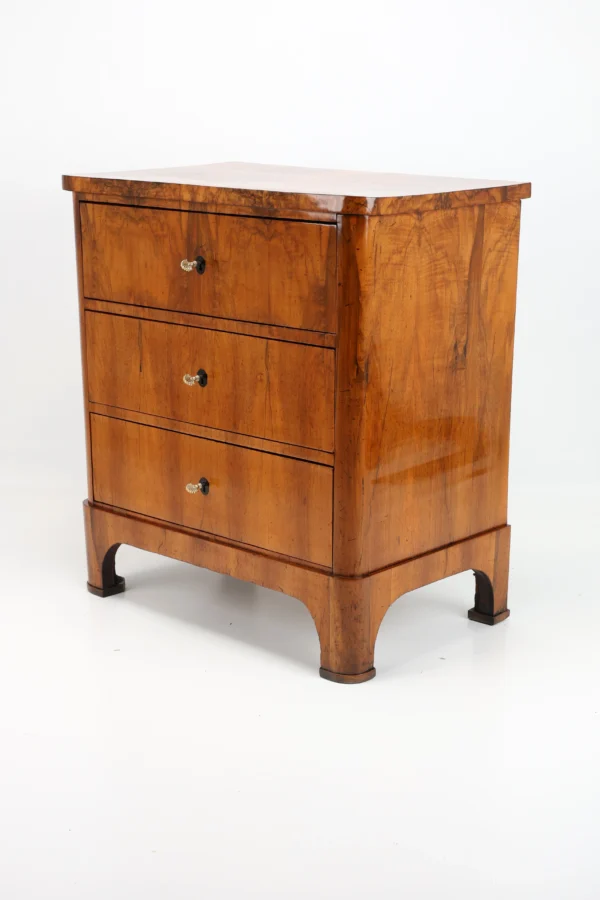


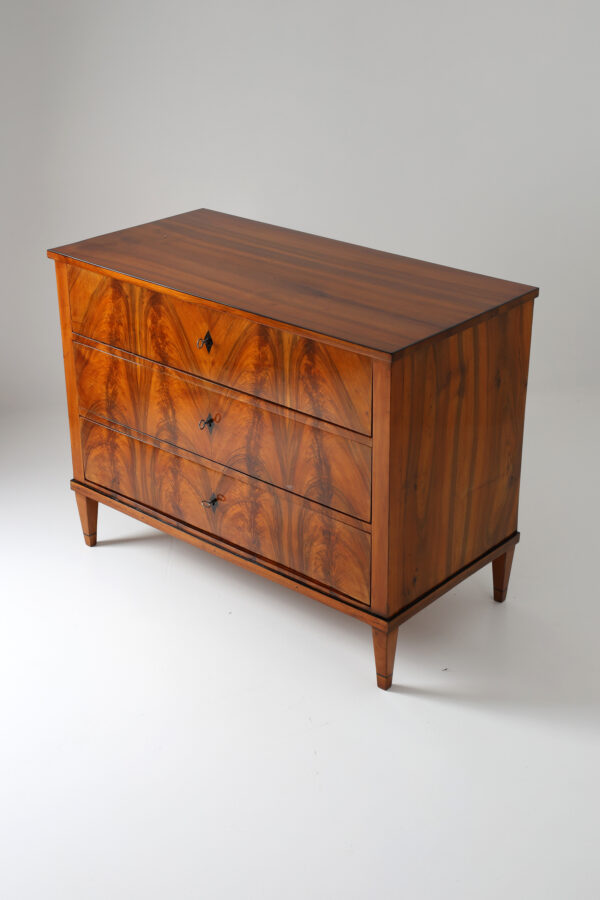
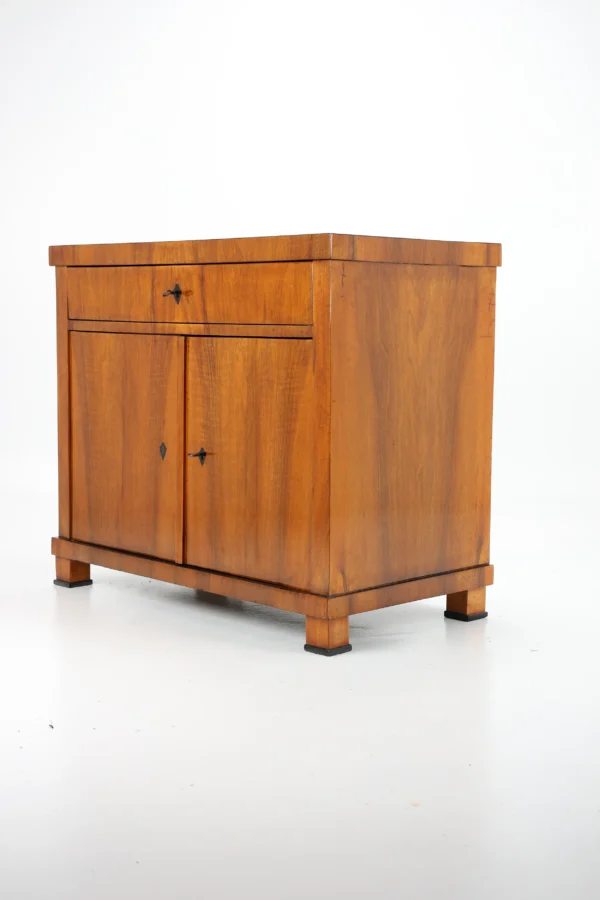
In this collection cover the full range of the tradition, from early 19th century Viennese examples in cherrywood and walnut to German Biedermeier pieces in birch and the paler Scandinavian variants of the Karl Johan style. Each chest has been assessed individually for the integrity of the veneer surface, the condition of the original finish, and the quality of the underlying construction.
The Biedermeier chest of drawers arrived as a direct rejection of what came before it. The Napoleonic wars had exhausted Central Europe economically and politically, and when Metternich’s conservative order settled over the German-speaking states after 1815, the growing middle class turned inward. The heavy Empire style commodes of the previous decade, dark mahogany, gilt bronze mounts, marble tops, and the symbolic weight of aristocratic power, gave way to something entirely different. Biedermeier designers stripped all of that away and let the wood speak for itself.
What emerged was a chest of drawers built around the grain. Walnut, cherrywood, birch, and fruitwood, all native European materials chosen for their warmth and figure, were sliced into sawn veneer sheets and laid in book-matched pairs across the drawer fronts, creating mirror-image grain patterns that ran uninterrupted from the top drawer to the base. The bookmatched walnut veneer on a fine Biedermeier chest has a visual depth that no applied ornament achieves, and it was arrived at through considerable cabinetmaker skill rather than decorative addition.
Ebonized details, thin column accents, chamfered edges, and simple escutcheons provided geometric contrast against the pale veneer without bronze mounts or marble. The plinth base or bracket feet kept the silhouette clean. The shellac finish, built up in layers by hand, developed a warm amber patina over two centuries that synthetic varnish cannot replicate.
The finest Biedermeier chests of drawers were produced in the decades immediately following the Napoleonic wars, roughly 1815 to 1840, when the style was at its most disciplined and its most resolved. An early 19th century Biedermeier chest from this period carries the full weight of the tradition’s design intelligence: sawn veneer of three to five millimeters with the depth and warmth that machine production never achieves, hand-cut dovetails in the drawer construction, and a shellac finish applied by hand that has developed over two centuries into something no modern coating replicates.
The drawer fronts on the best early examples show bookmatched walnut or cherrywood veneer running uninterrupted from the top drawer to the plinth base, with ebonized details providing precise geometric contrast and nothing more. A Biedermeier walnut chest of four drawers from circa 1830, in original unstripped condition with its patina intact, is among the more complete objects the period produced. The wood, the construction, and the finish tell a single coherent story, and that coherence is exactly what serious collectors and interior designers look for when they choose this period over later revival production.
Regional variations within the Biedermeier tradition are significant, and they affect both the character of specific pieces and their current value.
Viennese Biedermeier chests are the most refined expression of the form. Cherry and walnut veneer, gentle curves at the corners or feet, and a warmth of proportion that reflects the workshop tradition Josef Danhauser established in Vienna make these pieces the most immediately appealing for contemporary interiors. Many Biedermeier chests from the Vienna workshops feature three to five drawers with carefully graduated proportions, the lower drawers deeper and wider, which gives the piece a visual stability that suits both period and modern rooms.
German Biedermeier from Berlin and Munich, shaped by the architectural influence of Karl Friedrich Schinkel and the neoclassicism of the Prussian court, is more restrained in its curves and stronger in its proportions. Birch veneer and darker walnut appear more frequently, and the overall character is more architectural and disciplined than its Viennese counterpart. A 19th century Biedermeier chest from this tradition in birch veneer with ebonized details and a plinth base has a graphic quality that suits a contemporary interior without requiring any period framing.
Scandinavian Biedermeier in the Karl Johan manner, using pale Karelian birch with its characteristic flame pattern, is the most spare of all the regional traditions. The veneer surfaces on these pieces have a luminosity that reflects the northern European preoccupation with maximizing interior light, and the clean geometry of the drawer arrangement and the base suits minimalist contemporary rooms with particular ease.
Authentic Biedermeier pieces from the early 19th century, circa 1830 and the surrounding decades, are distinguished from late 19th century revival production primarily by veneer thickness. Original sawn veneer measures three to five millimeters, with a depth and warmth that machine-cut veneer from the revival period cannot approach. The drawer construction tells the same story: hand-cut dovetails with slight irregularities in spacing confirm pre-industrial making, while machine-cut joints from the revival period are perfectly uniform.
The late 19th century Biedermeier revival produced chests of drawers in considerable numbers, and distinguishing these from earlier authentic pieces matters for both authenticity and valuation. Revival pieces followed the original Biedermeier forms closely but were made with industrialized techniques that changed the character of the furniture in ways that are visible on close examination.
Machine-sliced veneer from the revival period is paper thin, often under one millimeter, and has a flatness and uniformity that sawn veneer does not have. The dovetails in revival drawer construction are machine-cut and perfectly uniform, lacking the slight irregularities of hand work. The proportions of many revival pieces are also slightly heavier than earlier originals, and the grain pattern on the drawer fronts tends toward narrower, more repetitive configurations rather than the broad, dramatic bookmatching of the 1815 to 1840 production.
This does not mean late 19th century Biedermeier chests are without interest. Many are well-made pieces in walnut or birch veneer that suit a contemporary interior and are available at more accessible price points than earlier originals. Understanding the distinction allows a buyer to make a deliberate choice rather than an uninformed one, which is always the better position to be in.
Vintage Biedermeier dressers from the mid-19th century occupy an interesting position in this category. Produced as the original Biedermeier period gave way to the historicist styles of the 1840s and 1850s, these pieces carry the Biedermeier vocabulary into a slightly heavier and more decorated register. The drawer fronts may incorporate modest inlay or marquetry details that earlier pieces would have avoided, and the proportions are occasionally more generous than the spare geometry of the 1815 to 1840 production. They are not lesser pieces for this reason. They reflect a different moment in the tradition and suit a different kind of interior.
A walnut chest of four drawers from this period in original condition, with its richly grained veneer surfaces and original escutcheons intact, is a practical and visually strong piece of antique furniture that works as naturally in a contemporary bedroom as in a more traditionally furnished room.
For the full context of the Biedermeier tradition, including secretaries, side tables, seating, and cabinets from the same period and the same regional workshops, the antique Biedermeier furniture section covers the complete range of forms available.
If you are looking for a specific Biedermeier chest of drawers, a particular wood, drawer configuration, or regional origin that is not currently listed, write to us at contact@antiqueria-breitling.com. The warehouse holds pieces not yet photographed or catalogued, and requests are often easier to fulfill than buyers expect.


