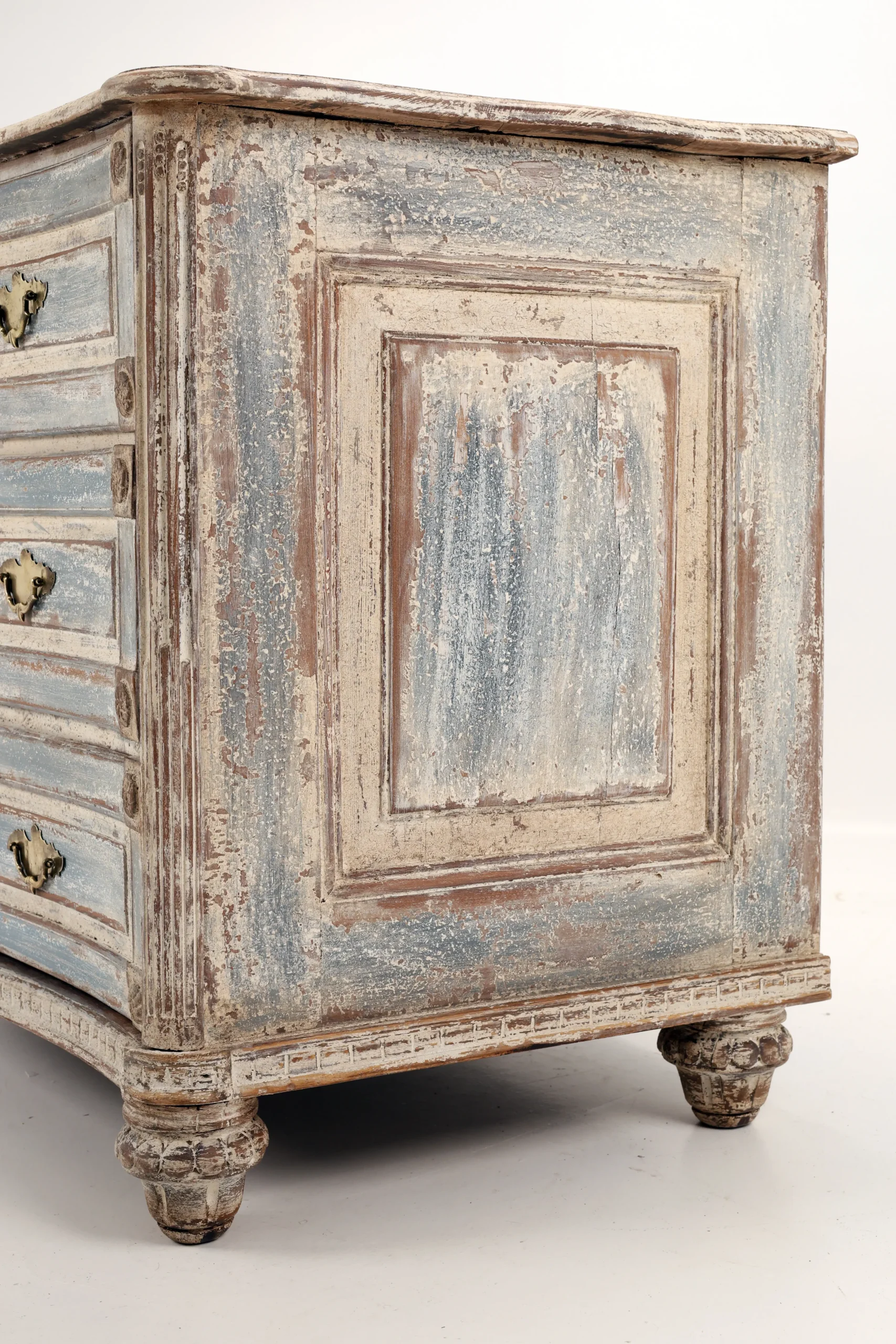
Behind every great desk is a person who needed to write, and to keep what they wrote safe. The antique desk is the piece of furniture where writing was raised to an art, the physical center of intellectual, administrative, and diplomatic life across four centuries of European history. Follow the desk from the grand flat writing tables of the Baroque through the Rococo, the rational Louis XVI period, and the monumental Empire, and you trace the whole story of how Europe worked, wrote, and governed. While the slant-front bureau and the fall-front secrétaire were built to push against a wall, it was the open desk forms, the bureau plat, the cylinder desk, and the pedestal desk, that came to command the center of the grand room as free-standing statements of authority and craftsmanship. At Antiqueria Breitling, a fine desk is one of the most rewarding things to own, because it is furniture you sit at and use, not just admire.
Why the Desk Was Born
Dedicated writing furniture appeared in force in the early seventeenth century, driven by the rise of the nation-state, the growth of centralized bureaucracy, the dawn of global banking, and a vast expansion in literacy and private correspondence. As Europe turned from war toward administration and the cultivated life of the salon, people needed somewhere proper to write.
The word bureau captures the whole evolution. It began as bure, a coarse brown woolen cloth, the kind used for monks’ cowls, which was draped over a fine table to protect the polished wood from ink and the scratch of a quill. By the mid-seventeenth century the word had shifted from the cloth to the furniture itself, and later expanded again to mean the office or government department where the desk stood, permanently linking the furniture to the idea of administration and authority. The desk was driven from the top of society. King Henry IV is recorded asking for a great desk fitted with a multitude of drawers, compartments, locks, and keys to organize sensitive state papers, and as the absolute monarchy demanded ever more record-keeping, the simple writing table evolved into specialized architectural forms.
The Open Desk Forms
The open and flat desks were conceived very differently from the wall-leaning bureau. They were three-dimensional centerpieces, made to be admired and used from every angle. The quintessential form is the bureau plat, the flat writing table, with a large rectangular top usually inset with tooled leather, a shallow frieze of drawers, and four supporting legs, finished flawlessly on all sides so it could stand in the center of a room. The owner sat facing outward, receiving visitors and signing documents, commanding the space.
The bureau à cylindre, the cylinder or roll-top desk, added a curved tambour or solid quarter-cylinder shutter that rolled back to reveal the writing surface and a fitted interior of pigeonholes and small drawers, letting a ruler or diplomat lock away confidential papers in an instant without disturbing their arrangement. The partner’s desk, an English invention, was a massive pedestal desk with drawers on both sides so two people could work face to face. The pedestal desk offered a central kneehole flanked by banks of drawers, and the smaller table à écrire and the lady’s bonheur du jour served lighter, more private correspondence. Each form answered a different way of working.
The Baroque Origins
The grand story begins under Louis XIV. The earliest specialized form was the Bureau Mazarin, a kneehole desk on eight legs joined by elaborate stretchers, but it was the royal cabinetmaker André-Charles Boulle who created the true bureau plat. Recognizing that the Mazarin’s eight legs and deep pedestals restricted movement and made it hard for a king and his secretaries to work from several angles, Boulle expanded the writing surface, replaced the pedestals with a shallow frieze of drawers, and reduced the legs to four.
His early bureaux plats were monumental and architectural, decorated in his namesake marquetry of tortoiseshell, pewter, and brass, often laid over red ground to produce a glowing crimson undertone. Crucially, Boulle established the practice of finishing the desk on all sides, turning the bureau plat from wall-leaning furniture into a free-standing monolith of authority placed squarely in the center of the room, its vulnerable veneer edges protected by sculptural gilt-bronze mounts.
The Rococo Flourish
When Louis XV came to the throne, the heavy geometry of the Baroque gave way to the flowing asymmetry of the Rococo, and the bureau plat changed with it, adopting sweeping cabriole legs and serpentine outlines that banished the straight line. The dark ebony and tortoiseshell of Boulle’s tradition gave way to brilliant floral and geometric marquetry in exotic imported woods, amaranth, kingwood, tulipwood, and rosewood. The mounts of the finest pieces were no longer applied superficially but integrated into the very lines of the desk, flowing from the top down to the bronze sabots on the feet, and to project authority from every angle the front drawer layout was echoed on the back with false drawer fronts.
This era also refined the cylinder desk, and produced the most famous desk ever made: the Bureau du Roi, begun in 1760 by Jean-François Oeben for the private study of Louis XV at Versailles and finished nine years later by his pupil Jean-Henri Riesener. Weighing some 450 kilograms and built from over 2,800 individual parts, with secret compartments and a mechanism that rolled the cylinder back at a single turn of the king’s key, it stands as the supreme example of the cabinetmaker’s and engineer’s art combined.
The Rational Elegance of the Louis XVI Desk
By the reign of Louis XVI the sensuous Rococo had triggered a neoclassical reaction, inspired by the excavations at Pompeii and Herculaneum, and the antique French desk abandoned its curves for straight lines and measured proportion. Whether a bureau plat or a cylinder desk, it now stood on straight tapering legs, frequently fluted in imitation of classical columns. Bold floral marquetry gave way to refined geometric parquetry and, increasingly, to broad expanses of figured mahogany, with gilt-bronze mounts becoming delicate architectural framing rather than sculptural outgrowths.
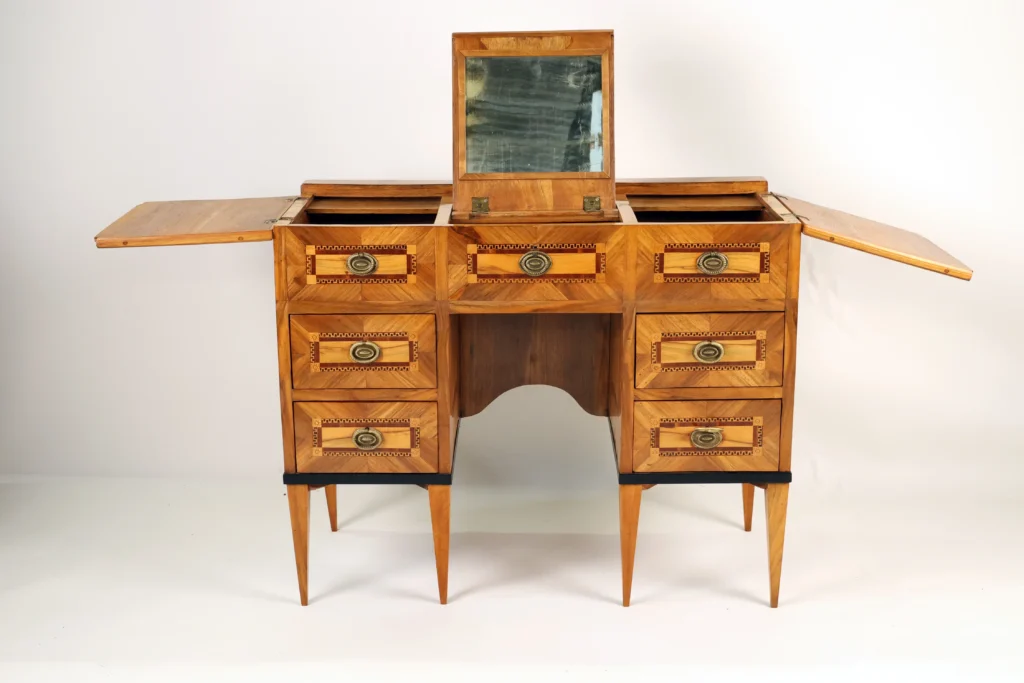
This was the golden age of the stamped desk, made by an elite of cabinetmakers, many of German origin, working in Paris. Riesener continued his dominance after the Bureau du Roi, delivering a celebrated desk for Marie-Antoinette at the Petit Trianon. Adam Weisweiler created delicate refined forms set with Japanese lacquer and pietra dura, working closely with the powerful dealer Daguerre, while David Roentgen, operating from Neuwied for an international royal clientele, was the master of the mechanical desk, its austere mahogany exterior concealing systems of weights and springs that deployed lecterns and hidden drawers at the turn of a key.
The Imperial Authority of the Empire Desk
The Revolution swept away the guilds, the dealers, and the royal patronage that had driven the Louis XVI style, and when stability returned under Napoleon the Empire period demanded a new aesthetic of military triumph, permanence, and Roman order, well suited to an age of vast administration and legal codification. The Empire desk is aggressively monumental, heavy and block-like where the Louis XVI desk was delicate. The material was almost exclusively dark, highly polished Cuban mahogany in broad flat expanses, marquetry abandoned as a relic of the fallen aristocracy, the unadorned wood serving as a stark backdrop for heavy fire-gilded ormolu.
The supports shifted from slender legs to full architectural columns, pilasters, and monolithic pedestal bases, sometimes taking the form of monopodia, classical supports with the head and chest of a lion resting on a single paw. The mounts carried strict imperial iconography: laurel wreaths, stars, winged victories, palmettes. The foremost maker was Jacob-Desmalter, working from the archaeological designs of Napoleon’s architects Percier and Fontaine, supplying monumental desks to the imperial palaces. These were not desks for light morning correspondence; they were tools of statecraft, designed for ruling a continent.
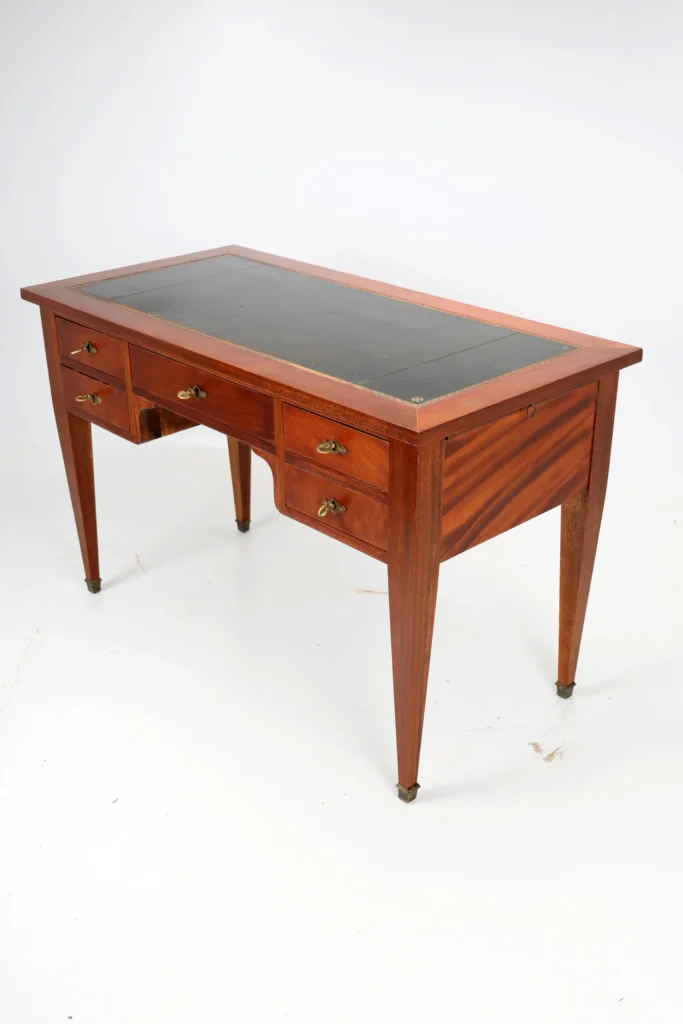
The Empire idiom reached beyond the grandest palaces and into more modest, practical pieces, which is exactly what an Empire-style desk of around 1840 represents. Built on a solid oak carcass and veneered in beautiful pyramid mahogany, it carries the classic character of the period in compact, usable form. Though modest in size it is highly practical, with pull-out side extensions that expand the working surface, the main top and the pull-outs all covered in leather embossed with delicate gilded detailing. It keeps its five original keys with finely crafted ends, the legs are mounted with brass appliqués, and subtle escutcheons frame the keyholes. It is a restrained, refined piece rather than a monument, and it shows how the Empire taste for dark figured mahogany and architectural clarity carried down into desks made for real daily use, the kind that fit as easily into a modern room as a period one.
Beyond France
While Paris set the high style, distinct regional traditions produced variations collectors prize today. In England the Georgian era gave rise to the storage-heavy pedestal desk and the partner’s desk, perfected for banks and legal firms where two professionals worked face to face across a shared leather surface, with makers like Chippendale and later Gillows prizing the rich unadorned beauty of solid mahogany over gilt bronze. In the German lands the post-Napoleonic Biedermeier writing table democratized the desk, stripping away ormolu and military severity in favor of clean architecture and the beauty of light native woods, walnut, cherry, ash, and bird’s-eye maple, in spectacular bookmatched veneers, the desk becoming the centerpiece of the middle-class living room and a symbol of intellectual self-improvement. The Dutch developed dramatic bombé writing desks in elaborate seaweed marquetry, and in Italy Pietro Piffetti, royal cabinetmaker to the House of Savoy in Turin, created breathtaking desks in burr walnut, exotic woods, tortoiseshell, and shaded ivory.
How to Read a Genuine Antique Desk
Authenticating a desk means reading the evidence left by the maker, the guild, and time. The hidden carcass tells the origin: French bureaux plats were built on stable frames of quarter-sawn white oak, English desks leaned on oak and pine for drawer linings and framing. Period veneer was cut by hand and is relatively thick, up to around three millimeters, far heavier than the paper-thin rotary-cut veneer of later reproductions. The dovetails should be hand-cut and slightly irregular, the drawer bottoms chamfered to allow seasonal movement, and the secondary woods should show deep natural oxidation from centuries of air exposure rather than clean, bright, machine-planed surfaces.
The single most telling test for a bureau plat is whether it is finished on all sides. A genuine free-standing desk was completed front and back, since it was meant to stand in the center of a room, so a desk with an unfinished or flat back was likely a wall console or a dressing table later modified to look like a desk. The gilt-bronze mounts are the next clue: true eighteenth-century ormolu was mercury-gilded, leaving a soft matte bloom in the recesses and a heavy, cold feel with crisp hand-chasing, while later electroplating looks thin, uniform, and brassy. The leather top is commonly and acceptably replaced once or twice over two centuries, but on a cylinder desk the original working mechanism is a rare survival that commands a premium. The French guild marks, the maker’s estampille and the JME inspection stamp, settle attribution where they survive, hidden beneath rails or drawers, though royal makers working outside the guild often left no stamp at all. Every desk that comes through Antiqueria Breitling is assessed against exactly these markers before it is offered.
The Antique Desk in the Modern Room
The antique desk has come full circle. As laptops have swept away filing cabinets and towers of paper, the home office and private study have returned to their eighteenth-century role as curated spaces of reflection and intellectual pleasure, and the desk has become a statement piece once more. The bureau plat is especially prized because, finished on all sides, it can anchor the center of a room rather than sit against a wall, letting light sweep across its leather top and define the flow of the space, while the clean lines of a Louis XVI desk or the warm veneers of a Biedermeier writing table slip easily into contemporary interiors as an anchor of historical gravity and craftsmanship.
The market is driven by verified provenance, the fame of the stamped maker, structural originality, and the condition of the mounts and marquetry, with documented Louis XVI and Empire pieces at the very top, a royal Riesener desk for Marie-Antoinette having sold for over a million pounds. But there is real opportunity across the range, from stamped Empire desks by Jacob-Desmalter to English mahogany partners desks and elegant Biedermeier writing tables, and value is best preserved when a desk keeps its original fire-gilded mounts, its unaltered carcass, its working locks, and the natural oxidized patina that aggressive over-restoration destroys. At Antiqueria Breitling, fine desks across the Louis XVI, Empire, and later traditions are restored in-house and assessed against every marker above, and the full range can be browsed in our antique desks collection. Write to us at contact@antiqueria-breitling.com for pieces not yet listed, with worldwide shipping available on everything we offer.