


Here is a strange fact about one of the most beautiful forms in European furniture: it was never meant to stand on its own. The console table is the most purely architectural object the great cabinetmakers ever produced, designed not to furnish a floor but to complete a wall. Conceived together with the room’s panelling, the tall mirror hung above it, and the heavy marble slab that crowned it, the antique console table cannot really be understood in isolation. To pull one into the middle of a room is to strip it of its meaning. At Antiqueria Breitling, the console is one of the most architectural pieces we handle, and understanding it means understanding the relationship between furniture, light, and the built room itself.
A Bracket That Became Furniture
The word console comes straight from architecture. A console was originally a structural bracket or corbel projecting from a wall to bear a weight, a cornice, a balcony, an arch. When that bracket was adapted in the early seventeenth century to support an ornamental shelf or a slab of marble in a grand interior, the new furniture form kept both the name and the logic of the corbel. It was, in essence, a decorated bracket.
The defining feature of a true console table, the thing that separates it from a side table or a center table, is its dependence on the wall. The earliest examples had only two front legs, or a single sculptural support, and were physically fixed to the panelling with iron brackets or wooden cleats. Even when the form grew four legs and could stand under its own weight, the reliance on the wall remained absolute. One of the most telling facts about the antique console table is that the back was never meant to be seen. The back rail was left plain, unfinished, often rough-hewn. The piece presented a magnificent carved facade to the room and turned a blind, utilitarian back to the plaster. The terms console table and pier table are often used interchangeably today, though strictly a pier table was the type designed to stand on the pier, the section of wall between two windows.
The Console, the Pier, and the Mirror
To see a console as just a surface on legs is to miss its genius entirely, because it was conceived as the lower half of an architectural ensemble. By the mid-seventeenth century the great rooms at Versailles had codified the arrangement, and the placement of the console was dictated by the rhythm of the windows. Set against the pier between two windows, the console was inextricably linked to the tall pier glass mounted directly above it, and that pairing was not merely decorative but a clever solution to a lighting problem. Windows flooded a room with daylight, but the solid masonry between them threw long dark shadows, and a large mirror on that dark pier turned the void into a source of reflected light.
The console below served as a stage for illumination, built to hold silver or gilt-bronze candelabra, often flanked by matching sconces. Lit at night, the candlelight bounced off the pier glass and effectively doubled, throwing the grandeur of the room back into itself. The console and the mirror were a single indivisible unit, frequently carved with the same motifs so that the ornament of the base echoed the ornament of the frame above, physically tying the floor line to the cornice. A grand gallery might hold matched pairs or sets of four, creating a unified architectural envelope. The console was not placed in a room. The room was designed around it.
The Crown of Stone
If the carved base tied the console to the woodwork of the room, the marble top tied it to the architecture of the building. Marble was the standard for the finest consoles, chosen for its durability against heavy candelabra and spilled wax, and for its sheer projection of permanence and wealth. The choice of stone was a real decorative decision, the color picked to harmonize with the fireplace, the panelling, or the silk on the walls. A period marble top was thick, often well over an inch, and its weight was considerable, which meant the carved base beneath had to function as a load-bearing structure as much as a sculpture, capable of carrying hundreds of pounds of stone for centuries without buckling.
The stones themselves form a lexicon of period and place. Polychrome Sarrancolin breccia from the French Pyrenees, declared a royal quarry by Louis XIV, ran through the grandest Baroque and Rococo rooms at Versailles. Deep cherry-red Griotte and Rouge Royal marked high-end Louis XV and Louis XVI pieces. Pure white Carrara became the standard of neoclassical purity in the late eighteenth century and the Empire. Black Portoro slashed with gold lent a severe luxury to Empire and later pieces, while golden Sienna and dark green Verde Antico ran through Italian and English consoles. There is a quiet irony in all this stone: because marble resists the woodworm, humidity, and sunlight that destroy gilded wood and fragile gesso, the original top often outlives the base it was made for, and an original period slab with its rough hand-cut underside carries a real premium today.
The Baroque Console and the Power of the Court
The history of the console maps the shifting priorities of the European elite almost perfectly. Under Louis XIV the console emerged as a vehicle for projecting absolute power. The earliest grand examples were massive, heavy, and deeply sculptural, carved from oak or walnut and lavishly water-gilded, standing on imposing baluster or term legs joined by an elaborate carved stretcher that swept up to a central urn or carved putto. The designs came from the orbit of Jean Berain and Charles Le Brun at the Gobelins manufactory, and the iconography was unapologetically regal: masks, sunbursts, acanthus, and military trophies.
There is a fascinating backstory here. These carved giltwood consoles were in many ways wooden substitutes for the legendary solid silver furniture of Versailles. Louis XIV owned over two hundred pieces of silver furniture that lined the Hall of Mirrors, but when the cost of the Nine Years’ War forced him to melt it all down in 1689 to fund his armies, carved and gilded wood took up the mantle of ultimate luxury, replicating the heavy, reflective, sculptural quality of the lost silver in an enduring new medium.
The Exuberance of the Louis XV Rococo Console
As the rigid protocol of the Sun King gave way to the intimate Parisian townhouse of the Régence and Louis XV, the console reached its most theatrical height. The Rococo dissolved the imposing symmetry of the Baroque into flowing, restless asymmetry, and the Louis XV console appears not to be built from joined wood at all but to grow organically out of the floor like a vine or a sea grotto. Heavy architectural legs gave way to sinuous cabriole legs ending in scrolled feet, and the aprons were pierced and carved with extraordinary lightness, a matrix of negative space filled with C-scrolls, shells, foliage, dripping water, and the occasional dragon or mask.
These were the supreme showpieces of the carver’s art, and producing one was a strictly divided guild affair. The menuisier built the structural frame and made sure it could bear the marble, the sculpteur executed the flamboyant three-dimensional carving, and the doreur applied the gold. Under designers like Nicolas Pineau and Juste-Aurèle Meissonnier, the Louis XV console stopped resembling furniture at all and became expressive sculpture pinned against a wall.
The Architectural Restraint of Louis XVI
By the 1760s the twisting excess of the Rococo had exhausted itself, and the excavations at Pompeii and Herculaneum turned taste sharply back toward classical antiquity. The Louis XVI console returned the form to its architectural roots. The cabriole leg was replaced by a straight tapering leg, deeply fluted like a classical column, and the pierced rocaille apron gave way to a disciplined frieze of guilloche, Greek key, laurel swags, and rosettes set into square corner blocks. The demilune, the perfect half-moon console, became fashionable, alongside the console desserte with open mirror-backed shelves made for displaying Sèvres porcelain and silver in the new dedicated dining rooms. Makers like Georges Jacob and Jean-Henri Riesener shifted the focus from fully carved giltwood toward polished mahogany and tulipwood mounted with jewel-like ormolu, and the form returned, in spirit, to the architectural bracket it had always been.
Imperial Severity — The Empire Console
Under Napoleon, guided by the architects Percier and Fontaine, the console pushed neoclassicism to an extreme of heavy, literal monumentality. The Empire console was overwhelmingly rectangular, its surfaces broad unbroken expanses of figured mahogany rather than delicate marquetry, and its front supports transformed into literal architecture: full columns, Egyptian caryatids, or carved monopodia in the form of winged lions and sphinxes. A defining feature of the Empire and the related Biedermeier pier table was a mirrored panel set between the rear supports, reflecting the floor and the backs of the front columns to create the illusion of a full free-standing table and amplifying the light from the windows above.
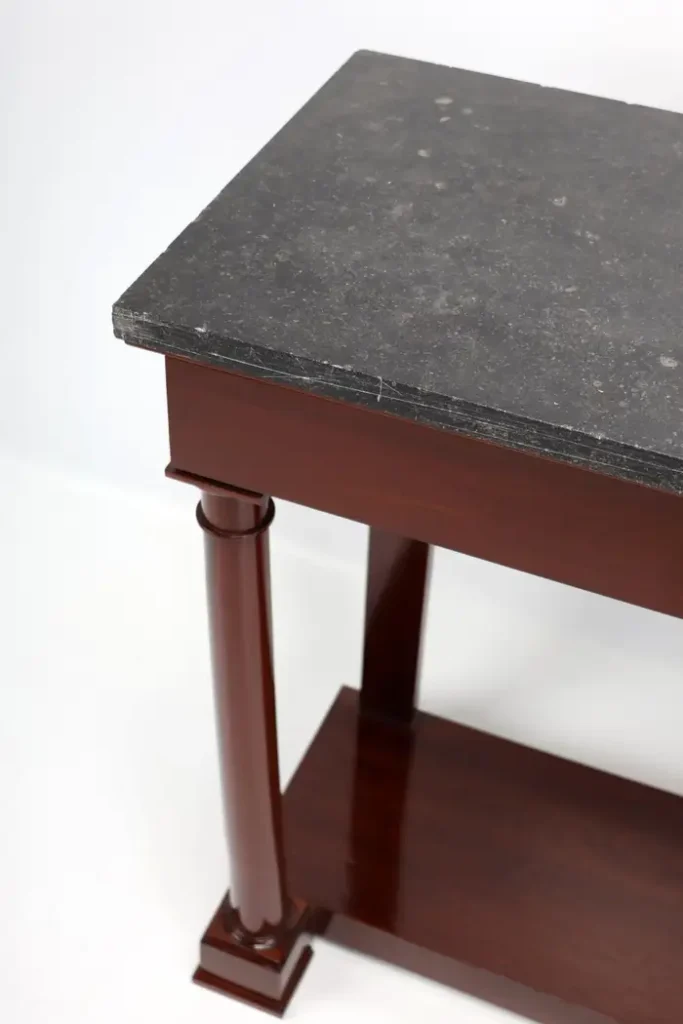
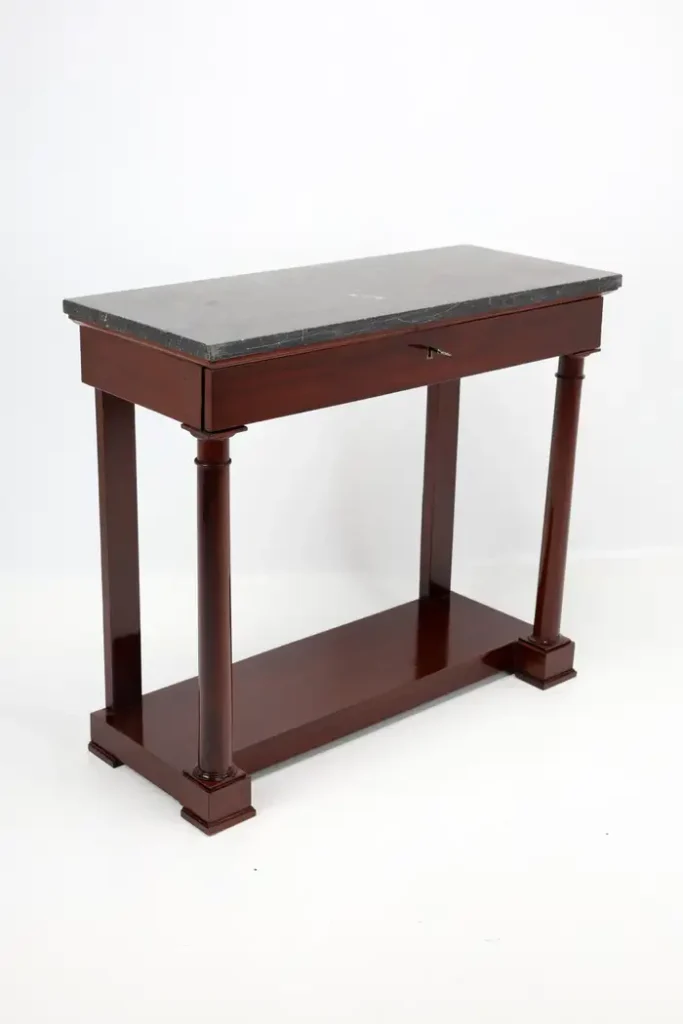
A French Empire console of around 1810 shows this language with great clarity. Built in mahogany and mahogany veneer, it rests on full freestanding columns at the front and flat pilasters at the rear, the classic Empire arrangement that turns the table into a small piece of architecture. The columns stand on a solid plinth base with a lower display shelf between them, the whole crowned with a thick slab of dark marble whose surface carries the natural mineral flecking of the stone, finished by hand with shellac to a deep mahogany glow. The plain rear pilasters are the honest mark of a true wall console, finished to face the room and left simple where they meet the wall. It is fine, stable, very good quality Empire furniture, and it carries the whole idea of the form in one piece: the column as support, the marble as crown, the back built for the wall.
The console did not end with Napoleon. Through the Restauration, Louis Philippe, and the Napoléon III revival it persisted as a prestige form, though the later nineteenth century leaned heavily on historicist revivals, reviving Boulle marquetry and Rococo giltwood, often made with industrial machinery rather than the hand-carved vitality of the eighteenth century, bringing the form to the rising middle class.
Regional Voices — Italy, Germany, England, and the Low Countries
France set the grammar, but other regions spoke powerful dialects of their own. The Italian console was the most operatic of all. In Rome, in the orbit of Bernini, tables abandoned conventional supports entirely in favor of violently twisting tree trunks, rockwork, plunging eagles, and interlacing figures, and in Venice the great carver Andrea Brustolon built monumental stands with life-size figures bearing the tops on their shoulders. Italian consoles often crowned themselves not with quarried marble but with scagliola, a painted imitation of rare stone, or with pietra dura, the costly mosaic of semi-precious hardstones reserved for royal workshops and diplomatic gifts.
In Germany, under Frederick the Great at Sanssouci, carvers like Hoppenhaupt produced a nervous, fluttering Rococo with deeply undercut bouquets and long-legged birds extending from the frame onto the mirror glass. In England, William Kent designed heavy architectural pier tables for Palladian interiors with carved eagles and dolphins, before Robert Adam lightened the form into delicate demilune consoles in satinwood and painted decoration. The Dutch blended French Louis XVI geometry with their own mastery of floral marquetry, producing slightly heavier pier tables for the wealthy merchant’s hall.
The Anatomy of Gold
A fine giltwood console was a triumph of specialized craft, and understanding its making is the key to judging it. The carved base was usually a close-grained wood chosen for carving and gilding, lime or beech in France, soft pine or poplar in Italy. The surface was built up in the labor-intensive process of water gilding. First the raw wood was sealed with hot rabbit-skin glue, then eight to twelve layers of gesso, a warm mixture of chalk and animal glue, were laid on. Because the gesso buried the crisp detail of the carving, a specialist called the répareur recut it with fine iron tools, a uniquely French technique known as reparure that produced razor-sharp detail impossible to achieve in raw wood. Over the recut gesso came a layer of clay bole, usually red to warm the gold, then the gold leaf itself, finally burnished with an agate stone to a mirror gleam, with the recesses left matte or toned with red glazes to deepen the shadows.
How to Read a Console
Assessing an antique console means reverse-engineering its making. The first focus is the gilded surface. Thousands of eighteenth-century consoles were later over-painted with bronze powder paint or aggressively stripped and re-gessoed, destroying the original reparure, so a knowing eye looks for genuine water gilding. Surprisingly, pristine gold is treated with suspicion, because connoisseurs place a premium on honest wear, where centuries of friction have worn the micron-thin gold through to the warm red bole beneath, and in the most worn spots to the white gesso. That patina tells an irreplaceable story and cannot be convincingly faked.
The back is just as revealing. A true wall console shows rough-hewn timber on the back rail, with hand tool marks and no decorative finish, and sometimes the rough mortises or iron hardware where it was once spiked to the panelling. A piece finished and gilded on all four sides was likely a free-standing table later married to a mirror, or a nineteenth-century reproduction made for flexible placement. The marble is the final test. A period top is thick, and while its surface and molded edges are polished, the underside should be rough, showing the irregular strikes of hand chisels and mallets. Smooth, uniform circular saw marks underneath betray a later machine-cut replacement. Every console that comes through Antiqueria Breitling is read against exactly these markers before it is offered.
The Console in the Modern Room
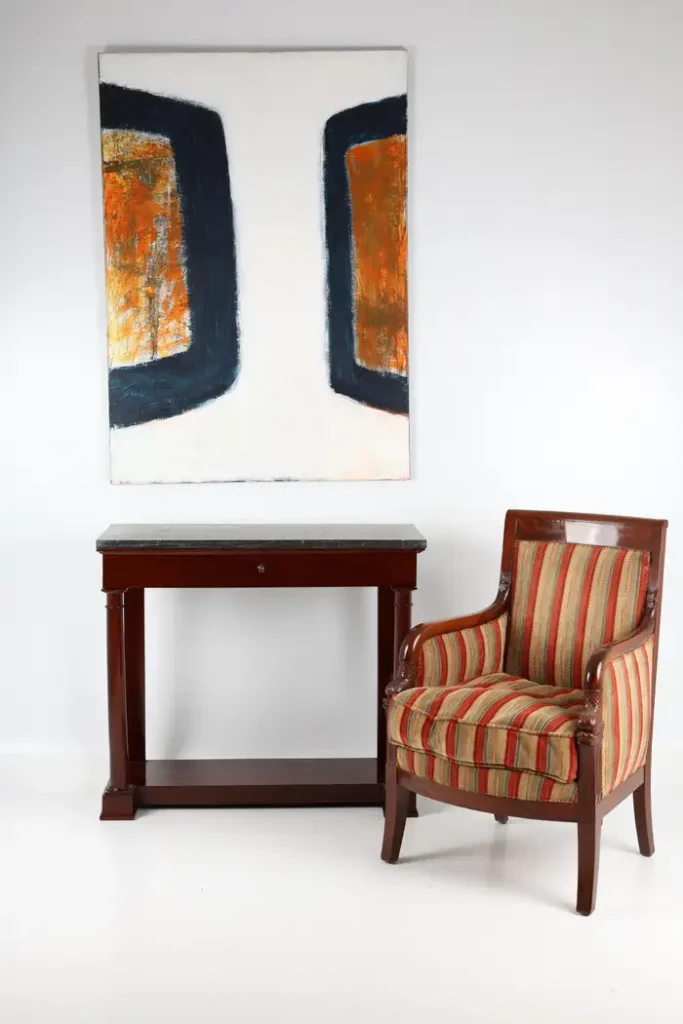
For a form born in candlelit palaces, the console adapts to contemporary interiors with remarkable ease, precisely because its shallow footprint makes it an ideal architectural anchor for open, uncluttered spaces. Designers use a French console table in a narrow entrance hall to set a tone of depth and reception, behind a low sofa to divide an open-plan space, or in a dining room as an elegant serving surface. The real magic comes from the tension between the patinated, architectural antique and the clean lines of modern art and contemporary walls, where the console becomes a commanding sculptural focal point. The old console-and-wall ensemble lives on whenever a mirror or a piece of modern art is hung above it, completing the vertical composition exactly as the pier glass once did.
The collector market stays robust and is driven by period, condition, and the quality of the work. Premium prices follow original undisturbed water gilding even when heavily worn, the survival of the original marble, and the mastery of the carving, and a signed Louis XVI console bearing the estampille of a master like Jacob or Riesener commands extraordinary sums. Even unsigned pieces, the wildly theatrical Italian carved consoles or the delicate English demilune tables, are coveted statement pieces. At Antiqueria Breitling, fine consoles across the Empire, neoclassical, and earlier traditions are restored in-house and assessed against every marker above, whether you are drawn to a columned Empire console in glowing mahogany or the carved grace of an earlier giltwood piece. The full range can be browsed in our antique side tables collection, and you can explore the wider period in our antique Empire furniture selection. Write to us at contact@antiqueria-breitling.com for pieces not yet listed, with worldwide shipping available on everything we offer.

