


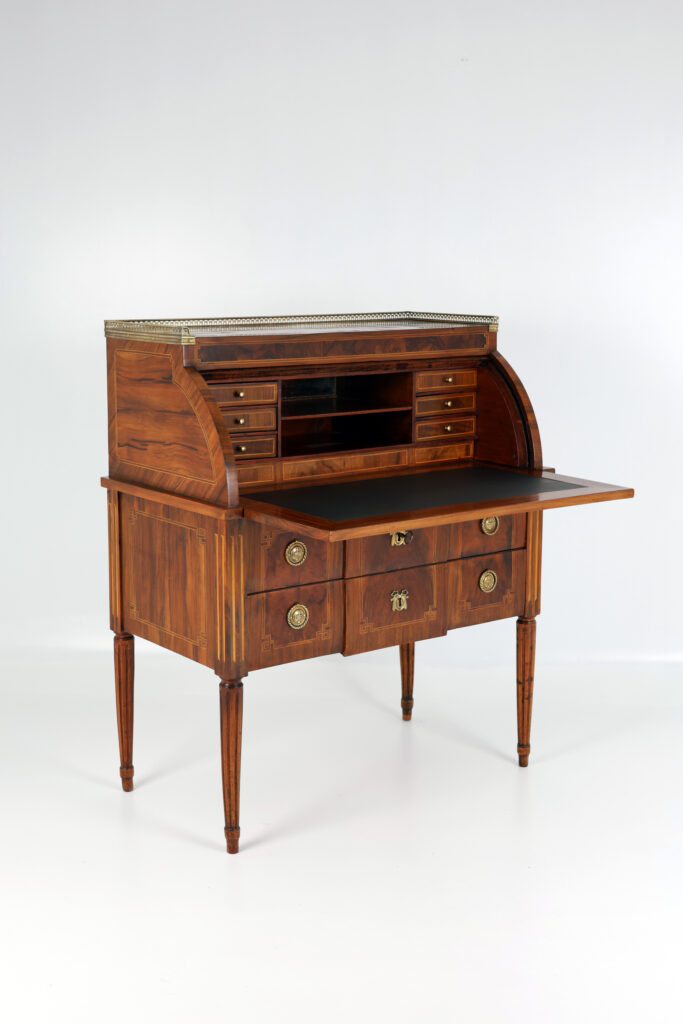
Anyone looking to buy an antique cylinder desk is buying a mechanism as much as a piece of furniture. The form appeared in Paris around 1760 and solved a problem every earlier writing desk had left open, and it did so with a curved lid that rolls back into the carcass and takes the whole working surface out of sight in one movement. At Antiqueria Breitling we have a French cylinder desk of about 1800 in walnut in the collection at the moment, with a central lock that secures the drawers and the cylinder together. This article follows the form from the royal cabinet at Versailles to the oak office desks of the late nineteenth century, and explains what is actually happening inside one.
What Defines an Antique Cylinder Desk
A cylinder desk is a writing desk whose working surface and fitted interior are closed by a curved element that rolls or slides back into the body of the piece. Two systems share that description. The first is the solid cylinder, a rigid quarter-round panel built up from staves or from steamed and shaped timber, which turns back as one piece. The second is the tambour, made of dozens of narrow slats glued side by side onto a backing of canvas or leather, flexible enough to follow a curved track.
The distinction matters when you are buying, because the two age differently and are repaired differently. The names vary as well. French sources say bureau à cylindre or secrétaire à cylindre for the solid form, German sources use Zylinderbureau for both, and English usage separates the cylinder desk from the tambour desk, while reserving roll-top desk for the mass-produced office furniture of the nineteenth century.
What all of them offered was something no earlier desk could. A bureau plat left papers in full view. A secrétaire à abattant or a slant-front bureau had to be cleared before the fall could be closed. A cylinder desk could be shut over an unfinished letter and locked, and opened again the next morning with everything where it had been left.
The Bureau du Roi and the Paris Origins of the Cylinder Desk
The form was born in the workshop of Jean-François Oeben in Paris around 1760, and the piece that defined it was the desk made for the private cabinet of Louis XV at Versailles, known since as the Bureau du Roi. Oeben began the commission in 1760 and died in 1763 with the desk unfinished. His former assistant Jean-Henri Riesener took over the workshop, married Oeben’s widow in 1767, and delivered the completed desk in 1769. The documented cost was in the region of 62,000 livres, among the highest sums paid for a single piece of furniture in the eighteenth century.
A tradition attaches the original idea to the Austrian ambassador Kaunitz rather than to a cabinetmaker, and it may be nothing more than a story, but it says something true about the market. This was furniture for people whose papers mattered, and who received visitors in the room where they wrote. Within a decade the form had spread through the Paris trade, and makers including Jean-François Leleu and Martin Carlin were producing versions for the same clientele. Carlin went as far as setting his desks with Sèvres porcelain plaques supplied by the marchands-merciers, the dealers who effectively directed Parisian taste.
The Mechanism of a Cylinder Desk
The appeal of these desks rests on engineering that is invisible when the piece is closed. In a solid cylinder desk the quarter-round hood runs in quadrant grooves milled into the thickness of the side panels, so the curve is guided along its whole travel rather than hinged at one point. Because that hood is heavy, lead counterweights were often concealed at the back of the carcass to take the effort out of the movement.
The best French and German examples go further and link the cylinder to the writing slide, so that drawing the leather-lined surface towards you rolls the cylinder back at the same time, and pushing it home closes the desk. Many pieces also carry a central locking system, in which one key turning in the cylinder throws internal rods that secure the drawers below at the same moment. That single feature explains a great deal about how these desks were used.
Tambours work on an entirely different principle and fail in an entirely different way. The slats are milled with interlocking or half-round profiles, laid tight against one another and glued onto canvas with hot animal glue. That glue is reversible, which is a virtue in restoration, but it is also sensitive to humidity, and over two centuries it crystallises and the backing rots, so the slats loosen and jam. Solid cylinders usually suffer from shrinkage instead: the substrate moves, the panel distorts, it binds in its grooves, and the veneer on the curve begins to lift. A correct repair of either uses warm hide glue rather than a modern adhesive, so that the next restorer can undo the work.
David Roentgen and the Mechanical Cabinetmakers of Neuwied
The most ambitious cylinder desks of the period were not made in Paris but in the small Rhineland town of Neuwied, in the workshop of David Roentgen. Working outside the guild structures that governed Paris and Berlin, Roentgen organised production on something close to an industrial model, with standardised carcasses that could be finished to order in different veneers, marquetry and mounts, and he sold across Europe through an export network he built himself.
His furniture is known for its mechanical complications. A concealed button or a key turned in a particular direction releases spring-driven drawers, rising compartments and hidden interiors. In 1784 he delivered a large desk to Catherine the Great in St Petersburg for a recorded 20,000 roubles, a sum that stood comparison with the price of an estate. Roentgen also sold by lottery on occasion, touring his stock through European capitals and turning the gambling habits of the nobility into a sales method.
The Louis XVI Cylinder Desk in Mahogany, Walnut and Marquetry
Under Louis XVI the cylinder desk took on the discipline of the new neoclassical taste. Curves flattened, proportions squared up, and the piece came to stand on tapering legs, often fluted. A raised superstructure with small drawers or a pierced brass gallery became common, and the decoration moved from flowing floral marquetry towards geometric inlay, banding and broad panels of figured veneer, with mahogany favoured in Paris and walnut, cherry and fruitwoods in the provinces and across the Rhine.
The French cylinder desk of about 1800 in the Antiqueria Breitling collection belongs to this moment. It has straight sides, a semi-circular roll-top in the upper section and two drawers below, and it stands on tapering, fluted legs. The carcass is veneered in walnut with strongly figured grain and fine inlay work, with a geometric meander pattern framing the drawer fronts and a pierced brass gallery around the top. The interior holds six small drawers and open compartments around a central recess, and the writing surface is lined in black leather. Its most interesting feature is the central locking mechanism, which secures both drawers and the roll-top together, exactly the arrangement described above. It measures 100.5 cm wide, 56.5 cm deep and 119 cm high, and it was restored in our own atelier and finished with shellac and wax.
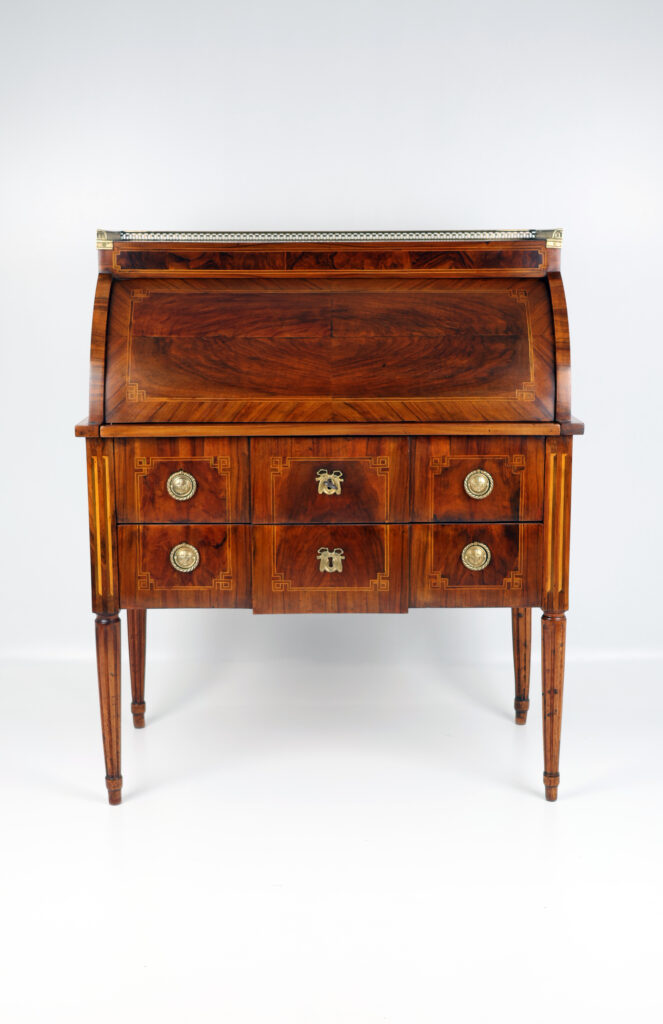
Desks of this size were made for a study or a private room rather than for display, and they remain among the most practical antiques to live with, since the working surface can be left in use and shut away in a second. Pieces with a comparable fitted interior appear regularly in our antique secretary desks section.
The Zylinderbureau in Germany, Austria and Central Europe
In the German-speaking lands the cylinder desk outlived the taste that produced it. After 1815 the gilt bronze disappeared almost entirely and attention moved to the timber, with mirrored veneers of cherry, walnut, ash and birch laid in broad panels, and small ebonised columns or mouldings supplying the contrast that bronze had provided in France. Vienna was the centre of production, and the large manufactories there turned out cylinder desks of a quality that matched anything made in Paris, in a plainer register.
These are usually the most usable examples on the market. The proportions are domestic, the interiors are generously fitted, and the surfaces were built to be repaired rather than replaced.
The English Tambour Desk and the Cylinder Bureau Bookcase
English cabinetmakers took the idea up from the 1770s and generally preferred the tambour to the solid cylinder. Thomas Shearer published designs for both in the Cabinet-Maker’s London Book of Prices of 1788, including the arrangement in which pulling out the lopers brings the writing surface forward and rolls the cover back in the same movement, and Sheraton’s drawing book carried the form further in the 1790s.
English examples are usually in mahogany or figured satinwood with fine stringing in ebony or holly, lighter in construction than their continental equivalents. The characteristic English development is the cylinder bureau bookcase, where a glazed bookcase stands on the cylinder section, turning the desk into a piece of library furniture.
From the Royal Cabinet to the Victorian Roll-Top Desk
The form’s second life was commercial. In the second half of the nineteenth century the cylinder desk became the standard desk of the office, above all in the United States, where Abner Cutler of Buffalo took out patents from 1850 onward and built a business on the roll-top. These desks were made in quartersawn oak, with deep pedestals of drawers and an S-curved tambour above, and their interiors were packed with pigeonholes that functioned as a filing system in an age that had no filing cabinets.
That is also why they went out of use. Once the vertical filing cabinet arrived in the 1890s and the typewriter took over correspondence, a hundred small compartments and a curved lid stopped making sense in an office. The form survived as domestic furniture, which is where it has stayed.
Dating an Antique Cylinder Desk
The cylinder desk was reproduced throughout the nineteenth century, including by Parisian workshops of real quality such as Linke and Dasson, so the question is rarely whether a piece is good and usually when it was made. An eighteenth-century carcass shows hand-cut dovetails of uneven spacing, the straight marks of a hand saw on the secondary timber, and thick sawn veneer, in the region of one and a half to two millimetres, laid on an oak or pine substrate. A piece made a century later tends to show the arcing marks of a circular saw, machine-cut dovetails of mechanical regularity, and thin sliced veneer.
Two further points are worth attention. Check whether the cylinder and the carcass agree in their veneer and their wear, since a replaced cylinder or a relined writing surface is common and should be reflected in the price. Check the mounts as well, because bright electroplated brass on a piece otherwise consistent with the eighteenth century usually means later replacement. At Antiqueria Breitling every piece is catalogued with the period and origin we can support, and where a desk is in the style of an earlier period rather than of it, the description says so.
Antique Cylinder Desks for Sale
The French walnut cylinder desk described above is available now, restored in our own atelier, where ten master restorers work in marquetry, French polishing, wax finishes and inlay repair. It can be seen alongside the rest of our neoclassical furniture, and further photographs, measurements and a condition report are available for it or for any other piece on request. Write to us at contact@antiqueria-breitling.com. We ship worldwide, fully insured, in crates built to measure for each piece.

