Worldwide Insured Shipping
Hand-Restored in our Atelier
Professional Custom Crating

Worldwide Insured Shipping
Hand-Restored in our Atelier
Professional Custom Crating

This collection brings together the neoclassical tradition as it developed across Europe between roughly 1760 and 1848, from French Louis XVI commodes and secretaires to Empire mahogany with gilt bronze mounts and the painted pine and birch of the Swedish Gustavian interior. Every piece is assessed individually for the quality of its veneer and marquetry, the condition of the original surface, the authenticity of its mounts and hardware, and the amount of original timber that survives. Antiqueria Breitling has been buying neoclassical furniture since the 1980s, and what appears here has passed through our own atelier, where ten master restorers work in marquetry, French polishing, wax finishes and inlay repair.
Neoclassicism was the longest-lived furniture style in modern European history. It began as an archaeological reaction against the Rococo, survived a revolution and an empire, and ended as the domestic language of the middle-class household. A neoclassical chest of drawers, secretaire or dining table suits a contemporary interior for the same reason it suited a room in 1790: the forms are straight, the proportions are calm, and the ornament stays in its place.
The characteristics of neoclassical furniture come from architecture rather than from nature. Where a Rococo commode swells and curves, a neoclassical one stands square, on legs that taper and are often fluted like columns. The carcass is read as a facade, with a clear cornice, a frieze and a plinth. Symmetry is strict. Ornament is drawn from Greek and Roman sources and applied in measured quantity: rosettes, urns, laurel and acanthus, guilloche bands, Greek key, fluting, paterae and palmettes.
The excavations at Herculaneum from 1738 and at Pompeii from 1748 gave European designers a supply of authentic classical models, and engraved publications carried them into every workshop within a generation. By the 1760s the new taste had a name in Paris, the goût grec, and by the 1770s it had reached Stockholm, Vienna, Berlin and London. What changed from country to country was not the vocabulary but the material and the degree of display.
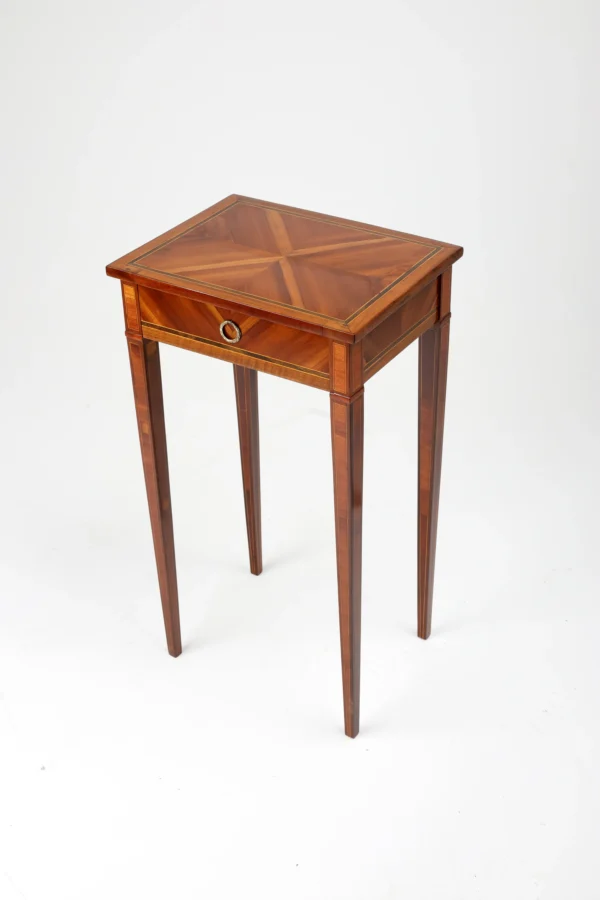
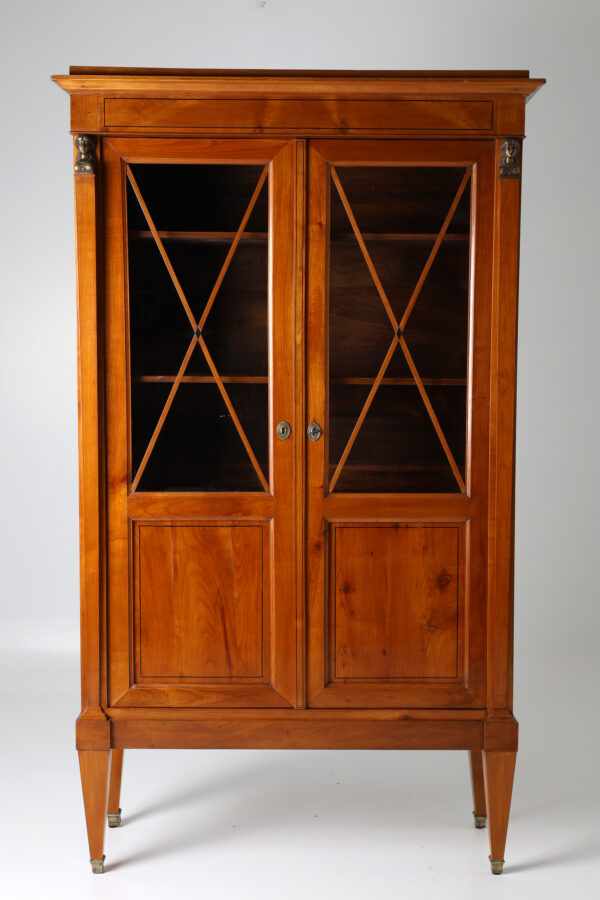
Surfaces carry most of the effect. Fine veneers laid in flat panels, marquetry in geometric or pictorial patterns, marble tops on case furniture, and gilt bronze mounts placed at the corners, the keyholes and the feet. Seating is upholstered flat rather than deeply scrolled, and the legs of chairs follow the same fluted or sabre-shaped logic as the case pieces. The neoclassical marquetry centre table and the neoclassical cherrywood display cabinet in this collection both show how far the style could travel through the nineteenth century while keeping that discipline.
French neoclassicism under Louis XVI, who reigned from 1774 to 1792, is the reference point for the whole movement. The bombé front of the Louis XV commode straightens, the cabriole leg becomes a tapered and fluted column, and marquetry turns from flowing floral sprays to geometric cube and trellis patterns, ribbon borders and small architectural scenes. Mahogany arrives from the colonies and is used in broad, plain panels framed by gilt bronze.
Parisian ébénistes of this generation, among them Jean-Henri Riesener and David Roentgen, worked to a standard of veneer cutting and mechanical ingenuity that later production rarely matched. Provincial French workshops translated the same forms into solid walnut and cherry, with carved rather than gilded ornament, and those pieces often have more presence in an ordinary room than their court counterparts. Our Louis XVI furniture section holds commodes, secretaires, desks and cabinets from both traditions.
The Empire style, formed under Napoleon between 1804 and 1815, took neoclassicism in a heavier and more political direction. Charles Percier and Pierre Fontaine designed interiors and furniture for the imperial residences and published their designs, giving cabinetmakers across Europe a pattern to follow. The workshop of Jacob-Desmalter supplied the court and set the technical standard.
Empire case furniture is architectural and severe: flat mahogany surfaces with almost no carving, columns or pilasters at the corners, plinth bases, and marble tops. The decoration is concentrated in gilt bronze mounts, and the motifs carry the message of the regime, with laurel wreaths, victories, swans, stars and bees, and after the Egyptian campaign of 1798, sphinxes, palmettes and caryatid figures. German and Austrian versions of the style, made in the same years, are usually quieter, substituting local walnut and cherry for mahogany and carved wood for bronze. Pieces of both kinds appear in our Empire furniture section.
Sweden produced the most distinctive northern version of the style. Gustav III, who reigned from 1771 to 1792, visited France as crown prince and returned with the taste that carries his name. Gustavian furniture takes the French neoclassical outline, the straight frieze, the fluted tapering leg, the carved rosette in the square block above it, and executes it in local pine and birch under paint.
The pale palette is the point. Grey, off-white, pearl and soft blue finishes were intended to hold the low northern light, and the effect in a modern interior is immediate: the same architectural forms as a Louis XVI commode, but without the weight that dark veneer brings. Original painted surfaces, worn thin at the edges and showing the wood beneath, are the most valued and the hardest to find, since generations of owners repainted them. The chests of drawers, sideboards and cabinets in our Gustavian furniture section are selected with the state of the paint surface as the first consideration.
The vocabulary stayed constant across the period, but each form applied it in its own way. The neoclassical commode is the clearest case. Three drawers or two, a straight front, canted and fluted corners, short tapering legs, a marble top and mounts set at the corners and around the keyholes. Compared with a Rococo commode it holds far less floor space for the same storage, which is one reason these pieces suit modern rooms so well. Examples in several regional traditions can be found in our antique chest of drawers section.
The secretaire is the architectural form of the period. A tall case, a fall front that drops to make a writing surface, and behind it an interior of small drawers and compartments laid out with the same symmetry as the exterior, often with a central niche flanked by columns. Cabinetmakers treated these interiors as miniature buildings, and the quality of that hidden architecture is the fastest way to judge the ambition of a piece. Our antique secretary desks section covers the French, German and Austrian variants.
Tables followed the same logic. Dining and centre tables moved onto turned columns or pedestal supports with moulded circular or oval tops, while console and side tables kept a straight frieze above tapering legs, frequently with a marble slab. Seating was built to match, with oval or square backs, flat upholstery and fluted legs, so that a room could be furnished as a single architectural composition.
Neoclassical cabinetmaking is veneer work above all. A commode of 1790 or 1820 is built from a softwood or oak carcass and faced in thin sheets of a more valuable timber, cut and laid so that the figure runs symmetrically across drawer fronts and sides. Marquetry of the period tends to be geometric, in cube, lozenge and trellis patterns, or pictorial, with urns, trophies, musical instruments and architectural views set into oval or rectangular reserves.
Marble tops were standard on French case furniture and common in Italy and Central Europe, usually in white, grey or black, moulded at the edge and cut to the shape of the carcass below. Mounts were cast in bronze and fire gilded, a process that leaves a deep, slightly uneven gold tone in the recesses, quite different from later electroplating. On German and Austrian pieces the same effects are often achieved in wood, with ebonised columns, black and gold painted capitals and turned bases replacing the bronze.
Neoclassicism was revived repeatedly in the nineteenth century, and telling a period piece from a later one matters when you are buying. A commode made around 1790 shows hand-cut dovetails of uneven spacing, saw marks from a pit or frame saw on the back and drawer bottoms, veneer that is thick enough to feel at the edges, and shrinkage across the grain that pulls the carcass slightly out of square. A revival piece made in 1890 in the Louis XVI taste will be more regular in every respect: machine-cut joints, thin sliced veneer, circular saw marks, and hardware with even, centred screw slots.
Neither is a fault in itself, and a well-made revival piece can be an excellent object, but the two belong to different price levels and should be described honestly. Each piece in this collection is catalogued with the period and the origin we can actually support, and where a piece is in the style of an earlier period rather than of it, the description says so.
Neoclassical furniture works in modern rooms because it was designed around the same principles that modern architecture returned to: straight lines, clear proportion, and ornament that follows structure rather than covering it. A Louis XVI commode against a plain wall, a Gustavian chest under a large contemporary painting, a mahogany secretaire in a hallway, all hold their place without crowding the room around them.
Scale is usually the deciding factor rather than style. Case furniture of this period was made for rooms with high ceilings, but the pieces themselves are often narrower and lower than modern equivalents, and a commode of 1800 will frequently sit comfortably where a modern sideboard would not. Mixing periods is straightforward as well, since the geometry that governs a neoclassical piece also governs most twentieth-century design, which is why neoclassical case furniture and mid-century design sit together so easily. Further pieces from the same decades can be found in our 18th century furniture and 19th century furniture sections.
Every piece offered here has been restored in our own atelier using traditional methods, including hand-applied shellac polish, wax finishes and period-correct repairs to veneer and inlay. Condition reports, additional photographs and full measurements are available for any piece on request.
If you are looking for a particular form, period or regional tradition that is not currently listed, a Louis XVI secretaire, an Empire console, a painted Gustavian cabinet, write to us at contact@antiqueria-breitling.com. The warehouse holds pieces that are not yet photographed or catalogued, and specific requests are often easier to fulfil than buyers expect. We ship worldwide, fully insured, in crates built to measure for each piece.


