Worldwide Insured Shipping
Hand-Restored in our Atelier
Professional Custom Crating

Worldwide Insured Shipping
Hand-Restored in our Atelier
Professional Custom Crating
In this collection cover the full range of the tradition, from early 19th century Viennese armoires in cherry veneer and walnut to German Biedermeier examples in birch and the paler Scandinavian pieces of the Karl Johan style. Each wardrobe has been assessed individually for the integrity of the veneer surface, the condition of the original finish, the functioning of the original lock mechanism, and the completeness of the interior fittings.
The Biedermeier wardrobe arrived as a direct rejection of everything the French Empire style had celebrated. Where Empire armoires imposed dark imported mahogany, heavy ormolu mounts, classical column supports, and the symbolic vocabulary of Napoleonic propaganda, the Biedermeier wardrobe stripped all of that away and replaced it with native woods, clean lines, and a domestic intelligence entirely suited to the urban middle class apartments of Central Europe.
The political conditions that produced this shift are worth understanding. After 1815, under Metternich’s system of censorship and political surveillance, the growing middle class of the German-speaking states turned inward. Family life and private activities replaced public discourse, and the home became the center of everything that mattered. The term Biedermeier itself was originally a satirical insult, a composite name mocking the apolitical, comfort-focused bourgeois citizen, but the furniture produced during the 1815 and 1848 period outlasted the joke entirely. It is now recognized as the first major European furniture design movement created specifically for the middle class rather than the nobility or the imperial court, and it anticipated the principles of modern functionalist design by a century.
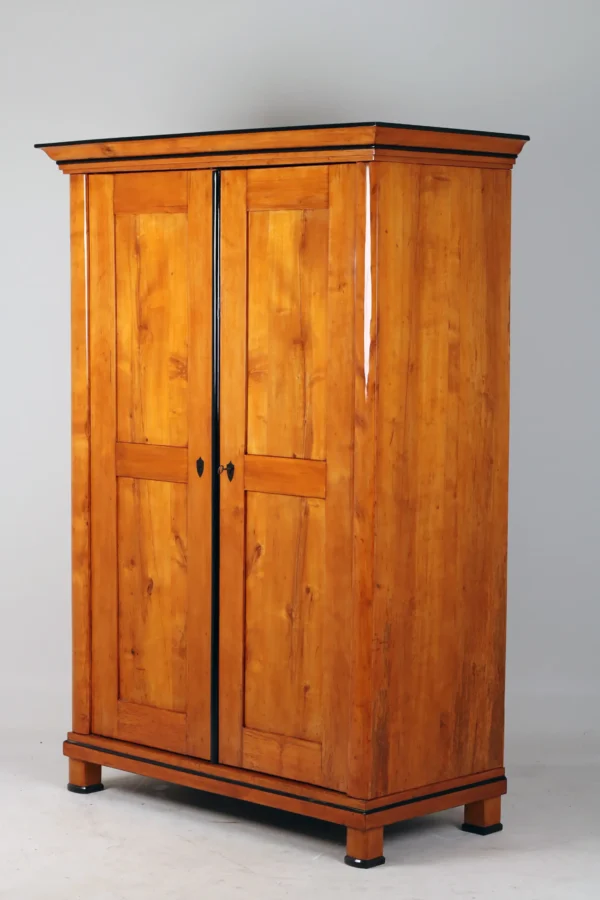
The furniture made for that domestic world had to be honest, functional, and beautiful in a way that did not reference aristocratic display or imperial power. The Biedermeier wardrobe was the result, and it remains one of the most considered pieces of 19th century antique furniture available. The construction follows the Blindholz system: a stable softwood carcass of spruce or pine covered with hand-sawn veneers of three to five millimeters in cherry, walnut, birch, or fruitwood. The bookmatched veneer on the doors creates mirror-image grain patterns that make the natural grains of the wood the primary decoration. Ebonized details in black-stained fruitwood or ebony provide geometric contrast at the columns, cornices, and escutcheons without any applied metal ornament. The shellac or French polish finish, built up in layers by hand, develops a warm amber depth over two centuries that synthetic varnish cannot replicate.
Biedermeier furniture was the first major European design movement created specifically for the bourgeois home rather than the palace or the court, and the wardrobe was central to that domestic program. A large Biedermeier wardrobe provided storage for the linens, clothing, and household textiles that signaled a family’s social standing, but it did so without the theatrical display of the aristocratic armoire. The elegance was internal, visible in the quality of the veneer, the precision of the joinery, and the craftsmanship of the interior fittings rather than in applied gilding or bronze mounts.
The interior of an original Biedermeier wardrobe is as carefully considered as the exterior. Fixed shelves, linen press sections with sliding trays, and occasionally a single hanging bar are arranged with the same geometric intelligence that governs the exterior. High-quality Biedermeier pieces often feature small drawers with hand-cut dovetail joints at the base, and the finest examples contain hidden compartments behind false panels or spring-loaded floors, a practical response to the era’s lack of reliable banking and the political surveillance of Metternich’s regime. Families used these concealed spaces for gold coins, private correspondence, and documents that needed to be kept from view.
The transition from Empire style to Biedermeier is most visible in the wardrobe form. The Empire armoire was a piece of furniture standing in a palatial gallery, designed to communicate the power of the state through dark mahogany, gilded mounts, and classical column supports. The Biedermeier wardrobe is a piece of home furnishings designed for an urban apartment, communicating domestic warmth through bookmatched cherry veneer, ebonized accents, and the honest craftsmanship of a cabinetmaker working without the resources or the pretensions of a royal commission.
Vienna produced the most refined expression of the Biedermeier wardrobe, and the Josef Ulrich Danhauser workshop established a standard that shaped furniture design across Central Europe. Danhauser employed over 350 craftsmen at his Vienna factory and published illustrated pattern books that allowed smaller workshops across the German-speaking world to replicate the Viennese aesthetic. The influence of this single workshop on the character of Austrian Biedermeier production is difficult to overstate.
Viennese Biedermeier wardrobes favor cherry veneer and walnut, applied in bookmatched sheets with depth and warmth that reflect careful material selection. The proportions are graceful and domestic, scaled for the urban apartments of Vienna’s affluent middle class rather than the state rooms of the nobility. Circa 1820 Viennese examples with their original French polish intact, their ebonized column details precise and consistent, and their interior fittings complete represent the Biedermeier period at its most resolved.
Austrian Biedermeier pieces from workshops beyond Vienna but within the Habsburg Empire share the Viennese preference for fruitwoods and organic proportion while occasionally showing regional character in their use of maple veneer or satinwood accents. These unique Biedermeier pieces suit contemporary interiors with particular ease, because the pale wood tones, clean lines, and absence of applied ornament speak the same visual language as Scandinavian-influenced modern design and minimalist interior design sensibilities.
Viennese Biedermeier wardrobes are the most sought-after in the current collector market, with early period pieces from 1815 to 1830 commanding the strongest prices. The applied arts museum in Vienna, the MAK, holds the definitive collection of Biedermeier design standards, and the benchmarks it establishes for veneer quality, proportion, and period authenticity inform the assessment of every piece at Antiqueria Breitling before it is listed.
German Biedermeier wardrobes from Berlin, Munich, and Southern Germany develop the tradition in distinct regional directions, and understanding those differences helps considerably when assessing a specific piece.
Berlin wardrobes, shaped by Karl Friedrich Schinkel’s architectural neoclassicism, are more disciplined and more architectural than their Viennese counterparts. Harder edges, stronger proportions, and birch veneer or darker walnut give these pieces a presence that suits a room needing structure alongside contemporary furnishings. Schinkel designed furniture to harmonize with the neoclassical buildings he constructed for the Prussian court, and that architectural discipline is visible in Berlin Biedermeier wardrobe production at every level of the quality range. Many Biedermeier pieces from Berlin workshops show the influence of the Prussian court in their formal geometric clarity, which distinguishes them clearly from the warmer, more organic character of Viennese production.
Southern Germany, particularly Munich and the surrounding workshops, produced wardrobes in cherrywood and walnut with strict neoclassical proportions and a focus on the quality of the bookmatched veneer on the large door panels. The court joinery tradition in Munich emphasized the beauty of unadorned surfaces and the architectural logic of the piece’s proportions above all else. A large Biedermeier wardrobe from Southern Germany circa 1820 in cherry veneer with ebonized details, plinth base, and original lock hardware is a piece of considerable refinement that works in a contemporary bedroom or dressing room without requiring any period framing from the surrounding furniture.
North German Biedermeier from Hamburg and the Hanseatic ports shows the influence of maritime trade with England. Mahogany appears more frequently than in the southern workshops, giving northern pieces a slightly heavier and more formal character that reflects the English Regency aesthetic these workshops absorbed through commercial contact. These pieces have their own distinct appeal, combining Biedermeier clean geometry with a material darkness that suits a more formally furnished room.
Scandinavian Biedermeier wardrobes in the Karl Johan style, using pale Karelian birch with its characteristic flame pattern, are the most spare of all the regional traditions. The luminous surfaces of these pieces, designed to maximize the reflection of natural light in the dark Scandinavian winter months, have a quality that connects directly to the Scandinavian design movements of the 20th century. A Karl Johan wardrobe in pale birch beside a contemporary piece of Scandinavian furniture looks entirely coherent because the two traditions draw from the same design principles.
Distinguishing an authentic 1815 to 1848 Biedermeier wardrobe from a Second Biedermeier revival piece produced from the 1870s onward requires looking past the visual surface into the construction.
Veneer thickness is the primary indicator. Original hand-sawn Biedermeier veneer measures three to five millimeters, with a depth and surface variation that machine production cannot replicate. Machine-sliced rotary veneer from the revival period is paper thin, under one millimeter, and has a flatness that is immediately apparent under close examination. Where a chip has occurred at a veneer edge, the depth of that loss tells you which era produced the piece.
The dovetail joints in any drawer construction confirm the period independently. Hand-cut dovetails show slight irregularities in spacing and depth, with faint chisel marks and scribe lines visible in the corners. Machine-cut dovetails from the revival period are mathematically uniform. The back panel of an authentic period wardrobe is assembled from wide solid wood planks, fixed with hand-forged iron nails, and shows the deep grey-brown oxidation of genuine age. A tight, clean, modern-looking back panel requires further investigation before purchase.
The original lock mechanism and hardware are equally telling. Hand-forged locks with their slight asymmetries and the original escutcheons with their period-consistent patina confirm authentic pieces. Square-cut screws with off-center slots indicate 18th or early 19th century production. Machine-threaded screws with perfectly centered slots confirm later manufacture.
The shellac or French polish finish on an original piece has developed over two centuries into a warm, amber depth that no modern application replicates. Many original Biedermeier wardrobes were stripped and refinished with modern lacquer during the 20th century. A piece that retains its original French polish is a considerably more complete and more valuable object than one that has been refinished, and that distinction is noted in the condition assessment for each piece in this collection.
At Antiqueria Breitling, Biedermeier wardrobes have been part of the collection since the early years of the business, and the assessment of each piece reflects the accumulated knowledge of four decades of sourcing Central European furniture. Every wardrobe is examined against the authentication criteria described above before it is offered for sale, and restoration work carried out in the atelier addresses what genuinely needs attention without touching what does not.
For the full range of antique storage pieces across European periods and traditions, the antique wardrobes and armoires section covers French armoires, Dutch Baroque kasten, Empire wardrobes, and Victorian examples alongside the Biedermeier pieces listed here.
If you are looking for a specific Biedermeier wardrobe, a particular wood, regional origin, or interior configuration not currently listed, write to us at contact@antiqueria-breitling.com. The warehouse holds pieces not yet photographed or catalogued, and requests are often easier to fulfill than buyers expect.