There is no piece of antique furniture more personal than the secretary desk. A chest of drawers stores linen. A dining table feeds a household. A wardrobe holds clothes. But a secretary holds a person’s correspondence, their financial records, their contracts, and sometimes their secrets. For four centuries, the educated European kept the documentation of an entire life behind a single fall-front or roll-top, and the furniture makers of each era poured their greatest ingenuity into the form. At Antiqueria Breitling, the secretary is one of the pieces we return to most often, because no other form tells the story of European cabinetmaking so completely.
This is the story of how the writing desk evolved across four centuries, from the architectural Baroque bureau through the refined Louis XVI secretaire to the proto-modern Biedermeier secretary, and why each generation reinvented the same fundamental object.
Why the Writing Desk Became the Most Important Piece in the House
Dedicated writing furniture is a relatively recent invention. Through the medieval period, writing was largely a clerical and monastic activity conducted at sloped lecterns and portable writing boxes. The idea that an ordinary educated household needed a permanent, dedicated place to write only emerged as literacy spread, personal correspondence became routine, and private individuals began managing their own financial and legal affairs.
By the seventeenth century, the writing desk had become a fixture of the prosperous European home, and it carried a weight that purely functional furniture never did. This was where you kept the letters that mattered, the deeds to your property, the records of your debts and credits, and in eras without reliable banking, often your actual money. The secretary was simultaneously a workspace, a strongbox, and an archive. That combination of functions explains why the form attracted such extraordinary craftsmanship and why hidden compartments became one of its defining features.
The Baroque Bureau — Writing as Display
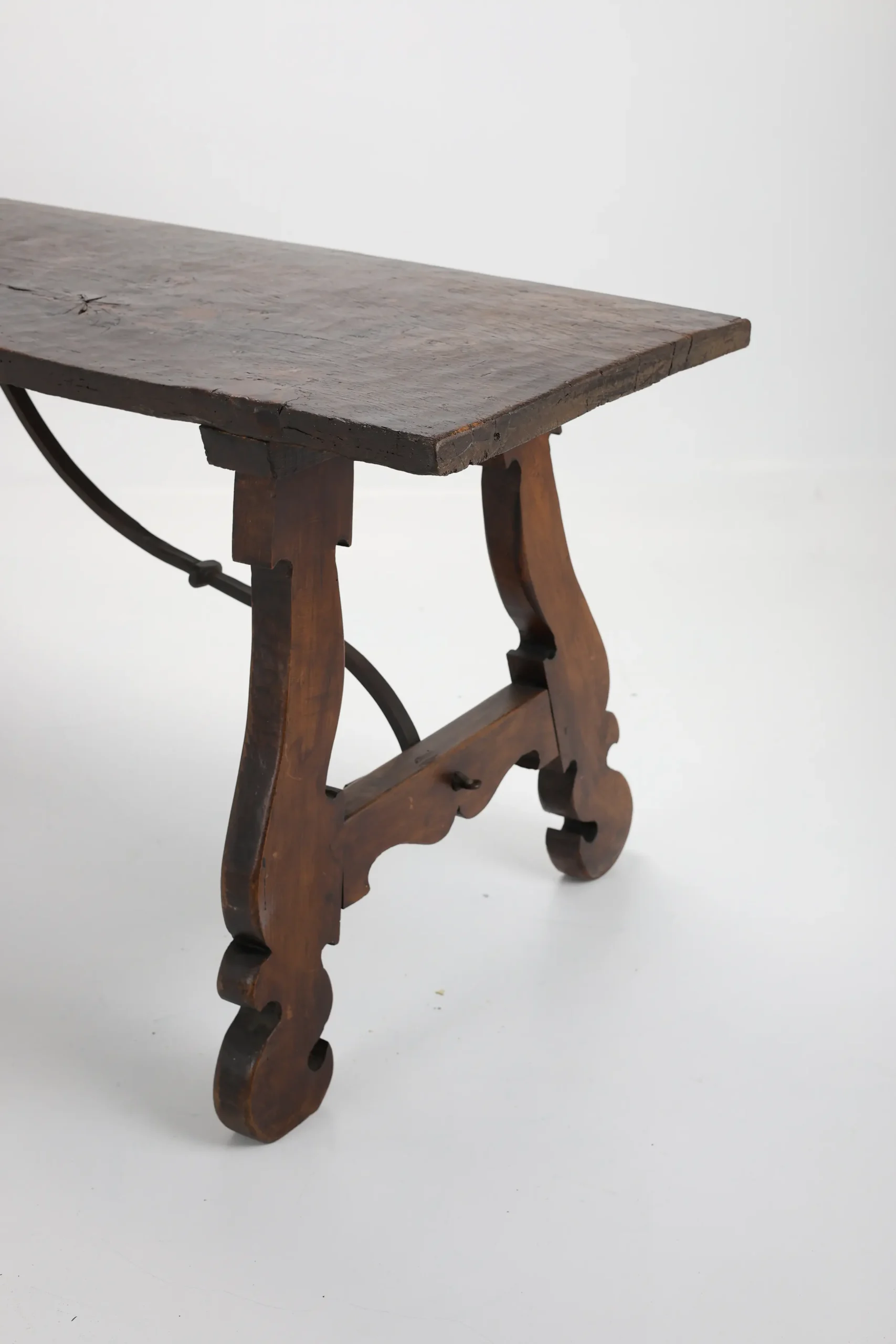
The earliest dedicated writing furniture treated the act of writing as an occasion for display as much as practicality. The Spanish bargueño, a drop-front cabinet over a stand, opened to reveal an interior of small drawers organized with architectural precision. Italian and Dutch cabinet-makers produced elaborate writing cabinets veneered in ebony and decorated with semi-precious stone. In France, the bureau Mazarin emerged as the first important French desk form, built on twin pedestals and covered in the brass-and-tortoiseshell Boulle marquetry that defined the court of Louis XIV.
What unites all of these Baroque writing forms is their refusal to be merely useful. A Baroque bureau was a status object first and a workspace second. The materials were the most expensive available, ebony veneer, tortoiseshell, gilt bronze, and the construction prioritized visual drama over the comfort of the person actually writing. The writing desk had arrived as a furniture form, but it had not yet been designed around the writer.
The Louis XV and Louis XVI Secretaire — The Form Comes of Age
The eighteenth century is where the secretary desk became the sophisticated, practical, endlessly inventive object we recognize today. The French led this development, and the progression of forms tells the story of changing taste across the century.
The Louis XV period brought the bureau plat, the flat writing table, and the bureau à cylindre, the roll-top desk whose curved tambour closed over the writing surface and its contents in a single motion. Jean-François Oeben invented the cylinder form, and the famous Bureau du Roi, completed by Jean-Henri Riesener, became the most celebrated desk in the world. The slant-front secretaire en pente and the small ladies’ writing desk known as the bonheur-du-jour rounded out a period of remarkable formal experimentation, all of it expressed in cabriole legs, floral marquetry, and asymmetrical Rococo curves.
The Louis XVI period disciplined all of this back into straight lines and geometric order. The secretaire à abattant, the tall vertical drop-front desk, became the dominant form, and it is one of the most satisfying objects in the entire history of furniture. A flat fall-front drops to become the writing surface and reveals a fitted interior of small drawers and architectural compartments. Above and below, additional storage. The whole composition reads as a small neoclassical building.
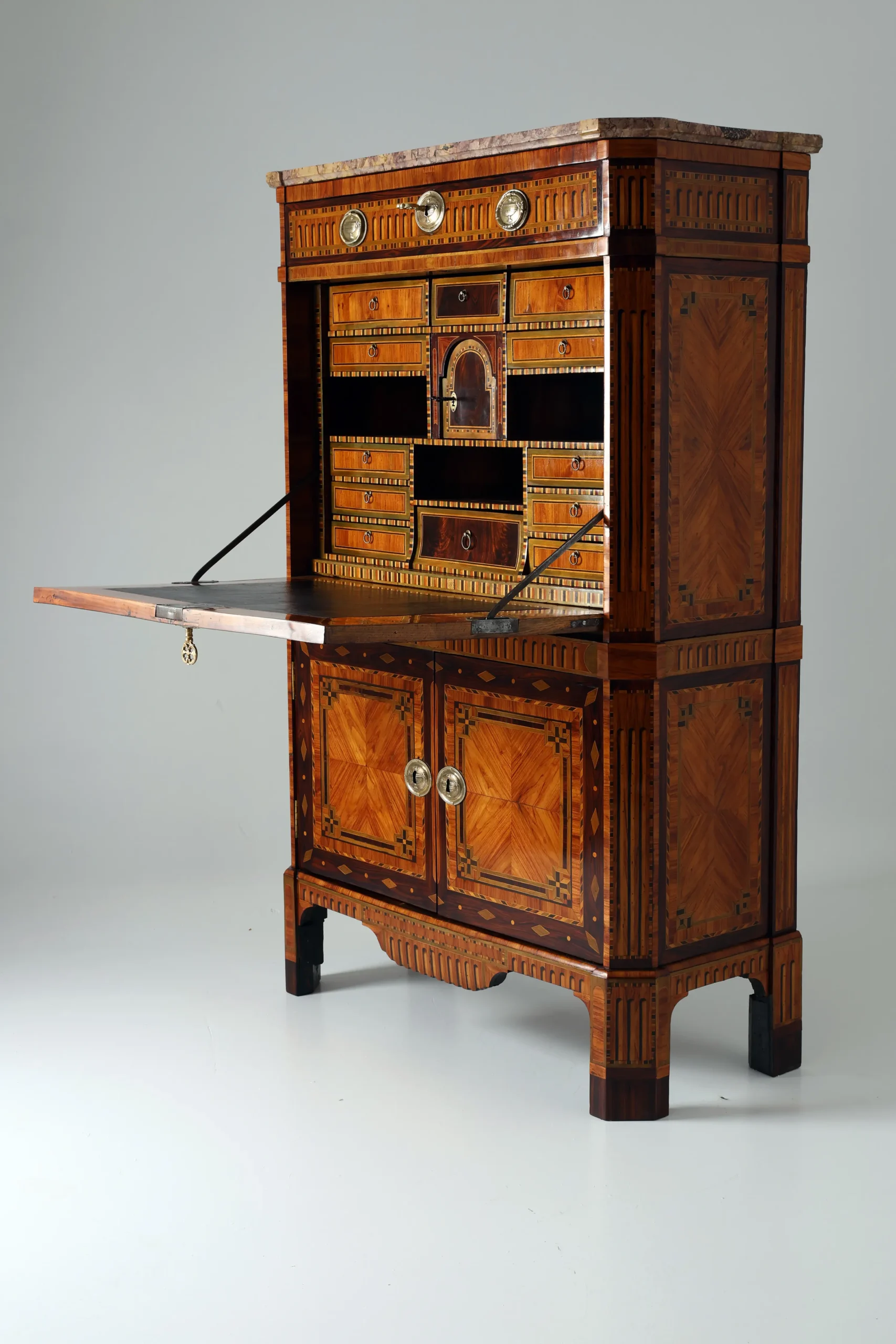
A French secrétaire à abattant from circa 1780 in the Louis XVI style demonstrates the form at its most refined. The exterior is richly decorated with intricate geometric marquetry in rosewood, palisander, and various fruitwoods, built on the solid oak carcass typical of fine French furniture of the period. The fall-front opens onto a carefully arranged interior of multiple drawers and a central architectural compartment, and crucially, it contains a concealed secret compartment hidden beneath one of the drawers. The leather-lined writing surface, the marble top, and the finely crafted bronze hardware complete a piece that represents the absolute high point of eighteenth-century French cabinetmaking. The lower section, enclosed by a pair of marquetry doors, anchors the architectural composition. This is exactly the kind of museum-quality French secretaire that serious collectors of the period seek out.
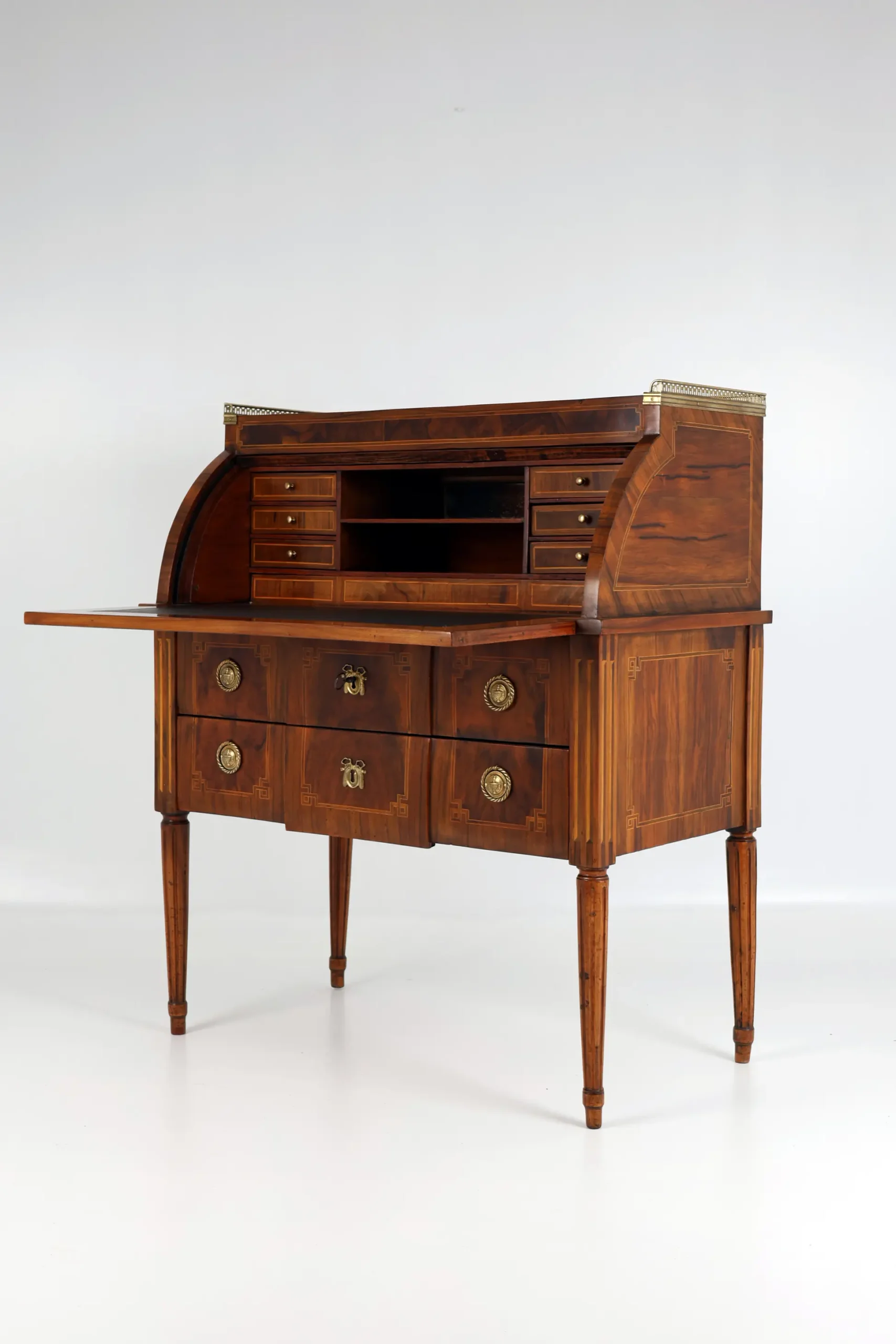
The roll-top tradition continued in parallel. A late eighteenth-century cylinder desk from France, circa 1800, shows the form in a more restrained provincial register. Straight sides, a semi-circular roll-top flap above two drawers, tapered angular legs, and rich walnut veneer with figured grain and fine inlay. The piece carries a particularly clever feature: a central locking mechanism that simultaneously secures both drawers and the roll-top flap with a single action. The interior writing surface is lined in black leather. The single-action lock is the kind of mechanical ingenuity that defined the best writing furniture of the period, where security and convenience were engineered together.
Mechanical Ingenuity and the Art of the Hidden Compartment
The secret compartment beneath a drawer in the Louis XVI secretaire is not a curiosity. It is central to what the secretary desk was for. In an age without reliable banking, under political regimes that surveilled correspondence, the ability to conceal documents and valuables was a practical necessity, and cabinetmakers competed to produce ever more ingenious concealment.
The undisputed master was David Roentgen, whose mechanical desks astonished the courts of Europe. At the turn of a single key, drawers sprang open, panels slid aside, and hidden compartments revealed themselves through concealed spring mechanisms. Roentgen’s transformer desks were the technological marvels of their day, and they represent the absolute peak of the cabinetmaker’s mechanical art.
But hidden compartments appeared at every level of the trade, not just the royal workshops. False back panels, spring-loaded drawers, pivoting columns, and concealed sliding floors were standard features of fine secretaries across the eighteenth and nineteenth centuries. What they concealed ranged from gold coins and legal documents to politically sensitive correspondence and private love letters. When you open an antique secretary at Antiqueria Breitling, the question is never whether it has a hidden compartment. The question is whether you can find it.
The Empire Secretaire — Monumental Statement
The fall of the French monarchy and the rise of Napoleon transformed the secretary desk along with everything else. The Empire period kept the secretaire à abattant form but reconceived it as monumental statement. Dark Spanish mahogany replaced the marquetry of the previous era. Heavy gilt bronze mounts, classical column supports, and imperial symbolism, eagles, laurel, classical figures, projected the political ambition of the Napoleonic state directly into domestic furniture.
The Empire secretaire is architecture in mahogany, severe and imposing, designed to communicate power rather than to charm. It is the heaviest expression the form ever took, and it set up the reaction that would produce the Biedermeier secretary.
The Biedermeier Secretary — The Form Reaches Its Most Personal Expression
When the Napoleonic Wars ended and the Continental Blockade that had cut off imported mahogany finally lifted, the German-speaking world did not simply return to the imperial style. The bourgeoisie of the Metternich era, denied political expression and turned inward toward domestic life, produced a furniture style that rejected Empire grandeur in favor of warmth, intimacy, and material honesty. Nowhere is this clearer than in the Biedermeier secretary, which became the single most important piece in the educated bourgeois home.
The Biedermeier secretaire à abattant kept the architectural fall-front form but stripped away the ormolu and the dark mahogany of the Empire. In its place came light fruitwood veneers, bookmatched cherry and walnut, ebonized detailing in place of bronze, and fitted interiors of extraordinary theatrical refinement. Under Metternich’s surveillance state, the secretary’s hidden compartments took on real significance, and the fitted interior became a private theater of contrasting veneers, mirrored niches, and architectural organization.
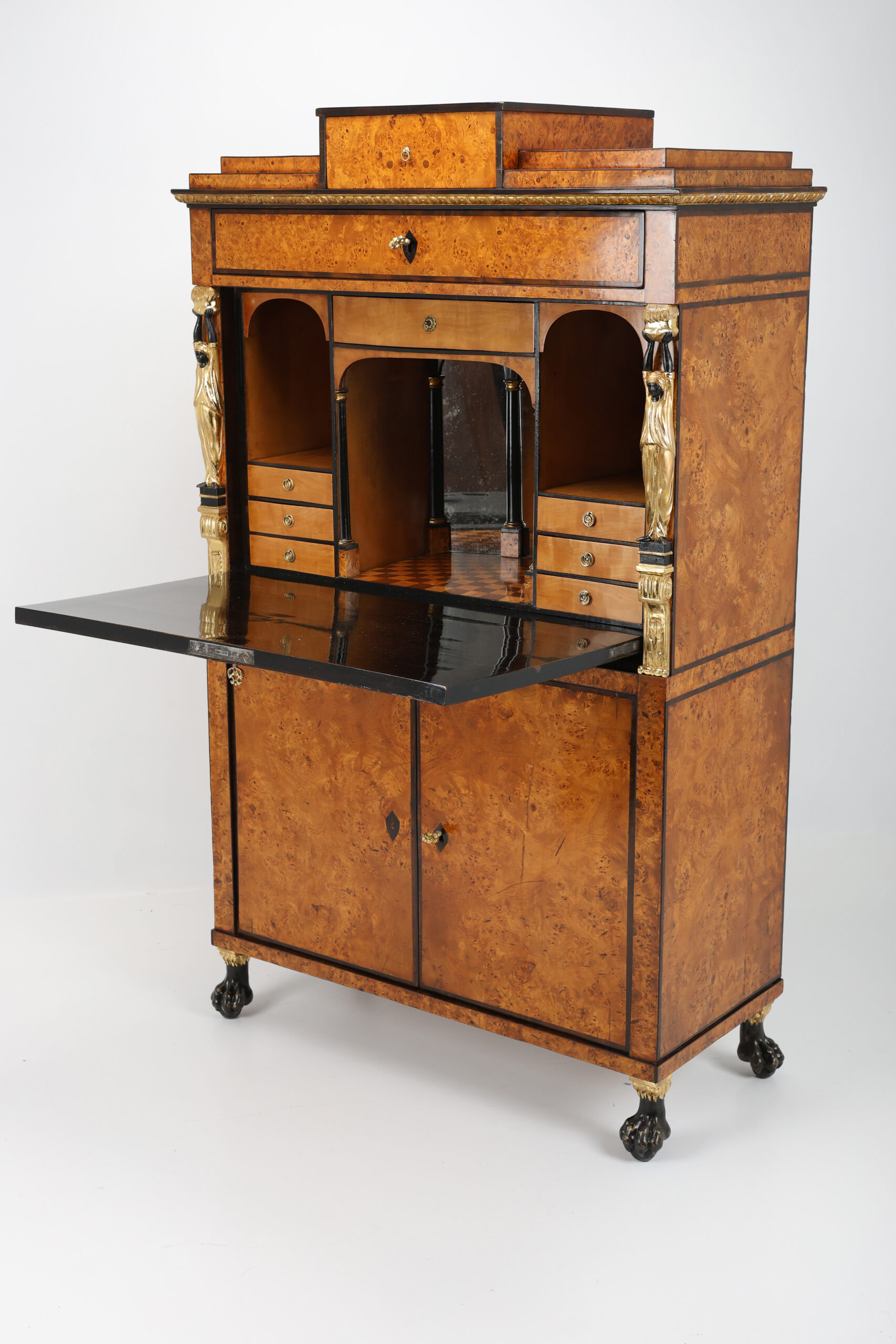
A Viennese secretaire from the early nineteenth century in burl birch shows the Austrian Biedermeier tradition at its most spectacular. The softwood body is veneered in beautifully grained burl birch and rests on gilded and ebonized lion’s feet. The lower doors, the writing flap, and the upper drawer are framed with fine plumwood moulding. On either side of the writing flap stand carved and gilded female Moorish figures holding vases, lending the piece classical drama. A gilded band decorated with ochsenaugen, bull’s-eye motifs, runs above the main drawer. But the interior is the masterpiece: seven small drawers in light maple surround a central compartment with a parquetry floor, and the side walls carry a delicate ebonized colonnade, between whose columns angled mirrors create a fascinating semicircular effect that artistically deepens the interior space. The original locks survive intact. This is Viennese cabinetmaking at the highest level, where the fitted interior becomes a piece of miniature architecture.
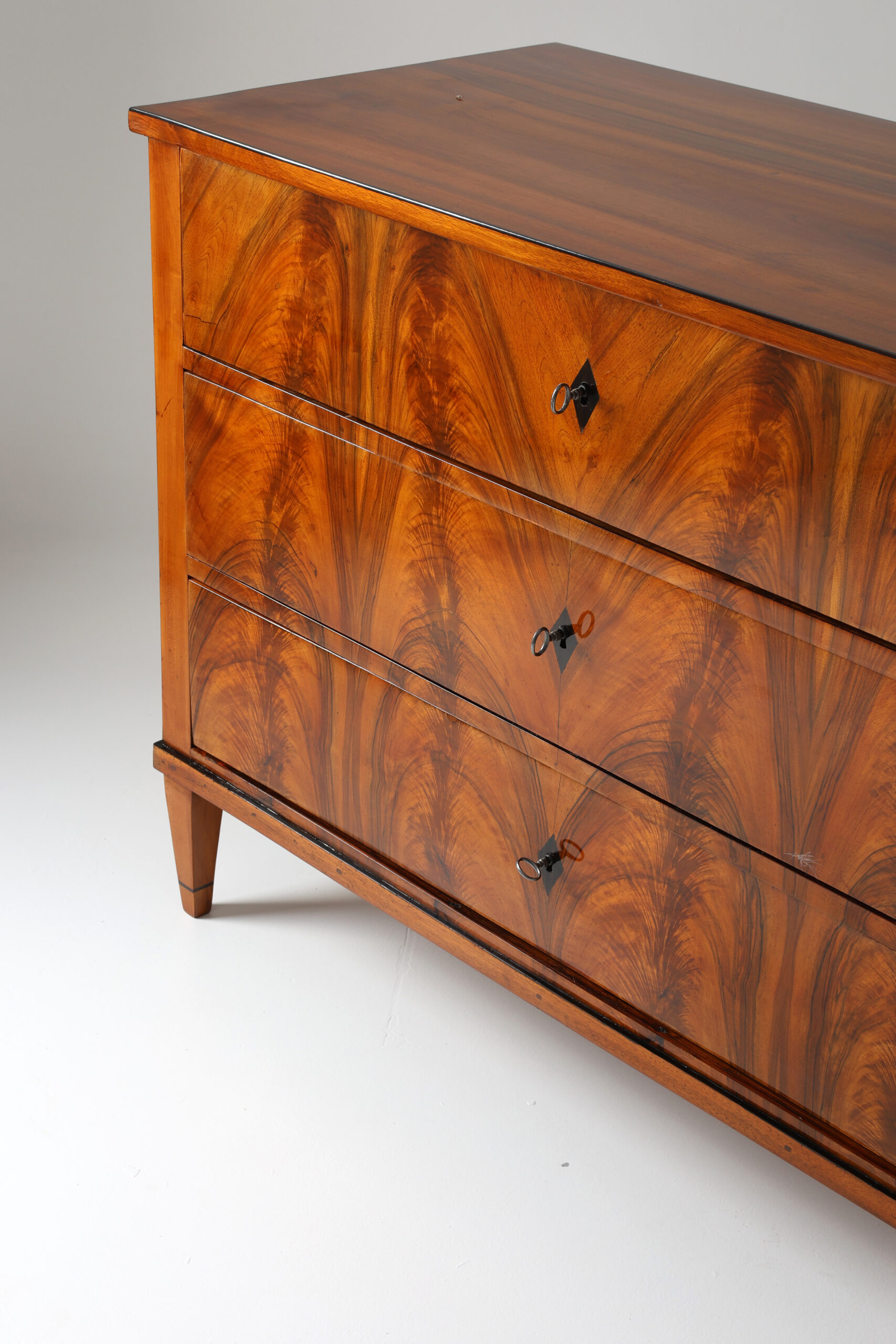
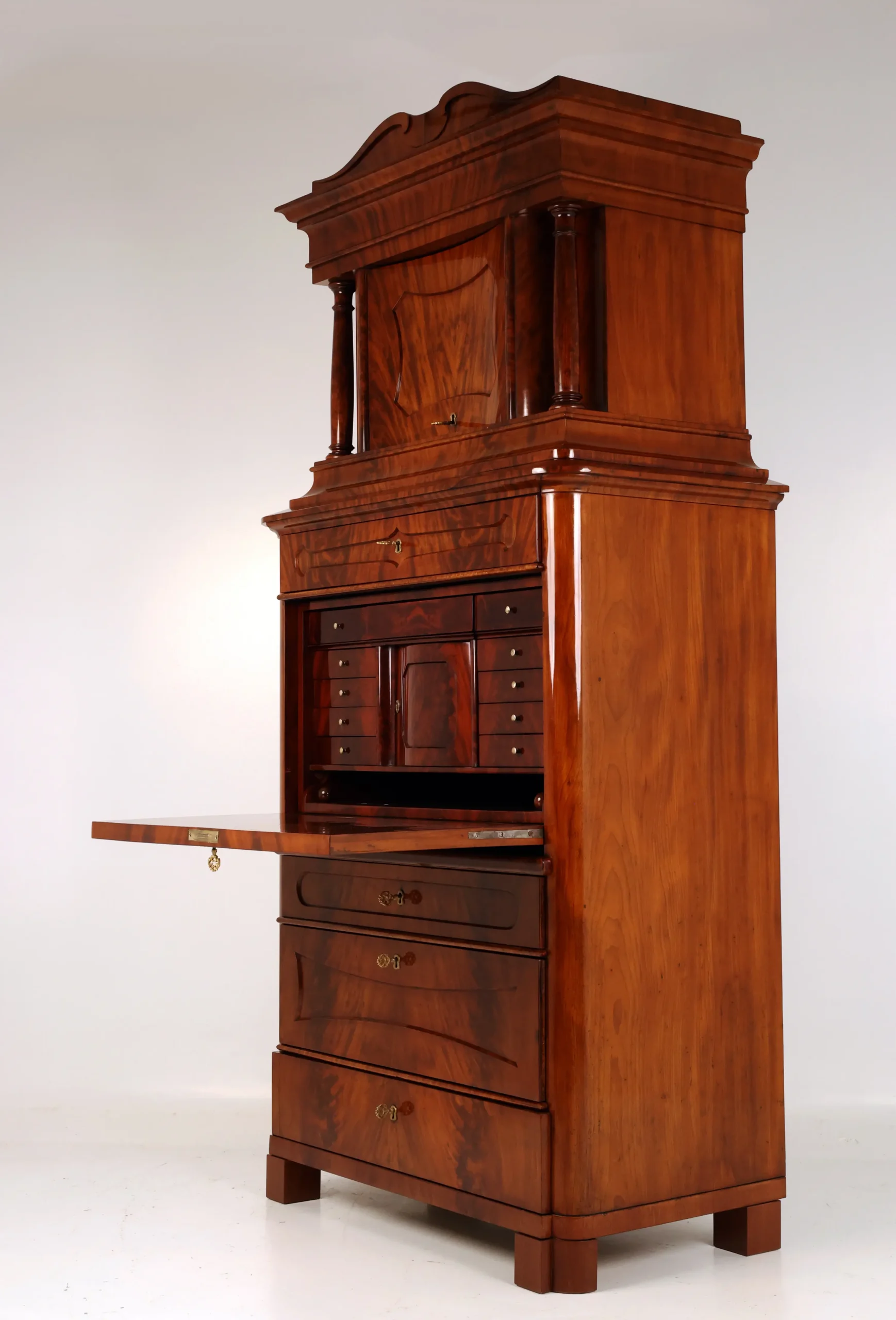
A different expression of the same tradition appears in an early nineteenth-century Biedermeier secretary cabinet of architectural form in superbly figured mahogany. Here the maker kept mahogany but treated it the Biedermeier way, arranged in symmetrical bookmatched patterns that create a dramatic flame figure across the fall-front and drawer fronts, with a warm honey-toned polished surface that gives the piece a luminous presence. The upper superstructure is flanked by turned columns and crowned with a shaped cornice, with a central panelled door concealing additional storage. The fall-front opens onto a fitted interior of multiple small drawers and a central cupboard compartment, with an extending pull-out writing surface lined in black leather. The cleverest feature is the drawer above the fall-front: when opened, it functions as an additional leather-lined writing surface, a refined constructional solution that significantly enhances the usability of the piece. Standing on solid block feet, the cabinet combines sculptural presence with genuine practicality, exactly the qualities that make Biedermeier furniture so compatible with both classical and contemporary interiors.
The full range of these pieces, from the architectural North German mahogany examples to the spectacular Viennese burl birch secretaires, can be explored in the Biedermeier secretary desk collection, where each piece carries detailed regional attribution.
How to Authenticate an Antique Secretary Desk
Across all four centuries, the same authentication principles apply, adjusted for period. Veneer thickness is the primary indicator: hand-sawn veneer of three to five millimeters indicates earlier production, while paper-thin machine-sliced veneer indicates later or revival pieces. The drop-front mechanism and its hardware should show consistent wear and original quadrant stays and hinges. The fitted interior should be original and complete, which is where many altered pieces reveal themselves.
Hand-cut dovetails with their subtle irregularities distinguish period work from uniform machine-cut joinery. On Baroque, Louis XVI, and Empire pieces, the ormolu should show the warm depth and mercury bloom of fire-gilding rather than the thin metallic appearance of electroplating. Back panel construction and oxidation indicate age and often region. The particular challenge with secretaries is that mechanisms wear and interiors are sometimes altered or replaced, so assessing whether the fitted interior belongs to the carcass is essential. Every secretary that passes through Antiqueria Breitling is assessed against these criteria before it reaches the collection.
The Secretary Desk in the Contemporary Interior
The secretary desk may be the single most practical antique furniture form for modern living. It contains a complete workspace, writing surface, storage, organization, and security, within a form that closes completely to present a clean, sculptural façade. For the contemporary apartment or home office, where space is limited and visual clutter is unwelcome, a piece that opens into a full desk and closes into a cabinet is close to ideal.
Different periods suit different interiors. A Louis XVI secretaire brings refined marquetry and neoclassical proportion to a formal room. A walnut cylinder desk suits a study with provincial warmth. A Biedermeier secretary, with its light woods and clean architecture, sits comfortably in a contemporary minimalist space in a way that heavier antique forms cannot always manage. The fitted interiors and hidden compartments that delighted their original owners delight contemporary buyers just as much.
At Antiqueria Breitling, the secretary desk has been a cornerstone of the collection for decades, across every period from the Baroque bureau to the Biedermeier secretaire. Each piece is restored in-house by our master artisans and assessed against the authentication standards described above. Whether you are drawn to the marquetry refinement of the French eighteenth century or the architectural warmth of Central European Biedermeier, the antique secretaires collection covers the full range of periods and regional traditions. Browse the collection now or write to us at contact@antiqueria-breitling.com for specific pieces not yet listed. Worldwide shipping available on all pieces.