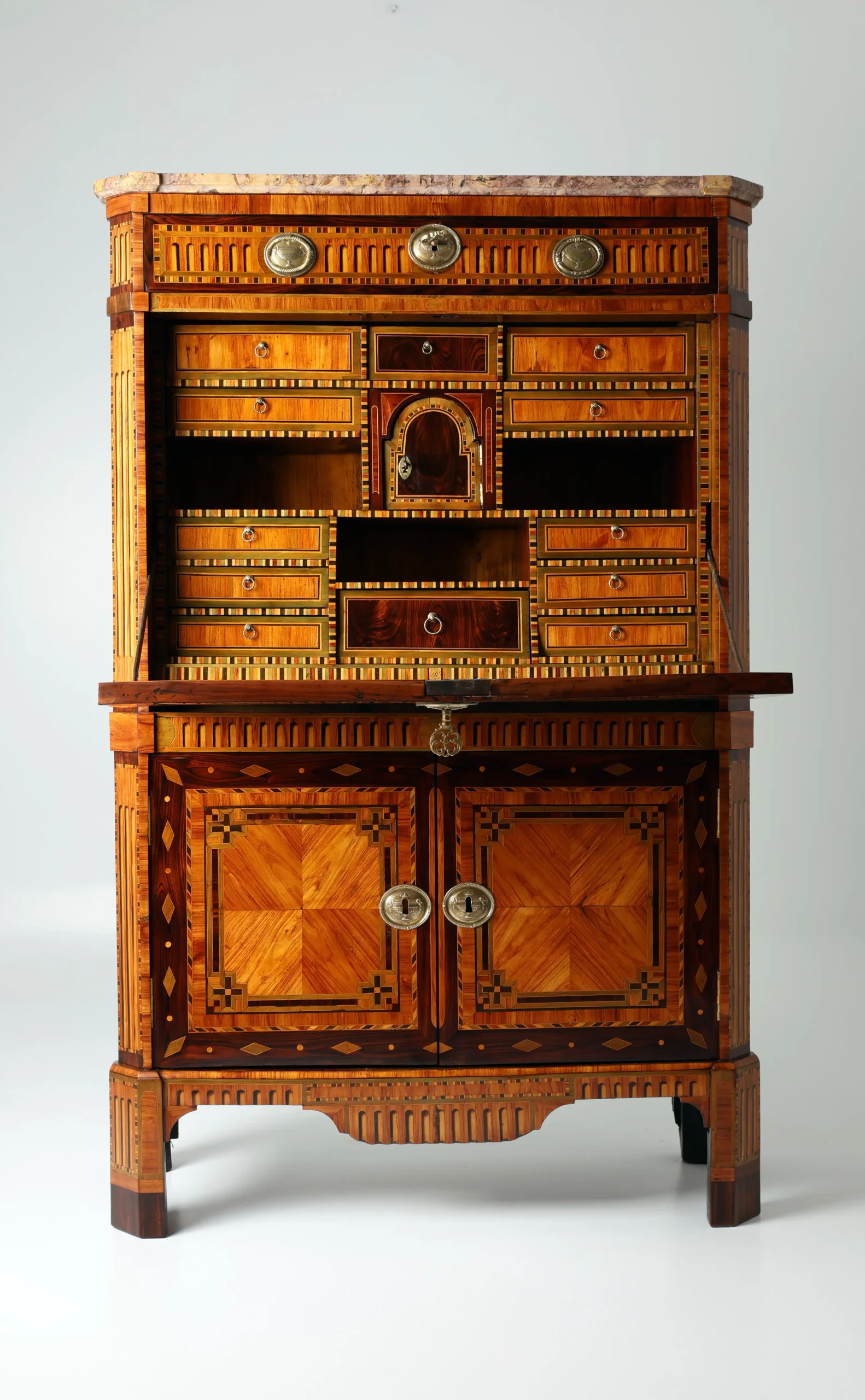
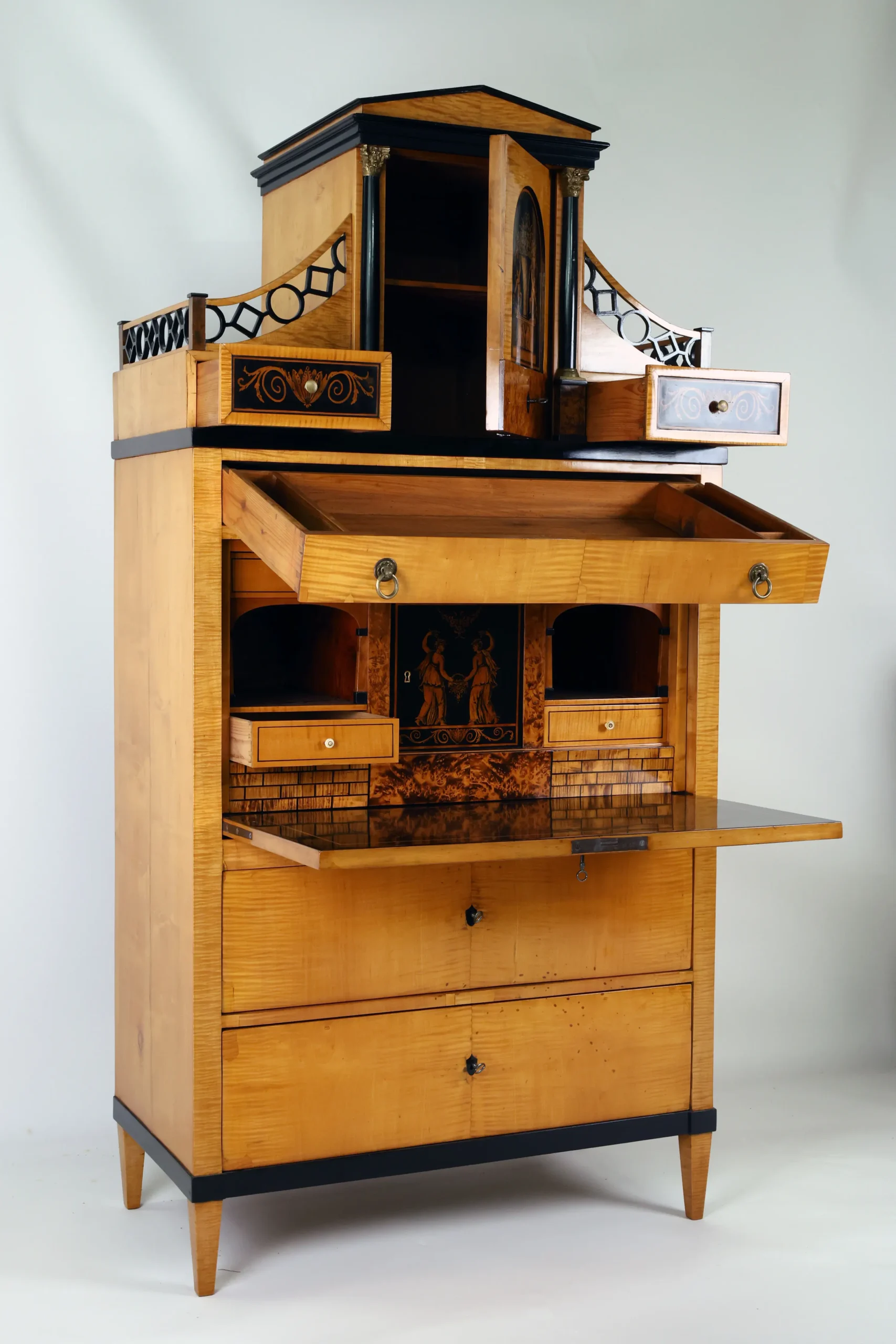
When the Baroque emerged in Rome around 1600, no one in Italy was thinking about how it would look when it reached Paris seventy years later. The style was a religious response, an instrument of the Catholic Counter-Reformation deployed to inspire awe and devotion in the faithful. By the time Louis XIV’s France adopted and transformed it into the official aesthetic of absolute monarchy, the Baroque had become something fundamentally different: a state-controlled instrument of political propaganda. The two traditions share a name. They share a vocabulary of curves, gilding, and theatrical scale. Beyond that, French and Italian Baroque furniture express two completely different worldviews.
The Two Origins of the Baroque
Italian Baroque furniture grew directly from the political and religious conditions of seventeenth-century Italy. The Catholic Church, responding to the austerity of the Protestant Reformation, sought to use the decorative arts to communicate spiritual power through sensory experience. Furniture became part of an integrated artistic project alongside architecture, painting, and sculpture, designed to create environments of overwhelming emotional intensity.
Italy itself was not a unified country. It was a collection of city-states, each with its own court, wealth, and artistic identity. Rome answered to the papacy. Venice was a maritime republic with eastern trade connections. Florence was governed by the Medici. Naples fell under Spanish rule. Genoa traded across the Mediterranean. Each of these centers developed its own Baroque tradition, and the resulting furniture reflects that regional diversity in a way that no other European tradition matches.
France took a fundamentally different approach. Louis XIV understood that absolute monarchy required visible, repeated, unmistakable expression in every dimension of public and private life. His finance minister Jean-Baptiste Colbert established the Manufacture Royale des Meubles de la Couronne, better known as the Gobelins Manufactory, in 1662. Under the artistic direction of Charles Le Brun, the Gobelins unified French luxury production under direct royal control. Every piece of furniture produced for Versailles communicated a single political message: the glory and permanence of the Sun King.
This is the fundamental philosophical difference between the two traditions. Italian Baroque is a constellation of regional traditions expressing the religious and civic identities of independent city-states. French Baroque is a top-down state project producing a unified aesthetic designed for political control. Once you understand that distinction, every visual difference between the two traditions makes sense.
Italian Baroque Furniture — Regional Diversity and Sculptural Theater
The Roman Baroque tradition emerged first, shaped by the papal court and the architectural ambitions of figures like Gian Lorenzo Bernini, who designed furniture as well as buildings. Roman pieces are monumental in scale, designed for the parade apartments of noble palazzos where the highest aristocracy displayed their status. Console tables on sculptural polychrome and gilded bases featuring mythological figures, mermaids, lions, and eagles. Marble tops, pietra dura, or scagliola surfaces. Beds and cabinets conceived as architectural compositions integrated with their rooms.
The Venetian tradition reached its highest expression in the work of Andrea Brustolon. Born in 1662 and active until 1732, Brustolon produced furniture that crosses the boundary between sculpture and functional object. His pieces for the Venier and Pisani families, now preserved in the Ca’ Rezzonico museum, dissolve the structural elements of furniture entirely. Legs become carved ebony moors. Supports become allegorical figures of the Four Seasons. Chair arms terminate in figural groups of cherubs and putti. Brustolon used boxwood, walnut, and ebony, and incorporated glass paste eyes in his carved figures to heighten the theatrical realism that defined the Venetian Baroque ambition.
Florence developed in yet another direction. In 1588, Grand Duke Ferdinando I de’ Medici established the Opificio delle Pietre Dure, a court-funded laboratory dedicated to the art of commesso fiorentino, semi-precious stone inlay. Florentine cabinets from the Baroque period combine ebony, gilded bronze, and intricate mosaics of lapis lazuli, amethyst, jasper, agate, and malachite, depicting floral arrangements, birds, and panoramic architectural views. These surfaces are not decoration applied to furniture. They are stone paintings integrated into furniture form, and they remain among the most technically demanding decorative work ever produced in any European tradition.
Genoa specialized in elaborate gilt gesso, lacquered surfaces, and high-backed armchairs. Naples, under Spanish influence, produced exuberant polychrome carving, intricate scagliola work, and the elaborate Neapolitan crèches that became a cornerstone of regional culture. Each of these traditions has its own identifiable character, and a serious collector learns to read them as distinct dialects of the same Baroque language.
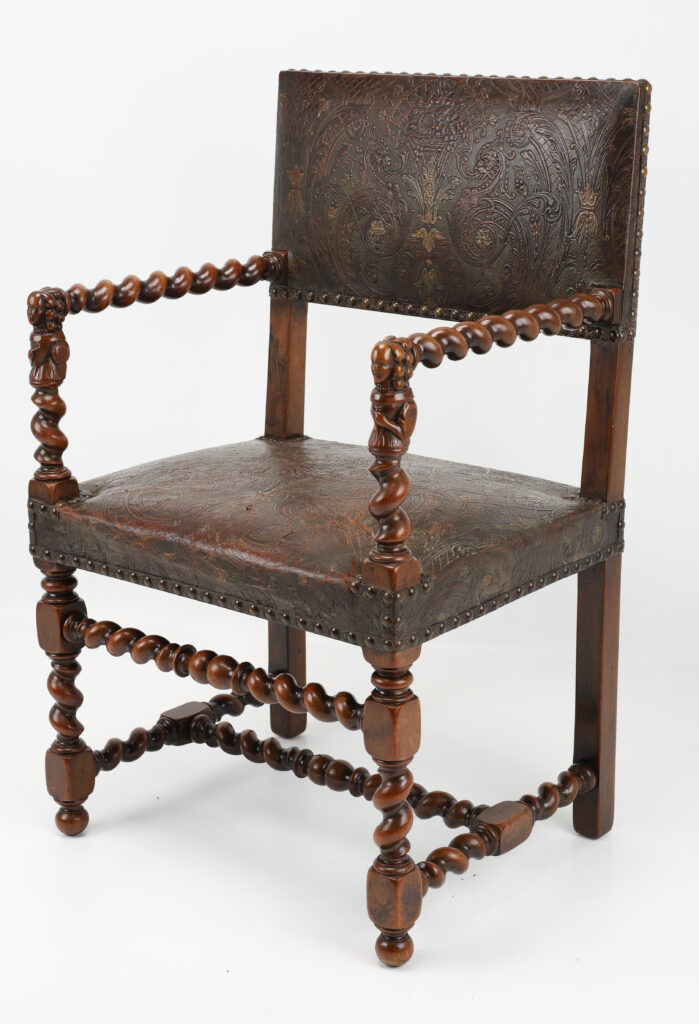
An Italian Renaissance-style walnut armchair from the 18th or early 19th century carries the long tail of this tradition forward. Solid walnut frame with turned spool detailing on the arms and stretchers, embossed Cordovan leather upholstery with hand-painted motifs of birds, foliage, and fruit in red, gold, blue, and green, large brass nail accents securing the leather. The Renaissance ornamental vocabulary persists in the leather work, while the structural Louis XIII influence shows the cross-pollination between Italian regional craft and French court formality that defined the late Baroque transition. This is exactly the kind of piece that demonstrates how Italian workshops absorbed and adapted broader European influences while maintaining their own distinctive material and decorative traditions.
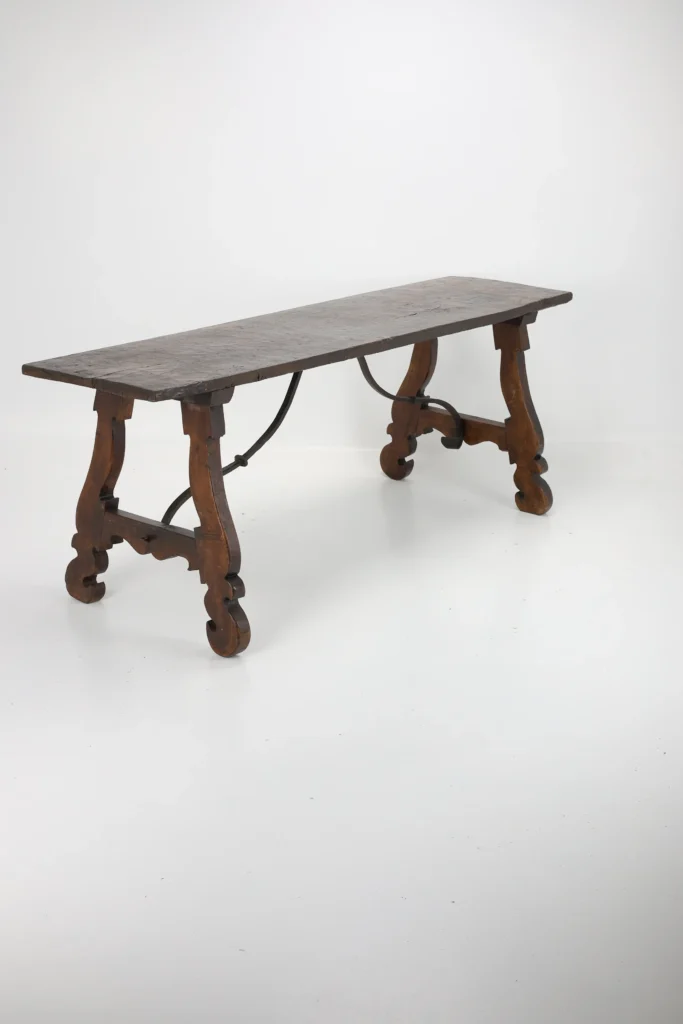
A Baroque oak table from Italy circa 1760 illustrates the rustic provincial tradition that ran alongside the courtly Baroque. Large single-plank top showing the marks of hand tools, scrolled lyre-shaped legs in carved walnut, and a hand-forged iron stretcher beneath the top providing structural rigidity. The carved detail along the edges adds refined ornament without overwhelming the piece’s essential character as a functional table built to last. These provincial Italian Baroque pieces, often in solid oak or walnut with hand-forged iron hardware, occupy a different register from the courtly cabinets and console tables but reflect the same fundamental Italian commitment to sculptural form and material honesty.
French Baroque Furniture — Boulle, Ormolu, and the Architecture of Royal Power
French Baroque furniture developed under conditions that no Italian workshop ever experienced. The Gobelins Manufactory imposed anonymous collective production, where craftsmen worked under the artistic direction of Charles Le Brun to ensure that the glory of every piece reflected on the king rather than on individual makers. This is the opposite of the Italian tradition, where Brustolon’s name and Bernini’s involvement were essential to the prestige of the furniture they produced.
The defining figure of French Baroque furniture is André-Charles Boulle, appointed ébéniste du roi in 1672 and granted the extraordinary privilege of working within the Louvre itself. Boulle perfected the technique of marquetry that bears his name: the intricate inlay of brass and tortoiseshell, cut simultaneously from stacked sheets to produce perfectly interlocking veneers. The première partie version, brass pattern on a tortoiseshell ground, and the contre-partie reverse, allowed Boulle to create mirrored pairs of furniture, a symmetry highly prized in the court of Louis XIV. The flat surfaces of his commodes, armoires, and writing tables catch light in candlelit rooms in a way that no Italian carved surface achieves, and that performance under candlelight was exactly the intention.
The ormolu mounts on French Baroque furniture were produced by fire-gilding, a process involving a gold and mercury amalgam painted onto cast bronze and fired in a kiln until the mercury vaporized. The process produced gold of extraordinary durability and warm, deep luminosity, with the mercury bloom visible in the deepest recesses of the chasing identifying genuine period work today. It also killed the craftsmen who performed it. Gilder’s Palsy, the chronic mercury poisoning that resulted from years of inhaling mercury vapor, reduced the life expectancy of master gilders to roughly thirty years. France officially restricted the practice around 1830, though it continued covertly in the finest workshops for decades.
The seating hierarchy at Versailles illustrates how completely French Baroque furniture functioned as social architecture. The fauteuil, the upholstered armchair, was reserved for the king, queen, and visiting monarchs. The chaise back-stooled chair was permitted to children of France and members of the royal family. The tabouret padded stool was a hard-won privilege granted to duchesses. Everyone else stood. The furniture in the room was not merely decoration. It was a system of social control that communicated rank at every moment of court life.
Solid silver furniture at Versailles, including tables, mirrors, torchères, and a silver throne, represented the absolute extreme of Baroque material excess. In 1689, Louis XIV ordered all of it melted down to fund the War of the League of Augsburg. Today these pieces are known only from contemporary descriptions and from depictions in the Gobelins tapestries that documented royal interiors. The melting of the silver furniture is one of the great losses in the history of European decorative arts and one of the most direct illustrations of how French Baroque luxury operated as political instrument rather than permanent collection.
The Italian-born Domenico Cucci worked at the Gobelins and represents the direct connection between the two traditions. His large ebony cabinets adorned with semi-precious stones and gilded bronze brought Italian sculptural ambition into the French court system, and his work helps explain why French and Italian Baroque furniture share so much technical vocabulary while differing so completely in their fundamental character.
How to Tell the Two Traditions Apart
The fastest way to distinguish French from Italian Baroque furniture is to ask what the piece prioritizes. French Baroque prioritizes the flat decorated surface and the interaction of veneer with ormolu. Italian Baroque prioritizes three-dimensional sculptural form and the integration of furniture with its architectural setting.
A French Baroque commode reads as a controlled rectangular volume covered in Boulle marquetry and bordered with ormolu mounts. An Italian Baroque cabinet reads as a sculpted object where the surface and the structure are integrated into a single carved composition. A French Baroque armchair is upholstered, symmetrical, and disciplined within strict proportional limits. An Italian Baroque armchair may dissolve its structural elements entirely into figural carving.
The materials also tell the story. French Baroque uses ebony, kingwood, tortoiseshell, brass, ivory, and the fire-gilded bronze that gives the tradition its characteristic warm luminosity. Italian Baroque uses walnut, boxwood, ebony, limewood for carving, semi-precious hardstones, gilded gesso applied over carved wood, and the lacca povera technique using cut-out prints varnished onto surfaces. Both traditions use exotic materials at the highest level, but they use them in completely different ways.
At Antiqueria Breitling, both French and Italian Baroque furniture have been part of the collection for decades, with each piece assessed against the regional attribution criteria and authentication markers described above. Whether you are drawn to the controlled state grandeur of the French tradition or the sculptural theater of the Italian regional workshops, the baroque furniture collection covers the full range of pieces from both traditions across the 17th and 18th centuries. Browse the collection now or write to us at contact@antiqueria-breitling.com for specific pieces not yet listed. Worldwide shipping available on all pieces.