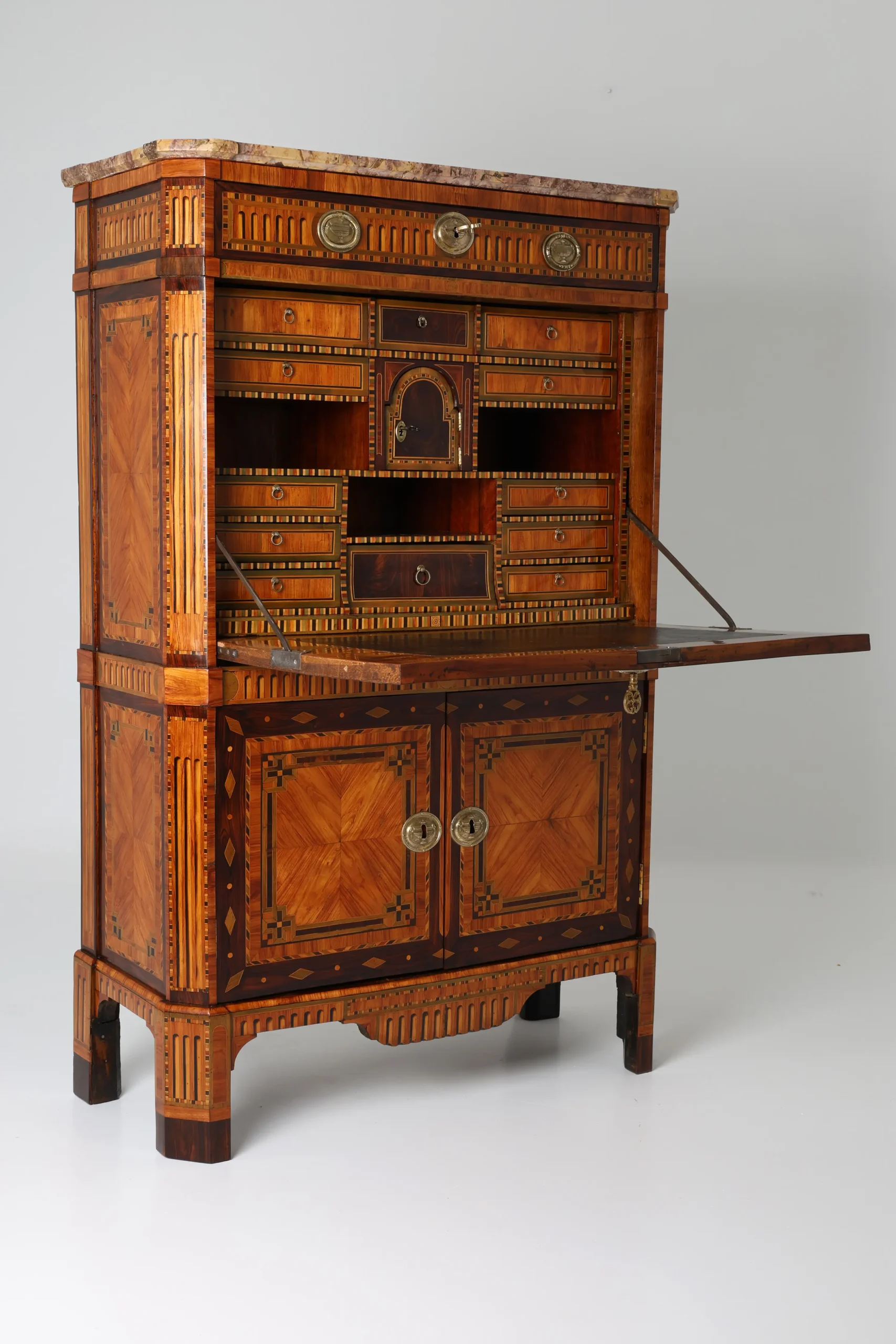
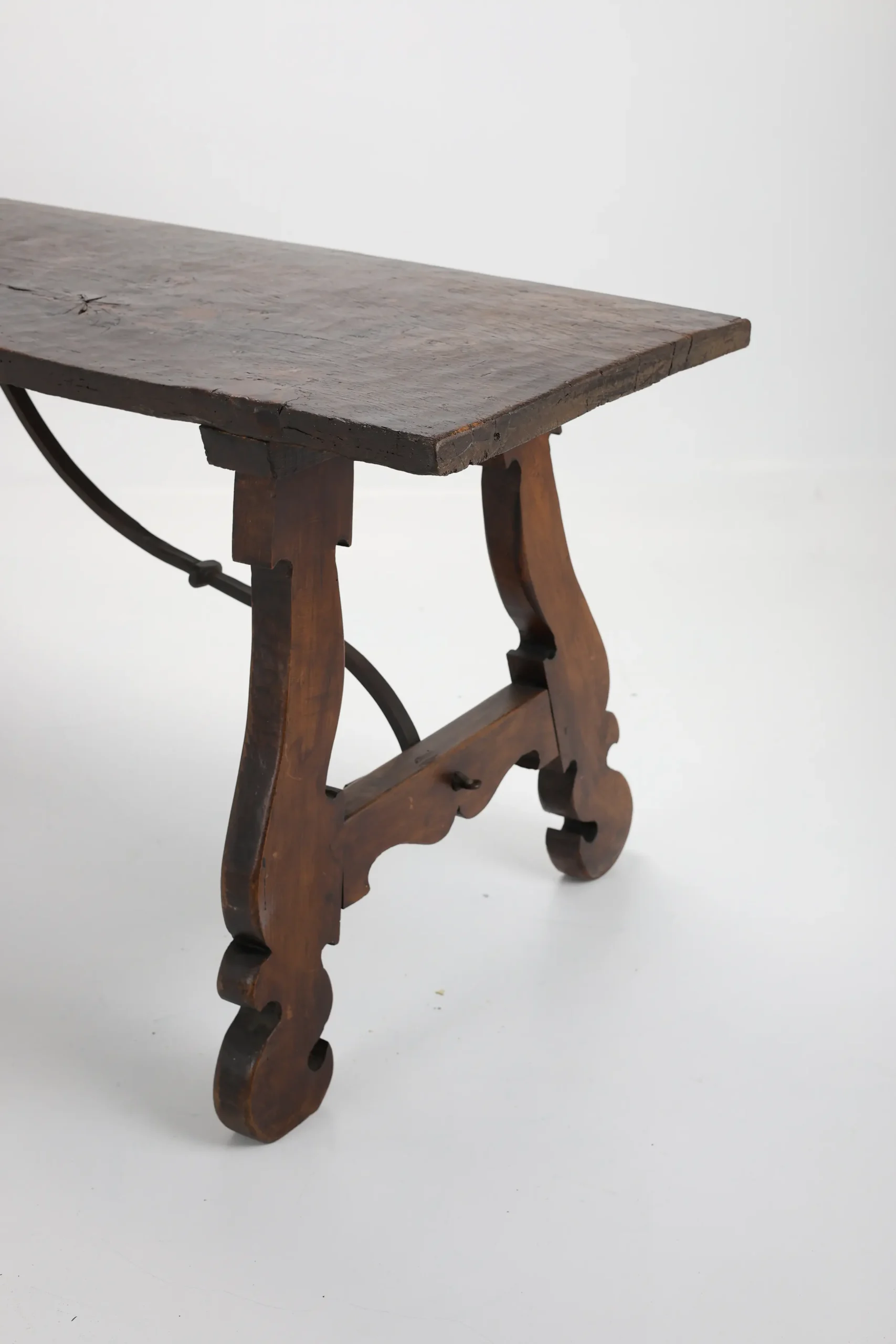
In June 1815 the cannon fell silent at Waterloo, and a continent that had spent a quarter of a century at war finally exhaled. The Congress of Vienna redrew the map, the old dynasties returned, and across Europe the grand imperial style that had decorated Napoleon’s ambitions suddenly looked like a relic of a world everyone wanted to forget. The dark mahogany, the gilded bronze eagles, the monumental scale designed to intimidate, all of it fell out of favor almost overnight. What replaced it is one of the most interesting episodes in the history of European furniture, because the same moment of exhaustion produced two different answers. Germany and Austria gave us Biedermeier. France gave us the Restauration style. They are cousins, born in the same year from the same impulse, and yet they grew up to be remarkably different.
Understanding how and why they diverged is one of the most rewarding things a collector of early nineteenth-century furniture can learn, and at Antiqueria Breitling it is a distinction we draw on constantly when we attribute and place pieces from this period.
The Same Starting Point — A Continent Turning Inward
The first thing to understand is what both styles were reacting against. The Empire style of Napoleon was public furniture. It was designed to project power, to fill palaces, to remind everyone who entered a room exactly where authority lay. After Waterloo, nobody wanted to be reminded of that anymore. The energy of European life shifted away from the public square and into the home, into family life, music, reading, and quiet domestic comfort. Furniture followed that shift.
Both the German-speaking lands and France abandoned the heavy dark mahogany and the aggressive ormolu of the Empire. Both turned toward lighter native woods. Both reduced the scale of furniture to something human, something that fit the apartment rather than the throne room. Both prized comfort and intimacy over grandeur. If you stood in a prosperous drawing room in Vienna and another in Paris in 1820, you would notice the same fundamental change: the furniture had become warmer, lighter, and more personal than anything made under Napoleon.
There was even a shared practical cause behind the move to pale woods. Napoleon’s Continental Blockade of 1806 had tried to strangle British trade by cutting off Europe from colonial imports, and one casualty of that policy was the supply of Caribbean mahogany. Cabinetmakers in both Paris and Vienna were forced to rediscover the timber growing in their own forests, the ash, the cherry, the maple, the elm burl. By the time peace returned, they had grown so skilled with these native woods, and the bright blonde tones had become so fashionable, that there was no going back to dark mahogany. It is one of history’s neat ironies that Napoleon’s own economic warfare helped create the light-wood aesthetic that would come to symbolize the rejection of his style.
So far, so similar. But this is where the two cousins part ways.
France and the Restauration — Courtly Memory in a Constitutional Age
When the Bourbons returned to the French throne, first Louis XVIII and then his brother Charles X, they brought with them the aristocrats who had fled the Revolution. These were people who remembered the elegance of the old regime and longed for its refinement, but who could not simply rebuild the grand court styles of Louis XIV and Louis XV. The political world had changed permanently. France was now a constitutional monarchy, and even the aristocracy lived in a more private, more domestic way than their grandparents had.
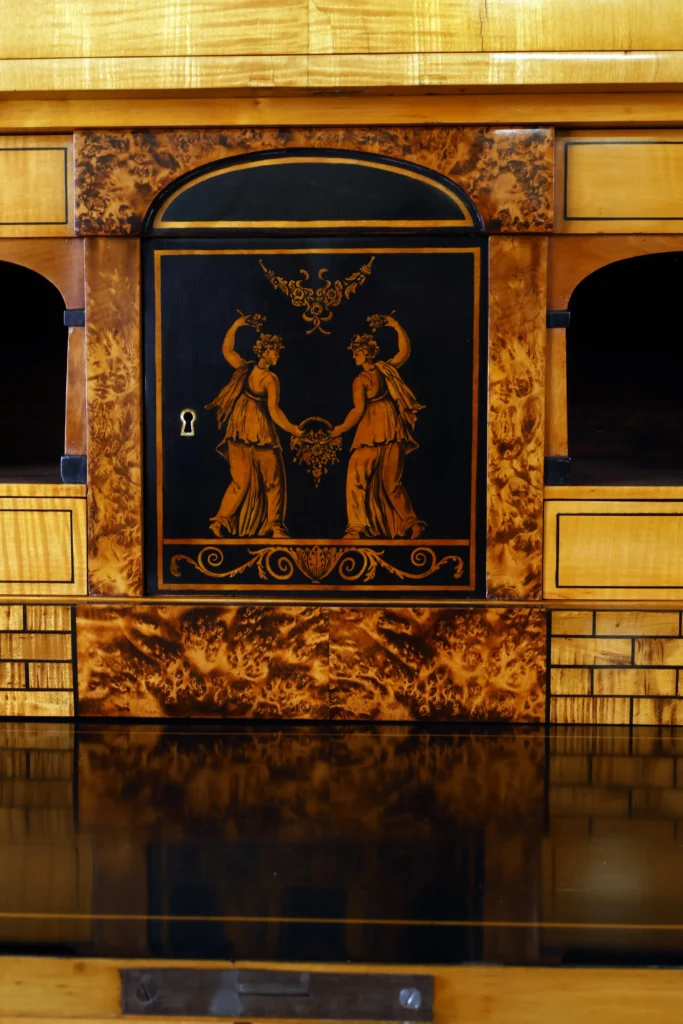
The result was the Restauration style, a furniture culture that softened the Empire into something warmer and more livable while never quite letting go of its courtly memory. French cabinetmakers abandoned dark Cuban mahogany in favor of the bois clairs, the light woods, ash, maple, sycamore, elm burl, and the prized citronnier or lemonwood. But where the Germans would let the wood speak almost entirely for itself, the French could not resist decoration. Instead of heavy bronze mounts, Restauration makers developed a refined system of dark inlay, fine scrollwork and palmettes and rosettes and arabesques cut from amaranth, palisander, and rosewood and set flush into the pale surfaces. The effect is graphic and elegant, a dark drawing laid over a blonde ground.
The forms tell the same story of courtly comfort. The chaise gondole, with its deeply curved back wrapping around the sitter, became the iconic seat of the age. The secrétaire à abattant remained central, its fall-front dropping to reveal an organized architectural interior. Console tables on lyre supports and scrolling brackets stood beneath gilded mirrors, and small portable guéridon tables allowed for the flexible, intimate arrangements that the new domestic life demanded. Even at its most relaxed, the Restauration style kept a polished, aristocratic poise. Toward the late 1820s it even absorbed an early Romantic taste for the medieval, producing the style à la cathédrale with its Gothic openwork chair backs.
French production stayed centralized in Paris, dominated by elite ébénistes working within a cohesive national style, and crucially, French makers stamped their work. That single fact shapes the entire French market today.
The German Lands and Biedermeier — The Beauty of Restraint
The German-speaking world was living under very different conditions. There was no single throne to return to, only the loose German Confederation of dozens of separate states, and over all of them hung the repressive system of Chancellor Metternich. The Carlsbad Decrees of 1819 brought censorship, surveillance, and the silencing of political life. Denied any voice in public, the educated middle class, the Bürgertum, retreated into the safety of the home, and out of that retreat came the Biedermeier style.
The name itself is a joke that aged badly. It was coined satirically in the 1850s from a fictional character, a small-minded provincial schoolmaster who cared for nothing beyond his cozy parlor and his garden. The irony is almost too perfect, because the style now carries one of the most respected names in furniture history, admired precisely for the radical geometric purity that anticipated modern design by a full century.
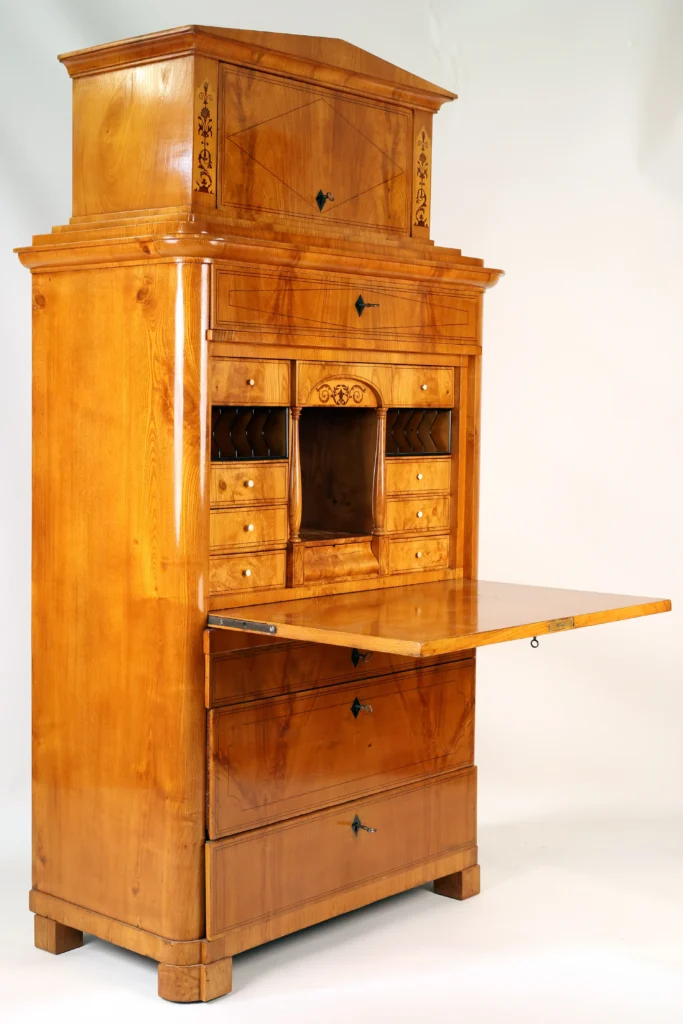
Without a dominant court to dictate taste, Biedermeier grew up in independent regional workshops making furniture for ordinary prosperous households. The philosophy was honesty, geometric clarity, and the near-total elimination of applied ornament. The beauty came from the wood itself. Southern Germany and Austria favored warm cherry and walnut, while the north reached for cooler birch, ash, and the mahogany that still arrived through the maritime trading cities. The construction relied on the Blindholz system, a stable carcass of local softwood wrapped in thick hand-sawn veneers of fine hardwood.
The single great decorative device was the bookmatched veneer, consecutive sheets cut from the same log and opened like the pages of a book to produce mirror-image grain flowing across drawer fronts and doors. A hand-rubbed shellac French polish brought out the depth of the figure, and the only contrast came from minimal ebonized detailing, a stained keyhole, a blackened column base, a thin outline tracing the geometry of the piece. There were no bronze mounts, no marquetry pictures, no carving to speak of. Long before the Bauhaus declared that form should follow function, the cabinetmakers of Vienna and Munich were quietly proving it in cherry and walnut.
The Real Difference — Court Versus Counting House
When you set the two styles side by side, the surface similarities give way to a deep divergence rooted in who the furniture was made for. The French Restauration was, at heart, still a court style, even in its quieter moments. It served a restored aristocracy, it was made in centralized Parisian workshops by named masters, and it carried delicate, sophisticated decoration as a matter of course. Biedermeier was a middle-class style through and through, made by regional workshops for a broad bourgeois market, plain and geometric and structurally honest, and so anonymous that most pieces never carried a maker’s mark at all.
That contrast runs right down to the decoration. The French expressed contrast through inlay, intricate dark drawings worked into the light wood. The Germans expressed it through nothing more than a stained edge and the natural drama of the grain. One is refined and curvilinear and classically formal. The other is stark, architectural, and proto-modern. They answered the same question in two completely different voices, and that is exactly what makes the comparison so illuminating for anyone learning to read furniture of this period.
The Last Great Age of the Hand
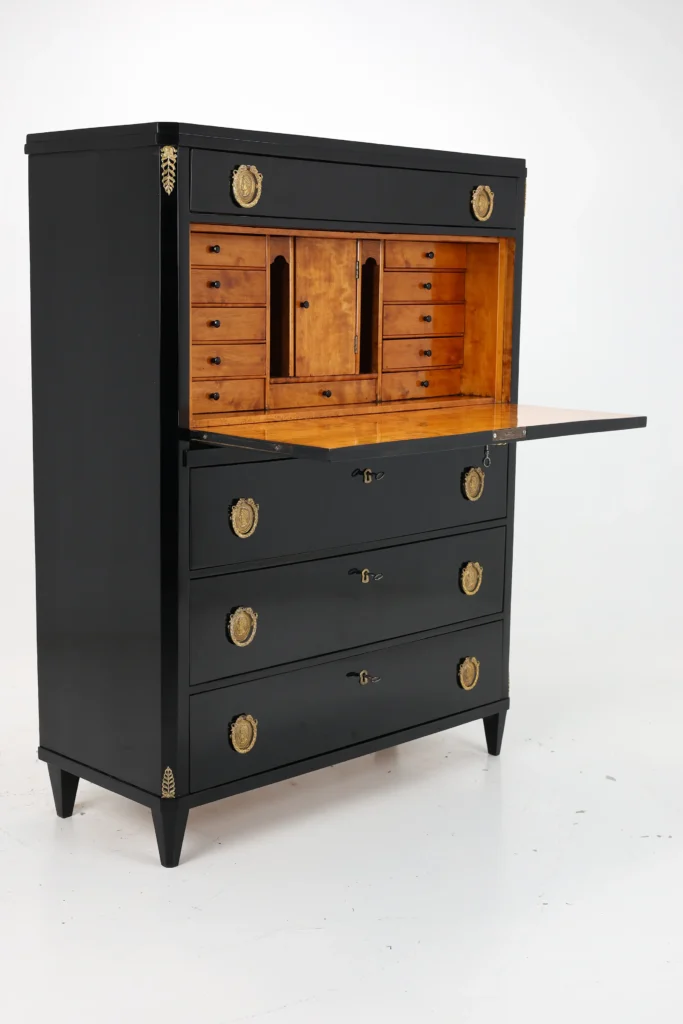
There is one more thing the two styles share, and for the serious collector it may be the most important of all. Both Biedermeier and the Restauration belong to the last era of genuinely pre-industrial furniture. Everything about them was made by hand, from the seasoning of the timber to the cutting of the joints to the rubbing of the polish, and within a generation that world would vanish.
The clearest evidence is in the veneer. Before the industrial slicing machines of the 1850s and 1860s, veneer was sawn from the log, by hand or on early mechanical frame saws, in sheets three to five millimeters thick. Because the wood was cut dry and cold, its fibers stayed intact, the veneer remained stable for centuries, and the natural crystalline structure of the grain caught the light with a shimmering depth. The later industrial method boiled or steamed the log soft and sliced it with a heavy knife into sheets less than a millimeter thick. The heat leached the color out of the wood, the knife tore the fibers, and over time those damaged fibers check into a web of fine cracks across the whole surface. A piece made before the watershed and a piece made after it are simply not the same object, however similar they may look at first glance.
This is why a genuine period piece is worth so much more than a later revival that copies its appearance. The thick sawn veneer, the hand-cut dovetails with their slight irregularities and visible scribe lines, the hand-forged screws with off-center slots and blunt tips, the deep amber oxidation on an untouched back panel, the warm translucent glow of real French polish, all of these are the fingerprints of a vanished craft. Every secretary, commode, and table that passes through Antiqueria Breitling is judged against exactly these markers before it earns a place in the collection, because the difference between handcraft and machine work is the difference between a finite historical artifact and a reproduction.
Living With These Pieces Today
Both styles suit the contemporary interior far better than the heavy Empire furniture that came before them. The golden tones of cherry, ash, maple, and birch bring light and warmth into a room rather than dominating it, and they sit comfortably alongside modern, Scandinavian, and eclectic schemes. Biedermeier’s geometric calm anchors a minimal space beautifully, while a Restauration piece adds a note of historical romance and fine detail. For collectors, the investment logic is clear too: as the modern world fills with engineered board and synthetic veneer, the structural and aesthetic honesty of genuine handcrafted period furniture only grows more distinct.
If you are drawn to this period, the Biedermeier tradition is where Antiqueria Breitling has built its deepest expertise over decades of collecting and in-house restoration. The full range, from architectural North German mahogany to the warm cherry and walnut of the south, can be explored in the Biedermeier furniture collection, and if you are looking for the single most useful and collectible form of the period, the Biedermeier chest of drawers is the place to begin. Browse the collection now or write to us at contact@antiqueria-breitling.com for pieces not yet listed, with worldwide shipping available on everything we offer.