For most of European history, a chair was not built to be comfortable. It was built to communicate power. The grand seating of the seventeenth century forced the sitter bolt upright, rigid and formal, a piece of architecture that imposed authority rather than offering rest. Then, in the early eighteenth century, something changed in France, and for the first time the finest cabinetmakers in Europe began to treat human comfort as a serious artistic problem. The result was the antique French armchair, one of the genuine triumphs of European craftsmanship and the reason a 250-year-old fauteuil or bergère can still feel like the most inviting seat in the room. At Antiqueria Breitling, fine antique seating is one of the categories we find collectors fall for fastest, because a great chair is something you experience with your whole body, not just your eyes.
This is the story of how the French chair learned to cradle the human form, the named forms every collector should know, and how to tell a genuine period piece from a later copy.
Why Comfort Suddenly Mattered
To understand the antique French chair, you have to understand what happened when Louis XIV died in 1715. For seventy-two years the court at Versailles had operated as a vast theater of absolute power, where every gesture was governed by suffocating etiquette and where seating was a tool of statecraft rather than rest. The chair commanded the person, not the other way around.
When power passed to the boy king Louis XV, the Regent moved the center of social life away from the cavernous halls of Versailles and back into the intimate townhouses of Paris. This shift gave birth to salon culture, where conversation became an art form and where the aristocracy and the rising bourgeoisie gathered for hours of relaxed, witty exchange in smaller, warmer rooms. People who intended to sit and talk all evening wanted furniture that actually accommodated the body, and so comfort became, for the first time in modern European history, a primary design goal.
The chair stopped being a rigid frame demanding a subordinate posture and became a curved, accommodating shell built to receive the human form. There was even a practical fashion driver: to make room for the wide hooped dresses of the period, the arm supports were set back from the front legs so the cascading silk would not be crushed. The desire to sit in comfort produced an entirely new vocabulary of French seating, and the greatest era of chair design in history began.
The Versailles Baseline — When a Stool Was a Privilege
To appreciate how radical this comfort was, you have to see what came before. The Baroque chair under Louis XIV was an extension of royal authority, with a tall straight rectilinear back, heavy carved stretchers, and arm supports set right at the front edge of the seat, forcing an uncompromisingly upright posture. Comfort was entirely secondary to its real purpose, which was to communicate rank.
At Versailles the right to sit, and the type of seat you were permitted, was a strictly policed privilege. The king and queen alone were universally entitled to an armchair. Princes of the blood and duchesses were granted the coveted right to a tabouret, a backless stool, and the competition for that privilege was vicious. One French-born Queen of Poland was openly mocked for her desperate ambition to secure, in the words of the court, a miserable stool nobody could sit on comfortably. Below the duchesses, lesser courtiers got armless side chairs, and everyone else stood, sometimes for hours, regardless of age or infirmity. The Baroque chair was a weapon of protocol. Only when the court’s center of gravity moved to Paris did seating finally turn toward the human body.
A Vocabulary of Repose — The Named French Forms
The eighteenth century produced an explosion of specialized seat forms, each engineered for a particular social or physical purpose, and learning to distinguish them is the foundational skill for any collector of antique chairs. The fauteuil is the open-armed upholstered armchair, the baseline of fine French seating, with its exposed carved frame and padded elbow rests. The bergère is its deeper, more luxurious cousin, the ultimate expression of eighteenth-century lounging comfort.
The single most useful distinction a collector can learn is the difference between the fauteuil and the bergère chair. A fauteuil has open sides, with the space between the armrest and the seat left clear. A bergère has closed, fully upholstered sides forming a solid wall of fabric from seat to armrest, and it is almost always fitted with a thick loose cushion over an upholstered deck. That deep cushion and those enclosed sides make the bergère arguably the first genuinely modern comfortable chair in European history, designed to keep out drafts and the direct heat of the fire while you sank into it.
The forms multiply from there. The bergère en gondole has a rounded back that sweeps without interruption into the arms. The marquise is an oversized bergère built for one and a half people, or for one enormous pannier dress. The duchesse is a full reclining lounge, and the duchesse brisée is its modular broken version in two or three separate pieces. The canapé is the sofa that anchored a matching suite of seating. There were even specialized spectator chairs, the voyeuse, designed for men to sit astride and rest their arms on a padded rail while watching card games, with a lower kneeling version for women.
A second crucial distinction is the back. The fauteuil à la reine has a flat straight back and was meant to stand permanently against the wall as architectural furniture. The fauteuil en cabriolet has a concave curved back that wraps around the spine, and because that curve would leave an awkward gap against a wall, it was designed to be pulled into the center of the room for intimate conversation. Knowing whether a chair has a cabriolet or an à la reine back tells you exactly how its original owner intended to use it.
The Flowing Line of the Louis XV Armchair
The high point of organic seating arrived under Louis XV. The Rococo was a deliberate rebellion against the heavy symmetry of the Baroque, and in a Louis XV armchair the rigid right angle simply vanishes. The defining feature is the cabriole leg, the sinuous S-curve that mimics the leg of a leaping animal, but the real mastery lies in the continuity of the whole. A great Louis XV fauteuil looks grown rather than assembled, the leg sweeping up into the serpentine seat rail and on into the arms and the cartouche-shaped back without a visible joint anywhere.
Carving was no longer applied as an afterthought but integrated into the structure itself, with asymmetrical C-scrolls, blooming flowers, and rocaille shells at the knees, the seat rail, and the crest. These frames were carved from solid beech or walnut, and the finest examples were painted in soft pastels or gilded, the gold leaf laid over hand-recarved gesso to keep every petal crisp. The Louis XV armchair is the perfect balance of voluptuous comfort and weightless grace, which is exactly why it remains one of the most sought-after of all antique armchair styles.
The Rational Frame of the Louis XVI Armchair
By the 1760s, taste swung hard the other way. The excavations of Pompeii and Herculaneum had revived a passion for classical antiquity, and the Louis XVI armchair straightened and disciplined the seat in response. The flowing cabriole leg gave way to a straight tapered leg carved with vertical fluting like a classical column. The continuous dissolving lines of the Rococo were abandoned for clearly marked joints, often with a carved rosette in a square block where the arm meets the seat rail.
The backs became strictly geometric, the oval medallion, the rectangle, the gently curved hat shape, and the carved ornament turned to precise classical motifs: ribbons, laurel wreaths, fluting, and acanthus leaves. Yet the neoclassical reaction never sacrificed the comfort the Rococo had won. The deep bergère and the padded fauteuil remained the standard for elegant living, simply dressed now in architectural restraint rather than organic exuberance. This continued refinement was the work of the era’s greatest named chairmakers.
The Makers — Menuisier Versus Ébéniste
Collecting antique French seating means engaging with one of the most rigidly regulated craft systems in European history. Parisian guild law split furniture makers in two. The ébéniste made veneered case furniture like commodes and cabinets and was forbidden by law from making solid carved seating. The menuisier made the chairs, working in solid beech for pieces to be painted or gilded and in walnut for pieces finished with wax, carving and joining the exposed frames. Because the guild held the menuisier responsible for the structural integrity of the frame, only he stamped his name into the wood with a cold iron estampille.
The named menuisier dynasties are what drive value at the top of the market. Georges Jacob, perhaps the most famous chairmaker in history, supplied neoclassical seating to Marie Antoinette, pioneered the use of solid mahogany for French chairs, and survived the Revolution to pass his firm to the sons who would supply Napoleon. The Tilliard family produced the most voluptuous Rococo giltwood fauteuils. Nicolas Heurtaut, uniquely a master of both sculpture and joinery, carved frames of unmatched depth. Louis Delanois bridged Rococo and neoclassicism, and the Lelarge dynasty produced beautifully balanced Louis XVI armchairs. A verified stamp from any of these makers transforms a chair into a blue-chip asset.
Beneath the Fabric
When you look at an antique upholstered chair, you are looking at an illusion. The carved frame may be 250 years old, but the upholstery is almost always a later replacement, because fabric perishes where wood endures. The original eighteenth-century upholsterer built the seat with a hand-stitched system containing no metal at all: jute webbing tacked to the frame, horsehair stuffing shaped by hand and stitched to a firm edge, with soft down reserved only for the loose cushions of a bergère or marquise. The covering textiles, fine Lyon silks, cut velvets, and Beauvais tapestry, often cost more than the frame itself.
Here is a fact that surprises most buyers: a genuine eighteenth-century chair was originally quite firm. The deep, sinking softness we expect today did not exist until 1826, when the coil spring was patented in England. During the Victorian era thousands of period fauteuils and bergères were sent back to be retrofitted with heavy iron springs, and upholsterers often cut away the original bracing of the delicate frames to make room, distorting the proportions the menuisier had intended. This is why a frame that escaped the destructive spring retrofit, and the exceedingly rare survival of original upholstery, are so highly prized.
Seating Beyond France
The forms the French menuisiers engineered radiated across Europe and took on local accents. The Italian armchair, especially the Venetian, prized theatrical sculptural drama over French restraint, treating the wood as a primary sculptural medium and gilding it head to toe. The English answer to the bergère confessional was the wingback chair, heavier and more masculine, built to exclude drafts in cold country houses with almost no exposed show-wood.
The German and Austrian answer was the Biedermeier chair, which reacted against the dark imperial mahogany of the French Empire with extreme simplicity and clean geometric lines. Biedermeier craftsmen abandoned gilt bronze and exotic veneers for light native fruitwoods, cherry, pear, and apple, alongside ash, birch, and walnut, letting the architectural curve of the frame and the vivid grain of the wood carry the whole design. With their curved barrel backs and early use of the new coil spring, Biedermeier chairs achieved an almost twentieth-century modernism that contemporary designers still chase. You can see the range across periods in the antique chairs collection.
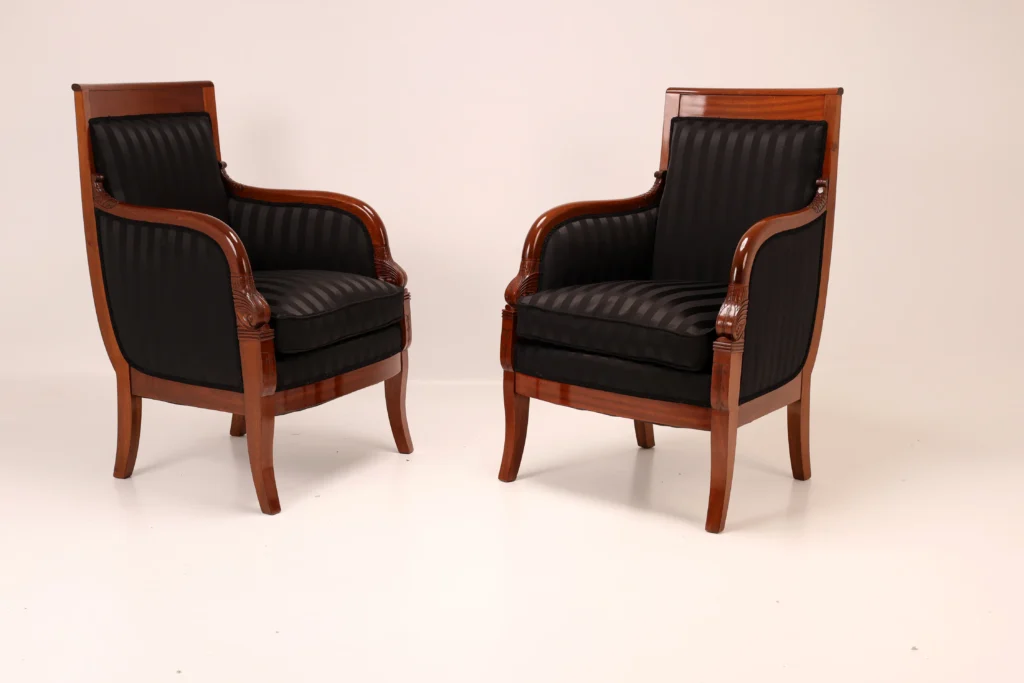
A pair of mahogany bergère armchairs in the Classical and early Empire style, from the early nineteenth century, shows exactly this moment where French form met the cleaner architectural sensibility that would feed into Biedermeier. The solid mahogany frames have been restored and finished with traditional French polish that deepens the natural grain, with delicately hand-carved detail to the arm supports. The fully restored upholstery in a black fabric with a subtle vertical stripe sets a sophisticated contrast against the warm mahogany, and the enclosed upholstered sides and loose seat cushion mark them unmistakably as true bergères rather than open fauteuils. As a pair, they carry the premium that matched seating always commands, and they would anchor a study, a library, or a formal salon with equal ease.
How to Read a Period Chair
The market for fine antique seating is full of nineteenth-century revivals and altered pieces, so authenticating a chair means examining its hidden skeleton. Turn the chair over and look at the joints where the legs meet the seat rail. A genuine period frame is held by mortise-and-tenon joinery locked with hand-carved wooden pegs, and over two centuries those pegs often shrink at a different rate than the frame and can be felt protruding slightly. Perfectly round modern dowels, hidden screws, or uniform machine-cut joints signal a piece made after about 1860. The interior corner blocks should be rough-hewn hand-cut wedges, not neat machined or stapled blocks.
The patina is the next test. Authentic exposed wood carries a deep patina from centuries of oxidation, waxing, and human touch, and the wear is always logical, soft and undulating on the armrest ends and the top rail where hands naturally grasped. Faked wormholes are uniform in size and direction, while genuine worm activity tunnels erratically across the grain. The ultimate prize is a genuine estampille, the maker’s cold-iron stamp in a hidden spot, but collectors should be wary, because fakes were common once eighteenth-century prices soared. The dirt and oxidation inside the stamped letters must match the surrounding wood; bright clean wood inside the lettering is a forgery. Every chair that comes through Antiqueria Breitling is assessed against exactly these markers before it joins the collection.
The French Chair in the Modern Room
The way we use antique seating has changed completely. The eighteenth-century aristocrat ordered a matching suite to line the walls of a salon, but modern designers rarely deploy matching sets that way, finding the effect too static. Instead the market prizes the single spectacular statement chair. A carved bergère en gondole, a neoclassical fauteuil, or an Italian giltwood armchair used as a sculptural French accent chair against clean modern walls and neutral textiles elevates both the antique and the contemporary around it.
Value rests on a precise calculus of maker, form, condition, and originality. A verified Jacob or Heurtaut or Tilliard stamp commands stratospheric prices, and among the forms the deep bergère stays the most sought-after by private buyers because it aligns so directly with how we want to sit today. The condition of the frame is paramount, and a piece keeping its original worn gesso is guarded far more fiercely than one stripped and repainted. A matched pair always outperforms two singles, which is part of what makes a genuine period pair so desirable.
At Antiqueria Breitling, fine French and continental seating has been part of the collection for decades, each piece restored in-house and assessed against the standards above. Whether you are drawn to the flowing grace of a Louis XV fauteuil, the architectural calm of a Louis XVI armchair, or the deep comfort of a mahogany bergère, the full antique chairs collection is searchable by period and form. Write to us at contact@antiqueria-breitling.com for pieces not yet listed, with worldwide shipping available on everything we offer.