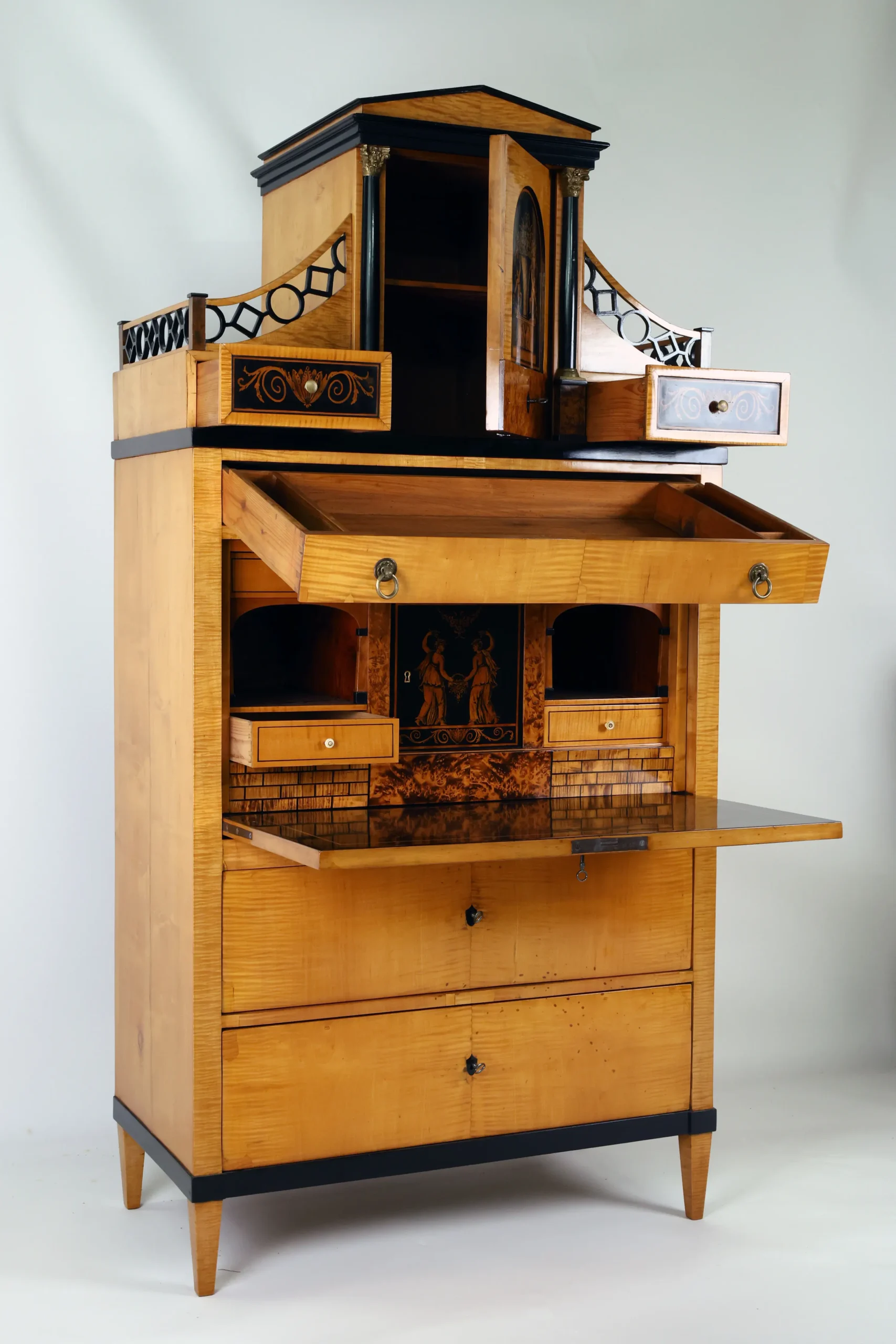
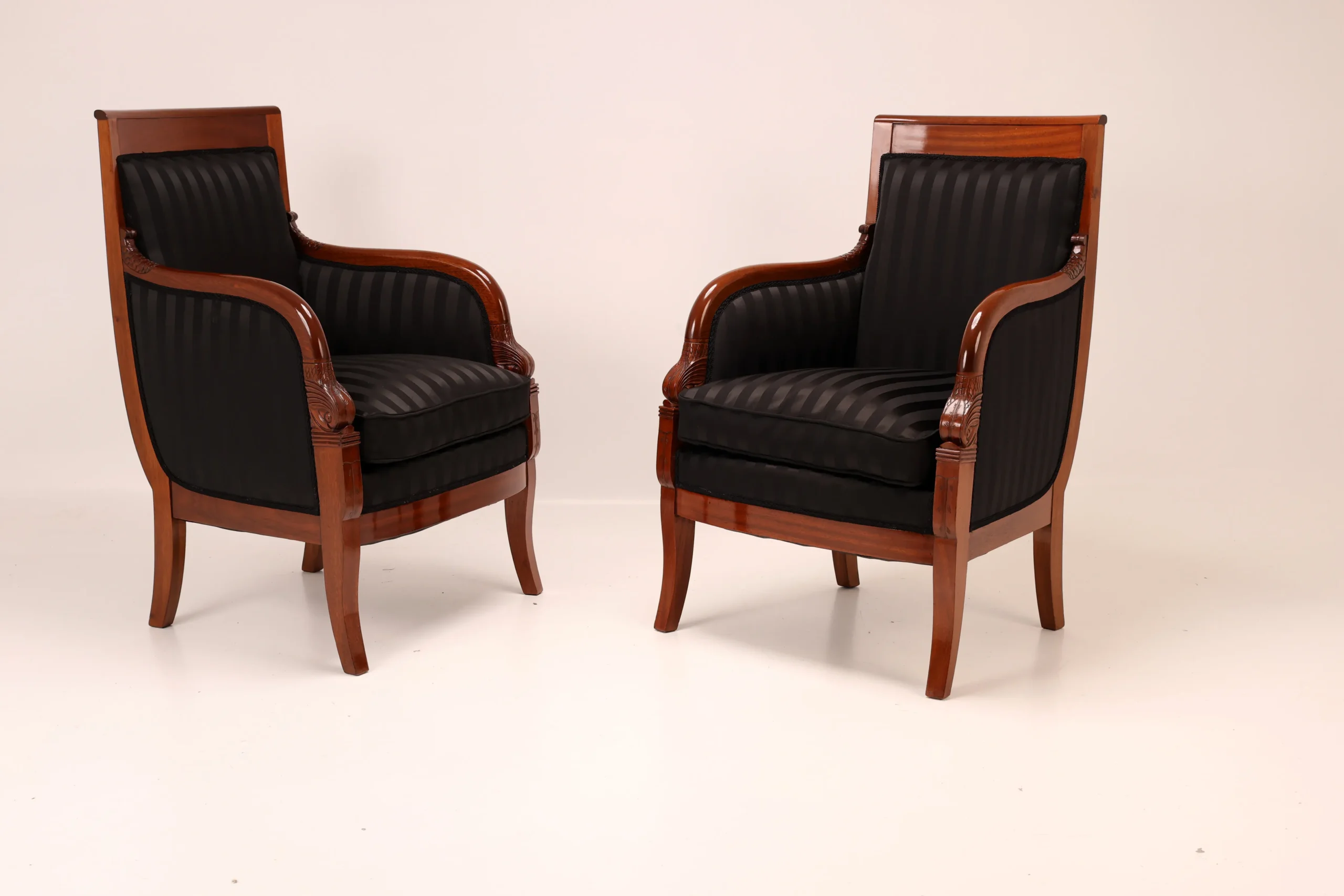
Pick almost any room in a European palace between 1700 and 1850, and the most expensive object in it was probably a chest of drawers. Not a painting, not a tapestry, but a low case of drawers standing against the wall beneath a mirror. The antique commode was the piece on which the finest cabinetmakers in Europe staked their reputations, and it is the single best object through which to read the entire history of European style, because every period that mattered was forced to reinvent it. Follow one form across four centuries and you watch the absolute power of the Sun King soften into the intimacy of the Rococo salon, harden again under Napoleon, and finally settle into the quiet confidence of the middle-class home. At Antiqueria Breitling, the commode is the form collectors return to most often, and for good reason: no other piece of furniture carries so much history in its drawers.
Why the Commode Became the Canvas
Before the commode there was the chest, a heavy top-loading box that forced you to unpack everything above to reach anything below. The commode solved that problem with drawers that pulled toward you, and the name itself comes from the French word for convenient. Over the centuries the word drifted, first to a cabinet for personal items, later to a night table hiding a chamber pot, and eventually, in everyday English, to the plumbing fixture. In the decorative arts, though, an antique commode means one thing only: the richly worked chest of drawers that anchored the European salon and bedchamber.
What made this particular form the showpiece was its proportion. Standing at roughly waist height, the commode offered a broad horizontal top for porcelain, candelabra, and bronzes, usually under a slab of fine marble, and an unbroken front façade where a cabinetmaker could display everything he knew about marquetry, parquetry, and sculptural mounts. Placed beneath a tall pier glass and flanked by sconces, it became the focal point of the room. It was storage and status object at once, and that double life is exactly why each new generation reinvented it to suit its own idea of beauty and power.
The Baroque Origins — Power in Brass and Tortoiseshell
The earliest French commodes were heavy, monumental things, built to project the absolute authority of Louis XIV. The form’s birth as a royal showpiece is credited to André-Charles Boulle, cabinetmaker to the king, who in 1708 delivered two pieces for the royal bedchamber at the Grand Trianon. These established the Baroque template: a massive en tombeau or sarcophagus shape, swelling outward toward the floor on heavy feet.
Boulle’s genius was a marquetry of brass and tortoiseshell cut together and set into dark ebony, a technique that still carries his name. Because he was housed in the Louvre and exempt from the guild rules that normally separated woodworkers from bronze casters, he designed and cast his own gilt-bronze mounts in complete harmony with the wood, winged sphinxes at the corners, lion’s paw feet below. The Baroque commode was micro-architecture, an unyielding block of solidity that mirrored the politics of the age.
The Régence and Louis XV Rococo — The Swelling Bombé Form
When Louis XIV died in 1715, the rigid court at Versailles gave way to the lighter, more sociable world of the Parisian townhouse, and the commode changed completely. The heavy floor-bound forms were lifted onto tall sweeping cabriole legs, and the architecture dissolved into the bombé form, where the front and sides billow outward in three-dimensional curves. Building one was a genuine technical feat. The cabinetmaker had to construct a curving carcass of oak or pine and then lay thin exotic veneer over those undulating surfaces without cracking it. The finest were built sans traverse, with the crossbars between drawers hidden so the floral marquetry could flow across the whole front like a single painting.
This is the world that produced the named masters. Charles Cressent, trained as a sculptor, gave his commodes flamboyant three-dimensional bronzes over restrained parquetry grounds. Bernard van Risenburgh, known by his stamp BVRB, was a master of end-cut floral marquetry and imported lacquer. Jean-Pierre Latz cut bloodwood obliquely to produce a waving, water-like grain. Driving all of them were the marchands-merciers, the elite dealers who acted as the first interior designers, supplying capital, dictating taste, and commissioning ébénistes to set Japanese lacquer panels or Sèvres porcelain plaques into their pieces. The marble tops were cut to follow every serpentine curve of the case below.
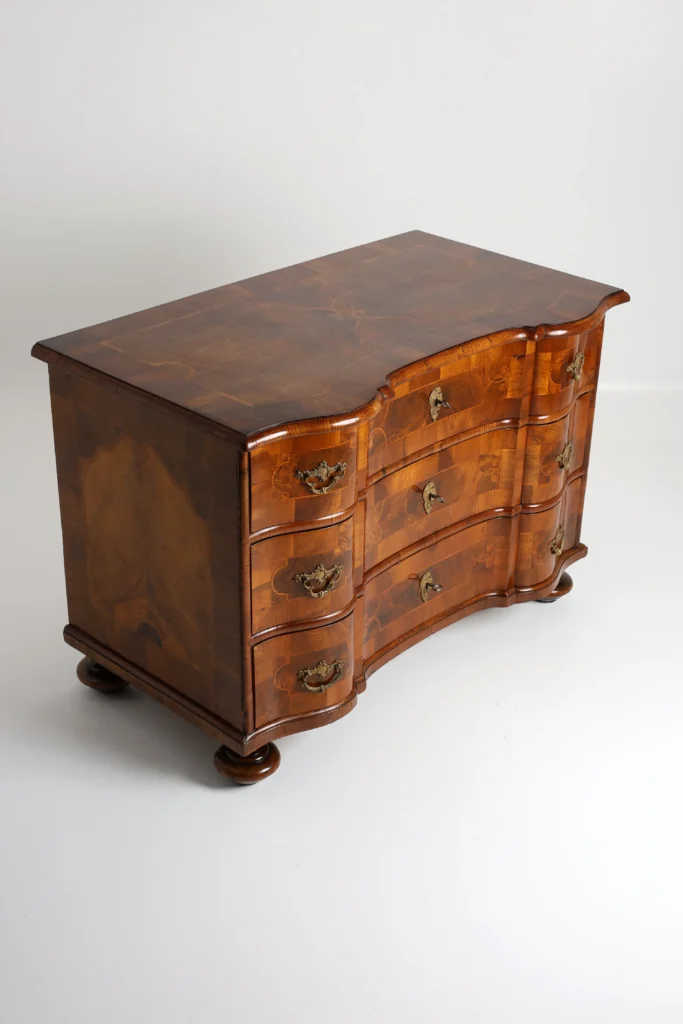
This transitional moment between Baroque solidity and Rococo movement is exactly where a small walnut commode of around 1760 sits. Crafted from fine walnut with original brass drop handles and escutcheons, its rectangular form is brought to life by beautifully shaped, double-curved drawer fronts, the early language of the bombé idea worked in a restrained continental manner rather than full Parisian exuberance. The top carries an intricate elm marquetry in a flowing interlaced pattern, the kind of surface decoration that turns a useful chest into something worth looking at, and the warm walnut has been brought up with a traditional hand-applied shellac polish that deepens the patina without erasing the history. Standing on elegant ball feet, with three working drawers and their original locks and keys, it shows how the curving Rococo sensibility reached the German-speaking lands and was made quieter, warmer, and more domestic.
The Louis XVI Reaction — Rectilinear Elegance
By the 1760s the elite had tired of Rococo excess, and the excavations at Pompeii and Herculaneum turned taste sharply toward classical antiquity. The Louis XVI commode straightened the swelling carcass back into clean rectilinear lines. The serpentine front gave way to the break-front, where a central section projects forward for architectural rhythm, and to the demi-lune, a perfect half-moon. Cabriole legs were replaced by straight tapering fluted legs like little columns. Asymmetrical floral marquetry yielded to geometric parquetry, trellis patterns, and disciplined classical motifs, and by the end of the period plain figured mahogany became fashionable, relying on the beauty of the grain and the brilliance of the bronze alone.
The towering figure was Jean-Henri Riesener, official cabinetmaker to Louis XVI, whose pieces remain among the most coveted objects in the decorative arts. His commode for Marie-Antoinette tells the whole story of the era: when the Queen was moved to the smaller Tuileries as the Revolution began, Riesener took the piece back to his workshop in 1791, reduced its size, refitted the bronzes, and signed the new marquetry panels himself, an unusual act of pride. Around him, makers like Oeben, Carlin, Weisweiler, and Vandercruse worked within the strict guild system, stamping their pieces to guarantee quality, right up until the old order collapsed. You can trace the broader arc of the form across periods in our Baroque chest of drawers collection.
The Empire Commode — Imperial Power in Mahogany and Ormolu
After the Revolution abolished the guilds in 1791 and Napoleon rose, the commode took its most severe turn. Stripped of delicate marquetry and Rococo grace, the Empire commode became an instrument of imperial propaganda. Under the architects Percier and Fontaine, it turned into a flat, unyielding architectural block built to project order and permanence. The material shifted to dark, heavily grained Cuban mahogany in broad unbroken expanses, the legs gave way to heavy plinth bases, and the fronts were flanked by full columns or animal-form supports with lion heads and paw feet.
The leading maker was Jacob-Desmalter, whose large workshop supplied the imperial palaces with monumental mahogany commodes carrying heavy fire-gilded ormolu. This bronze was no longer floral but strictly symbolic: imperial eagles, sphinxes, winged victories, tightly bound laurel, the heads of Hercules and Apollo. Dark monolithic marble tops completed an aesthetic that commanded a room through sheer mass.
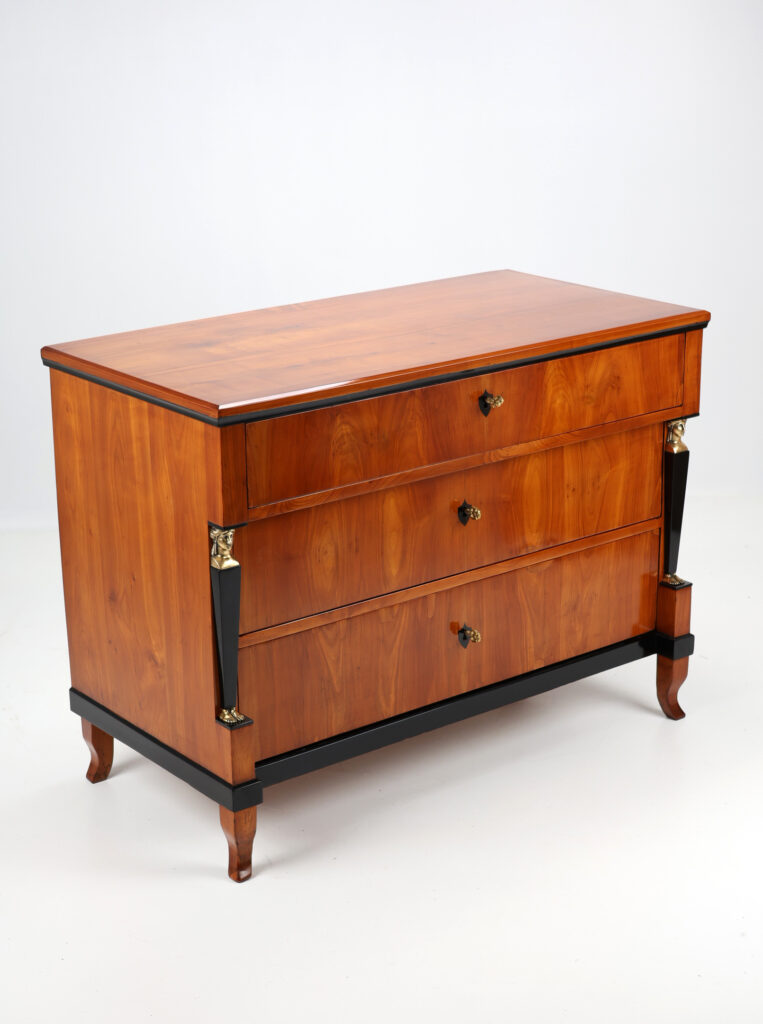
The Empire idiom did not stay in Paris. It travelled, and in the German-speaking lands it was reinterpreted in warmer native woods, which is exactly what you see in an Empire chest from South Germany dated around 1815. Made from solid cherrywood, with a warm veneer running continuously across three drawer fronts, it carries the full architectural vocabulary of the style in a regional voice. The drawers are flanked by finely carved gilded caryatid figures and ebonized pilasters, the classic Empire motifs of strength and beauty, while ebonized edges and base sharpen the clean lines and each drawer keeps its shield-shaped escutcheon and original brass key. Standing on four splayed feet and hand-polished with shellac, it shows how the imperial style was softened by the cherry and the restraint of the south, the bridge between Napoleon’s Paris and the bourgeois interior that came next.
The German Lands and the Biedermeier Commode
While Paris set the trajectory, the German-speaking centers had long held traditions of their own. Through the eighteenth century, Augsburg produced exceptionally precise bookmatched walnut, Mainz balanced architecture with subtle curves, Munich leaned sculptural and Italian-influenced, Hamburg went monumental and merchant-proud, and Dresden turned soft and courtly. The German Baroque chest of drawers was conceived as miniature architecture, with moulded edges, framing pilasters, and overhanging cornices. Rather than rely on imported woods and bronze, German makers bookmatched native walnut into vast symmetrical patterns and made the grain itself the ornament, then brought it to a luminous depth with countless hand-rubbed layers of shellac.
The absolute peak of German cabinetmaking belonged to the Roentgen workshop in Neuwied, where David Roentgen became the most famous cabinetmaker in Europe, supplying mechanical marvels to Catherine the Great, Louis XVI, and the King of Prussia, commodes whose hidden compartments sprang open at the turn of a single key.
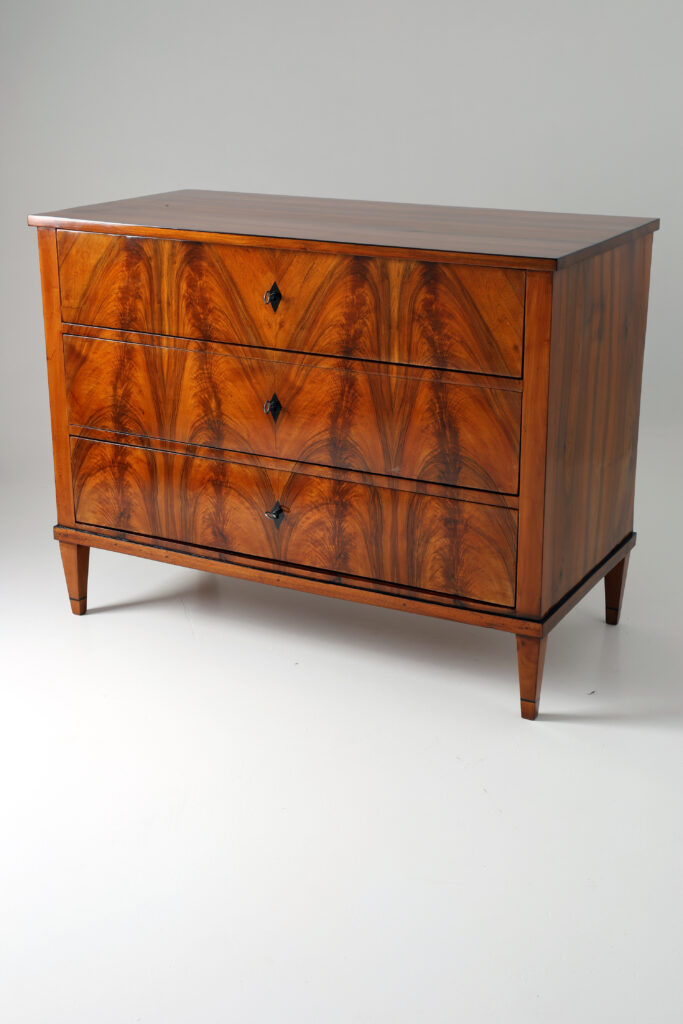
Then came the form closest to our own heart. After the Napoleonic Wars, the German lands pioneered the first modern decorative style not dictated by aristocratic taste: Biedermeier. As the prosperous middle class withdrew into the private world of the bourgeois salon, the Biedermeier commode became the practical and beautiful core of the home. Reacting against heavy Empire mahogany and bombastic ormolu, it returned to clean architectural lines and abandoned gilt bronze almost entirely. Instead it relied on richly grained, honey-toned bookmatched veneers of local fruitwood, walnut, and cherry, with the contrast provided by stark ebonized detail: black keyhole escutcheons, fine stringing, the occasional ebonized column. The result is celebrated today for a geometric purity that looks startlingly modern, a clear ancestor of twentieth-century design.
An early Biedermeier chest of drawers from the first quarter of the nineteenth century is the perfect illustration. Its striking walnut veneer carries a warm tone and a beautifully arranged grain, laid symmetrically across the drawer fronts so the wood itself does all the decorative work. The carcass is pine, exactly as the period demands, and the subtle ebonized stringing and escutcheons sharpen the restrained early Biedermeier aesthetic. It stands on slender tapered legs that give the whole piece lightness, with three generously sized drawers on working locks and keys, their interiors finished in shellac, and a hand-polished surface that pulls a deep lustre from the walnut. Fully original and ready to use, it is early Biedermeier elegance at its purest, and the cleanest possible answer to the dark imperial weight that came before it. The full range of the style is gathered in our Biedermeier chest of drawers collection.
Italy and the Low Countries
The commode took on its own accent wherever it travelled. In Venice, where the damp climate lifted traditional veneer, painted furniture thrived, and artisans developed lacca povera, pasting finely printed paper cutouts of chinoiserie figures and floral bouquets onto a painted serpentine commode and varnishing them to imitate costly Asian lacquer. In Piedmont, Pietro Piffetti built dizzying marquetry of walnut, ivory, mother-of-pearl, and boxwood, while in Milan Giuseppe Maggiolini defined the Italian neoclassical commode with precise pictorial intarsia in dozens of natural wood tones. The Dutch tradition pushed the bombé form to an exaggerated, swelling voluptuousness, smothering massive cases in bold, brightly coloured floral marquetry of urns and tulips, accented by heavy brass rather than delicate ormolu.
How to Read a Genuine Commode
The market is full of brilliant nineteenth-century revivals, so authenticating a commode means reading its materials honestly. Start with the carcass: Parisian workshops used white oak for the frame and drawer linings, provincial and German makers used pine, spruce, or poplar. The drawers should show hand-cut dovetails, slightly irregular in the eighteenth century and proudly bearing the marks of the maker’s saw. The veneer matters too. Baroque and period veneers were hand-sawn and relatively thick, while the water-powered circular saws of the nineteenth century produced paper-thin sheets.
The bronze mounts are where a connoisseur often looks first. True eighteenth-century ormolu was fire-gilded with a gold and mercury amalgam, then fired so the mercury burned off and left a thick, deeply bonded layer of gold with a characteristic matte bloom in the recesses. The process was so toxic that gilders rarely lived past forty, and France outlawed it by 1830. Period mounts were chased by hand, leaving crisp fine tooling under magnification, and secured from behind with heavy irregular hand-cut screws. Nineteenth-century electroplating, by contrast, lays down a thin cold film without sculptural depth, and reproduction mounts cast from originals show a telltale blurring of detail.
The French guild marks are the final piece of evidence. To stamp his work, a craftsman completed years of training and a masterpiece to earn the title of master, after which an approved piece received the JME stamp, usually struck into the raw oak beneath the marble or on the back posts. Because the guild was abolished in 1791, a genuine JME stamp is a definitive sign of pre-Revolutionary manufacture. A careful eye also watches for marriages, where later bronzes or a replaced top have been added to an older carcass, and reads the oxidation of the backboards and the wear on the drawer runners for the honest story of two hundred years. Every commode that comes through Antiqueria Breitling is assessed against exactly these markers before it is offered.
The Commode in the Modern Room
The antique commode remains the single most collectible form of European case furniture, and in the contemporary interior it works as a grounding statement piece, anchoring a minimalist living room, standing grandly in an entrance hall, or returning to its old role in the bedroom. Value rests on the named maker, the provenance, the originality of the marble and the mounts, and the condition of the marquetry, and at the very top the form commands prices that rival major paintings. It is a quiet irony that an object first conceived as a mere convenience now sits among the most valuable furniture ever made, a testament to the fact that a single commode required the combined genius of cabinetmaker, bronze caster, gilder, marble cutter, and dealer working as one.
That is the real reason the commode is the best window onto European style. The Baroque sarcophagus, the swelling Rococo bombé, the disciplined Riesener neoclassicism, the dark Empire block, the warm restraint of Biedermeier, each period was forced to remake the same form in its own image, and the result is a four-century record you can open one drawer at a time. At Antiqueria Breitling, fine commodes from across these periods are restored in-house and assessed against every marker above, whether you are drawn to the curves of an early walnut piece, the architectural calm of an Empire chest, or the clean modern lines of a Biedermeier original. Write to us at contact@antiqueria-breitling.com for pieces not yet listed, with worldwide shipping available on everything we offer.