Most people know Karl Friedrich Schinkel as the architect who rebuilt Berlin, the man behind the Altes Museum and the Neue Wache, whose colonnades still define the Prussian capital. Far fewer know that the same hand that drew those facades also drew chairs, cabinets, and writing desks, and that in doing so he shaped an entire furniture tradition. Karl Friedrich Schinkel furniture is the key to understanding North German Biedermeier, because Schinkel treated a salon chair with exactly the same seriousness he gave a temple front. For him the interior was never decoration added to a building. It was architecture at a smaller scale, governed by the same laws of geometry and proportion. At Antiqueria Breitling, this is the tradition behind many of the finest North German pieces we handle, and understanding Schinkel is the surest way to understand why Berlin Biedermeier looks the way it does.
The Architect Who Came to Furniture
Schinkel was born in 1781 in Neuruppin, a provincial town in Brandenburg. When he was six, a fire destroyed much of it, and the town was rebuilt on a strict rational grid under state architects. That early lesson in disciplined, orderly reconstruction stayed with him for life. He trained in Berlin under David and Friedrich Gilly, early champions of a pure, unadorned neoclassicism drawn from ancient Greek and Roman forms.
His career was almost stopped before it began. In 1806 Prussia was crushed by Napoleon at Jena and Auerstedt, the French occupied Berlin, and state building came to a halt. With no commissions, Schinkel worked as a painter, a stage designer, and a maker of panoramas and dioramas. That detour mattered more than it might seem, because it trained him to imagine complete, immersive three-dimensional spaces, a theatrical instinct that later shaped how he integrated furniture into rooms as a single unified environment.
When Napoleon fell in 1815, a proud Prussia wanted to project intellectual rigor and state efficiency, and Schinkel became its aesthetic visionary. Appointed to the powerful Oberbaudeputation, the state building commission, he rose to lead it, gaining authority over public works across the kingdom. He earned the trust of the royal family, and for these elite patrons an architect of his stature willingly turned to designing chairs, tables, and cabinets. He understood that the domestic world of the ruling class needed a new language, one that signaled stability and enlightened government without the ostentation of the old French court or the militaristic weight of the Napoleonic Empire style.
Furniture as Architecture
The single idea that unlocks everything is this: Schinkel saw furniture as micro-architecture. His neoclassicism was structural, not decorative. Where the French Empire style applied gilded bronze motifs over heavy, unresolved blocks, Schinkel built his classicism into the bones of the object. He worked from the principle that every structural part should be given beauty and truth to its own function.
In a Schinkel design the frame is always visible and logical. A chair leg is not just a support but a column bearing weight. A cabinet cornice is not a flourish but an entablature completing a facade. The geometry is celebrated rather than softened or padded away. He gave the same intellectual seriousness to a writing desk as to the front of a museum, and that idea of a total interior, where every element from the cornice to the feet of a sofa serves one unified vision, anticipated the modernist movements of the twentieth century by a full hundred years.
This severity was not an accident of taste. It was the visual form of the Prussian self-image. After the humiliation of the Napoleonic years, Prussia rebuilt itself on discipline, frugality, efficiency, and intellectual rigor, and Schinkel’s classicism was meant to be clearer and simpler in Prussia than anywhere else. His furniture is the physical embodiment of that character: structured, rational, and unyielding.
How to Recognize the Berlin Idiom
Biedermeier across Central Europe shared a technical foundation: pale native woods, bookmatched veneers, and a stable softwood carcass. But North German Biedermeier, and the Berlin sphere in particular, has formal traits that set it apart at a glance.
Napoleon’s Continental Blockade had cut Central European workshops off from imported mahogany, which pushed cabinetmakers toward indigenous woods and created the signature Biedermeier palette of cherry, maple, pear, birch, and ash. Berlin leaned toward the cooler, paler woods, birch and ash above all, though as a wealthy capital with northern trade routes it never abandoned fine mahogany for prestige pieces, often with spectacular pyramid grain.
The defining decorative move, established by Schinkel himself, is ebonized detailing. Where French furniture used gilded bronze for contrast, Schinkel and the Berlin cabinetmakers used sharp black lines, solid ebonized columns, darkened moldings, and black escutcheons to articulate the structure of the piece. That stark contrast between pale luminous veneer and severe black outlining gives the furniture a graphic, monumental stance. The ornament is never superfluous. Instead of applied bronze or heavy carving, the decoration comes from the architectural massing of the wood itself: triangular pediments crowning secretaries, columns flanking doors, stepped plinths anchoring the case to the floor. Carving is kept to a minimum, limited to restrained classical motifs like palmettes, laurel, and lyres.
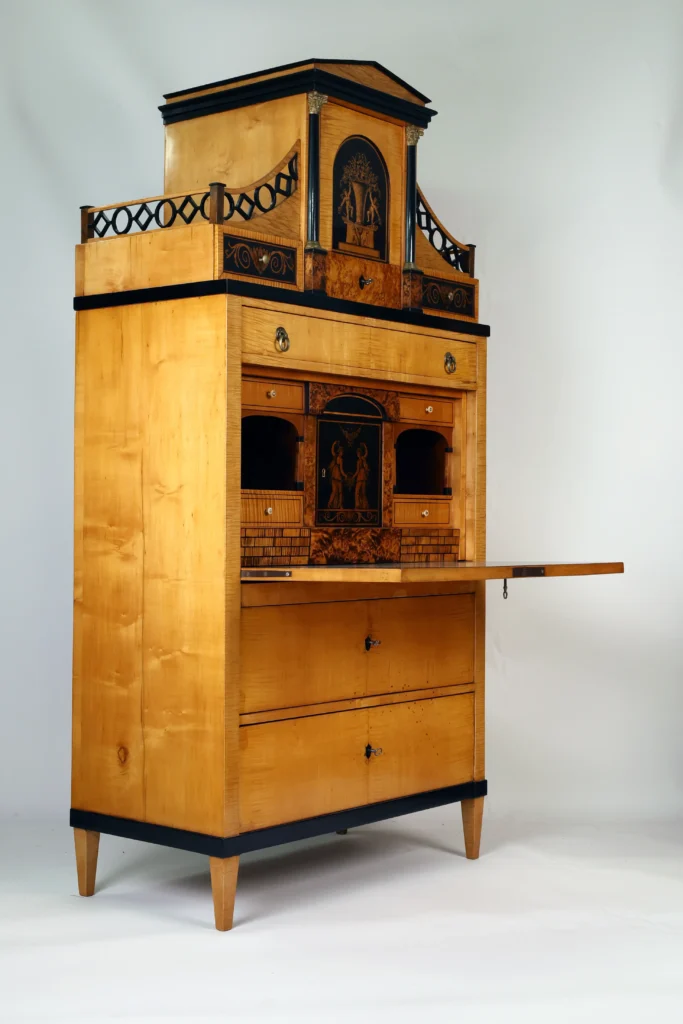
A North German Biedermeier secrétaire from the Braunschweig region, made around 1815, shows this thinking almost diagrammatically. Its architectural superstructure is crowned by an ebonized pediment carried on slender black columns with bases and capitals, the exact vocabulary Schinkel drew from ancient temple fronts and brought down to the scale of a writing cabinet. Executed in finely figured maple over an oak and softwood carcass, it treats the whole object as a small building. At the center of the upper section a little door with verre églomisé decoration in the Greek taste sits flanked by open galleries and tiny drawers, and the fall-front opens to a sophisticated interior of compartments and arcaded niches, with a central door painted with a classical Greek scene concealing a hidden compartment. The lower section is inlaid with intarsia simulating masonry, literally rendering the desk as architecture. Schinkel’s celebrated secretaires for the royal palaces worked on exactly this principle, the cabinet as miniature building complete with classical proportions and engineered secrets. This piece is not one of those royal commissions and makes no claim to be a documented Schinkel design. It is one of the many fine North German secretaires built in his idiom, the architectural language of Berlin carried into a skilled provincial workshop. You can see the same architectural discipline across the pieces in our Biedermeier secretary desk collection.
The Royal Masterpieces
Schinkel’s furniture reached its height in his designs for the Prussian palaces, the Neuer Pavillon at Charlottenburg, Schloss Glienicke, and the Berlin City Palace. The armchairs he designed around 1828 for the Marble Hall of the City Palace are among the most iconic, built from mountain ash that was then gilded, with fiercely rectilinear frames and tightly controlled curves. The choice of mountain ash, a humble native wood, elevated through gilding, captures the Biedermeier synthesis of local material and high-court prestige exactly.
Another piece reveals how far ahead of his time he was. A salon chair designed around 1828 to 1830 for the Palais Cumberland uses, in its backsplat, mahogany-veneered plywood, a laminated material we associate with twentieth-century modernism, shaped to look like a textile stretched taut across fluted dowels. The pale maple marquetry against dark mahogany was designed to conjure the shimmer of silk moiré. It is severe classical restraint and playful visual illusion at once.
The Cast-Iron Surprise
The most counterintuitive fact about Schinkel is that the same man who hand-built furniture for royal interiors also pioneered industrial mass production. Prussia was industrializing, and cast iron from the state foundries became a source of national pride. Schinkel believed industrial materials could carry real aesthetic value if treated with architectural honesty, and he designed cast-iron garden furniture that combined iron with wood and marble.
His most famous design is a garden chair whose side segments form a single continuous sweeping curve, merging backrest, armrest, and front leg into one line. Made from a few standardized cast components, it could be produced in unlimited quantity for the parks and gardens of Prussia, an early triumph of mass production. The stark linearity and functional purity of these pieces pointed straight toward the Bauhaus, and observers have long noted how that continuous curving line anticipates Mies van der Rohe’s Barcelona Chair, designed a century later.
The Cabinetmakers Who Built the Vision
Schinkel drew the designs, but he did not build the furniture. He relied on a tightly vetted network of Berlin master cabinetmakers with the skill to turn rigorous architectural drawings into flawless woodwork. The maker most closely linked to him was Karl Wanschaff, born near Braunschweig in 1775, who settled in Berlin in 1806. By 1816 he was executing Schinkel’s uncompromising designs for Prince August of Prussia, and his technical command of tensioned veneer and crisp edges was exactly what Schinkel’s classicism demanded. In 1825 his workshop furnished the king’s summer house, the Neuer Pavillon, and in 1829, on Schinkel’s recommendation, he was made Hoftischler, court cabinetmaker. After Schinkel died in 1841, Wanschaff’s stream of major state commissions notably dried up, a measure of how intertwined the two careers were.
Johann Christian Sewening was the other key figure, a master from 1797 whose premier workshop served the top of the court and produced, alongside Wanschaff, the seating for the Marble Hall. The presence of these names guarantees the absolute apex of Biedermeier craft, and the distinction between pieces designed by Schinkel, pieces made by his favored workshops, and pieces simply made in the Schinkel style is the main driver of value in today’s market.
How Schinkel Reached Every Workshop
Schinkel’s influence spread far beyond the palace, and the mechanism was a remarkable one: a state-sponsored pattern book called Vorbilder für Fabrikanten und Handwerker, Models for Manufacturers and Craftsmen. Published between 1821 and 1837 by the Prussian trade authority, with Schinkel as its chief aesthetic advisor, it contained 151 detailed plates and was distributed free of charge to selected manufacturers and master cabinetmakers across the kingdom.
The goal was economic. After the devastation of the Napoleonic Wars, Prussia needed to raise the quality of its manufactures to compete with French and English exports, and the book served as a visual curriculum for the new trade schools. Several plates featured chairs and sofas designed by Schinkel himself, and by sending these into provincial workshops, the state ensured that his proportions, his rigid sabre legs, and his classical motifs were copied and standardized across Northern Germany. Through this brilliant piece of state-sponsored industrial design, the local Schinkel style became the baseline for the entire North German Biedermeier aesthetic. It is the reason a chest made far from Berlin can still speak with Schinkel’s accent.
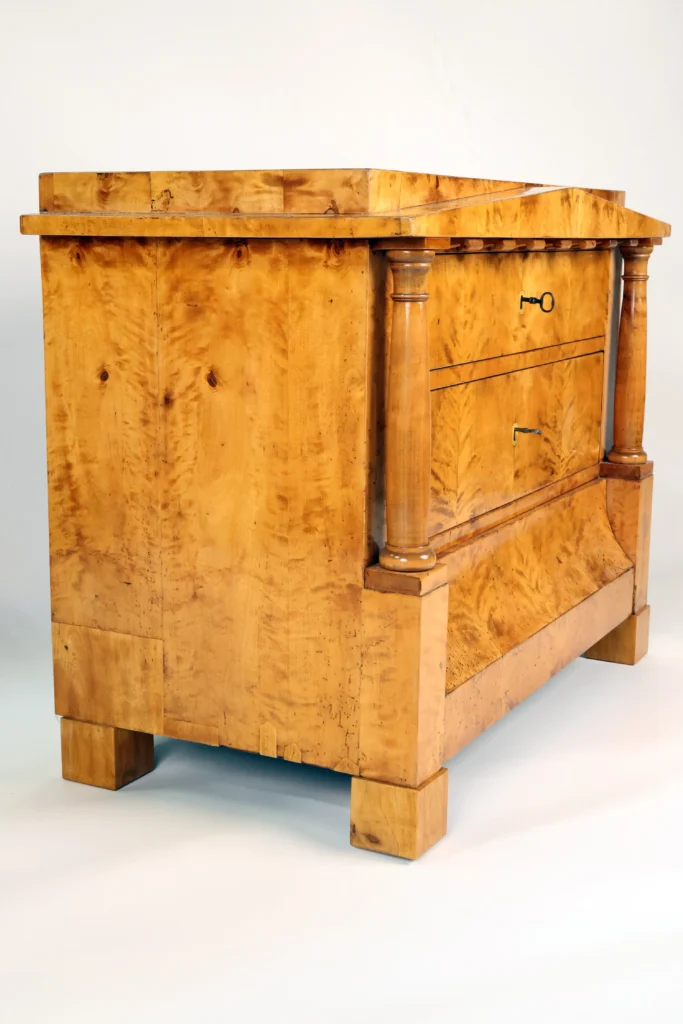
A Biedermeier chest of drawers in figured birch, made in Germany around 1820, is exactly such a descendant. Its façade carries a warm, softly toned birch grain, and it is crowned with a pediment-like element decorated with a dentil frieze, a classical architectural accent lifted straight from the temple-front vocabulary Schinkel popularized. Full columns flank both sides, giving the chest a strong architectural presence and turning the supports into load-bearing elements rather than decoration, precisely the Schinkel principle. It rests on solid block feet that anchor it firmly to the floor, with horn escutcheons as a refined period detail, and has been hand-polished with shellac to preserve its natural patina. This is not a palace commission, and it makes no claim to be one. It is something more useful to understand: the Schinkel idiom as it actually lived in German homes, carried out of Berlin by the pattern book and into the hands of skilled provincial makers.
Telling the Real Thing from a Revival
The market is full of later Biedermeier Revival pieces from the late nineteenth and twentieth centuries, so authentication matters. The structural heart of genuine Biedermeier is Blindholz construction, a stable secondary carcass of slow-grown pine or spruce, assembled with carefully hand-cut dovetails. Open a drawer on a real Berlin piece and the interior is as considered as the exterior. Over that carcass went thick decorative veneer, bookmatched so that consecutive sheets from the same log opened like the pages of a book into mirror-image grain patterns. Because Schinkel and his circle avoided heavy bronze and carving, this natural symmetry carried the decorative weight.
The veneer itself is the clearest forensic evidence. Period Biedermeier veneer is thick by modern standards, roughly three to five millimeters, sawn rather than the paper-thin rotary-cut sheets under a millimeter that betray a later piece. Genuine dovetails are slightly irregular and hand-cut, not the perfectly uniform machine joints of mass production. The back panels of an authentic piece show real oxidation, while revivals often reveal plywood, clean unoxidized boards, or hard glassy synthetic varnish instead of the warm, deep, slightly uneven glow of hand-rubbed shellac.
Attributing a piece directly to Schinkel or to the Wanschaff or Sewening workshops commands an extraordinary premium, but it requires ironclad provenance, royal inventory brands struck into the carcass, or alignment with surviving drawings in the Berlin print collection. Short of that, a high-quality period piece is honestly catalogued as North German Biedermeier or in the Schinkel style, authenticated by the unmistakable idiom: strict rectilinearity, birch, ash, or prestige mahogany, rigorous ebonized articulation, and period-correct thick sawn veneer over a Blindholz core. Every piece that comes through Antiqueria Breitling is read against exactly these markers before it is offered.
Why Berlin Biedermeier Belongs in the Modern Room
Demand for Berlin Biedermeier, and for anything connected to Schinkel, has stayed remarkably strong, precisely because the style anticipates modern design so cleanly. It draws traditional collectors and contemporary interior designers alike. Its architectural discipline makes it uniquely suited to minimalist interiors. Where the curved warmth of Viennese Biedermeier melts into soft, Scandinavian-inspired spaces, the severe ebonized geometry of a North German piece acts as a structural anchor, holding its own against stark modern art, concrete, and steel. Buyers who gravitate to Berlin Biedermeier are looking for discipline and monumental presence rather than soft enveloping comfort, and a tall Berlin secretaire or a columned chest gives a room exactly that.
That is the lasting achievement of Karl Friedrich Schinkel. By bringing the same geometric rigor to a salon chair or a writing cabinet that he brought to the Altes Museum, and then sending those designs out across Prussia through his pattern book, he forged a furniture language that still feels powerful and modern two centuries later. At Antiqueria Breitling, fine North German Biedermeier in the Schinkel tradition is among the most rewarding furniture we offer, restored in-house and assessed against every marker above. Whether you are drawn to a columned birch chest or an architectural secrétaire crowned with an ebonized pediment, the full range is gathered in our Biedermeier furniture collection. Write to us at contact@antiqueria-breitling.com for pieces not yet listed, with worldwide shipping available on everything we offer.