


In most of Europe, paint on antique furniture was a sign of cheapness, a way to hide inferior wood. In Sweden it became the opposite: the very thing that makes a piece precious. Gustavian furniture, Sweden’s luminous answer to French neoclassicism, took the straight lines and classical motifs of Louis XVI Paris and reinterpreted them in soft, chalky painted finishes built for the northern light. The result is one of the most sought-after of all antique styles today, prized for the way it bridges historical weight with an airy, almost modern calm. At Antiqueria Breitling, the appeal is easy to understand the moment you stand in front of a genuine piece: a worn pearl-grey commode does something to a room that polished mahogany never can.
This is the story of how a Francophile king, a scarcity of exotic wood, and the long Swedish winter combined to produce a style defined by pale paint, and why that paint is exactly what collectors chase.
A King Who Wanted Paris in the North
The style takes its name from King Gustav III, who came to the Swedish throne in 1771, a cultured and authoritarian Francophile raised on French taste. The decisive moment came on his grand tour as crown prince, when he spent 1770 and 1771 in France and was captivated by the emerging neoclassical style at Versailles and the French court. He returned determined to turn Stockholm into the Paris of the North, and he used state patronage to do it, importing French designers and ideas to align the Swedish court with the intellectual vanguard of Europe.
But French taste had to be translated. The Louis XVI style depended on expensive exotic veneers, elaborate marquetry, and heavy gilt bronze, and Sweden had neither the colonial supply chains nor the wealth of France, nor quite the appetite for Catholic opulence in a restrained Protestant culture. So French forms were adapted to Swedish materials, climate, and sensibility. The architects who did the translating, chief among them Jean Eric Rehn and the Italy-trained interior designer Louis Masreliez, straightened the curves of the Rococo into smooth surfaces, tapering columns, and disciplined classical ornament. Gustavian furniture shares its classical DNA with Louis XVI, but it speaks with a completely different voice. You can see the French side of that lineage across our Louis XVI furniture collection.
Why Paint, and Why Pale
The defining feature of Gustavian furniture is its pale painted surface, and that choice was driven by a mix of economics, climate, and a sophisticated eye for light. Exotic tropical hardwoods were prohibitively expensive in Sweden, so craftsmen worked in abundant native woods, Baltic pine, birch, alder, and elm. Because pine lacks the dramatic grain of tropical wood, it was treated as a canvas, a base for an applied finish rather than something to display bare.
The pale palette, though, was more than thrift. In the long Swedish winter, daylight is scarce and precious, and the Gustavian colours, pearl grey, dove grey, pale blue, soft cream, bone white, muted sea green, were formulated to catch and reflect every bit of available light. Each piece of furniture became a secondary light source, scattering candlelight and weak winter sun softly around the room. Pearl grey became the most quintessential of all the Gustavian finishes.
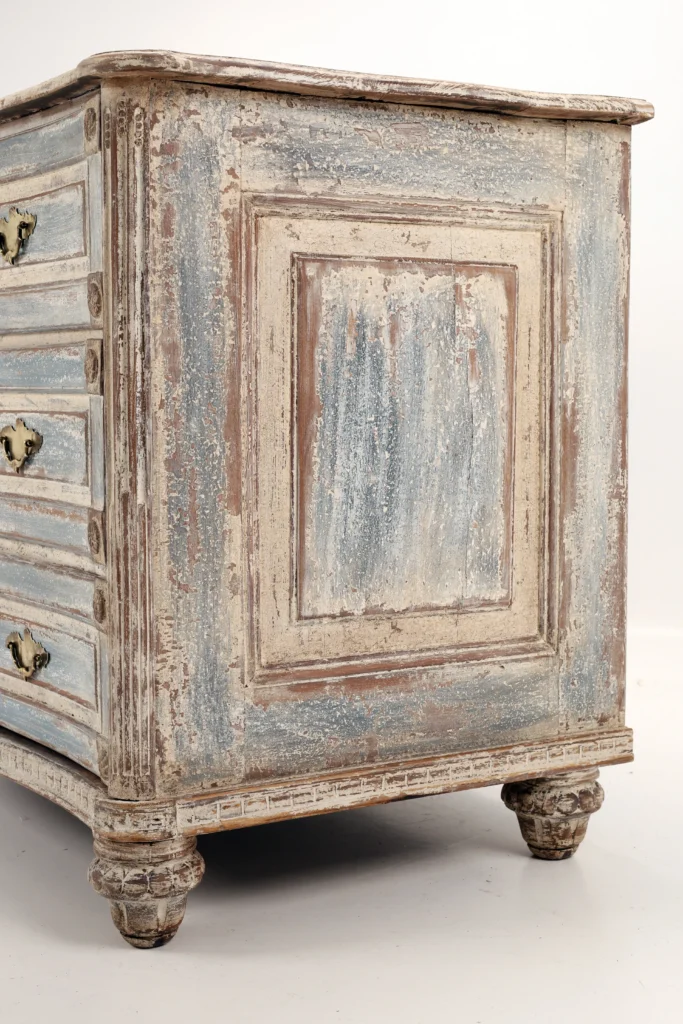
The paint itself was nothing like modern paint. The raw pine or birch was first sealed with gesso, a warm mixture of chalk and animal glue built up in layers to fill the grain. Over that came distemper, known in Swedish as limfärg, earth pigments suspended in glue and chalk, which dried to an extraordinarily dry, matte, chalky surface with no sheen at all. That micro-texture is what scatters light so beautifully, and over two centuries those brittle layers oxidise, shrink, and wear away at the edges and high points to reveal hints of gesso and bare wood beneath. This dry, layered patina is the hallmark of authenticity, and it is almost impossible to fake convincingly. The finest pieces for the Stockholm elite added subtle parcel gilding, gold leaf on a rosette or the fluting of a leg, a restrained flash of luxury against the matte grey.
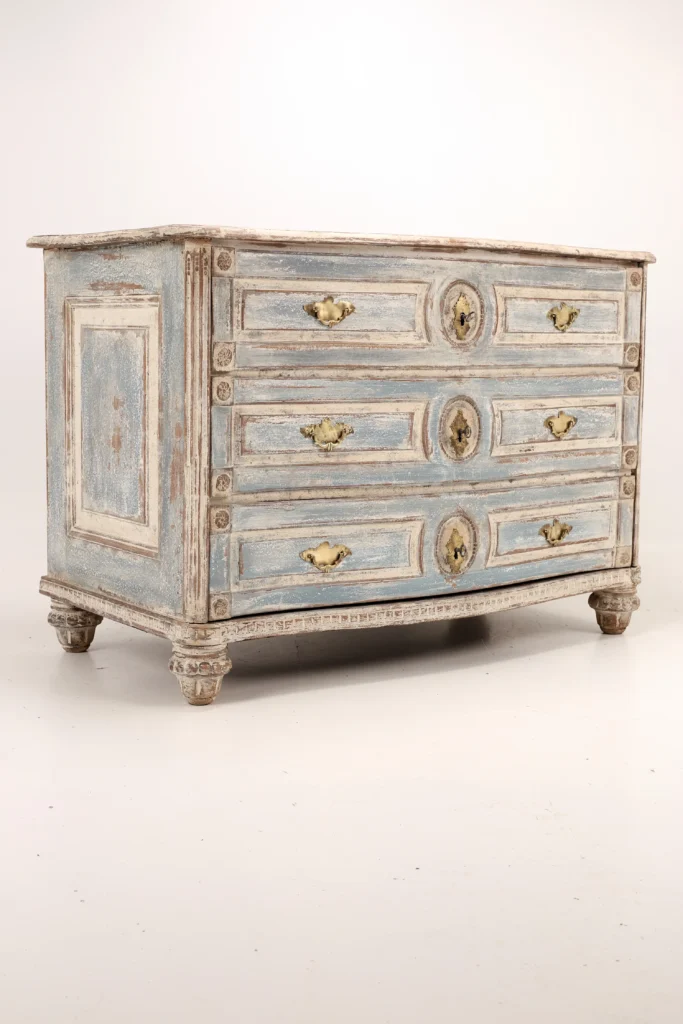
A Swedish commode in the Gustavian style shows this language perfectly. Hand-painted in a soft blue-grey with a naturally aged, distressed surface, it has a gently curved front, panelled drawers, turned feet, and brass hardware, the balanced proportions and quiet neoclassical detailing that define Scandinavian design of the period. The worn paint is not a flaw to be corrected but the whole point, the dry patina that tells you the piece has lived through two centuries of use, and it is exactly this quality that lets a piece like this move so easily between classic and contemporary interiors.
The Vocabulary of the Style
Where the Rococo was all vegetative, asymmetrical movement, Gustavian furniture is architectural and disciplined. Silhouettes are straightened, curves brought under geometric control, and the proportions drawn from classical antiquity. The quintessential Gustavian leg is straight, slender, and tapering, almost always carved with vertical fluting like the shaft of a classical column. Chair backs become strict ovals, medallions, shields, and rectangles, replacing the violin shapes of the Rococo. The carved ornament comes straight from antiquity: rosettes set into the square blocks above the legs, laurel wreaths, acanthus, Greek key, ribbons, bellflowers, and urns.
The forms follow French models with a Swedish accent. The Gustavian chair, with its carved oval or medallion back on fluted tapering legs, is the most iconic. Case pieces were radically simplified, the commode trading the bombé Rococo front for a flat, smooth, architectural facade. The Swedish drop-front secretaire, the skrivbyrå, stood as an architectural monolith when closed and opened to a theatre of small drawers and compartments. Demilune consoles were placed in pairs beneath pier mirrors to complete a room’s symmetry. And no Gustavian interior was complete without two uniquely Swedish forms: the Mora clock, a longcase clock with a curvaceous figure-eight silhouette painted in pearl grey or pale blue, and the kakelugn, the tall tiled stove that rose floor to ceiling and dictated the arrangement of the room.
The Guild, the Masters, and the Country Cousins
Production was no free-for-all. The Stockholm chairmakers guild, established in 1664, controlled the making of seating in the capital, and after 1765 masters were required to stamp their finished work, much as the French struck the estampille. A Gustavian piece might carry a cold-stamped set of initials pressed into the frame and a printed guild paper label under the seat, which gives collectors unusually good attribution data. Several Stockholm masters rose to prominence, Melchior Lundberg, the royal chairmaker Ephraim Ståhl, and Erik Öhrmark, who collaborated with Masreliez on chairs based on the ancient Greek klismos, while the great cabinetmakers Georg Haupt and Gottlieb Iwersson brought the veneered Louis XVI style to the Swedish court at the highest level.
There is a fascinating split running through the style. High Gustavian court furniture, made for palaces like Drottningholm and Haga, sometimes abandoned the pale paint entirely in favour of polished mahogany, rich inlay, and gilt bronze, the purest and most literal echo of France. Swedish country Gustavian, by contrast, was the style’s democratic spread into the provinces, where local carpenters reinterpreted the court forms in native pine with charmingly naive carving, a slightly lopsided rosette, wider fluting, and finished them in the thick chalky distempers that protected the wood and reflected the light. The irony of today’s market is that it is often these humble provincial pieces, with the genuine worn patina of two centuries of manor-house and farmhouse use, that designers chase hardest, because their warmth and authenticity speak to modern taste more directly than the gilded formality of the court.
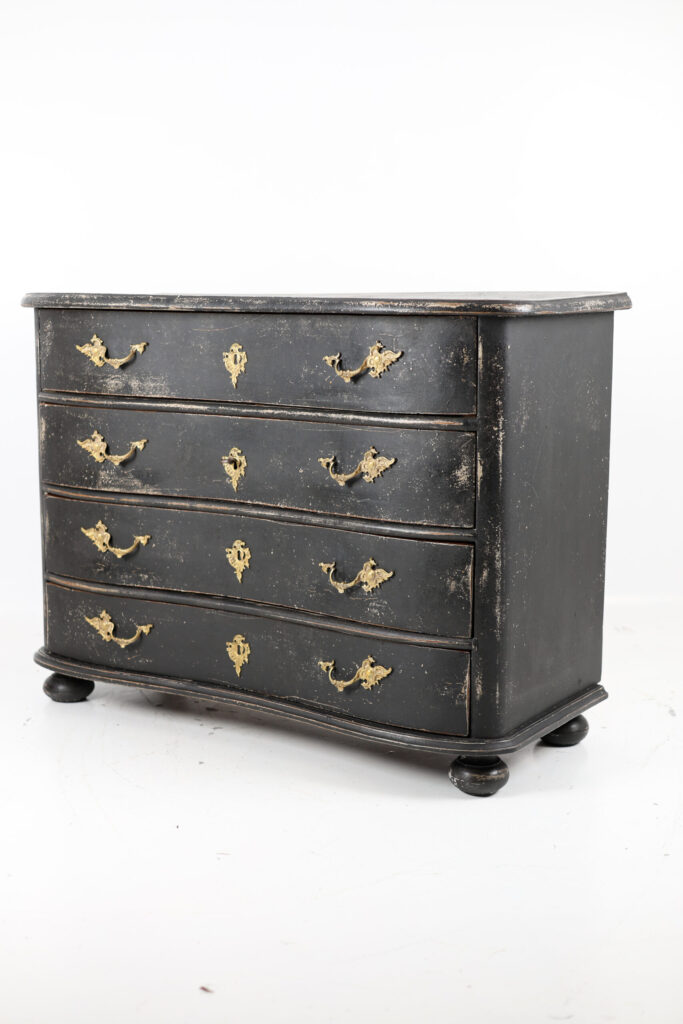
A refined Gustavian chest of drawers from Sweden, dated around 1790, shows a different and rarer face of the style. Crafted in walnut and finished in deep black paint with traces of its original patina, it has four drawers, the central one keeping its original lock and key, with interiors lined in shellac and a protective wax polish on the surface. Original gilt-bronze fittings strike a sharp contrast against the dark ground, and the gently serpentine drawer fronts, rounded sides, and bun feet capture the Gustavian balance of classical influence and Swedish restraint. The black finish is a reminder that the pale palette, though dominant, was never the only Gustavian voice, and a dark painted piece like this with its original bronzes is a distinguished thing for a collector. You can see related case pieces in our antique chest of drawers collection.
From Gustavian to Karl Johan
The style did not stand still. After Gustav III was assassinated at a masked ball in 1792, the early Gustavian grace hardened into the Late Gustavian phase, roughly 1790 to 1810, with severe square chair backs, minimal carving, and flatter, plainer surfaces. That growing austerity led, after the political upheaval of 1809, into a complete shift. When the French marshal Bernadotte became King Karl XIV Johan, he brought the French Empire style to Sweden, adapted into the Karl Johan style, the Swedish parallel to Biedermeier and the broader Empire movement. It rejected pale paint outright in favour of polished light woods, especially spectacularly grained flame birch, elm, and alder, or dark unpainted mahogany for grander pieces, with military symbolism replacing the delicate laurel of the Gustavian years. The painted era was over.
How to Read a Genuine Gustavian Piece
Authenticating Gustavian furniture is, above all, about reading the paint. Because provincial pieces were utilitarian, they were routinely repainted by successive generations, so an untouched original 1780s paint layer is exceedingly rare and commands an enormous premium. To recover it, skilled conservators use a painstaking technique called dry scraping, removing later layers of modern paint with scalpels and great patience, working entirely dry to avoid dissolving the fragile original distemper beneath. Even when the revealed paint is worn, chipped, and fragmentary, the piece is worth far more than one stripped to bare wood and freshly repainted. The market prizes genuine layered wear over artificial perfection, and a stripped-and-repainted piece loses much of its value.
Beyond the surface, the hidden structure tells the truth. In the eighteenth century, finishing the unseen parts of furniture was considered a waste, so a genuine Gustavian chest will show rough, unevenly planed backboards, visible saw marks, and stray paint splatters on the back and underside, with drawer interiors bearing the stains and ingrained dirt of centuries. The joints should be mortise-and-tenon secured with slightly irregular hand-carved pegs, the drawers held by hand-cut dovetails, and the fluting carved with the small organic irregularities of a hand tool rather than machine uniformity. A supposedly Gustavian commode with a perfectly sanded back, flawlessly finished drawers, and uniform machine marks is almost certainly a later Gustavian-revival piece or a modern reproduction, honestly described as Gustavian-style rather than period. A knowledgeable collector turns the piece around and looks at the back first. Every Gustavian piece that comes through Antiqueria Breitling is read against exactly these markers before it is offered.
Gustavian in the Modern Room
Demand for Gustavian furniture is strong and sustained, and the reason is simple: while heavy dark brown antiques have struggled in recent decades, the Gustavian vocabulary of pale paint, matte texture, clean architectural lines, and restrained form aligns almost perfectly with modern Scandinavian-inspired interiors. Designers treat these antiques as living, functional art, using a patinated pearl-grey secretaire, a tall Mora clock, or a pair of medallion-back chairs as sculptural focal points in stark contemporary rooms. The style is an unmatched bridge between old and new, adding historical intelligence and tactile warmth without clutter.
The market rewards a clear hierarchy: original or carefully dry-scraped paint above all, then the integrity of the carving, a verified guild stamp from a recognised Stockholm master, the purity of the period, and the desirability of the form. There is even a striking pricing inversion that surprises new buyers, where high-end modern reproductions, custom-made and artificially distressed to mimic age, can retail for more than genuine period originals, because so many buyers want the look immediately and flawlessly. Serious collectors, meanwhile, compete for the finite, shrinking supply of authentic, beautifully imperfect pieces. At Antiqueria Breitling, genuine period Gustavian and continental neoclassical pieces are restored in-house with respect for original surfaces and assessed against every marker above. Whether you are drawn to a soft blue-grey painted commode or a rare black Gustavian chest with its original bronzes, write to us at contact@antiqueria-breitling.com for pieces not yet listed, with worldwide shipping available on everything we offer.

