Worldwide Insured Shipping
Hand-Restored in our Atelier
Professional Custom Crating

Worldwide Insured Shipping
Hand-Restored in our Atelier
Professional Custom Crating
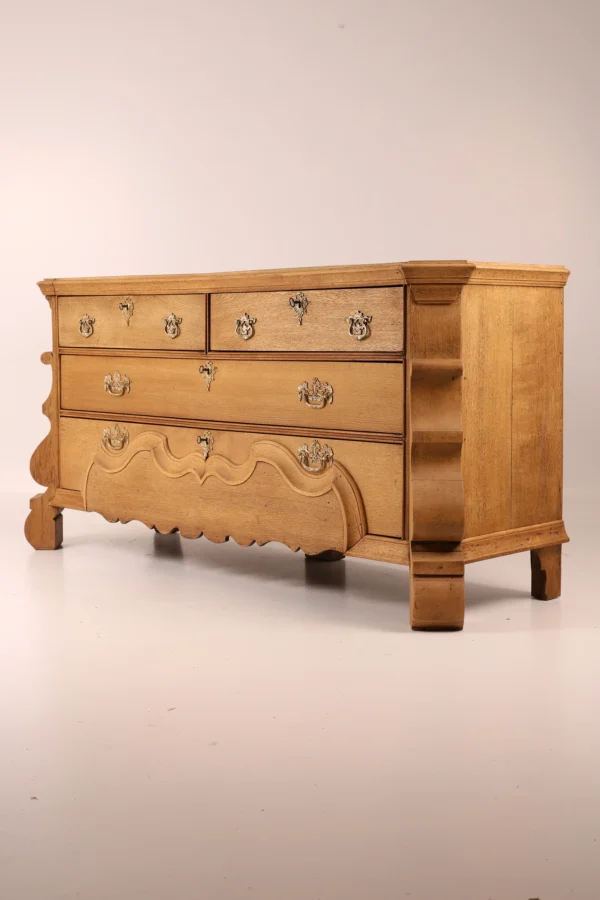


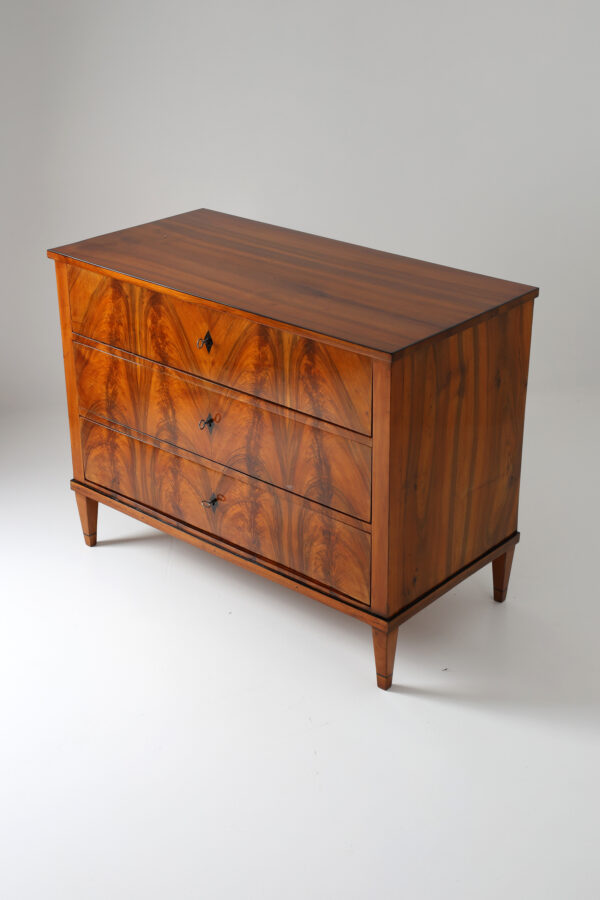

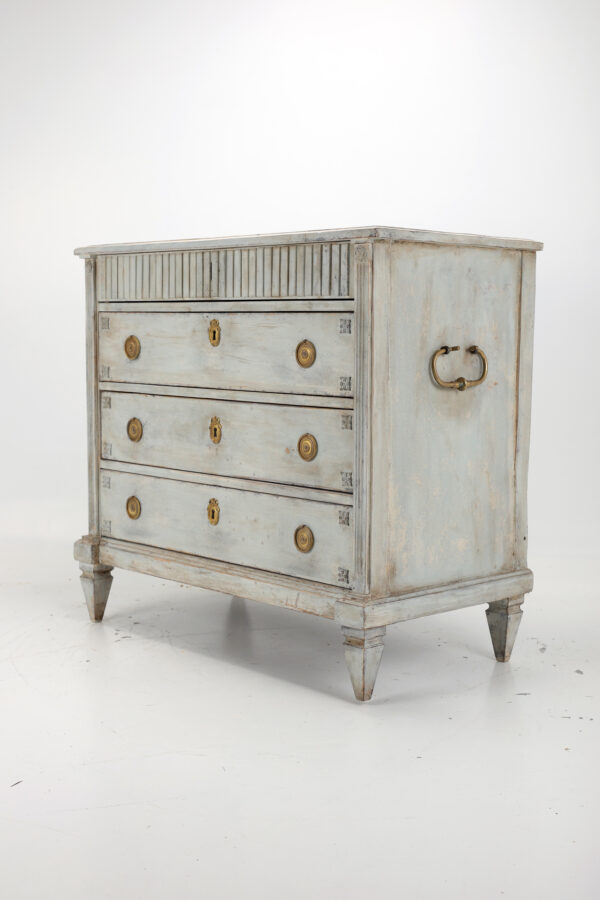
Finding an antique chest of drawers that actually fits your home, your taste, and your budget takes more patience than most people expect. The market is wide, the quality varies enormously, and a piece that looks beautiful in a photograph can disappoint in person. This collection brings together chests of drawers that have been examined, selected, and in many cases professionally restored before they ever reach a buyer. Each one is a functional piece of furniture built to last, not a decorative prop.
Antique chests range from compact three-drawer bedroom pieces to tall, narrow tallboy chest of drawers that make use of vertical space. You’ll find bow front designs, flat-fronted classics, and serpentine shapes that curve gently at the front. Materials include walnut, mahogany, oak, and painted finishes, each with its own character and its own way of aging. Drawer pulls, brass handles, and drop handles vary just as much as the wood beneath them.
Victorian furniture has a confidence to it. The proportions tend to be generous, the joinery is solid, and the decorative details, turned knobs, brass fittings, fittings like lion head handles, are there because someone cared enough to add them. A Victorian chest of drawers typically offers serious storage. Larger examples often have seven drawers or more, with deep top drawers suitable for folded clothing and lower drawers wide enough for linens.
Many of the Victorian chests in this collection feature serpentine or bow front profiles, which give an otherwise rectangular form a sense of movement. Others are more restrained, with flat fronts and turned wood details that suit both period interiors and modern rooms that benefit from a strong antique piece.
The Wellington chest is one of the more unusual forms in English furniture. Tall, narrow, and fitted with a hinged locking bar that secures every drawer at once, it was designed for security as much as storage. Most Wellington chests were built in mahogany, though walnut examples exist and tend to command attention when they appear.
These are genuinely collectible pieces. A good Wellington chest with original brass hardware and a sound locking mechanism is not easy to find. The ones listed here have been inspected carefully, and any restoration work has been done with the structure and original finish in mind.
Mahogany has been the dominant wood in English and American furniture for over two centuries, and for good reason. It cuts cleanly, finishes beautifully, and develops a depth of color over time that no stain can replicate. A mahogany chest of drawers from the Regency or early Victorian period is about as reliable as antique furniture gets.
The bow front mahogany chest is perhaps the most recognized form, with its gently curved front creating a shape that looks elegant from any angle. Serpentine chests are less common and typically more refined in their construction. Both forms appear regularly with brass handles and bracket feet, and many have been finished with traditional French polish or wax, which preserves the wood and keeps the surface honest.
Cuban mahogany, denser and darker than later plantation-grown varieties, shows up occasionally in 18th and early 19th-century pieces and is worth noting when it does. If the provenance is clear and the condition is sound, a piece in Cuban mahogany is a serious find.
The Georgian period in English furniture runs from roughly 1714 to 1830, and the chests produced during that time reflect an era that valued order, symmetry, and restrained elegance. A Georgian chest of drawers typically stands on bracket feet or shaped ogee bracket feet, has a graduated series of drawers with cock-bead moulding around each front, and uses brass hardware that was made to last.
Oak was common in earlier Georgian pieces, especially in country-made furniture. Mahogany became the preferred wood as the century progressed, particularly in urban workshops. Some Georgian chests include a brushing slide, a pull-out surface positioned between the top drawer and the case, originally used for laying out clothes. It’s a detail that appears in antique Georgian and Victorian chests of a certain quality and signals careful original construction.
Antique English furniture from this period is increasingly hard to source in good original condition. A Georgian chest of drawers that retains its original feet, handles, and surface finish is worth considering seriously.
Walnut was the wood of choice in Europe before mahogany arrived, and it remains one of the most beautiful materials ever used in furniture. The grain is complex, the color ranges from pale honey to near-black depending on the cut and age, and a well-figured walnut chest of drawers can hold your attention in a way that plainer woods simply don’t.
Antique walnut chests are most commonly found in late 17th and early 18th-century forms, often featuring crossbanded veneers, featherbanding at the drawer edges, and bun or bracket feet. Dutch and English makers were particularly skilled with walnut, and both traditions are represented here. A walnut chest in good condition with original brasses is genuinely rare. The ones listed have been assessed individually, and the condition of the veneer and any inlay repair noted honestly.
In European furniture, the commode or commode chest of drawers occupies a different category from the straightforward English chest. The form developed in France during the late 17th century and spread quickly through the German, Dutch, and wider European markets. What distinguishes a commode is its lower, wider profile, often with two or three large drawers, more elaborate surface decoration, and legs rather than a plinth or bracket feet.
French commodes from the 18th century frequently feature parquetry or marquetry veneers, ormolu mounts, and marble top surfaces. German Baroque and Classicism examples tend to be heavier in scale with strong figural veneers and inlaid banding. Dutch commodes sit somewhere between the two, often with serpentine fronts and restrained decoration that rewards close looking.
A chest of drawers with marble top is one of the more striking pieces you can place in a room. The weight of the stone anchors the piece visually and the contrast between a dark walnut or mahogany case and a veined marble slab is hard to beat. These pieces were built for important rooms and they carry that presence with them.
A serpentine chest of drawers is one of the more technically demanding forms in 18th-century cabinetmaking. The front curves outward at the center and inward at the sides, which means every drawer front had to be individually shaped and fitted. The veneer, typically laid across the curve in sections, adds another layer of difficulty. The result, when it works, is a piece with extraordinary visual movement.
Most serpentine chests date from the second half of the 18th century, when the form was at its most refined. English examples often appear in mahogany with brass handles and splayed feet. Continental examples, particularly German and Dutch pieces, sometimes incorporate inlay work or contrasting banded veneers that emphasize the shape of the front.
The serpentine form has never really gone out of style, which makes these pieces versatile in a way that more period-specific furniture is not. A good serpentine chest works equally well in a traditional interior and in a contemporary room where it becomes something of a focal point.
The mule chest sits at an interesting point in furniture history, partway between the old coffer and the modern chest of drawers. It has a hinged top that opens for bulk storage and one or more drawers in the base for items that need easier access. Most mule chests were made in oak, built with solid joinery and finished simply. They were working pieces, and they look it in the best possible way.
As an antique coffer with practical features, the mule chest suits a hallway, bedroom, or any space that needs storage without formality. The worn surfaces and honest construction of a well-aged oak mule chest have an appeal that polished mahogany cannot replicate. These are old chests that have been used, and the patina they carry reflects that history directly.
Not every antique chest of drawers needs to be made from a fine hardwood to be worth owning. Pine chests of drawers were produced in large numbers throughout the 18th and 19th centuries, primarily for domestic use, and many have survived in very good condition. A pine chest of drawers is lighter in color, simpler in construction, and considerably more affordable than comparable hardwood examples, which makes them practical choices for bedrooms and informal spaces.
Painted chests occupy their own category. A painted chest of drawers, whether it retains its original painted surface or has been refinished at some point, has a character that bare wood does not. Scandinavian and Central European examples are particularly worth seeking out, with folk-painted decoration that can be remarkably well-preserved. An older painted chest in its original surface is increasingly difficult to find, and when the decoration is intact it’s something to hold onto.
The most important thing to look at when buying an antique chest of drawers is the drawers themselves. Pull them open. They should slide without forcing and close without dropping. The drawer linings, the sides and base of each drawer, tell you a great deal about the age and quality of a piece. Hand-cut dovetails with slight irregularities are a reliable indicator of age. Machine-cut dovetails are uniform and typically indicate a later date.
Check the feet. Original bracket feet on an 18th-century chest are increasingly rare. Many pieces have had feet replaced at some point, and replacements are not necessarily a problem as long as they are sympathetically done. Turned feet appear on later pieces and have their own character.
Look at the drawer pulls and brass hardware. Original handles with their original back plates and the original fixing holes behind them add genuine value. Replacements are common, and again not disqualifying, but original brass handles with a natural patina are harder to source than people assume.
Small chests with three drawers or 3-drawer configurations in a compact format work well in rooms where space is limited. Larger chests with six drawers or more serve a different purpose and need more floor space and wall clearance to look their best. Take measurements before you buy.
Furniture from the 18th century represents the high point of European cabinetmaking, and chests of drawers produced during this period reflect that directly. The century opened with the Baroque style still dominant, particularly in Germany and the Dutch Republic, where makers favored bold proportions, heavily figured walnut veneers, and shaped fronts that gave even a storage piece a sculptural quality. Bombé commodes with swelling fronts and sides were common in South German and Bavarian workshops, and the best examples incorporated parquetry or marquetry surfaces of considerable complexity.
By mid-century the Rococo had softened those forms, introducing asymmetry, lighter scale, and more playful ornament. French influence spread quickly through the German courts and into the Netherlands, and the commode became the prestige piece of the interior. Louis Seize style arrived in the final decades of the century, pulling everything back toward straight lines, geometric inlay, and classical proportion. The chest of drawers in this period often featured tapered legs, oval or rectangular inlaid panels, and refined brass hardware that complemented rather than dominated the surface.
English furniture from the same period developed along its own lines. The Georgian chest of drawers, built in mahogany with cock-bead drawer fronts, bracket feet, and understated brass handles, became the template that later centuries returned to repeatedly. Late 18th century pieces in particular show a refinement of proportion that is hard to improve on.
Finding furniture from the 18th century in genuinely good condition requires experience and a trained eye. Surfaces get refinished, feet get replaced, and hardware changes hands. The pieces selected here have been assessed individually, and where restoration has been carried out in the atelier, the work follows the methods and materials appropriate to the period.
The 19th century produced an enormous variety of furniture styles, often in rapid succession, and the chest of drawers evolved differently depending on where and when it was made. The century opened with the Empire style at its peak, particularly in France and the German states that followed French fashion closely. Empire furniture is characterized by its architectural seriousness, dark mahogany or mahogany veneer, heavy gilt bronze mounts, and a deliberate absence of frivolity. A chest of drawers in the Empire manner sits close to the floor, often on short paw feet or plain plinths, with large drawer fronts and minimal surface interruption.
Biedermeier followed in the German and Austrian markets from roughly the 1820s onward, and it represents one of the most distinctive furniture movements of the entire century. Biedermeier makers stripped away the imperial heaviness of Empire and replaced it with lighter forms, pale fruitwood veneers, and a domestic warmth that still feels modern. Cherry, ash, maple, and birch were all used, sometimes with ebonized accents that provide sharp contrast. A Biedermeier chest of drawers is rarely large, but it is almost always well-proportioned and honest in its construction.
In England, the Victorian era brought a return to heavier forms and more elaborate decoration. Victorian chests of drawers in mahogany or walnut, with carved details, turned handles, and substantial proportions, were built for bedrooms that expected furniture to make a statement. Later in the century the Aesthetic Movement and the influence of Arts and Crafts design pushed back against that heaviness, producing simpler, better-jointed pieces that acknowledged the quality of the wood rather than obscuring it.
19th century antique furniture is well represented in this collection across all major styles. Many pieces have passed through the restoration workshop, where the approach is always to preserve what is original and address only what genuinely needs attention.
Antique furniture from the early 20th century occupies an interesting position in the market. Pieces made before 1920 are now over a century old, which qualifies them as antique by any serious definition, and the best of them reflect the craft traditions that were still alive in workshops across Europe at that time. Arts and Crafts furniture, produced in England and exported widely, used solid oak with visible joinery and simple hardware, a deliberate reaction against the machine-made excess of late Victorian production.
Art Nouveau brought a brief and extraordinary flowering of organic design, with furniture makers in France, Belgium, and Germany incorporating curved forms, floral inlay, and carved natural motifs into pieces that have never been replicated convincingly. A chest of drawers from this period in good original condition is now genuinely collectible and increasingly difficult to find.
The period between the wars produced the clean geometry of Art Deco, which translated into chest of drawers designs with strong horizontal lines, contrasting veneers, and chrome or bakelite hardware. French Art Deco pieces in particular can be strikingly beautiful, with macassar ebony, zebrawood, or lacquered surfaces that look as sharp today as they did when they were made.
Earlier 20th century pieces tend to be undervalued relative to their 18th and 19th century counterparts, which makes them worth considering seriously. The construction is often excellent, the materials are genuine, and the forms have aged well.
French furniture has influenced cabinetmaking across Europe for three centuries, and the antique French chest of drawers remains one of the most sought-after categories in the market. The French commode, developed under Louis XIV and refined continuously through the 18th century, set the standard for what a chest of drawers could be. Where English furniture valued restraint and practicality, French makers pushed toward surface decoration, proportion, and material richness as ends in themselves.
A Louis Seize commode in marquetry walnut or tulipwood with a marble top and ormolu mounts is among the finest pieces of antique furniture a buyer can find. The construction underneath the decoration is equally serious, with drawer linings in oak, precisely fitted joints, and hardware that was cast and finished by specialist craftsmen. These are not pieces that were made quickly.
Provincial French furniture offers a different appeal. Made in regional workshops that interpreted Parisian styles at some remove, provincial pieces tend to be simpler in their surface decoration but equally strong in their construction. Cherry and walnut were the dominant materials outside Paris, and the forms, while less elaborate than court furniture, have a directness that suits contemporary interiors well.
Pieces restored in the atelier are treated according to their origin. A French polished surface gets French polished, not waxed. Marquetry repairs are carried out using traditional inlay techniques with period-appropriate materials. The goal is always a result that looks as it should, not as if it has been improved.
If you are looking for a specific antique chest of drawers and have not found it in the listings above, it is worth reaching out directly. The warehouse holds a rotating stock of pieces that have not yet been photographed, catalogued, or listed online, and a request for a particular style, period, or size is often easier to fulfill than buyers expect. Write to contact@antiqueria-breitling.com . with as much detail as you have about what you are looking for, and we will come back to you with what is currently available.


