Worldwide Insured Shipping
Hand-Restored in our Atelier
Professional Custom Crating

Worldwide Insured Shipping
Hand-Restored in our Atelier
Professional Custom Crating
In this collection cover the full range of the European Baroque tradition, from South German and Dutch oak commodes of the late 17th century to French and Italian examples in walnut and marquetry from the first half of the 18th century. Each piece has been assessed individually for the quality of the original surface, the integrity of the carving and hardware, and the soundness of the underlying construction.
The Baroque commode arrived in European interiors at a specific historical moment. Before the late 17th century, storage meant a chest with a lifting lid, a form that required removing everything on top to access what was inside. The chest of drawers, with its graduated drawers sliding in and out independently, was a genuine functional advance, and the Baroque period embraced it with considerable ambition.
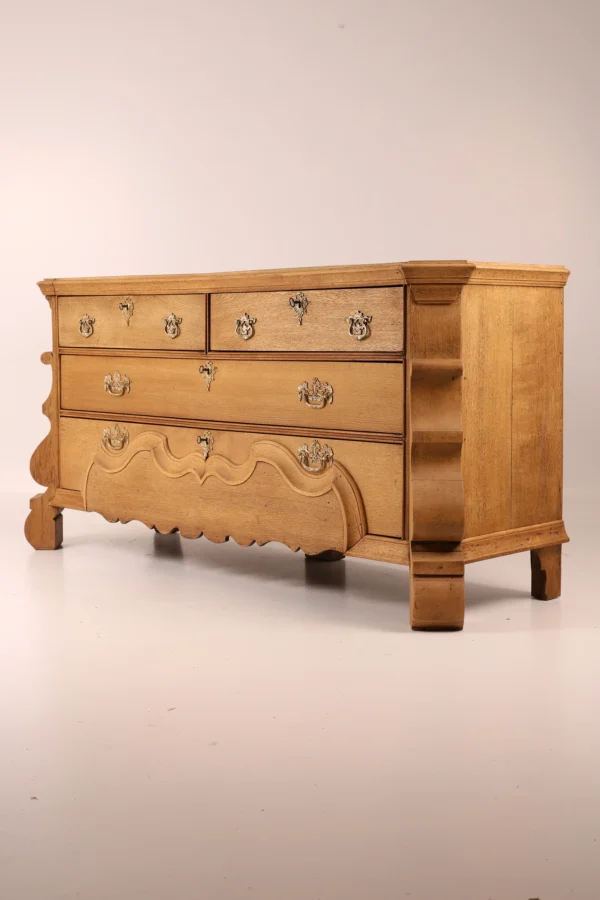
A Baroque chest of drawers is not a modest object. The proportions are substantial, the carving is deep and confident, and the silhouette communicates a sculptural presence that later, more restrained furniture traditions deliberately moved away from. Scroll feet, curved bombay sides, serpentine fronts, acanthus carved drawer fronts, hand carved panels, and the warm depth of walnut wood or solid oak give these pieces a physical authority that suits a room capable of carrying them.
The materials vary considerably by region and period. Dutch and German examples lean toward solid oak with architectural panel moldings and wrought iron handles, reflecting the merchant class aesthetic of the northern European Baroque tradition. French Baroque chests of drawers in walnut or with marquetry inlay surfaces reflect the court tradition more directly, with gilt details and the decorative ambition of a style that understood furniture as an extension of interior architecture. Italian, and specifically Venetian Baroque examples, push the decorative register furthest, with lacquer surfaces, hand-painted baroque decoration, and gilded details that make these pieces as much sculpture as storage.
French Baroque furniture produced for the court at Versailles and the great Parisian hôtels particuliers represents the most ambitious expression of the tradition. A French Baroque commode in walnut with serpentine front, cabriole legs, and gilt bronze hardware from the first half of the 18th century is a piece that carries the full visual vocabulary of the Louis XIV and early Louis XV transition, with the organic energy of the Rococo beginning to soften the heavier architectural forms of the high Baroque.
French country style Baroque chests of drawers, made in provincial workshops in Normandy, Burgundy, and the southern regions, translate the court vocabulary into solid walnut or oak with hand carved decoration and a directness of construction that suits contemporary interiors particularly well. A French country chest of drawers from circa 1750-60 in solid walnut with three spacious drawers, carved apron, and original iron hardware has a warmth and honesty that the more elaborate court pieces deliberately avoid. The natural wood grain on these provincial pieces, polished to a soft sheen rather than lacquered or gilded, is their primary decoration.
The distressed patina that develops on a French Baroque chest of drawers over three centuries of careful use is one of the more visually compelling qualities of these pieces. Unlike artificially distressed white finish reproductions or distressed white painted pieces made to evoke an antique style, genuine Baroque patina develops unevenly and organically, darker in the carved recesses and worn bright on the surfaces touched by hands over generations. That difference is immediately apparent in the room.
South German Baroque furniture from Munich, Augsburg, and the surrounding workshops of Bavaria and Württemberg represents one of the most distinct regional traditions within the European Baroque. Southern Germany produced commodes of considerable sculptural ambition, with convex drawer fronts, carved scroll feet, deeply paneled sides, and the heavy architectural presence that reflects the influence of the Catholic church and the imperial courts of the Holy Roman Empire.
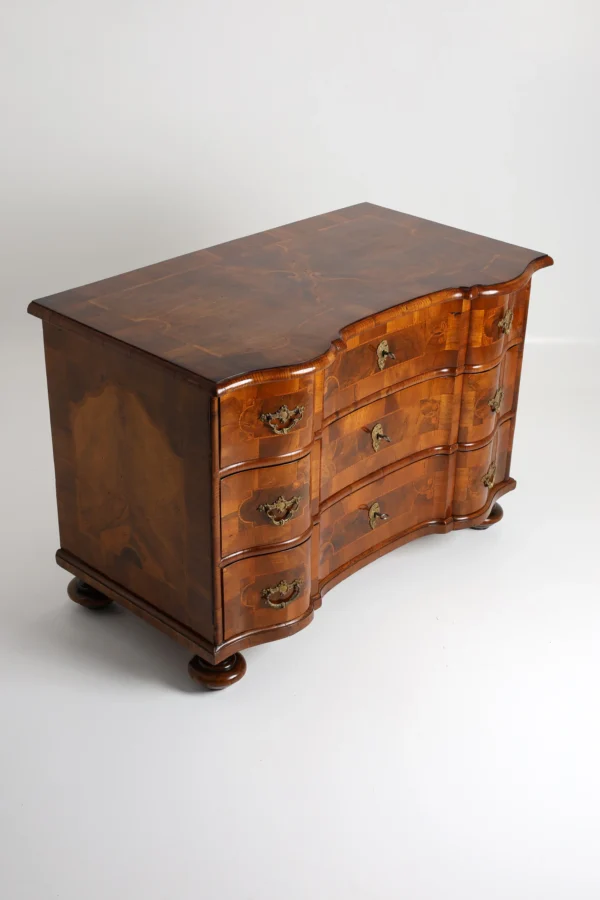
An 18th century baroque commode from southern Germany in walnut with four drawers, carved drawer fronts, and the characteristic curved bombay silhouette of the regional tradition is a piece that anchors a room with genuine authority. The cabinetmaker tradition in these workshops was exceptional, producing solid wood construction with hand cut joinery that has survived three centuries of daily use without structural compromise.
Marquetry appears on the finest South German Baroque commodes, using contrasting wood veneers to create geometric or floral patterns across the drawer fronts that add visual complexity without the weight of applied bronze mounts. The natural wood grain of these marquetry surfaces, combined with the sculptural carving of the case and feet, gives the best South German examples a quality that is entirely their own within the European Baroque tradition.
Dutch Baroque chests of drawers reflect the merchant class aesthetic of the Golden Age Republic with considerable consistency. Solid oak construction, architectural panel moldings on the drawer fronts, heavy brass or wrought iron handles, and the overall character of furniture made for practical use in prosperous but unpretentious households. An oak chest of drawers from the Dutch Baroque tradition, with its paneled drawer fronts and bracket feet, has a robustness and material honesty that distinguishes it from the more decorative French and Italian examples of the same period.
The Venetian Baroque chest of drawers occupies the opposite end of the decorative register. Venice’s long trading relationships with the East and the theatrical sensibility of the city’s artistic culture produced commodes of extraordinary visual ambition. Lacquer surfaces in jewel tones, hand-painted baroque decoration with floral and figural motifs, gilded carved details, and the characteristic curved silhouette of the Venetian tradition make these pieces as much decorative objects as functional storage. A Venetian Baroque chest in original lacquer with its hand-painted decoration intact is among the more dramatic pieces available in this category, and it suits an interior that can absorb that drama without being overwhelmed by it.
The drawer construction is the most reliable starting point for any assessment. Baroque commodes were built before industrial manufacturing, which means every joint was cut by hand. The dovetails connecting the drawer sides to the drawer fronts show slight irregularities in spacing and depth that machine production cannot replicate. The drawer bottoms on authentic period pieces show hand-plane marks on their undersides, the subtle parallel ridges of a tool worked by hand. Perfectly smooth, machine-sanded surfaces indicate later production.
The carving on an original Baroque chest of drawers shows slight variations in depth and line that reflect the hand of the artisan who made it. Mass-produced ornament cast from molds has a uniformity and shallowness of relief that hand carved work does not. Look closely at the acanthus scrolls, the carved feet, and the molded drawer fronts: genuine hand carved Baroque ornament has organic irregularities that reward examination, while reproduction carving reads as flat and repetitive under close inspection.
The back panel of an authentic Baroque chest is assembled from wide solid wood planks with hand-forged iron nails, and the wood has developed the deep grey-brown oxidation of genuine age from centuries of air exposure. A clean, tight, modern-looking back panel on a supposedly 18th century baroque dresser requires further investigation before purchase.
The patina on the exterior surface of an original piece should be uneven and logical, concentrated on the surfaces most frequently touched and worn away on the projecting edges of the carving. Artificially antiqued pieces tend toward uniform darkening that pools in recesses in ways that genuine use never produces.
The antique baroque furniture section covers the full range of Baroque forms including mirrors, cabinets, console tables, and seating from the Dutch, French, German, and Italian traditions, all assessed against the same criteria applied to the chests of drawers listed here.
Worldwide shipping is available on all pieces, with white glove delivery handled through specialist fine art carriers experienced in moving large antique furniture. If you are looking for a specific Baroque chest of drawers, a particular regional tradition, wood, or drawer configuration not currently listed, write to us at contact@antiqueria-breitling.com. The warehouse holds pieces not yet photographed or catalogued, and requests are often easier to fulfill than buyers expect.