European furniture history is not a calm chronology. It is a series of arguments, each generation rejecting what the one before built, swinging the pendulum from grandeur to intimacy, from straight lines to curves, from dark woods to light, from public display to private comfort. Knowing the major styles is one thing. Understanding how they grew out of each other is what turns a buyer into a collector, and after decades of handling pieces from every period at Antiqueria Breitling, the connections between the styles are what we find ourselves explaining to clients more often than anything else.
This guide walks through the seven major European furniture styles in chronological order, from the seventeenth-century Baroque to the Second Empire of Napoléon III. Each section explains what defines the style, what produced it, how to recognize it, and how it gave way to what came next. Read end to end, it works as a single connected story. Read in sections, it works as a reference.
Baroque (Seventeenth Century to the First Half of the Eighteenth Century)
The Baroque was the first European style that understood furniture as theater. Born in the Italian Counter-Reformation and amplified by the French absolutism of Louis XIV, Baroque furniture existed to communicate power, religious or royal, and it did so with monumental scale, dark rich woods, dramatic carving, and a confidence that brooked no contradiction.
Italy and France produced two different versions of the same impulse. The Italian Baroque was decentralized, a constellation of regional traditions in Rome, Venice, Florence, Genoa, and Naples, each carving its own identity into the furniture it produced. Italian Baroque is sculptural, theatrical, sometimes almost shocking in its three-dimensional ambition. The Venetian master Andrea Brustolon produced armchairs in which mythological figures replaced the structural elements entirely, and Roman workshops built console tables on bases of polychrome and gilded mythological creatures.
The French Baroque was the opposite of decentralized. Under Louis XIV and his finance minister Jean-Baptiste Colbert, the Gobelins Manufactory became a state instrument from 1662 onward, producing furniture under the artistic direction of Charles Le Brun for a single client, the king. The most famous figure of the French Baroque is André-Charles Boulle, the royal ébéniste who perfected the brass-and-tortoiseshell marquetry that bears his name and, working from his privileged position inside the Louvre, cast his own gilt-bronze mounts in defiance of the Parisian guilds. Boulle’s commodes and armoires define the high French Baroque, dark grounds inlaid with metalwork and bordered with sculpted ormolu.
One of the strangest chapters in furniture history belongs to this period. Louis XIV originally furnished the Hall of Mirrors at Versailles with solid silver tables, candelabra, and a silver throne over two and a half meters tall. In 1689, the cost of his wars forced him to melt the entire collection down to fund the campaign against the League of Augsburg. Almost nothing survives. The Baroque obsession with luxury was so absolute that even the silver of the king himself could be reduced to coin when the empire needed it.
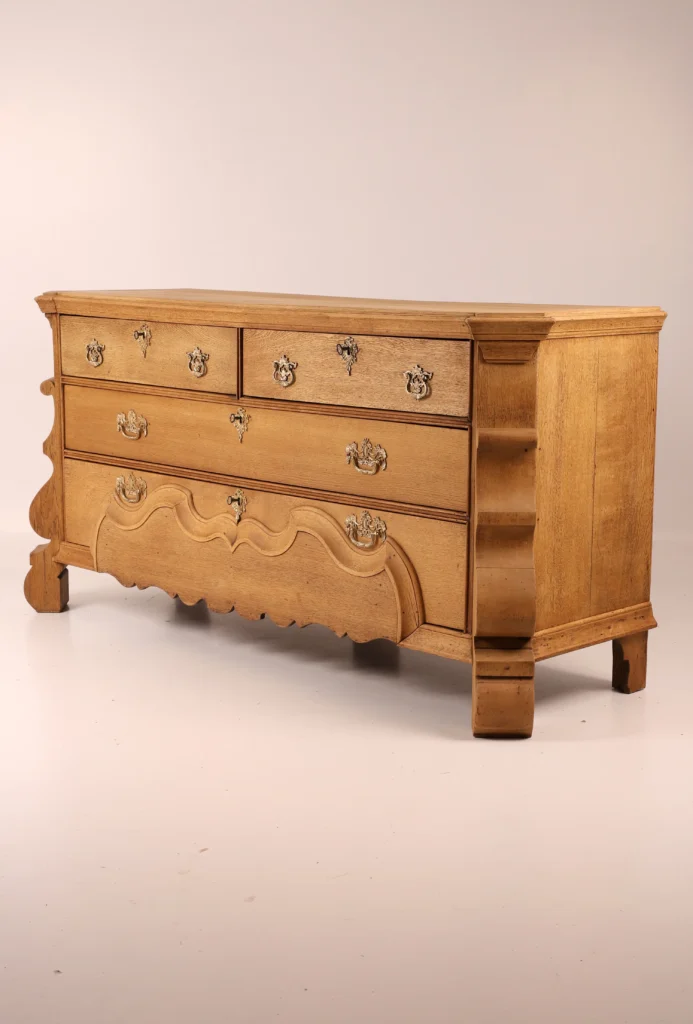
A late Baroque oak commode from the Netherlands illustrates how the style adapted as it spread through Europe. Solid bleached oak with a serpentine front, four drawers organized two over two, carved paw feet, and a dramatically shaped apron with sculptural carving. This is Baroque in the broader European sense, monumental, sculptural, built to last centuries, with the heavy architectural presence that defined the period across France, Italy, the German lands, and the Low Countries.
You can explore the period in depth through the baroque furniture collection, which covers both the French and Italian traditions across their full range.
Louis XV and the Rococo (1715 to 1774)
When Louis XIV died in 1715, the French aristocracy did something unexpected. They left Versailles. Not literally at first, but culturally and architecturally, abandoning the rigid ceremony of the great palace for the smaller, more intimate hôtels particuliers of Paris. The salon replaced the throne room as the center of cultural life. Conversation, music, and flirtation replaced military spectacle. And the furniture, inevitably, followed.
The Rococo or Louis XV style is the result, and it is the first truly intimate furniture in European history. Straight lines vanished. Right angles vanished. The defining element of a Rococo piece is the cabriole leg, an S-curve sweeping from the case down to a scrolled foot, and that same flowing line runs through the entire vocabulary of the period. Commodes swelled into bombé and serpentine silhouettes, decorated with asymmetrical rocaille ornament drawn from shells, rocks, and water. Marquetry moved from the geometric to the floral, with trailing bouquets in exotic tropical woods like tulipwood, kingwood, and amaranth flowing across drawer fronts.
The new salon culture demanded new forms. The bergère, a deep upholstered armchair with closed sides, gave physical comfort a place in serious furniture for the first time. The fauteuil en cabriolet, lighter and concave-backed, accommodated the wide skirts of the period. Small writing desks, reading stands, and gaming tables proliferated. The commode became the visual centerpiece of the Parisian salon, covered in floral marquetry and capped with marble.
A behind-the-scenes shift made all of this possible. The marchand-mercier, a class of luxury merchants operating outside the guild system, functioned as a kind of eighteenth-century interior designer and luxury brand manager combined. Figures like Lazare Duvaux and Simon-Philippe Poirier purchased rare Asian lacquer panels, commissioned Sèvres porcelain plaques, and contracted with master cabinetmakers to integrate these materials into single pieces. The greatest makers of the period, Charles Cressent with his sculptural espagnolettes and Bernard II Vanrisamburgh with his delicate floral marquetry, worked within this system.
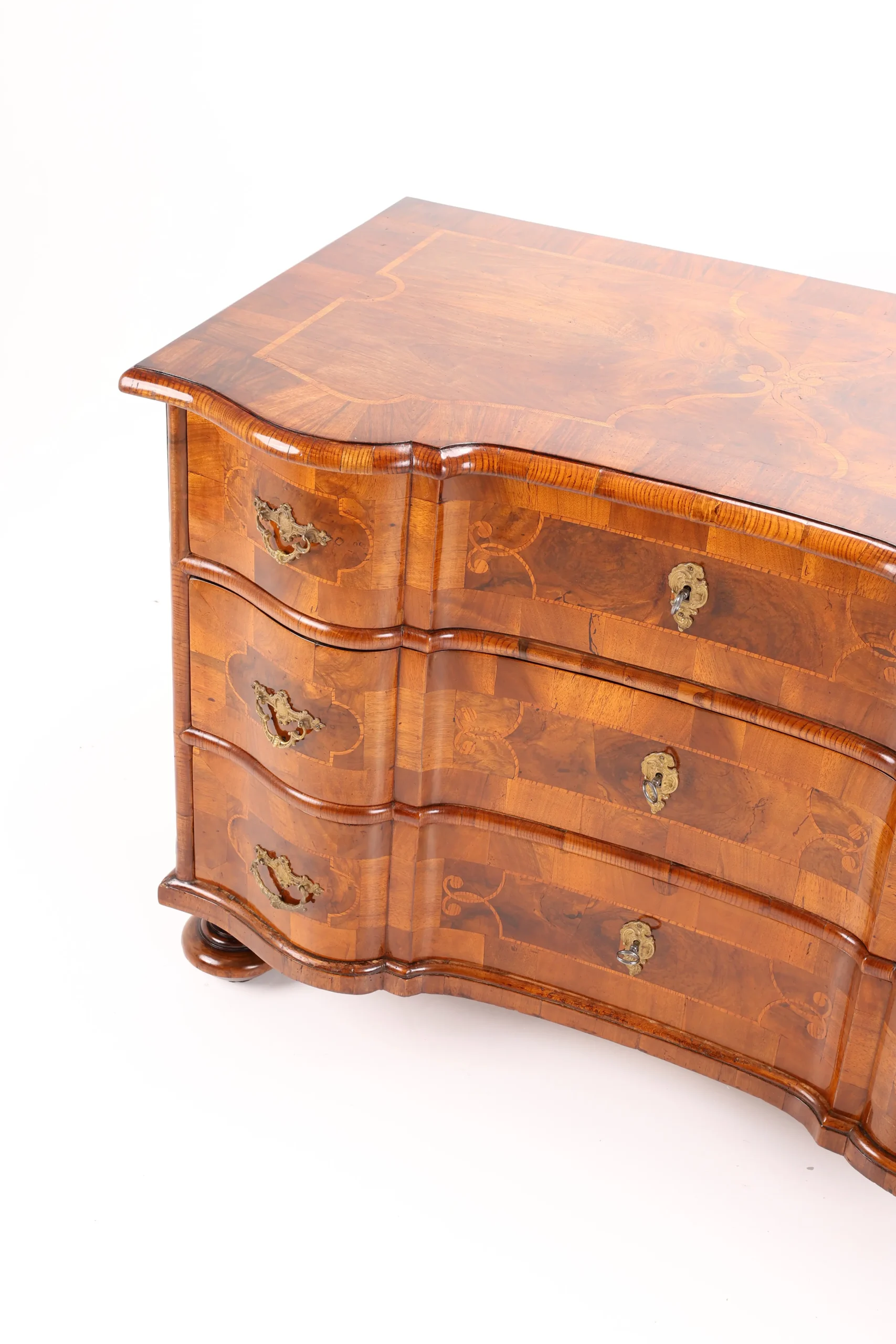
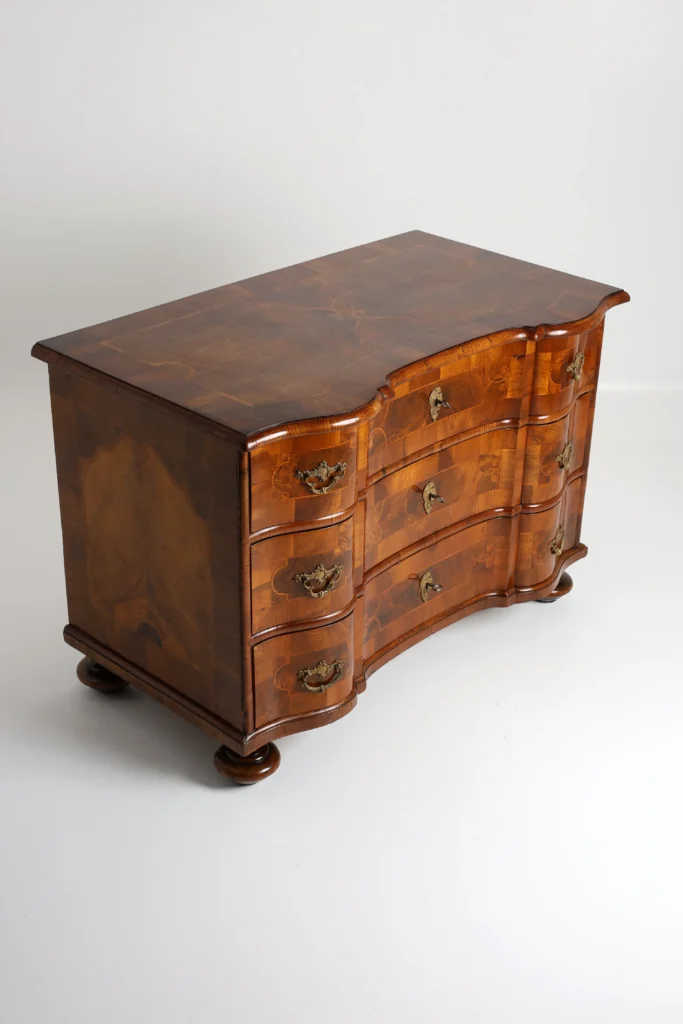
An elegant small walnut commode from circa 1760 shows the style at its most refined provincial expression. Three drawers with beautifully shaped double-curved fronts, original brass drop handles and escutcheons, the top decorated with intricate elm marquetry in a flowing interlaced pattern, and ball feet that give the piece its grounded yet sophisticated stance. The deep walnut tone, brought up by hand-applied shellac, captures the warm sensuality of the Rococo period, where surface beauty and tactile pleasure mattered as much as form. Pieces like this represent the broader European spread of the Louis XV vocabulary into the German lands and beyond.
Louis XVI and Neoclassicism (1774 to 1790)
By the 1760s, the Rococo’s curves had run their course. The pendulum swung, as it always does, and the swing was driven this time by archaeology. The excavations of Pompeii and Herculaneum had been releasing genuine Roman antiquities into European cultural consciousness for two decades, and by the time Louis XVI ascended the throne in 1774 alongside Marie-Antoinette, the taste for classical order had become irresistible.
Louis XVI furniture is the Rococo reversed. The cabriole leg becomes the straight tapered fluted leg, explicitly modeled on a classical column. The bombé curve becomes a clean rectilinear silhouette. Asymmetrical rocaille becomes geometric marquetry, parquetry, and stylized motifs drawn from antiquity: laurel wreaths, urns, Greek key patterns, oak leaves, and egg-and-dart bands. The wood itself shifts too, with marquetry giving way in the later 1780s to expanses of solid figured mahogany set off against gilt bronze, a cooler and more restrained palette influenced by an emerging French taste for English sobriety.
The dominant figure of the period is Jean-Henri Riesener, the German-born cabinetmaker who became the most important ébéniste at the French court. Riesener’s work evolved through several phases, from a transitional period under his master Jean-François Oeben through rectilinear sarcophagus-shaped commodes to delicate floral pieces for Marie-Antoinette and finally to mahogany work of severe elegance. His technical innovations were as important as his designs, including laminated construction, sophisticated locking mechanisms, and the seamless integration of seventeenth-century Japanese lacquer panels into French neoclassical carcasses. Working alongside him were David Roentgen, whose mechanical desks astonished European courts, and Adam Weisweiler, whose refined guéridons defined the late Louis XVI taste.
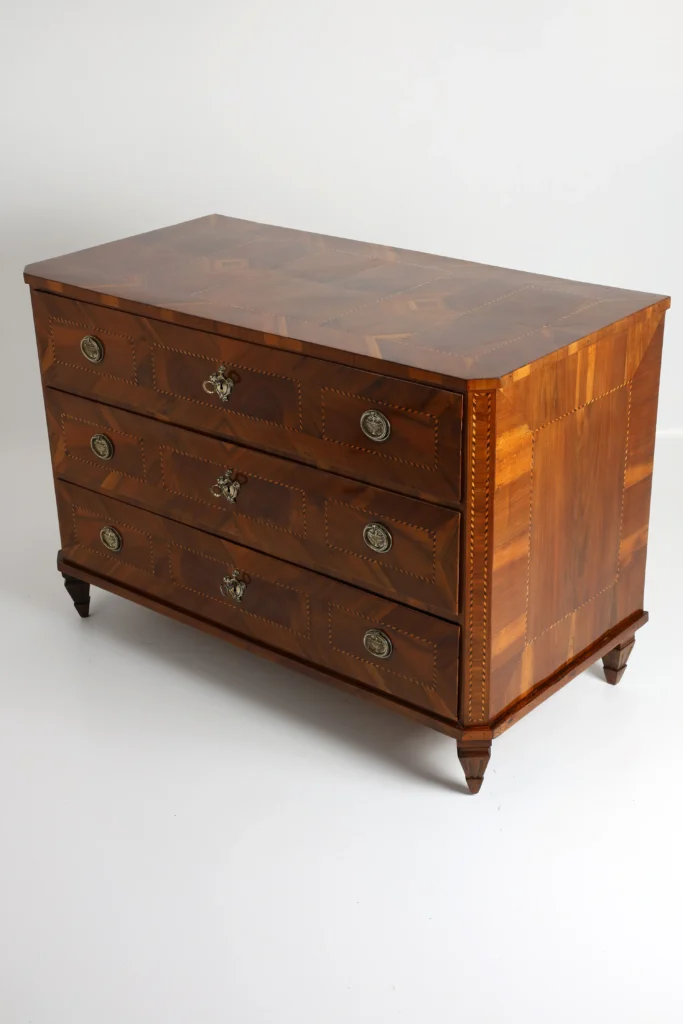
A Louis XVI commode from circa 1790 in walnut illustrates the style at its most disciplined. The façade is structured into geometric panels framed with delicate banded inlay, with each of the three drawers divided into three architectural panels that maintain the rhythmic coherence of the design. The top carries fielded veneer with crossbanding and inlaid detailing. Original brass handles, fluted legs that taper to a classical column form, and a warm walnut surface brought up by hand-applied shellac. The piece embodies everything the neoclassical reaction demanded: symmetry, geometry, restraint, and architectural clarity. The full range of the period can be explored through the Louis XVI furniture collection at Antiqueria Breitling.
The Empire Style (1804 to 1815)
The French Revolution swept away the court that had patronized Louis XVI furniture, dismantled the guilds, and ended the marchand-mercier system. After the transitional Directoire and Consulate periods, Napoleon crowned himself Emperor in 1804 and transformed furniture into something it had not been since the Baroque: an instrument of state propaganda.
The Empire style was designed to legitimize Napoleon’s regime by visually linking it to ancient Rome and Egypt. The architects Charles Percier and Pierre Fontaine codified an entire decorative scheme in which every piece of furniture spoke of imperial permanence. The vocabulary was strict and aggressive: vast expanses of dark Cuban mahogany, severe architectural forms, and heavy fire-gilded ormolu mounts cast as symbols of power. Eagles for Jupiter and the empire, bees for the Merovingian kings whose legacy Napoleon claimed, laurel wreaths, Winged Victories, and after the Egyptian campaign, sphinxes, scarabs, lotus flowers, and caryatids.
The Empire workshop that defined the period was the Jacob family firm, led by François-Honoré-Georges Jacob-Desmalter, whose monumental seating revived Roman forms like the curule stool and the gondola chair. The bronzier Pierre-Philippe Thomire provided the meticulously chased ormolu mounts that made Empire furniture glitter with martial confidence. Jacob-Desmalter built the throne of Napoleon I in 1804, and his workshop produced ceremonial furniture across the empire from Madrid to Warsaw.
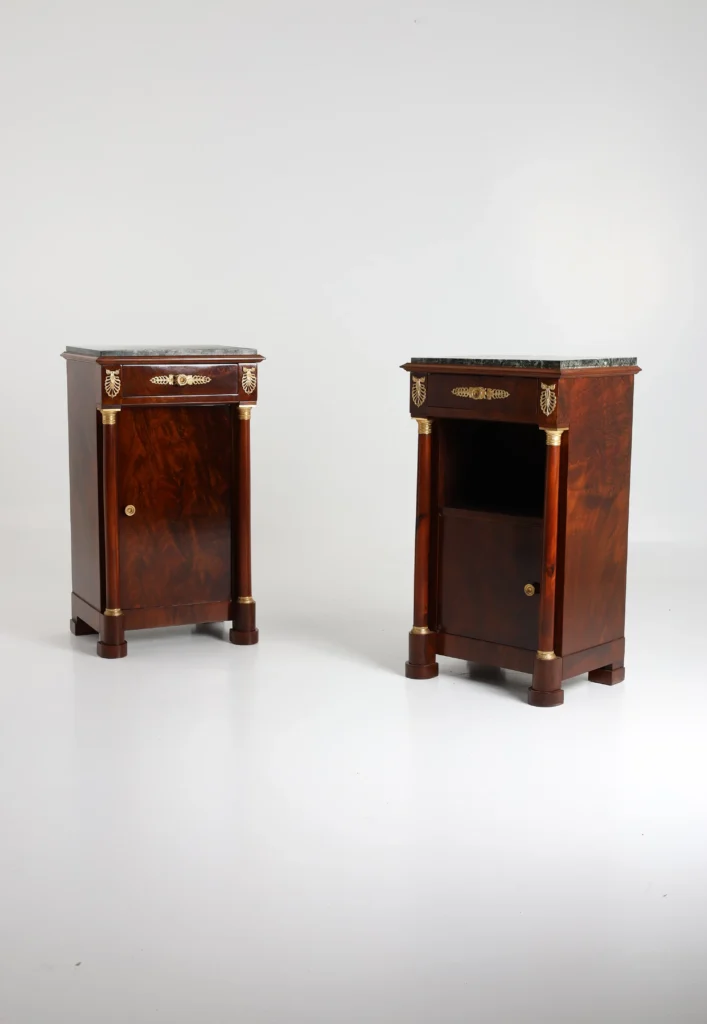
A pair of French Empire-style bedside cabinets shows the style with all of its essential elements present. Finely figured mahogany construction with deep warm tone, architectural form defined by flanking columns with gilded capitals and bases, dark marble tops, and delicate gilt-bronze appliqués on the fronts. The mahogany surface and the gilded details produce exactly the contrast the Empire style was built around, dark wood and bright bronze, severity and luxury combined. The antique Empire furniture collection covers the full range of the period from monumental commodes to refined seating.
Empire furniture is the last truly monumental style in European history, and its severity is exactly what produced the reaction that came next.
Biedermeier (1815 to 1848)
When Napoleon fell at Waterloo in 1815, an exhausted Europe turned inward. Nowhere was the change more complete than in the German-speaking world, where the new Confederation of thirty-nine states under Metternich’s repressive surveillance produced the most radical rejection of Empire grandeur on the continent.
Biedermeier furniture is the result, and it is the most quietly revolutionary style of the nineteenth century. Where Empire was dark, Biedermeier is light. Where Empire was heavy, Biedermeier is human-scaled. Where Empire was loud with ormolu, Biedermeier is silent, relying on nothing more than the natural figure of the wood and a thin line of ebonized detail to articulate its forms. The Continental Blockade that Napoleon had imposed in 1806 had cut Central European workshops off from imported mahogany, forcing them to rediscover native woods, and by the time peace returned the blonde tones of cherry, walnut, birch, and ash had become so fashionable that no one wanted to go back.
The technical foundation of Biedermeier is the Blindholz construction system, a stable softwood carcass wrapped in thick hand-sawn hardwood veneer of three to five millimeters. The decorative principle is bookmatching, where consecutive sheets of veneer cut from the same log are opened like pages to create mirror-image grain patterns flowing across drawer fronts and cabinet doors. A hand-rubbed shellac French polish brings the figure of the wood to a luminous depth that no later industrial finish can match.
Because the German Confederation had no single dominant court, Biedermeier developed regionally. Vienna, dominated by the Josef Danhauser workshop, produced the most curvilinear and salon-like furniture. Berlin under Karl Friedrich Schinkel produced architectural pieces of rigorous neoclassical discipline. Hamburg, with its English trade connections, favored mahogany and heavier proportions. Munich and the South German workshops produced the most extreme minimalism, stripped almost entirely of ornament and relying on warm cherry and walnut veneers alone.
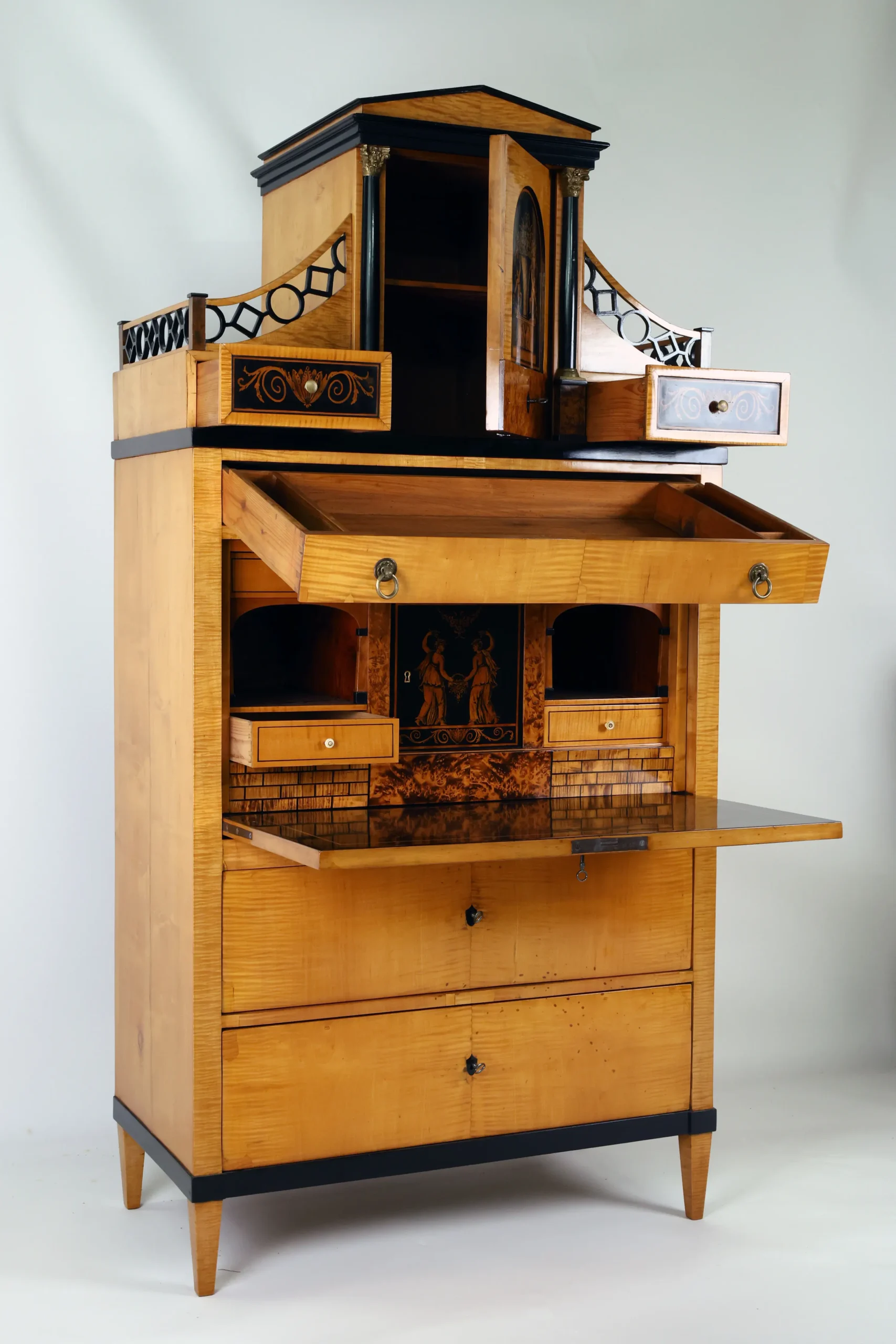
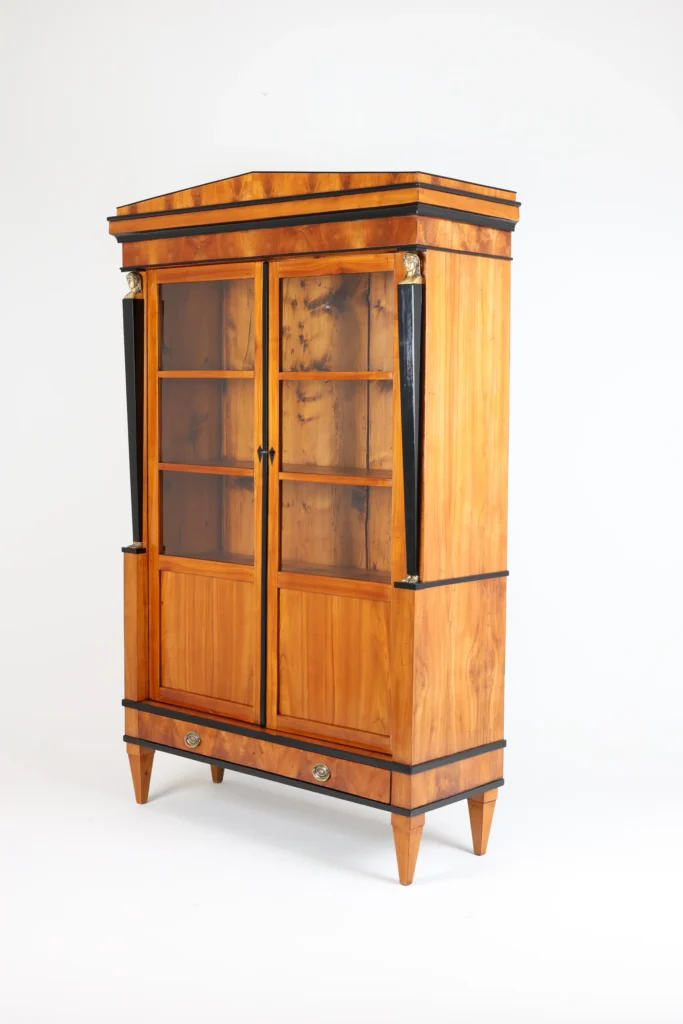
A South German Biedermeier vitrine from 1820 to 1825 shows the regional tradition at its most refined. Cherry wood veneer with beautifully symmetrical grain, two glazed doors each divided into four fields, conical feet, and a single drawer with brass handles at the base. The case is flanked by ebonized pilasters carrying gilded caryatid heads at the top and feet at the bottom, and the whole composition is crowned with a Schinkel-style triangular pediment, the architectural reference that ties the piece to the broader Biedermeier sensibility while keeping the warm Southern fruitwood character. The full range, from architectural North German mahogany to warm Southern cherry and walnut, is available in the Biedermeier furniture collection that forms the heart of Antiqueria Breitling’s specialty.
It is one of the great ironies of furniture history that Biedermeier was originally a satirical name, coined in the 1850s after a fictional middle-class everyman, intended as mockery. The style now bears the name with honor, and its proto-modern character directly anticipated the Bauhaus a full century before it appeared. A Munich cherry secretary from 1830 sits beside a Mies van der Rohe chair without dissonance because they are speaking the same language.
The French Restauration (1814 to 1830)
While Germany produced Biedermeier, France was producing its own answer to the same post-Napoleonic moment. The Bourbon Restoration returned Louis XVIII and then Charles X to the throne, and with them returned an aristocracy that wanted the elegance of the ancien régime adapted to the smaller, more intimate scale of the new era.
The French Restauration shares the light-wood palette of Biedermeier. It uses the same bois clairs, ash, maple, sycamore, elm burl, and prized citronnier. But the French could not resist decoration. Instead of the bare bookmatched surfaces of Biedermeier, Restauration cabinetmakers developed a refined system of dark inlay, cutting fine scrollwork and palmettes and arabesques from amaranth, palisander, and rosewood and setting them flush into the pale grounds. The effect is graphic and elegant, a dark drawing laid over blonde wood.
The iconic seat of the period is the chaise gondole, with a deeply curved sweeping back that wraps around the sitter. The secrétaire à abattant remained central, its flat fall-front serving as the perfect canvas for dark inlay against burled ash. Jean-Jacques Werner became the period’s master, championing burled ash and winning a gold medal at the 1819 exhibition. François Baudry produced spectacular curvilinear pieces including the boat-shaped lit en nacelle. Félix Rémond made refined toilet tables for elite patrons. The Restauration remained, at heart, a courtly style. Where Biedermeier served the middle class, the Restauration served a restored aristocracy.
Napoléon III and the Second Empire (1852 to 1870)
The final great style of nineteenth-century French furniture is also the strangest, because it is not really one style but all of them at once. When Louis-Napoléon crowned himself Emperor Napoléon III in 1852, he wanted to legitimize his regime by displaying wealth on a scale that would outshine even the original Bourbon court. The result was triumphant eclecticism, a furniture culture that revived Louis XV, Louis XVI, Renaissance, and Baroque forms simultaneously and often combined them on a single piece.
The Napoléon III period coincided with the industrial revolution and the massive urban renewal of Paris under Baron Haussmann. A newly enriched bourgeoisie wanted to live like the aristocracy, and industrial production scaled up to meet the demand. Ebonized woods became fashionable, providing a dark dramatic ground for revived boulle marquetry, mother-of-pearl inlay, and heavy gilt bronze. The principle of decoration was horror vacui, the fear of empty space. Every surface was covered.
The Second Empire was the reign of the upholsterer. The capitonné technique of deep systematic buttoning created the plush enveloping surfaces that defined the period, and entirely new seating forms appeared, including the fauteuil crapaud, the canapé indiscret, and the borne, a circular or triangular central seat often topped with a sculpture or planter. Wooden frames disappeared under fabric, fringes, and tassels.
The finest Napoléon III makers, including Henry Dasson, Alfred Beurdeley, and Henri-Auguste Fourdinois, produced revival pieces of breathtaking quality that often matched or exceeded their eighteenth-century originals. The Expositions Universelles held in Paris during the 1860s established the city as the undisputed capital of decorative arts, and the firms that exhibited there produced furniture that now commands serious prices at auction. The period also marks the end of an era. Within decades, industrial production would transform furniture making completely, and the great handcraft tradition that ran unbroken from the Baroque to the Second Empire would belong to history.
Reading the Map at a Glance
If you can recognize one defining feature of each style, you can place almost any piece of European antique furniture within a generation. Baroque means monumental scale, dark woods, deep carving, and Boulle marquetry. Louis XV means the cabriole leg and asymmetrical rocaille. Louis XVI means the straight fluted column leg and geometric symmetry. Empire means dark Cuban mahogany with fire-gilded classical mounts. Biedermeier means light bookmatched fruitwood with minimal ebonized detail. Restauration means light wood with dark scrolling inlay. Napoléon III means ebonized eclecticism and deep buttoned upholstery.
The materials thread runs through all of it. Walnut and ebony in the Baroque give way to tropical marquetry woods in the Rococo, then to dominant mahogany through Louis XVI and Empire, then to native fruitwoods in Biedermeier and Restauration, and finally back to ebonized darkness in the Second Empire. Wood is the most reliable single dating clue any collector can learn to read.
At Antiqueria Breitling, decades of collecting and in-house restoration across all of these periods means each piece in the collection arrives with detailed period attribution and authentication. Whether your interest lies in the architectural grandeur of the Baroque, the intimate elegance of the Louis XV salon, the disciplined classicism of Louis XVI, the imperial weight of Empire, the warm honesty of Biedermeier, the refined lightness of the French Restauration, or the eclectic exuberance of Napoléon III, the full collection is searchable by period and region. Write to us at contact@antiqueria-breitling.com for specific pieces not yet listed, with worldwide shipping available on everything we offer.