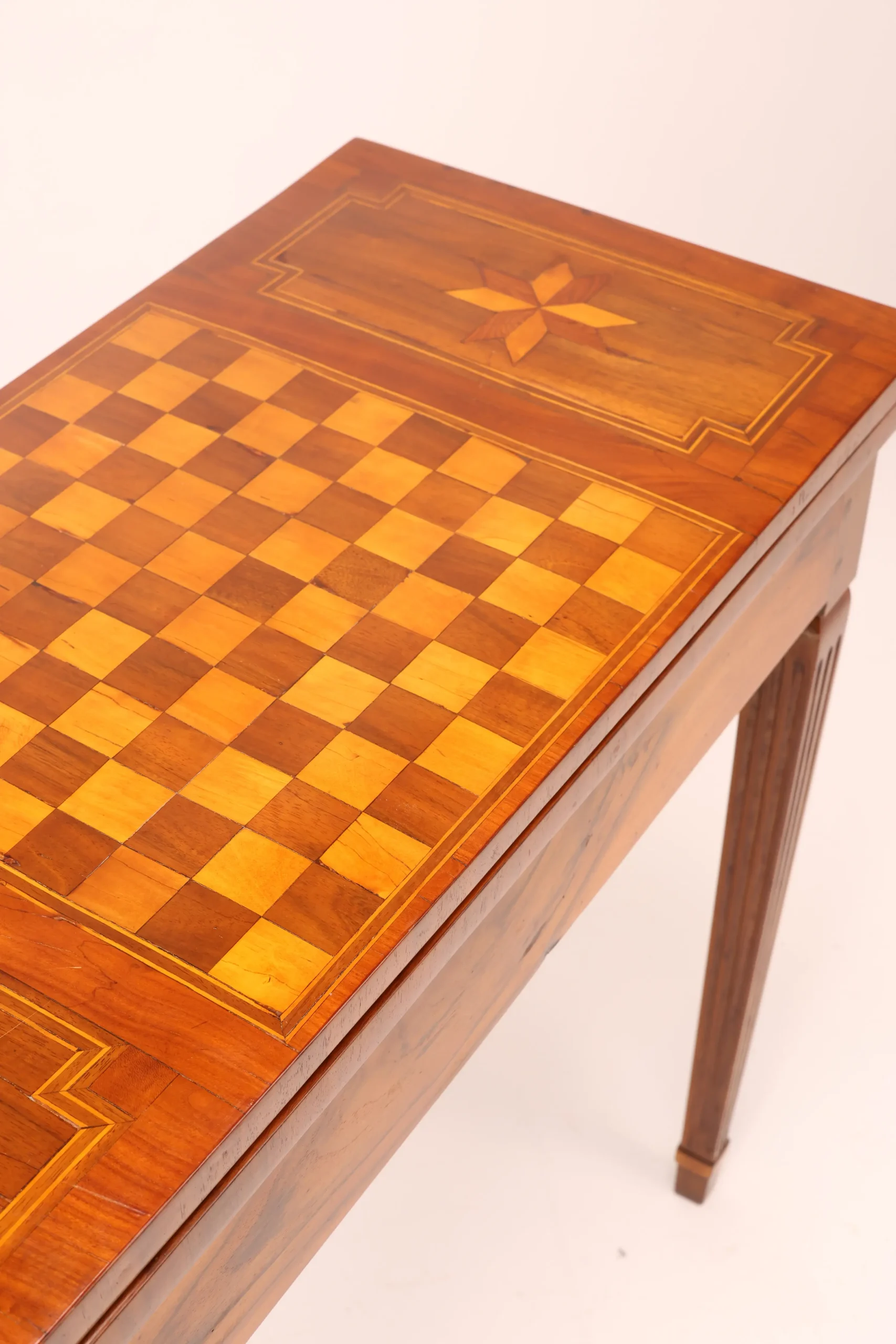
When Napoleon fell and the Congress of Vienna redrew the European map in 1815, the German Confederation that emerged was not a country. It was 39 separate states, each with its own court, economy, and workshop traditions, loosely held together by Metternich’s conservative political order. The furniture made across those 39 states during the next three decades shares a name, Biedermeier, but it is not one tradition. It is several, and the sharpest divide runs between the architectural North and the warmer South.
Why German Biedermeier Split Into Two Distinct Traditions
Unlike France, where Paris dictated taste for the entire country, or Austria, where Vienna defined the Habsburg court style, the German Confederation had no single dominant center. Berlin in the Prussian north, Munich in the Bavarian south, Hamburg on the North Sea, and Dresden in Saxony each operated as independent cultural ecosystems with their own patrons, materials, and aesthetic preferences. The result was a regional mosaic rather than a unified national style.
The political conditions that produced this fragmentation also shaped the furniture itself. Under the Carlsbad Decrees of 1819, Metternich imposed press censorship, university surveillance, and an extensive secret police across the German states. The educated bourgeoisie, denied political expression in public, turned inward to the domestic interior. Family life, music, reading, and quiet conversation replaced the public sphere as the site of culture, and furniture had to support that retreat with seriousness and craft.
What it absolutely did not have to do was reference the French Empire style that had dominated Europe under Napoleon. The dark imported mahogany, heavy gilded ormolu mounts, marble tops, and imperial symbolism of the Empire period were associated with French occupation and aristocratic display, and the Biedermeier response across both North and South Germany was a clear rejection of all of it.
North German Biedermeier — Schinkel, Architecture and Maritime Trade
North German Biedermeier is dominated by two cities with very different characters. Berlin in Prussia produced the most architectural and disciplined interpretation of the style, shaped almost single-handedly by one of the most important architects in European history. Hamburg on the North Sea produced a heavier, more English-influenced tradition based on imported mahogany and Hanseatic merchant taste.
Karl Friedrich Schinkel was appointed state architect of Prussia in 1815, and his influence on Berlin furniture design is impossible to overstate. Trained as an architect, Schinkel viewed furniture as an extension of the building it occupied, and his designs translate architectural principles directly into domestic objects: clear right angles, strong proportions, controlled silhouettes, and minimal applied ornament. The Berlin idiom favors birch and ash veneers in cooler, paler tones, sometimes mahogany for prestige commissions, framed by ebonized lines and column details that articulate the architectural structure of the piece.
A Schinkel-designed Biedermeier chair executed by his preferred cabinetmaker Karl Wanschaff illustrates the Berlin character immediately: a rectangular frame in mahogany, turned but controlled legs, a right-angled silhouette, and only the most restrained relief decoration. Compared to its Viennese contemporary, the same chair form would feel hard-edged and disciplined where the Viennese piece would feel curved and graceful. The Prussian state’s self-image as serious, military, and rational projected directly into the furniture made for its bourgeoisie.
Hamburg developed in a different direction entirely. As one of the most important Atlantic trading ports in northern Europe, Hamburg had direct maritime contact with Britain and access to imported mahogany that inland workshops could not afford. The result is a Hanseatic Biedermeier that blends German simplicity with English Regency weight. Proportions are heavier, surfaces are darker, and forms reflect Georgian pedestal tables, sideboards, and channelled upholstery rather than the Prussian neoclassicism dominant in Berlin.
Danish Golden Age design, developing across the border simultaneously, also influenced northern German production through Altona and the Duchies of Holstein. Light birch surfaces, modest carving, and a particular sober restraint became hallmarks of furniture from this border region.
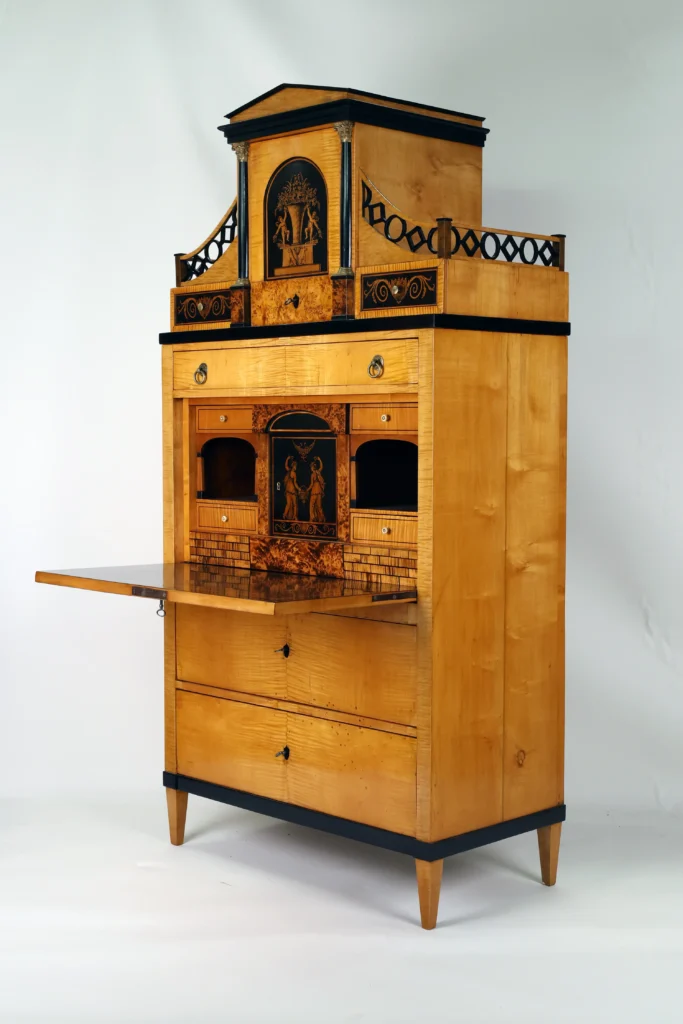
A Biedermeier secretary made in Braunschweig around 1815, finely figured in maple veneer over an oak and softwood carcass, illustrates the most refined expression of the northern tradition. Architectural superstructure, ebonized pediment supported by slender black columns with bases and capitals, fall-front opening onto a fitted interior with verre églomisé decoration in the Greek taste, and base section with original box locks and tapered feet. This is North German Biedermeier at its most ambitious: structural discipline, light wood, ebonized accent, classical reference, and the kind of constructional rigor that the Stobwasser workshops in Braunschweig were known for.
South German Biedermeier — Munich, Cherry and Proto-Modernism
South German Biedermeier developed from an entirely different starting point. Centered in Munich and extending through Bavaria, Württemberg, and the Upper Rhine, the southern tradition produced what many specialists consider the most quietly radical furniture of the entire Biedermeier period.
The Munich court joinery tradition, the Hofkistlerei system, provided the institutional framework. Workshops including Hofkistlerei Daniel, operating from at least 1813 under Klara Daniel and later Johann Hemmer, supplied the Bavarian court with furniture of extraordinary refinement. Melchior Frank and Josef Pössenbacher worked alongside in the same tradition. What made these Munich workshops historically significant was their development of an idiom stricter and more minimal than even Viennese production, yet warmer and more materially expressive than Berlin.
The defining material is cherry. Where the north preferred birch, ash, and imported mahogany, the south worked overwhelmingly in cherry and walnut, with pear and apple appearing in finer pieces. These native fruitwoods, applied as hand-sawn veneers of three to five millimeters over softwood carcasses of fir or spruce, produce surfaces in warm honey, amber, and reddish-brown tones that no northern wood approaches. The bookmatched veneer technique, where consecutive sheets from the same log are opened like pages to create mirror-image grain patterns, becomes the primary decorative element of the piece.
The most remarkable quality of Munich Biedermeier is its move toward extreme minimalism. While the north used architectural references and Vienna sometimes drifted into more romantic forms, the best South German pieces stripped applied ornament almost entirely and let the proportions and the wood do all the work. A Munich secretary in wild cherry with almost no carving or moulding, finished with hand-applied French polish over a flawless bookmatched veneer surface, can sit beside an early 20th century modernist piece without visual conflict. The connection between Biedermeier minimalism and the later Bauhaus is direct, and specialists trace the Munich tradition specifically as a proto-modernist source.
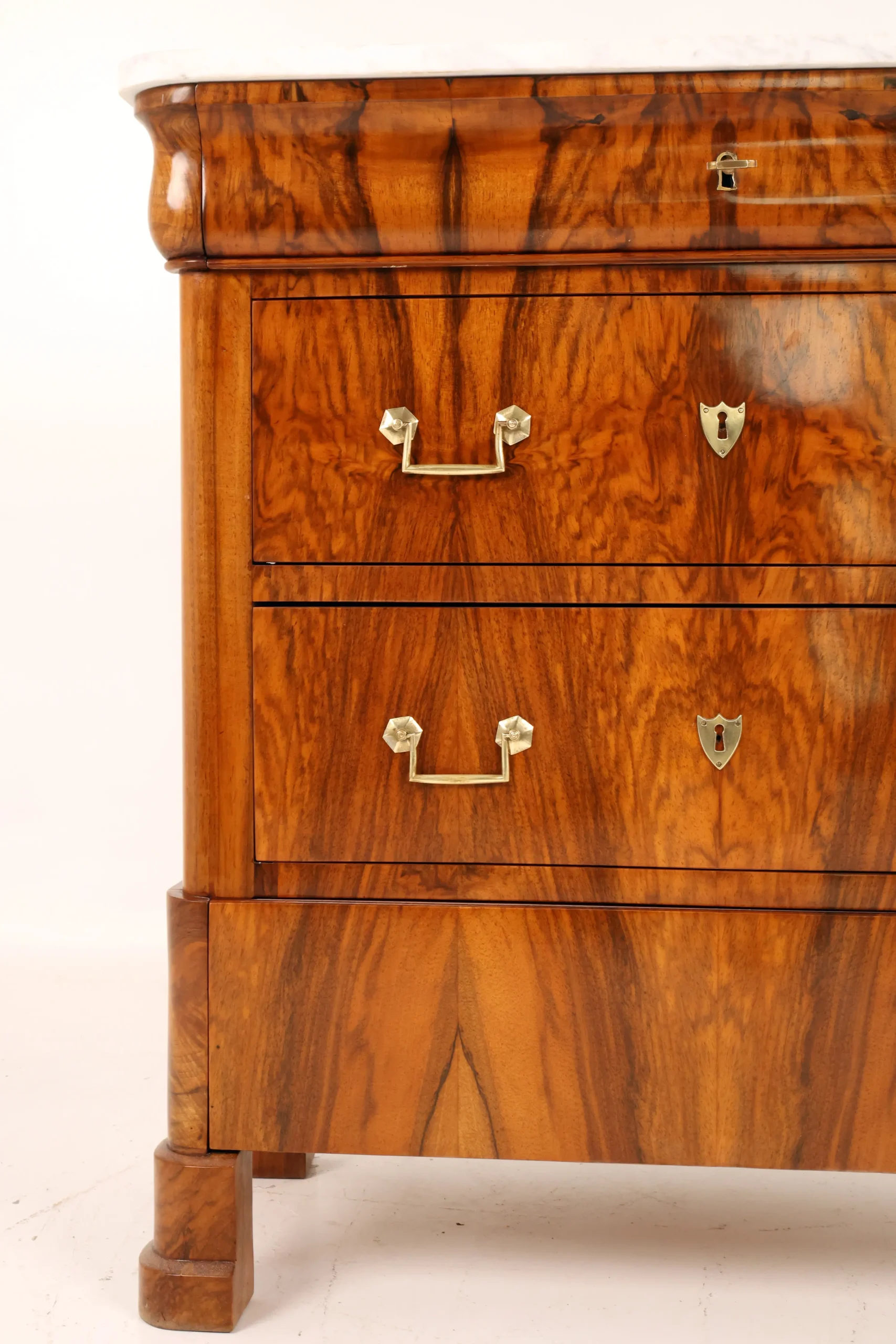
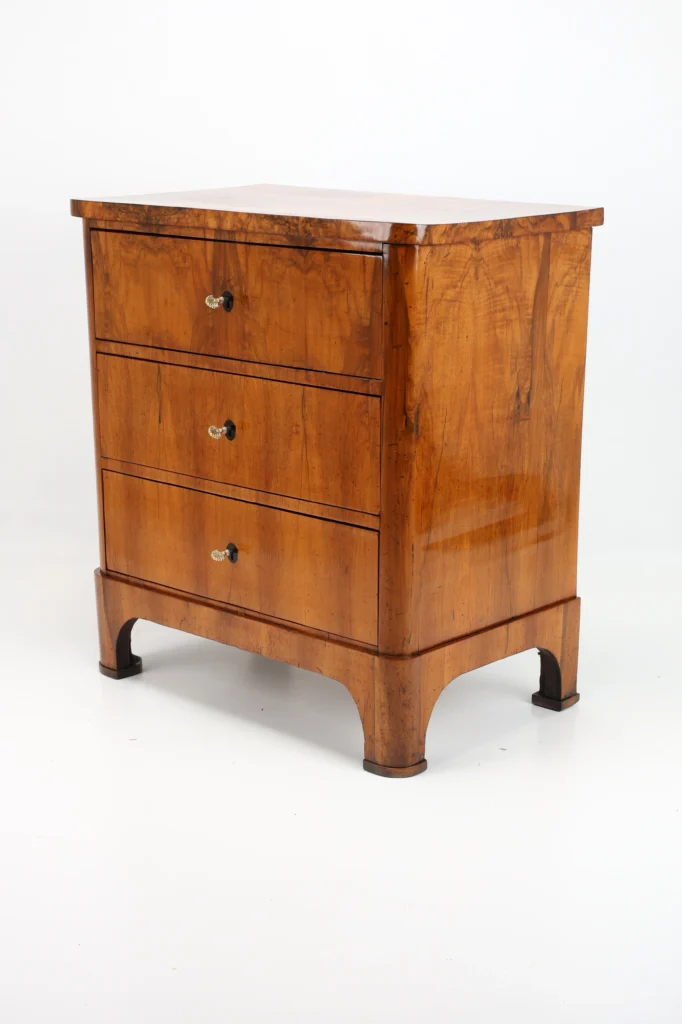
An antique South German chest of drawers from circa 1825 in walnut veneer on solid pinewood demonstrates the regional character precisely. The richly textured walnut grain, three drawers organized with clean horizontal lines, ebonized key escutcheons shaped as shields with leaf-shaped brass key tips, and the delicate plinth on petal-shaped feet. The construction is the standard Blindholz system used throughout the region, walnut veneer on pinewood carcass, but the proportional grace and the absence of any unnecessary ornament are specifically South German. A Berlin chest of the same period would be stiffer, taller, and cooler in tone. A Viennese chest might add curves the South German example deliberately avoids.
Stuttgart, Württemberg, and the Upper Rhine produced variations on the Munich tradition with slightly different proportions and occasional decorative emphases. Four-panelled facades, modest columns, and overhanging tops appear more frequently than in pure Munich minimalism. Dresden and Saxony occupy the most interesting bridging position, with strong rectilinear structures reminiscent of Prussian work combined with walnut or cherry veneers closer to South German practice. These transitional regional traditions reflect the reality that Biedermeier was a networked design culture, not a set of isolated workshops.
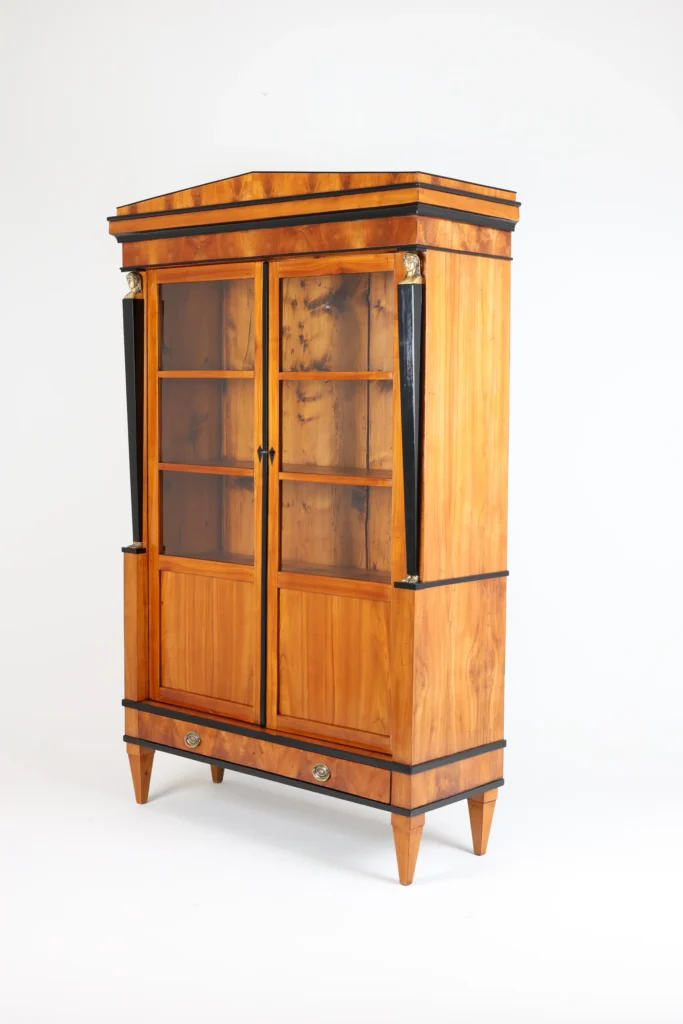
A Biedermeier vitrine from South Germany dating to 1820 to 1825 captures the regional character at its most refined. Conical feet, two doors each with four fields, three of them glazed, cherry wood veneer with very nice symmetrical grain, two ebonized pilasters with caryatids at the top and feet at the bottom, and a Schinkel-style pediment topping the case. The drawer below carries two brass handles, and the interior is fitted with three shelves. The piece combines Munich-area cherry veneer with the architectural pediment that signals familiarity with Schinkel’s published designs, exactly the kind of cross-regional dialogue that pattern books and trade exhibitions encouraged.
How to Read a German Biedermeier Piece — Practical Attribution
Distinguishing North from South German Biedermeier in person comes down to three rapid assessments.
First, the wood. Mahogany veneer on oak strongly suggests North Germany, particularly Hamburg or the coastal regions. Birch or ash in cooler, paler tones suggests Berlin or the Prussian north. Cherry, walnut, or pear in warm honey to reddish-brown tones over softwood strongly suggests South Germany. Karelian birch in flame patterns suggests Scandinavian Karl Johan production.
Second, the silhouette. North German pieces, especially from Berlin, read as architectural blocks with clear right angles, heavier cornices, and a monumental stance. South German pieces feel lighter, more domestic, more vertically elongated, with gently curved transitions and recessed plinths. Viennese pieces, by comparison, use the most curves of any Biedermeier tradition: swept sofa arms, lyre supports, bowed fronts.
Third, the details. Hardware in the north tends to be slightly stronger geometrically, with pressed brass shields, oval escutcheons, and occasionally English-style ring pulls in Hamburg. Hardware in the south is extremely discreet, often tiny turned wooden knobs or small flat brass keyholes that disappear into the veneer surface. Leg forms in the north favor sabre legs on seating and block plinths on cases. South German legs are typically straight and tapered in cherry or walnut, with simple bracket feet or low plinths that visually float the volume above.
Where the Two Traditions Meet — Pattern Books and Cross-Regional Influence
Both traditions share more than they differ. The fundamental Biedermeier philosophy, simplicity, functional honesty, geometric clarity, and the rejection of Empire excess, applies equally to a Berlin secretary and a Munich commode. Both use the Blindholz construction system. Both rely on hand-sawn veneer of three to five millimeters. Both use ebonized details as contrast without metal mounts. Both finish with hand-applied shellac in the French polish tradition.
The Danhauser furniture factory in Vienna spread Biedermeier forms across the German-speaking world through pattern books and published interior designs. The MAK in Vienna preserves over 2,500 Danhauser sketches and catalogues, and Josef Franz Danhauser’s published series Wiener Meuble-Formen from the 1830s appeared as supplements to fashionable journals across Europe. North German workshops adapted Danhauser designs in birch and mahogany. South German workshops adapted them in cherry and walnut. The forms were shared. The materials and proportions were regional.
For interior designers and collectors today, this means a mixed German Biedermeier interior is entirely authentic to historical practice. A Berlin secretary, a Munich chest of drawers, and a Saxon cabinet in the same room represent how educated households across the German Confederation actually furnished their interiors during the 1820s and 1830s.
The Biedermeier chest of drawers section covers commodes from both Northern and Southern German traditions, with detailed regional attribution for each piece. The Biedermeier secretary desk section includes fall-front secretaires from Berlin, Braunschweig, Vienna, and the South German workshops, with the Stobwasser-tradition Braunschweig piece and Munich-area examples both available.
Which Tradition Suits Which Interior
North German Biedermeier suits architectural interiors with strong lines and disciplined spatial planning. Lofts, contemporary apartments with white walls, and rooms where the furniture is meant to provide structural anchor benefit from the right-angled discipline of Berlin pieces or the heavier mahogany weight of Hamburg production.
South German Biedermeier suits warmer, more intimate interiors where material richness and quiet refinement matter more than architectural statement. A Munich cherry commode or a South German walnut chest of drawers brings warmth into a contemporary minimalist room in a way that more architectural pieces do not always achieve. The proto-modern character of the finest South German production makes these pieces particularly compatible with Scandinavian-influenced design.
At Antiqueria Breitling, both traditions have been part of the collection for decades, with each piece assessed against the regional attribution criteria described above. Whether you are looking for the architectural discipline of a Braunschweig secretary or the warm minimalism of a South German walnut commode, the Biedermeier furniture collection covers the full range of regional traditions. Browse the collection now or write to us at contact@antiqueria-breitling.com for specific pieces not yet listed.