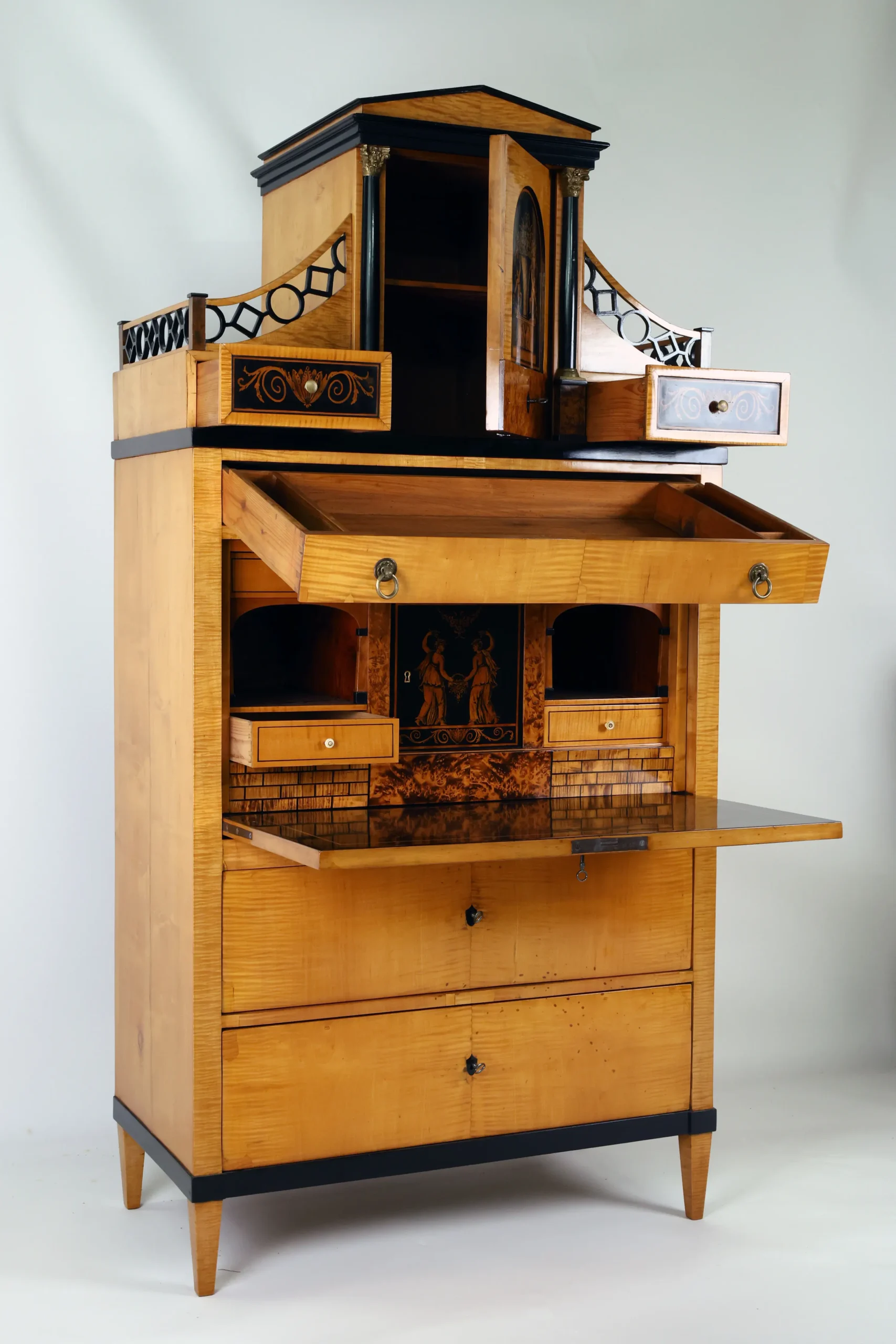
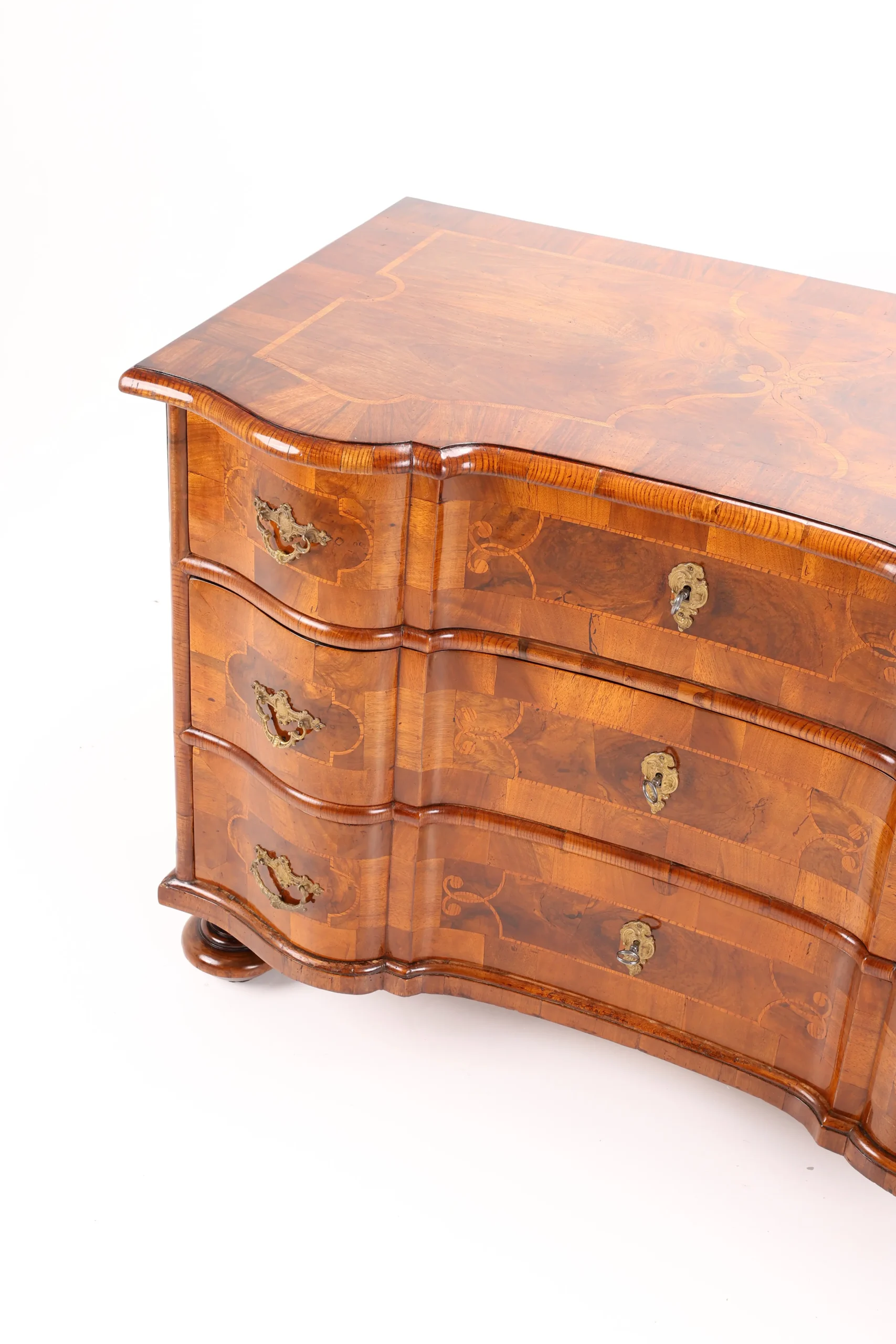
A commode without its marble top is like a sentence without its final word. The wood underneath may carry the marquetry, the bronze mounts, the architectural form and the maker’s reputation, but the marble is what closes the composition and tells you, at a glance, what you are actually looking at. Every fine piece of European case furniture from the late seventeenth century onward was conceived with its stone top as part of the design, not as an accessory laid on afterward. Understanding marble is therefore inseparable from understanding the furniture itself, and after decades of handling pieces from every period at Antiqueria Breitling, the marble top remains one of the most revealing things we examine when a new piece arrives.
This is the story of how stone met wood in European furniture, what the different marbles tell you about the period and origin of a piece, and how to recognize an original marble top from a later replacement.
Why Marble Climbed Onto Furniture in the First Place
The Romans had used colored marble for floors, walls, and columns for centuries, and the Renaissance reawakened that taste through the excavations of classical sites across Italy. By the seventeenth century, marble had become the prestige material for any surface that wanted to communicate wealth and permanence, and it was only a matter of time before furniture makers brought it down from the walls and onto the tops of their cabinets.
The practical reasons were as compelling as the symbolic ones. A wooden commode in an eighteenth-century room had to survive an environment of open fires, dripping wax candles, water spills from washbasins, and the constant chemistry of cosmetics and wine. Wood scorched, stained, and warped. Marble did none of these things. A heavy slab of stone laid across the top of a commode protected the wooden carcass below and turned the surface into something that could be used, every day, for centuries.
The aesthetic reason was the most important of all. The cool geological permanence of stone laid against the warm organic flow of veneered hardwood produced a visual contrast that no other material combination could match. Sarrancolin against kingwood, Bleu Turquin against mahogany, Portoro against walnut. These were not random pairings but carefully calculated combinations chosen for the way the polished stone caught light differently than the polished wood beneath it. The marble top is, in this sense, the architectural capstone of European furniture, the moment where the warm botanical world of the cabinetmaker meets the cool geological world of the quarryman.
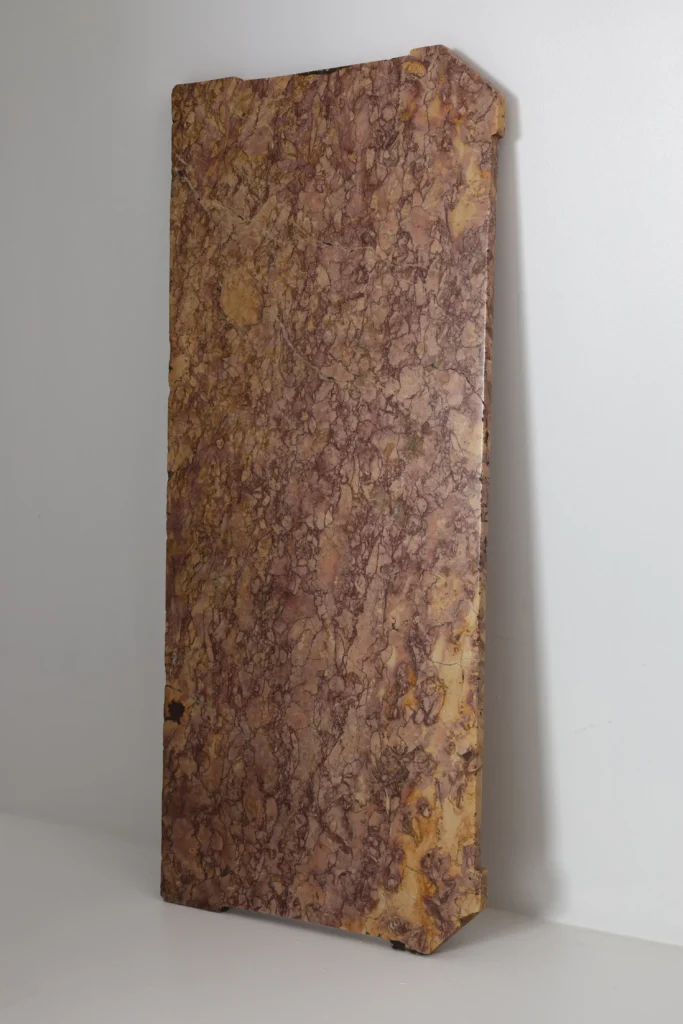
A polychrome breccia slab shown on its own makes the geological reality of these stones visible in a way that no integrated photograph can. The complex pattern of fragmented yellow, ochre, pink, grey, and creamy stones suspended in a warm matrix, with fine fracture veins running across the surface, is the signature of a French breccia marble such as Brèche d’Alep or a related Pyrenean stone. These were among the most prized materials of the eighteenth century, and a slab like this one would originally have crowned a Louis XV or Louis XVI commode of considerable importance.
The Florentine Miracle — Pietra Dura and the Medici Workshop
The most extraordinary stone surfaces in furniture history were produced not in France but in Florence, and they were not really marble at all. In 1588, Grand Duke Ferdinando I de’ Medici founded the Opificio delle Pietre Dure, a court laboratory in the east wing of the Uffizi devoted entirely to semi-precious stone inlay. The workshop’s craftsmen worked exclusively for the Medici on a salaried basis, which gave them the financial security and the unlimited time required to produce works of unimaginable complexity.
The technique they perfected, commesso fiorentino, is best described as painting in stone. Rather than the uniform geometric tesserae of Roman mosaics, the Florentine masters cut precisely interlocking irregular slices of lapis lazuli, malachite, agate, jasper, chalcedony, amethyst, porphyry, and mother-of-pearl, fitting them together so tightly that the joins became invisible. They exploited the natural veining of the stones themselves, using a piece of chalcedony to mimic a flower petal or a shifting jasper gradient to suggest three-dimensional depth.
The resulting table tops depicted floral arrangements, exotic birds copied from the Medici aviaries in the Boboli Gardens, panoramic views of Florence, and architectural fantasies that seemed to flow across the stone surface like paintings. The Medici sent these pieces as diplomatic gifts to courts across Europe, and the fashion spread. Under Louis XIV, the Italian master Domenico Cucci worked at the Gobelins producing monumental cabinets that combined Florentine pietra dura panels with French ebony and gilt bronze, fusing the two greatest traditions of European luxury into single objects.
Pietra dura remains the most expensive antique furniture surface ever produced. The technical demands were astronomical, the raw materials cost a fortune, and the labor required for a single tabletop ran into thousands of hours. It is one of the great counterintuitive facts of furniture history that producing the highest quality pietra dura was essentially impossible outside a royal workshop. The state-funded resources of the Medici were what made it possible at all.
A Collector’s Lexicon of Stones
To the trained eye, the type of marble on a commode tells you where the piece was made and roughly when. The most important stones to recognize are the ones that dominated different periods of European furniture.
Sarrancolin, quarried in the French Pyrenees near the towns of Sarrancolin and Ilhet, is the iconic marble of the French court. Its warm polychrome breccia mixes fragmented yellow, pink, grey, and cream stones with striking red and white calcite veining, and Louis XIV prized it so highly that in 1692 he formally declared the Sarrancolin quarries Royal, legally restricting their use to the crown. Between 1686 and 1689 alone, forty massive blocks were transported to Paris exclusively for royal building projects.
Griotte, named after the French Morello cherry, is the other great Louis XIV marble. Quarried in the Aude region, it has an intense cherry-red ground famously punctuated by fossilized goniatites whose white calcite centers create the visual effect known as oeil de perdrix, the partridge eye. Genuine oeil de perdrix Griotte is a fingerprint of authenticity. The fossils are a localized geological anomaly and cannot be reproduced.
Brèche d’Alep, originally from Syria and later from Bouches-du-Rhône in France from 1712, is the dramatic mustard-ochre breccia with large rounded fragments of brown, grey, red, and black. It dominated French Rococo commodes and architectural fireplaces, and the French quarries were aggressively mined for it across the eighteenth century until the historic veins were essentially depleted within a century.
Rouge Royal from Belgium carries a deep burgundy to cherry-red ground fractured with stark white calcite, providing the most theatrical contrast to gilded wood of any European marble. Portoro from Liguria, with its pitch-black ground and explosive gold veining, dominates Empire and Napoléon III production. Vert de Mer, an oceanic green from the Alps, performs the same role in severe neoclassical and Empire compositions.
Cooler stones came into favor with the Louis XVI period. Pure statuary white Carrara, used by master ébénistes including Riesener, complemented the geometric marquetry of late neoclassical pieces, while Bleu Turquin in its muted blue-grey provided the right note of restraint for the disciplined forms of the period.
One of the surprising realities of the antique marble market is that several of the most prized stones are functionally extinct. The historic Brèche d’Alep veins are exhausted, the high-quality Sarrancolin deposits have been depleted, and Grand Antique marble saw its quarrying halt for nearly seventy years in modern times. An original period top in genuine Brèche d’Alep or a highly figured Sarrancolin is therefore not just an antique. It is a finite, irreplaceable geological asset, and that scarcity is increasingly reflected in the prices serious collectors are willing to pay.
How French Furniture Used Marble Across the Centuries
The treatment of marble in French furniture is a perfect barometer of changing taste across four major styles. Each period chose its stones, its edge profiles, and its proportions according to the broader aesthetic philosophy it was expressing, which is why marble can date a piece almost as reliably as the wood beneath it.
Under Louis XIV, the Baroque period demanded monumentality. Heavy thick slabs of Sarrancolin, Rouge Royal, and Griotte anchored the massive proportions of Versailles furniture, and the stones were frequently paired with André-Charles Boulle’s brass-and-tortoiseshell marquetry to produce the severe majesty that defined the court of the Sun King. The cool variegated chaos of the breccia laid against the mathematical precision of the brass inlay below became the signature visual of high French Baroque.
The Louis XV and Rococo period brought a technical revolution in stone cutting. Rococo commodes had serpentine fronts and bombé sides, so the marble could no longer be a simple rectangle. It had to be shaped to follow the undulating compound curves of the case below, with a precise overhang maintained across a constantly shifting plane. The edges of these tops were cut into sophisticated moulded profiles, the most prized of which was the bec de corbin, the crow’s beak, a soft multi-tiered rounded edge that provided an elegant transition from stone to wood. Cutting a bec de corbin into a serpentine slab of Brèche d’Alep using only hand tools, abrasive sand, and water was a feat of skill that took weeks and could be ruined in a single mistake.
The Louis XVI period straightened everything out again. The neoclassical reaction returned furniture to rectilinear forms, and the marble tops became rectangular or demi-lune again, with simpler squared or quarter-round edges replacing the bec de corbin. Masters like Riesener and Adam Weisweiler paired these straighter tops with geometric marquetry and disciplined neoclassical bronze mounts. Carrara and Bleu Turquin replaced the warmer Rococo stones for many commissions, matching the cooler intellectual mood of the period.
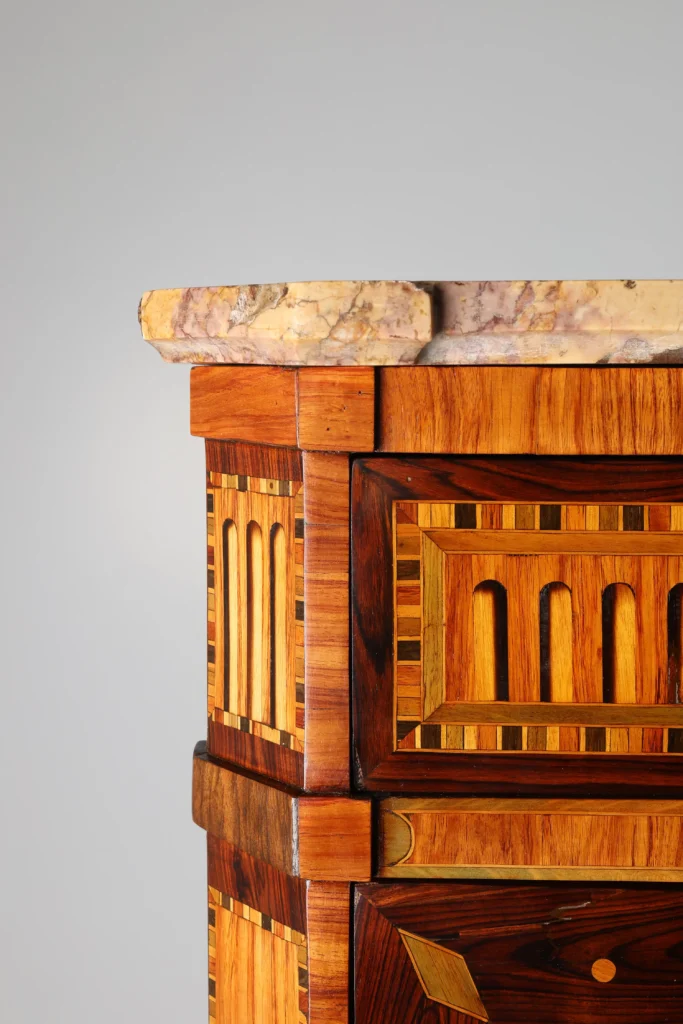
A French Louis XVI secrétaire à abattant from circa 1780 shows the relationship between stone and wood at its most refined. The piece is richly decorated with intricate marquetry in rosewood, palisander, and various fruitwoods arranged in precise geometric compositions on a solid oak carcass, and the marble top sits on the architectural superstructure exactly as the neoclassical formula demanded.
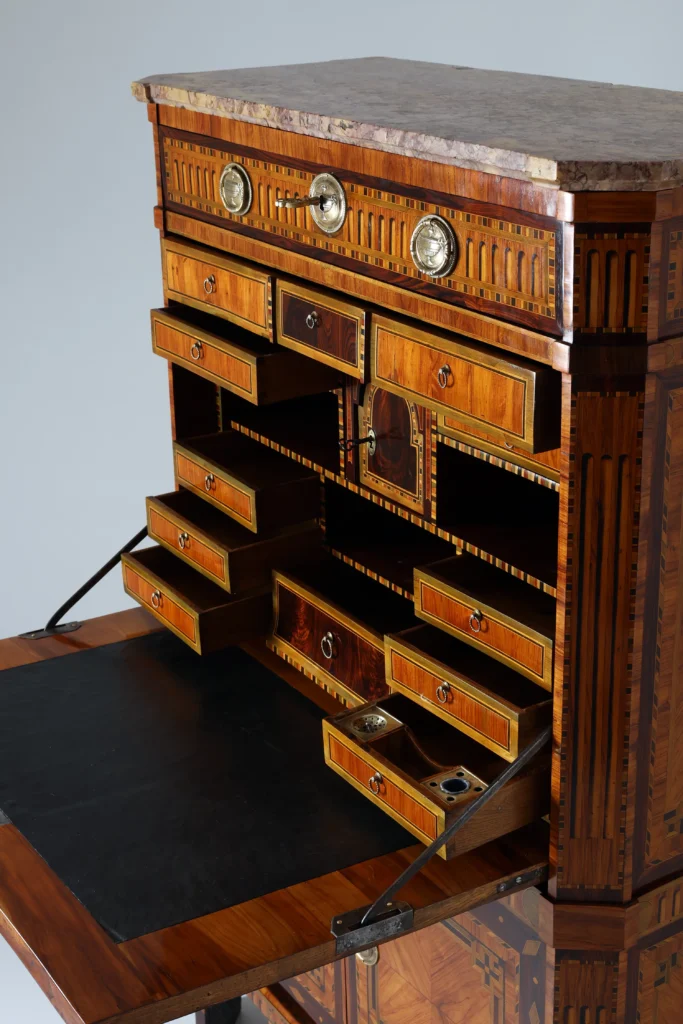
A close detail of the same piece shows what makes a period marble top so different from a later replacement. The stone is a warm polychrome breccia, almost certainly a Pyrenean stone closely related to Sarrancolin, with the rose, ochre, and cream tones that the Louis XVI cabinetmakers favored for fine work. The edge profile is hand-cut and shaped, and the way the marble sits on the marquetry pilasters and fluted columns of the case below shows the original integration of stone and wood that no replacement top can recreate. The fall-front opens to reveal an extraordinarily organized interior of multiple drawers, a central architectural compartment, and a concealed secret compartment hidden beneath one of the drawers, all of it complemented by the architectural weight that only the original marble can provide. The piece is a museum-quality example of the period, and you can explore similar pieces in the Louis XVI furniture collection at Antiqueria Breitling.
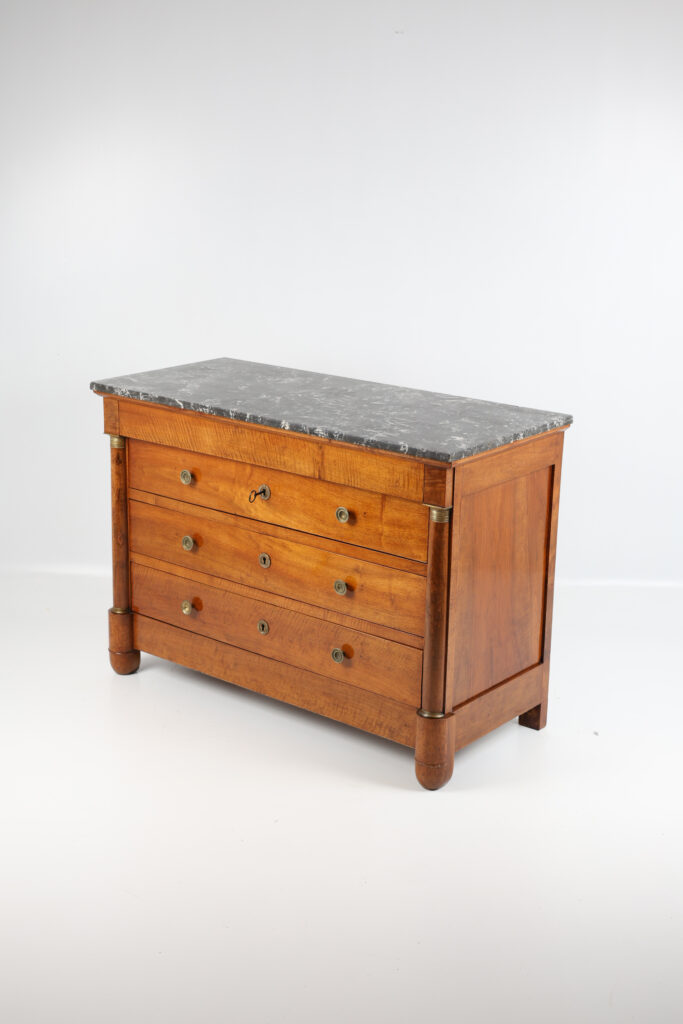
The Empire period changed everything. Napoleon’s furniture rejected the warm playful stones of the Ancien Régime in favor of severe dark marbles. Portoro with its black ground and aggressive gold veining, and grey-veined or near-black stones with white calcite, became the marbles of choice, paired with vast unadorned expanses of dark Cuban mahogany or rich walnut. The contrast between dark wood and dark stone produced compositions of stark military weight, relieved only by the brilliant flash of fire-gilded ormolu mounts depicting eagles, sphinxes, and laurel wreaths.
A nineteenth-century Empire walnut chest of drawers from France, 1810, illustrates the Empire treatment of marble at its most direct. Beautiful grain of walnut on the front and sides, two classical half columns flanking the case with bronze capitals detailed with acanthus leaves and spiraled beading, three lower drawers of dovetail construction, and crowning the whole composition a black marble top with dramatic white veining. The marble is cool, severe, and architectural, exactly the right note for the disciplined Empire vocabulary below. Explore the broader Empire tradition in the antique Empire furniture collection.
How to Read a Marble Top — Authentication for Collectors
For the serious collector, knowing how to tell an original period marble top from a later replacement is essential, and most of the evidence is hidden where buyers rarely look.
The single most reliable indicator is the thickness of the slab. Original eighteenth and early nineteenth century tops measure almost a full inch in thickness and are often considerably thicker on monumental French pieces. Modern machine-cut replacements, produced to standardized industrial sizes, typically measure only three quarters of an inch. A measurement with calipers reveals the truth instantly.
The underside of the slab carries the second great clue. Before mechanized stone cutting took over in the mid-nineteenth century, marble was cut from the quarry block using hand-drawn wire saws and abrasive sand. The underside of an original period top is slightly rough and irregular, with straight parallel hand-sawn marks running across it. If the underside shows sweeping circular arc marks, it was cut by a mechanized circular saw, dating it firmly to the post-1860 industrial era. If it is completely smooth and machine-planed with no tool marks at all, it is a modern replacement.
The fit between marble and wood is the third great test. The shape of the marble must perfectly mirror the shape of the case below. On a serpentine Rococo commode with bombé sides, the marble must carry the exact corresponding compound curves with a precise uniform overhang of one to two centimeters all the way around. A top that overhangs unevenly, or has a simplified profile on an elaborate case, is almost certainly a marriage, an antique top salvaged from another ruined piece and laid onto a different base. The wooden carcass itself should show a rebated frame or shaping specifically designed to receive that particular stone.
Finally, look at the edges and the wear. Original hand-cut bec de corbin and other moulded edges show slight organic inconsistencies along their length, the natural variation that the cold mathematical perfection of a modern CNC router can never replicate. Centuries of human hands brushing past the edges, combined with the natural aging of the calcite, produce a soft warm patina on the stone. Small original chips and tiny flea-bite damage along the edges are signs of life, not defects, and reputable dealers will note them honestly rather than try to hide them.
One of the strangest realities of the marble top market is that the stone often outlives its base. Wood is organic and vulnerable, susceptible to woodworm, rot, fire, and structural failure. Stone is essentially immortal. A beautiful slab of Sarrancolin saved from a ruined Louis XV commode might appear two centuries later on a newly built nineteenth-century base, and assessing whether the wood is older than the stone, or the stone older than the wood, is part of the basic evaluation we perform on every piece that comes through the workshop.
Marble Tops in the Contemporary Interior
A commode with its original verifiable marble top commands a substantial premium over the same piece with a replacement, and that gap is widening as collectors become more sophisticated. The original stone elevates the furniture from a beautiful object to an intact historical artifact, complete and undisturbed across two or three centuries.
Practically, antique marble tops bring their own challenges. They are extraordinarily heavy, and moving a commode requires removing the marble first to protect the wooden joints below. Marble is also brittle, and if a top is carried flat rather than vertically, it can snap under its own weight. At Antiqueria Breitling, all transport and placement is handled by our team to protect both the wood and the stone.
In a contemporary interior, an antique marble top performs a role that no modern reproduction can match. The patina of two centuries on a polished Brèche d’Alep slab, or the deep oxidized warmth of a piece of period Sarrancolin, brings a textural anchor to any room. Place a modern sculpture or contemporary lighting on a 200-year-old marble surface, and the layered tension between past and present becomes one of the defining qualities of the space.
At Antiqueria Breitling, every commode, console, and side table is assessed for the originality and quality of its marble top before it enters the collection. Whether your interest is in the warm breccia of Louis XV and Louis XVI pieces, the cooler stones of late neoclassical work, or the dramatic dark marbles of the Empire period, the full range is searchable across the collection. Write to us at contact@antiqueria-breitling.com for specific pieces not yet listed, with worldwide shipping available on everything we offer.