Worldwide Insured Shipping
Hand-Restored in our Atelier
Professional Custom Crating

Worldwide Insured Shipping
Hand-Restored in our Atelier
Professional Custom Crating
in this collection cover the full range of the tradition, from early 19th century Austrian antique examples in cherrywood and walnut to German antique Biedermeier side tables in birch and the paler late 19th century Swedish antique pieces of the Karl Johan manner. Each table has been assessed individually for the integrity of the veneer surface, the condition of the original finish, and the quality of the underlying construction.
Before 1815, furniture stood against the walls of a room. The Biedermeier period changed that. When the urban middle class of Central Europe retreated from public life under Metternich’s political censorship and built their domestic world with considerable intention, furniture moved to the center of the room. Grouped around a central table, positioned for conversation and shared domestic activity rather than formal display, the Biedermeier interior created an entirely new relationship between furniture and the people using it. The side table was central to that shift.
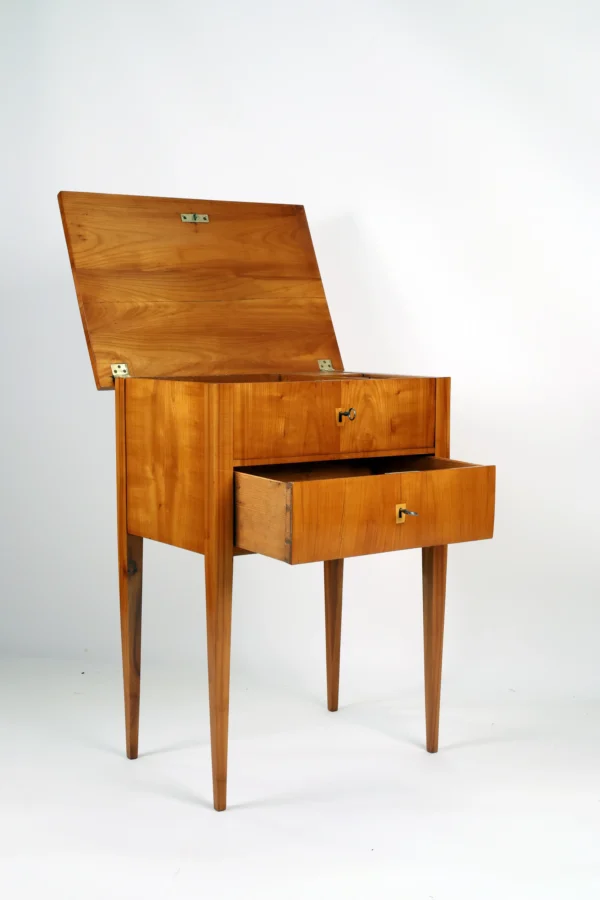
A Biedermeier side table was not a decorative object placed for appearance. It was a functional piece of home furnishings designed for daily use: a sewing table with hidden compartments under a liftable lid, a circular pedestal table used as a lamp table or occasional surface, a small rectangular table with a single drawer pulled close to a chair for letter writing or reading. The bourgeois interior that produced these pieces valued utility and domestic warmth over aristocratic display, and the tables reflect that directly in their scale, their materials, and their construction.
The veneer surfaces of Biedermeier side tables, cherry, walnut, birch, and occasionally rosewood on luxury examples, were selected for the warmth and figure of their grain and applied in bookmatched sheets that make the grain pattern itself the primary decoration. Ebonized column details, sabre legs, shellac or French polish finishes, and simple brass hardware provide the geometric counterpoint. No bronze mounts, no marble tops, no symbolic program. Just wood, proportion, and craft.
German antique Biedermeier side tables from Berlin, Munich, and the workshops of southern Germany have a character distinct from their Viennese counterparts. A table from southern Germany dating to around 1820 reflects the architectural influence of Karl Friedrich Schinkel’s neoclassicism in its stronger proportions, harder edges, and more disciplined geometry. The circular pedestal table form appears frequently in German production, with a column support that references classical architecture directly and a base of three curved feet that provides stability without mass.
Germany circa 1820 produced some of the most architecturally resolved Biedermeier side tables available. Walnut and birch veneer dominate, giving these pieces a cooler, more precise character than the warm cherrywood of Vienna. The hardware is minimal, a small brass escutcheon on a single drawer, or no hardware at all on pedestal forms where the drawer opens by finger pull. The overall effect is one of considerable refinement achieved through discipline and clean geometry rather than warmth or organic curve.
A century German antique Biedermeier side table in original condition, with its veneer intact and its shellac finish unstripped, is a practical and visually strong piece that suits a contemporary living room, a study, or a bedroom without requiring any period framing from the surrounding furniture.
Viennese Biedermeier side tables are the most poetic expression of the form. The workshops of Vienna, shaped by the tradition Josef Danhauser established with his influential factory, produced tables of extraordinary grace and warmth. Cherrywood and walnut veneer, applied in bookmatched sheets with a depth and warmth that reflect careful material selection, characterize the Viennese tradition. The proportions are softer than German examples, with gently curved feet, column supports of elegant taper, and an overall lightness of silhouette that gives these pieces an immediate domestic quality.
An early 19th century Austrian antique Biedermeier sewing table from circa 1825, with its liftable lid, fitted interior compartments for fabrics and threads, and original shellac finish, is one of the more complete expressions of the Biedermeier domestic ideal. These tables were made for the specific rituals of bourgeois home life, and the quality of their construction reflects the importance placed on those rituals. Original biedermeier sewing tables with their interior fittings intact are increasingly rare and worth acquiring when they appear in honest condition.
The circular pedestal table in cherry or walnut from a Viennese workshop, dating to around 1820 or 1830, is among the most versatile pieces in the collection. It functions as a lamp table, an occasional table beside a sofa, or a small accent table in a hallway or bedroom. The scale is right for a contemporary apartment, the wood tones suit almost any interior palette, and the absence of applied ornament means the piece integrates naturally without imposing a historical narrative on its surroundings.
Late 19th century Swedish antique Biedermeier side tables in the Karl Johan manner occupy a distinct position in this category. Produced in pale Karelian birch with clean horizontal lines and a spare geometric character, these pieces anticipate the Scandinavian design movements of the 20th century in ways that make them among the most compatible antique side tables with contemporary interiors.
Vintage Biedermeier side tables from the revival period, produced from the 1870s onward as the Biedermeier aesthetic was rediscovered and commercially reproduced, are distinguished from authentic period pieces primarily by veneer thickness. Revival veneer is machine-sliced and paper thin, under one millimeter, while original sawn veneer from the 1815 to 1848 period measures three to five millimeters and has a depth and warmth that machine production cannot replicate. Condition and provenance both matter considerably for this distinction, and the individual listing notes for each piece in this collection address these points directly.
Shop vintage Biedermeier side tables and authentic period examples are available across all regional traditions in this collection. The difference in price between a late revival piece and an authentic period table reflects a genuine difference in material quality, construction standard, and historical significance, and understanding that difference allows a buyer to make a deliberate choice rather than an uninformed one.
The compatibility of Biedermeier side tables with contemporary interiors is one of the more consistent observations made by interior designers and collectors who work with this period. The clean geometry, light wood tones, and domestic scale of these pieces make them natural companions for contemporary Scandinavian furniture, minimalist interiors, and more traditionally furnished rooms where a piece of warm historical character is needed without period-room commitment.
A Biedermeier side table designed for conversation, placed beside a contemporary sofa or chair, does not announce itself as antique in a way that disrupts the room. It settles into the space and improves it, which is exactly what the bourgeois cabinetmakers of Central Europe intended when they designed these pieces for the center of the room rather than the perimeter.
For related Biedermeier writing and storage furniture from the same period, the Biedermeier secretary desk section covers drop-front desks and secretaires from Viennese and German workshops. The broader Biedermeier furniture collection covers the full range of forms including chests of drawers, cabinets, seating, and commodes across all major regional traditions.
If you are looking for a specific Biedermeier side table, a particular wood, form, or regional origin not currently listed, write to us at contact@antiqueria-breitling.com. Worldwide shipping is available on all pieces, handled through specialist fine art carriers with experience in antique furniture delivery.